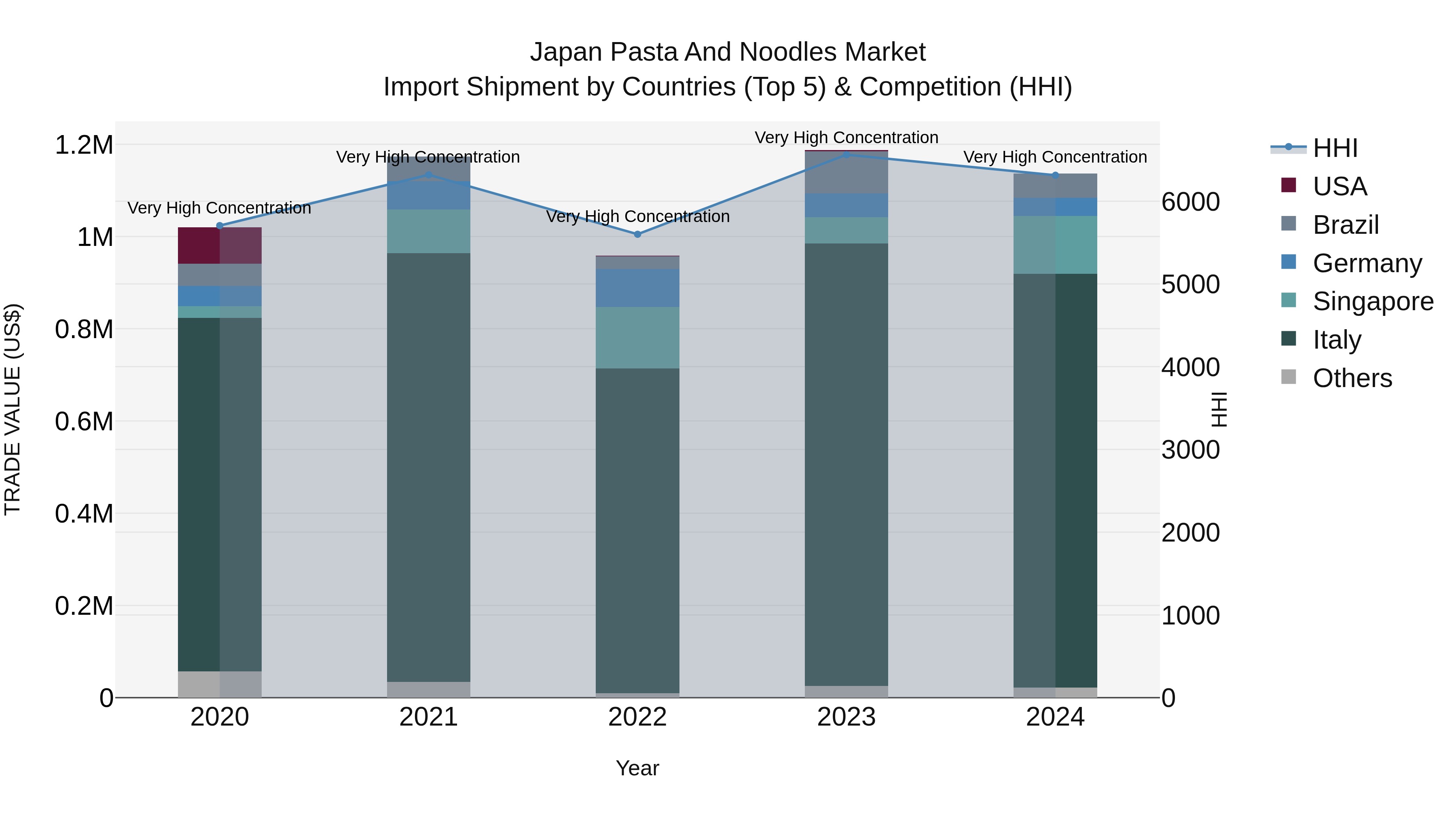
Japan Pasta And Noodles Market Import Shipment by Countries (Top 5) & Competition (HHI)
Japan's pasta and noodles import market in 2024 continued to be dominated by key exporting countries such as Italy, Singapore, Brazil, Germany, and Taiwan, Province of China. Despite a slight decline in growth rate from 2023 to 2024, the industry maintained a moderate CAGR of 2.73% over the period of 2020-24. The high Herfindahl-Hirschman Index (HHI) indicates a concentrated market structure, suggesting a competitive landscape. This data underscores the significance of these top exporting countries in supplying pasta and noodles to Japan, highlighting ongoing trends and potential opportunities for market players to explore.
Japan Pasta and Noodles Market Overview
The Japan Pasta and Noodles Market is a mature and highly competitive industry, driven by the country`s strong culinary culture and increasing demand for convenient and diverse food options. Traditional Japanese noodles such as ramen and udon continue to be popular choices among consumers, while pasta dishes have also gained popularity in recent years. The market is characterized by a wide range of products, including instant noodles, fresh pasta, and ready-to-eat meals, offered by both domestic and international brands. Health and wellness trends have led to a growing demand for healthier and more natural ingredients in pasta and noodle products. With a focus on innovation and product development, companies in the market are constantly introducing new flavors, packaging formats, and marketing strategies to cater to evolving consumer preferences.
Japan Pasta and Noodles Market Trends
The Japan Pasta and Noodles market is experiencing a shift towards healthier and more diverse options, driven by consumer demand for nutritious and convenient meal solutions. There is a growing interest in whole grain and gluten-free pasta varieties, as well as noodles made from alternative ingredients such as buckwheat or konjac. Companies are also innovating with unique flavor profiles and packaging formats to cater to changing consumer preferences. The market is witnessing an increase in online sales and delivery services, offering consumers greater convenience and access to a wider range of products. Overall, the Japan Pasta and Noodles market is evolving to meet the demand for healthier, more diverse, and convenient options among consumers.
Japan Pasta and Noodles Market Challenges
In the Japan Pasta and Noodles market, some challenges include changing consumer preferences towards healthier options, such as low-carb or gluten-free alternatives, which can impact traditional pasta and noodle consumption. Additionally, competition from other convenient meal options, like ready-to-eat meals or fast food, poses a threat to the market. Rising production costs and fluctuating raw material prices also present challenges for manufacturers in maintaining competitive pricing. Furthermore, with an aging population and shrinking workforce in Japan, there is a need for innovative marketing strategies to target younger consumers and increase demand. Adapting to these evolving trends and preferences while ensuring product quality and affordability will be crucial for companies operating in the Japan Pasta and Noodles market.
Japan Pasta and Noodles Market Investment Opportunities
The Japan Pasta and Noodles Market offers promising investment opportunities due to the growing popularity of convenience foods and the increasing demand for authentic Japanese cuisine worldwide. Investors can consider opportunities in expanding distribution channels, introducing innovative product variations to cater to changing consumer preferences, and leveraging digital marketing strategies to reach a wider audience. Additionally, investing in sustainable and organic pasta and noodle products can tap into the rising trend of health-conscious consumers. Collaborating with local suppliers and producers to ensure high-quality ingredients can also be a strategic investment move in this market. Overall, the market presents a favorable landscape for investors looking to capitalize on the evolving food trends and the strong cultural appeal of Japanese cuisine.
Japan Pasta and Noodles Market Government Policy
In Japan, the pasta and noodles market is regulated by various government policies aimed at ensuring food safety, quality standards, and consumer protection. The Ministry of Agriculture, Forestry and Fisheries (MAFF) oversees regulations related to ingredient sourcing, processing methods, and labeling requirements for pasta and noodles products. The Ministry of Health, Labour and Welfare (MHLW) sets guidelines for food safety and hygiene standards in manufacturing facilities. Additionally, the Japan Agricultural Standards (JAS) system certifies products that meet specific quality criteria. Importantly, the government also promotes domestic production of wheat and other key ingredients to support the local agriculture industry. Overall, these policies play a crucial role in maintaining the integrity of the Japan pasta and noodles market and ensuring the trust of consumers in the products they purchase.
Japan Pasta and Noodles Market Future Outlook
The Japan Pasta and Noodles Market is expected to witness steady growth in the coming years, driven by changing consumer preferences towards convenient and healthy food options. With the increasing popularity of Italian and other international cuisines in Japan, the demand for pasta and noodles is projected to rise. Additionally, the growing trend of at-home cooking and the availability of a wide variety of pasta and noodle products in supermarkets and online platforms will further fuel market growth. Manufacturers are focusing on product innovation, such as introducing healthier and gluten-free options, to cater to the evolving consumer needs. Overall, the Japan Pasta and Noodles Market is anticipated to expand, offering opportunities for both domestic and international players to capitalize on the growing demand.
Key Highlights of the Report:
- Japan Pasta and Noodles Market Outlook
- Market Size of Japan Pasta and Noodles Market, 2021
- Forecast of Japan Pasta and Noodles Market, 2031
- Historical Data and Forecast of Japan Pasta and Noodles Revenues & Volume for the Period 2018 - 2031
- Japan Pasta and Noodles Market Trend Evolution
- Japan Pasta and Noodles Market Drivers and Challenges
- Japan Pasta and Noodles Price Trends
- Japan Pasta and Noodles Porter's Five Forces
- Japan Pasta and Noodles Industry Life Cycle
- Historical Data and Forecast of Japan Pasta and Noodles Market Revenues & Volume By Product for the Period 2018 - 2031
- Historical Data and Forecast of Japan Pasta and Noodles Market Revenues & Volume By Ambient for the Period 2018 - 2031
- Historical Data and Forecast of Japan Pasta and Noodles Market Revenues & Volume By Dried for the Period 2018 - 2031
- Historical Data and Forecast of Japan Pasta and Noodles Market Revenues & Volume By Chilled for the Period 2018 - 2031
- Japan Pasta and Noodles Import Export Trade Statistics
- Market Opportunity Assessment By Product
- Japan Pasta and Noodles Top Companies Market Share
- Japan Pasta and Noodles Competitive Benchmarking By Technical and Operational Parameters
- Japan Pasta and Noodles Company Profiles
- Japan Pasta and Noodles Key Strategic Recommendations






































