Japan Planting Equipment Market Size, Share & Growth Rate
The Japan Planting Equipment Market was estimated at USD 205 Million in 2025 and is projected to reach USD 219 Million by 2032, growing at a CAGR of 0.9% from 2026 to 2032. This growth trajectory is fueled by an increasing emphasis on precision agriculture and technological advancements that promote efficient farming practices. As farmers seek innovative solutions to enhance productivity amid an aging workforce, the demand for advanced planting equipment continues to rise.
Japan Planting Equipment Market Year-wise Growth Rate and Key Drivers
This graph highlights how the Japan Planting Equipment Market has steadily grown over the years, supported by major growth factors.
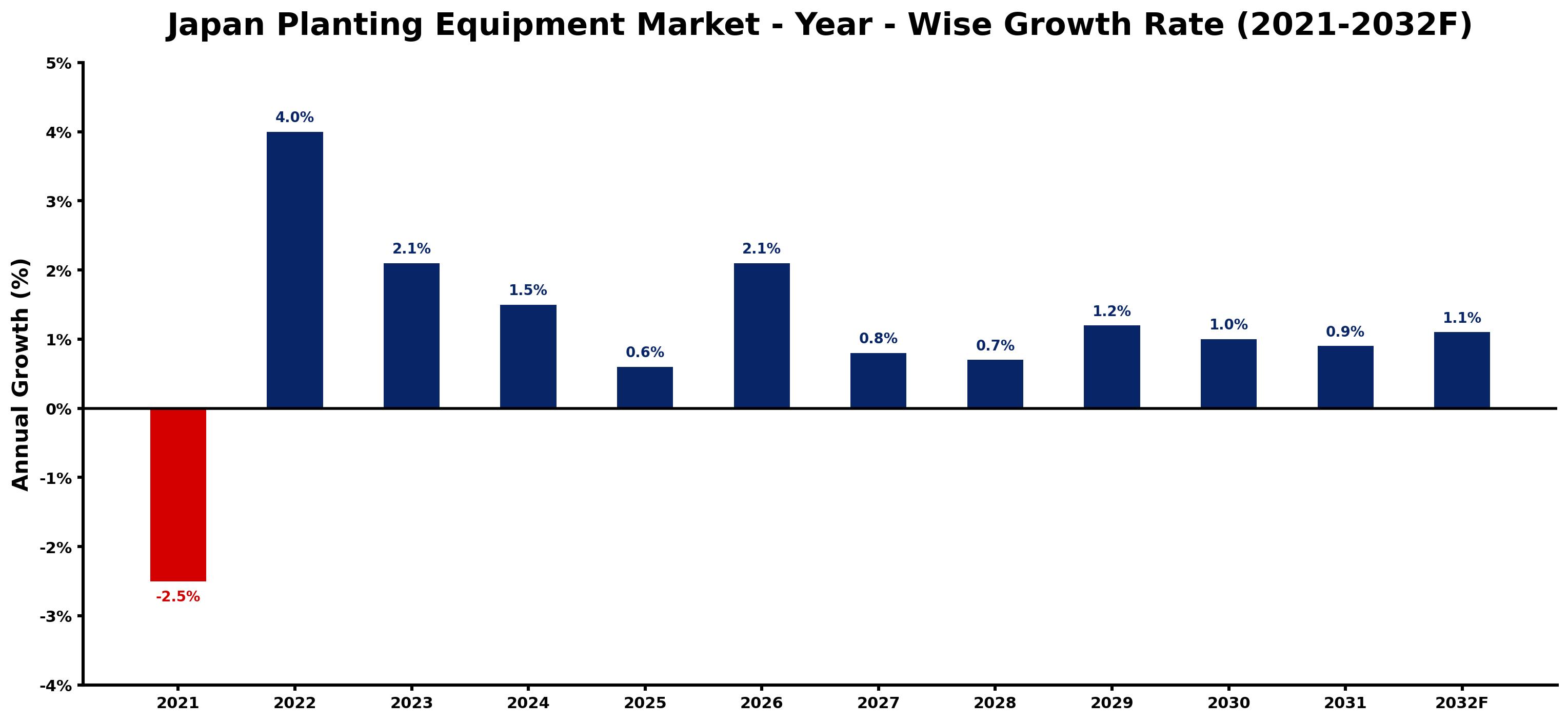
The table below presents the year‑wise growth rates along with the key drivers influencing the market
| Year | Growth Rate | Major Drivers |
| 2021 | -2.5% | Growing renewable energy integration projects |
| 2022 | 4.0% | Rapid growth in telecom and data center sectors |
| 2023 | 2.1% | Increasing smart city development projects |
| 2024 | 1.5% | Increasing industrial infrastructure investments |
| 2025 | 0.6% | Expansion of commercial construction activities |
| 2026 | 2.1% | Growing urbanization and commercial development |
| 2027 | 0.8% | Growing urbanization and commercial development |
| 2028 | 0.7% | Expansion of commercial construction activities |
| 2029 | 1.2% | Rapid growth in telecom and data center sectors |
| 2030 | 1.0% | Increasing smart city development projects |
| 2031 | 0.9% | Increasing industrial automation investments |
| 2032 | 1.1% | Increasing adoption of advanced technologies |
Note - Market size estimations and growth projections presented in this report are based on 6Wresearch’s advanced forecasting approach, validated with industry datasets as of June 2026.
Japan Planting Equipment Market Synopsis
In Japan, the adoption of precision agriculture is shifting the landscape of planting equipment. Farmers are increasingly gravitating towards machinery that ensures precise seed placement, thereby optimizing input costs and crop yields. Such advancements not only cater to traditional farming needs but also align with modern sustainability goals.
The market is also witnessing innovations in autonomous planting equipment, reflecting a broader trend towards automation in agriculture. This shift is crucial, given the challenges posed by a shrinking labor pool and the need for enhanced operational efficiency.
Japan Planting Equipment Market Key Takeaways
- Significant growth driven by technological advancements and precision agriculture.
- Increasing demand for innovative planting equipment tailored for efficiency.
- Shift towards autonomous and robotic solutions to tackle labor shortages.
- Growing focus on sustainability and eco-friendly practices in equipment design.
- Investment opportunities exist in developing affordable solutions for small-scale farmers.
Evaluation of Restraints in Japan Planting Equipment Market
One of the most pressing constraints in the Japan Planting Equipment Market is the aging demographic of farmers. This trend results in a labor shortage, necessitating the adoption of advanced machinery to maintain productivity levels. Furthermore, the high costs associated with modern planting equipment can deter small and medium-sized farms from transitioning to new technologies. Traditional farming practices and cultural reluctance also hinder the widespread acceptance of innovative solutions, requiring tailored approaches to address these barriers.
Japan Planting Equipment Market Trends
Current trends indicate a marked shift towards precision farming, with the incorporation of GPS-guided systems and automated planting processes. Farmers are increasingly investing in technologies that enable variable rate seeding and real-time monitoring, directly responding to the need for efficiency in the face of rising operational costs. Moreover, a heightened awareness of sustainability is prompting manufacturers to design lighter, more compact equipment suitable for urban and small-scale farming.
Japan Planting Equipment Market Opportunities
The opportunities within the Japan Planting Equipment Market are abundant, especially as precision agriculture gains traction. There is a clear demand for innovative solutions that can help farmers increase productivity and sustainability. Investments in developing eco-friendly equipment are particularly promising, as environmental concerns continue to shape consumer preferences. Collaborations with local manufacturers and distributors also present viable pathways for new entrants aiming to penetrate this dynamic market.
Government Initiatives in the Japan Planting Equipment Market
The Japanese government is actively promoting initiatives to enhance agricultural productivity through the adoption of advanced planting equipment. Various subsidies and support programs are designed to encourage farmers to invest in modern technologies, particularly those focused on sustainability. Additionally, the government enforces regulations ensuring safety and quality standards for planting machinery, which further boosts consumer confidence in these innovations.
Future Insights of the Japan Planting Equipment Market
Looking ahead to 2026-2032, the Japan Planting Equipment Market is set to experience steady growth, driven by ongoing advancements in agricultural technology and supportive government policies. The persistent challenges related to labor shortages and the need for precision will further fuel demand for innovative planting solutions. With a focus on enhancing agricultural productivity and sustainability, the market appears poised for robust expansion, reflecting the evolving needs of Japanese farmers.
Japan Planting Equipment Market Latest Developments (May 2025 - June 2026)
In the recent period, there has been a noticeable acceleration in the development of autonomous planting technologies. Companies are actively exploring partnerships to integrate artificial intelligence into planting equipment, further enhancing precision and efficiency. Additionally, new government initiatives aimed at sustainable agriculture are encouraging investments in eco-friendly equipment solutions, reflecting a broader industry shift towards environmental responsibility.
Japan Planting Equipment Market - Key Attractiveness of the Report
- 10 Years of Market Numbers
- Historical Data Starting from 2022 to 2025
- Base Year: 2025
- Forecast Data until 2032
- Key Performance Indicators Impacting the Market
- Major Upcoming Developments and Projects
Key Highlights of the Report:
- Japan Planting Equipment Market Outlook
- Market Size of Japan Planting Equipment Market, 2025
- Forecast of Japan Planting Equipment Market, 2032
- Historical Data and Forecast of Japan Planting Equipment Revenues & Volume for the Period 2022-2032F
- Japan Planting Equipment Market Trend Evolution
- Japan Planting Equipment Market Drivers and Challenges
- Japan Planting Equipment Price Trends
- Japan Planting Equipment Porter's Five Forces
- Japan Planting Equipment Industry Life Cycle
- Historical Data and Forecast of Japan Planting Equipment Market Revenues & Volume By Type for the Period 2022-2032F
- Historical Data and Forecast of Japan Planting Equipment Market Revenues & Volume By Air seeders for the Period 2022-2032F
- Historical Data and Forecast of Japan Planting Equipment Market Revenues & Volume By Seed drills for the Period 2022-2032F
- Historical Data and Forecast of Japan Planting Equipment Market Revenues & Volume By Planters for the Period 2022-2032F
- Historical Data and Forecast of Japan Planting Equipment Market Revenues & Volume By Others for the Period 2022-2032F
- Historical Data and Forecast of Japan Planting Equipment Market Revenues & Volume By Design for the Period 2022-2032F
- Historical Data and Forecast of Japan Planting Equipment Market Revenues & Volume By Mechanical for the Period 2022-2032F
- Historical Data and Forecast of Japan Planting Equipment Market Revenues & Volume By Automatic for the Period 2022-2032F
- Historical Data and Forecast of Japan Planting Equipment Market Revenues & Volume By Crop Type for the Period 2022-2032F
- Historical Data and Forecast of Japan Planting Equipment Market Revenues & Volume By Cereals & grains for the Period 2022-2032F
- Historical Data and Forecast of Japan Planting Equipment Market Revenues & Volume By Oilseeds & pulses for the Period 2022-2032F
- Historical Data and Forecast of Japan Planting Equipment Market Revenues & Volume By Fruits & vegetables for the Period 2022-2032F
- Historical Data and Forecast of Japan Planting Equipment Market Revenues & Volume By Others for the Period 2022-2032F
- Japan Planting Equipment Import Export Trade Statistics
- Market Opportunity Assessment By Type
- Market Opportunity Assessment By Design
- Market Opportunity Assessment By Crop Type
- Japan Planting Equipment Top Companies Market Share
- Japan Planting Equipment Competitive Benchmarking By Technical and Operational Parameters
- Japan Planting Equipment Company Profiles
- Japan Planting Equipment Key Strategic Recommendations






































