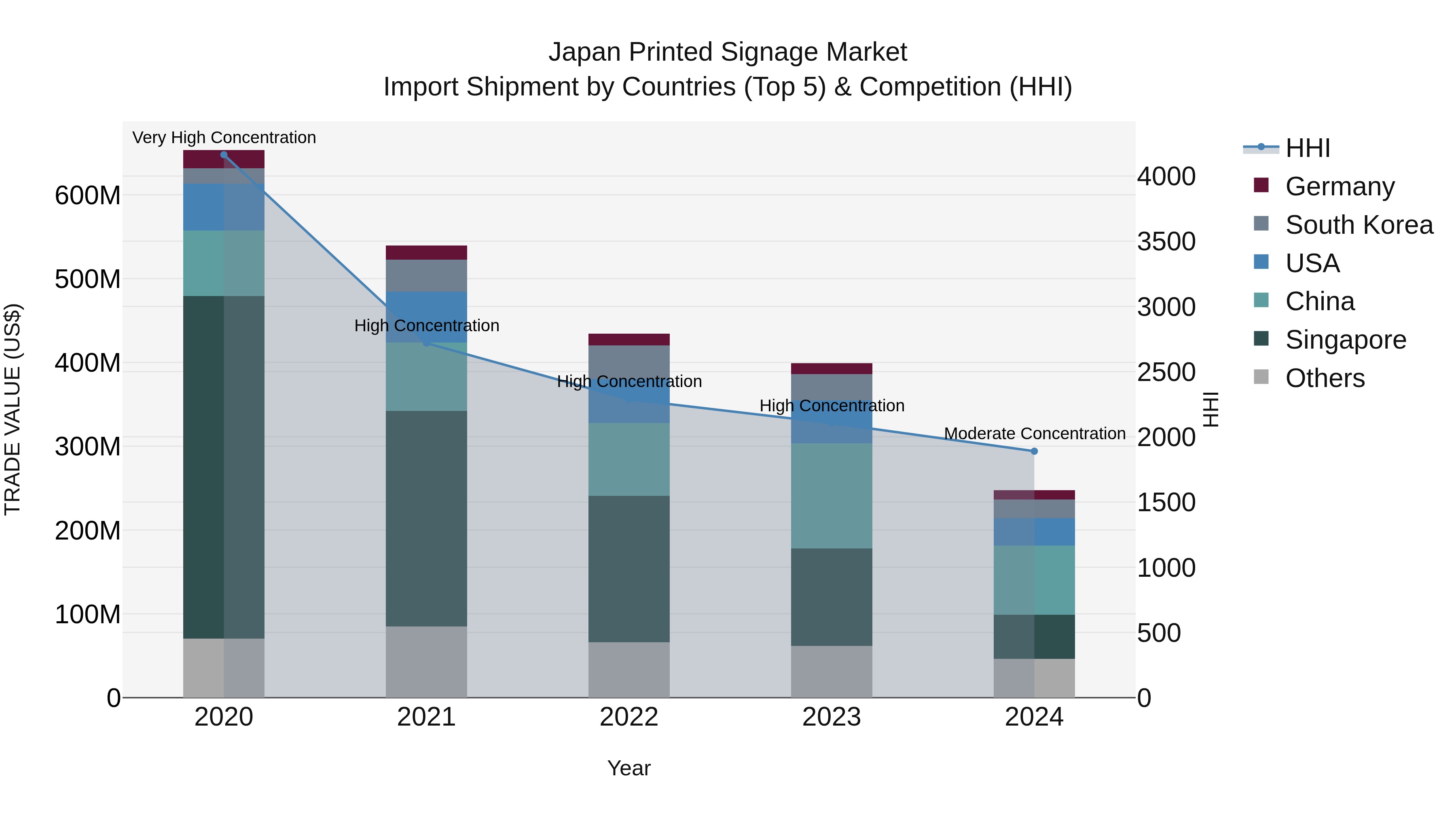
Japan Printed Signage Market Import Shipment by Countries (Top 5) & Competition (HHI)
The printed signage import market in Japan saw a shift in concentration levels from high to moderate in 2024, signaling a more diversified import landscape. Top exporting countries such as China, Singapore, USA, South Korea, and Metropolitan France continue to play key roles in supplying printed signage to Japan. However, the market experienced a significant decline in both CAGR and growth rate in 2024, with a negative trend reflecting challenges and changes in the industry. Monitoring these trends will be crucial for stakeholders to adapt and strategize effectively in the evolving Japanese printed signage market.
Japan Printed Signage Market Synopsis
The Japan Printed Signage Market is a dynamic and thriving sector characterized by a high demand for innovative and visually appealing signage solutions. With a strong emphasis on quality and precision, Japanese companies in this market cater to diverse industries including retail, hospitality, transportation, and events. The market is driven by advancements in printing technology, leading to the production of high-resolution and durable signage products. Sustainability and eco-friendly practices are also gaining prominence, with an increasing number of companies adopting environmentally friendly materials and production processes. The market is competitive, with a focus on customization and personalized services to meet the specific needs of clients. Overall, the Japan Printed Signage Market is poised for continued growth, fueled by a combination of technological advancements, design innovation, and a customer-centric approach.
Japan Printed Signage Market Trends
The Japan Printed Signage Market is experiencing a shift towards digital signage solutions, driven by advancements in technology and the increasing demand for dynamic and interactive advertising mediums. LED displays and digital screens are gaining popularity due to their ability to deliver targeted messaging and real-time updates. Personalized and customized signage solutions are also in demand, as businesses look to stand out in a crowded market. Sustainability is another key trend, with a growing emphasis on eco-friendly materials and energy-efficient signage options. Additionally, there is a rising interest in mobile integration, with QR codes and augmented reality features being incorporated into printed signage to enhance user engagement and interactivity. Overall, the Japan Printed Signage Market is evolving towards more innovative, tech-savvy, and environmentally conscious solutions.
Japan Printed Signage Market Challenges
In the Japan Printed Signage Market, some challenges that are commonly faced include competition from digital signage solutions, high production costs, and a slow adoption rate of new printing technologies. The market is increasingly shifting towards digital signage due to its dynamic and interactive features, posing a threat to traditional printed signage providers. Additionally, the cost of production for printed signage, including materials and equipment, can be high, especially for small businesses. Furthermore, the conservative nature of some businesses in Japan may result in a slower acceptance of newer printing technologies and designs. To remain competitive, companies in the Japan Printed Signage Market need to innovate, offer cost-effective solutions, and educate customers on the benefits of printed signage in a digital age.
Japan Printed Signage Market Investment Opportunities
The Japan Printed Signage Market offers several promising investment opportunities due to the country`s strong economy and vibrant advertising industry. With the increasing demand for visually appealing and innovative signage solutions, there is a growing market for digital and large format printing technologies. Investing in companies that specialize in advanced printing technologies, such as UV printing and eco-solvent printing, can be lucrative. Additionally, there is a trend towards personalized and customized signage solutions, presenting opportunities for companies that offer unique and niche printing services. As Japan continues to embrace digitalization and modernization, investing in the printed signage market can be a strategic move to capitalize on the country`s evolving advertising landscape.
Jordan Agar Market Government Policies
The Japanese government has implemented various policies to regulate the Printed Signage Market, aimed at ensuring safety, promoting environmental sustainability, and maintaining aesthetics. Regulations require signage to meet specific standards for materials, size, and placement to enhance public safety and prevent visual clutter. Additionally, there are guidelines in place to promote energy efficiency and reduce environmental impact, encouraging the use of eco-friendly materials and technologies in signage production. The government also supports the development of innovative and visually appealing signage designs through initiatives that promote collaboration between industry stakeholders and designers. Overall, these policies aim to create a well-regulated and visually pleasing Printed Signage Market in Japan that contributes to public safety, environmental sustainability, and aesthetic quality.
Japan Printed Signage Market Future Outlook
The Japan Printed Signage Market is poised for steady growth in the coming years, driven by increasing demand from various sectors such as retail, hospitality, and transportation. The market is expected to benefit from technological advancements in printing techniques, leading to higher-quality and more customizable signage solutions. Additionally, the growing emphasis on visual communication and branding strategies is likely to fuel the adoption of printed signage in both traditional and digital formats. With the upcoming Tokyo Olympics and Paralympics in 2021, the market is also expected to witness a surge in demand for event-related signage and promotions. Overall, the Japan Printed Signage Market is projected to experience a positive trajectory, offering opportunities for market players to innovate and expand their offerings to cater to evolving consumer preferences.
Key Highlights of the Report:
- Japan Printed Signage Market Outlook
- Market Size of Japan Printed Signage Market, 2024
- Forecast of Japan Printed Signage Market, 2031
- Historical Data and Forecast of Japan Printed Signage Revenues & Volume for the Period 2021- 2031
- Japan Printed Signage Market Trend Evolution
- Japan Printed Signage Market Drivers and Challenges
- Japan Printed Signage Price Trends
- Japan Printed Signage Porter's Five Forces
- Japan Printed Signage Industry Life Cycle
- Historical Data and Forecast of Japan Printed Signage Market Revenues & Volume By Product for the Period 2021- 2031
- Historical Data and Forecast of Japan Printed Signage Market Revenues & Volume By Billboard for the Period 2021- 2031
- Historical Data and Forecast of Japan Printed Signage Market Revenues & Volume By Backlit Display for the Period 2021- 2031
- Historical Data and Forecast of Japan Printed Signage Market Revenues & Volume By Pop Display for the Period 2021- 2031
- Historical Data and Forecast of Japan Printed Signage Market Revenues & Volume By Banner for the Period 2021- 2031
- Historical Data and Forecast of Japan Printed Signage Market Revenues & Volume By Corporate Graphics for the Period 2021- 2031
- Historical Data and Forecast of Japan Printed Signage Market Revenues & Volume By Others for the Period 2021- 2031
- Historical Data and Forecast of Japan Printed Signage Market Revenues & Volume By Type for the Period 2021- 2031
- Historical Data and Forecast of Japan Printed Signage Market Revenues & Volume By Indoor Printed Signage for the Period 2021- 2031
- Historical Data and Forecast of Japan Printed Signage Market Revenues & Volume By Outdoor Printed Signage for the Period 2021- 2031
- Historical Data and Forecast of Japan Printed Signage Market Revenues & Volume By End-user Vertical for the Period 2021- 2031
- Historical Data and Forecast of Japan Printed Signage Market Revenues & Volume By BFSI for the Period 2021- 2031
- Historical Data and Forecast of Japan Printed Signage Market Revenues & Volume By Retail for the Period 2021- 2031
- Historical Data and Forecast of Japan Printed Signage Market Revenues & Volume By Sports and Leisure for the Period 2021- 2031
- Historical Data and Forecast of Japan Printed Signage Market Revenues & Volume By Entertainment for the Period 2021- 2031
- Historical Data and Forecast of Japan Printed Signage Market Revenues & Volume By Transportation and Logistics for the Period 2021- 2031
- Historical Data and Forecast of Japan Printed Signage Market Revenues & Volume By Healthcare for the Period 2021- 2031
- Historical Data and Forecast of Japan Printed Signage Market Revenues & Volume By Others for the Period 2021- 2031
- Japan Printed Signage Import Export Trade Statistics
- Market Opportunity Assessment By Product
- Market Opportunity Assessment By Type
- Market Opportunity Assessment By End-user Vertical
- Japan Printed Signage Top Companies Market Share
- Japan Printed Signage Competitive Benchmarking By Technical and Operational Parameters
- Japan Printed Signage Company Profiles
- Japan Printed Signage Key Strategic Recommendations






































