Japan Public Cloud Market Size & Growth Rate (2026-2032)
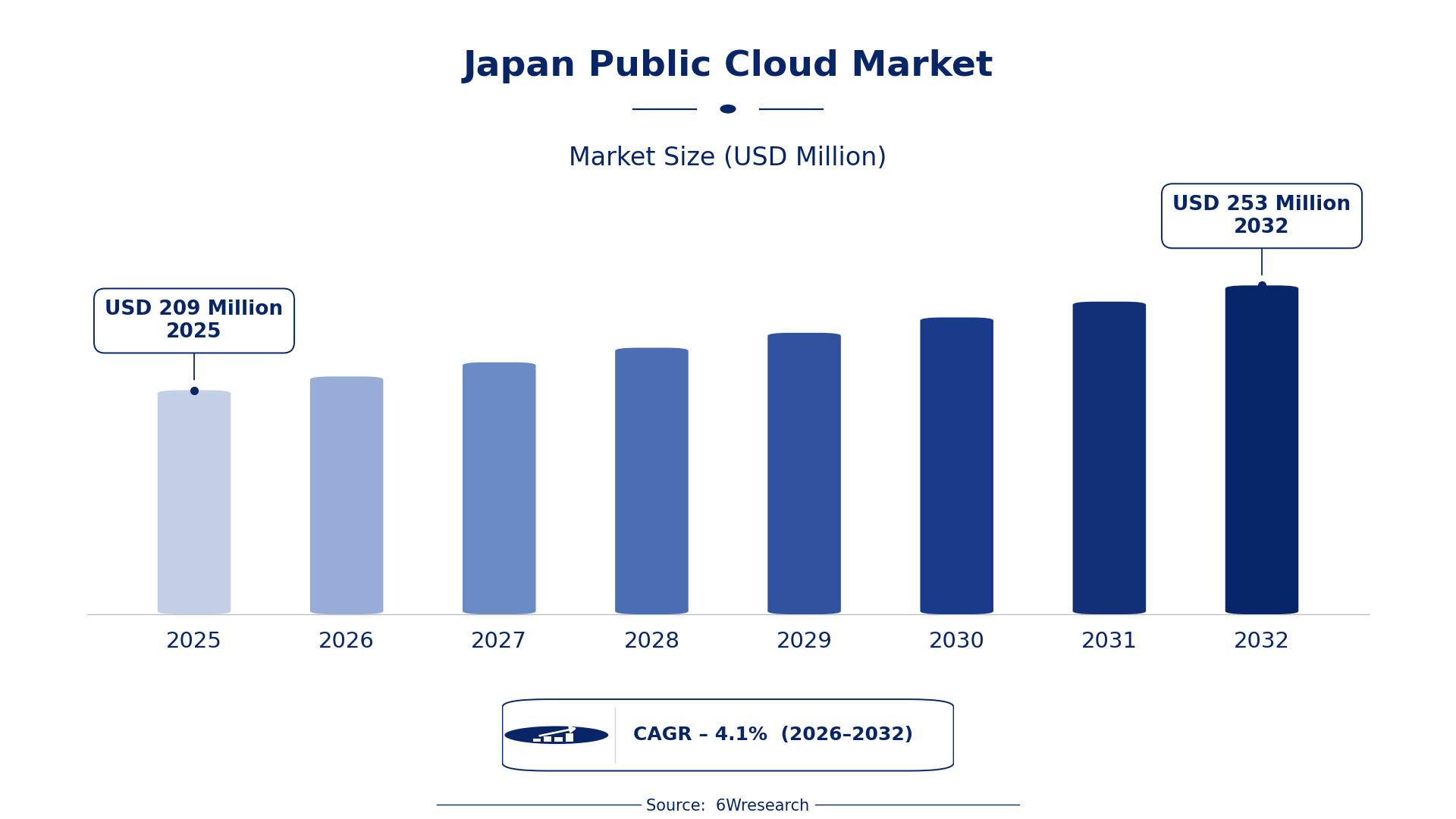
The Japan Public Cloud Market was estimated at USD 209 Million in 2025 and is projected to reach USD 253 Million by 2032, growing at a CAGR of 4.1% from 2026 to 2032.
Japan Public Cloud Market Synopsis
A surge in digital transformation initiatives is the foremost force shaping the Japan Public Cloud Market today. Organizations across various sectors are increasingly adopting cloud technologies to enhance operational efficiency and scale their businesses effectively.
This shift is particularly evident in industries like finance, healthcare, and manufacturing, where cloud solutions are instrumental in leveraging data analytics, IoT, and AI. As major cloud providers expand their offerings, the competition intensifies, pushing the market towards unprecedented growth.
Japan Public Cloud Market Year-wise Growth Rate and Key Drivers
This graph illustrates the annual growth rates of the Japan Public Cloud Market from 2021 to 2032, highlighting a steady upward trajectory and projected expansion over the forecast period.
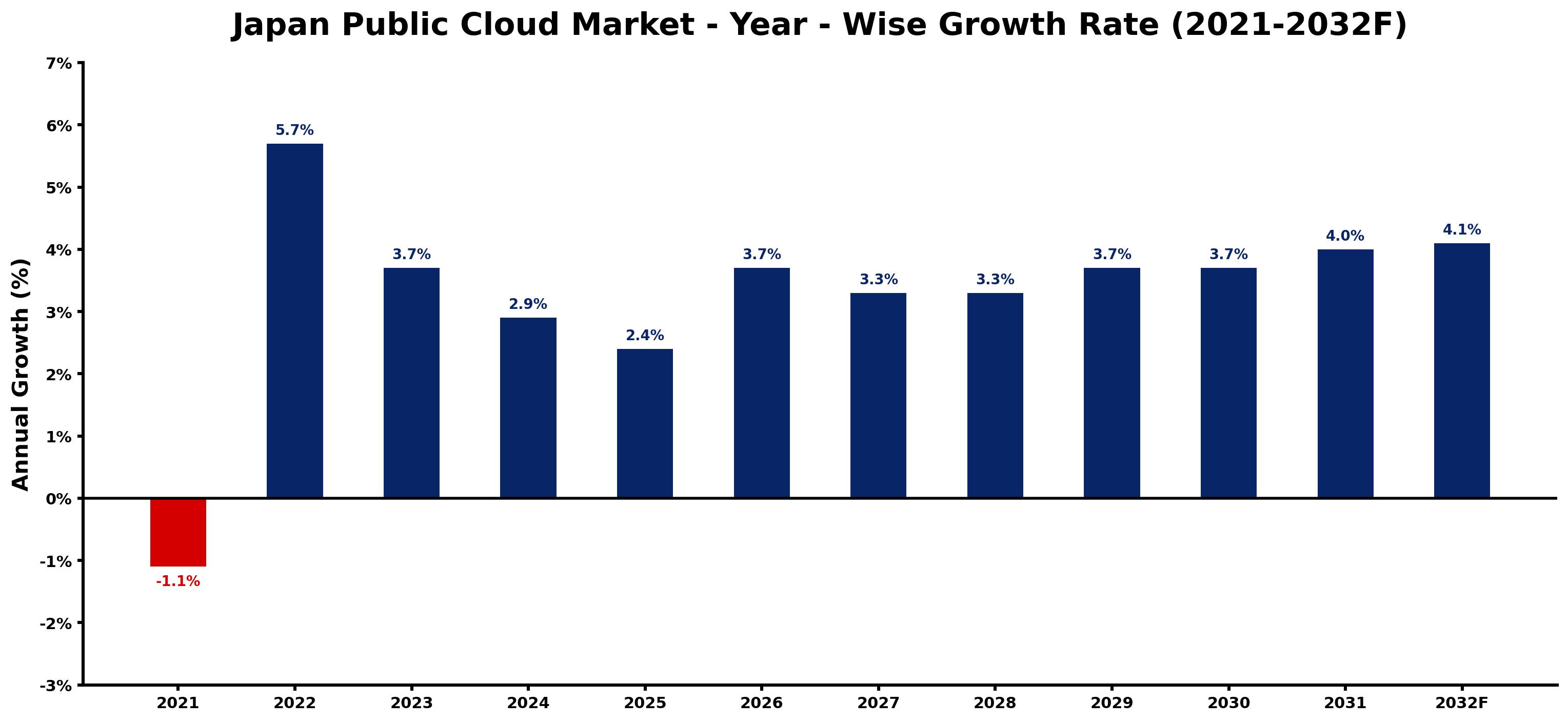
The table below presents the year‑wise growth rates along with the key drivers influencing the market
| Year | Growth Rate | Major Drivers |
| 2021 | -1.1% | Delayed 5G rollout affected cloud adoption rates. |
| 2022 | 5.7% | Government's 'Digital Government Strategy' boosts cloud adoption. |
| 2023 | 3.7% | Increased AI integration demands scalable cloud infrastructure. |
| 2024 | 2.9% | Growing remote work culture drives cloud services utilization. |
| 2025 | 2.4% | Regulatory push for data localization accelerates cloud migration. |
| 2026 | 3.7% | Demand for e-commerce platforms enhances cloud service offerings. |
| 2027 | 3.3% | Cybersecurity mandates encourage businesses to adopt cloud solutions. |
| 2028 | 3.3% | Rising cloud-native application development supports digital transformation. |
| 2029 | 3.7% | 5G rollout increases demand for edge computing services. |
| 2030 | 3.7% | Health tech innovations require robust cloud data management. |
| 2031 | 4.0% | Government incentives for tech startups boost cloud service use. |
| 2032 | 4.1% | Increased focus on sustainability drives green cloud solutions. |
Note: Market size estimations and growth projections presented in this report are based on 6Wresearch's proprietary forecasting methodology, utilizing the latest available industry data, government publications, and primary research inputs.
Japan Public Cloud Market Key Takeaways
Below are some of the specific key takeaways from the market, including:
- The growing emphasis on data security and compliance is driving cloud adoption across sectors.
- Hybrid and multi-cloud environments are increasingly becoming the preferred strategy for businesses.
- Investment opportunities are emerging in industry-specific cloud solutions, especially in healthcare and finance.
- Government initiatives are fostering a conducive environment for cloud service providers.
- The demand for AI and machine learning services is escalating as businesses seek advanced analytics capabilities.
Evaluation of Restraints in Japan Public Cloud Market
Despite its growth potential, the Japan Public Cloud Market faces several restraints. Data security and privacy concerns remain paramount, driven by stringent regulations that complicate compliance. Cultural preferences for on-premises solutions also pose a barrier, as many organizations are hesitant to fully transition to cloud-based infrastructure. Additionally, language barriers for non-Japanese providers can hinder market penetration and customer trust. The reliance on traditional IT infrastructure further complicates matters, as many companies struggle with integrating legacy systems into cloud environments. Addressing these challenges requires a nuanced understanding of local market dynamics.
Japan Public Cloud Market Trends
The Japan Public Cloud Market is experiencing notable trends that are shaping its future. A prominent trend is the increasing shift towards hybrid and multi-cloud strategies, as businesses seek flexibility and resilience. The adoption of AI and machine learning services is becoming mainstream, with organizations recognizing the potential of cloud computing to enhance analytics and operational efficiency. on top of that, there is a growing emphasis on industry-specific cloud solutions, enabling companies to tailor their cloud usage to meet sector-specific demands. These trends are indicative of a market evolving rapidly to meet changing business needs.
Japan Public Cloud Market Opportunities
As digital transformation accelerates, the Japan Public Cloud Market presents a wealth of investment opportunities. Companies providing cloud infrastructure services, including data centers and storage solutions, stand to benefit as organizations increasingly transition to cloud-based operations. on top of that, the demand for software-as-a-service (SaaS) applications tailored to specific industries is on the rise, offering avenues for growth. Additionally, investing in cloud security solutions is crucial as businesses prioritize data protection amid evolving regulatory requirements. These opportunities highlight the market's potential for innovation and expansion.
Government Initiatives in the Japan Public Cloud Market
The Japanese government has taken proactive steps to promote cloud computing adoption, recognizing its importance for national digital transformation. By implementing various policies, the government is fostering a regulatory environment that encourages cloud innovation and prioritizes data security. This public-sector focus on cloud adoption is crucial for creating a sustainable ecosystem that benefits both service providers and end-users.
- A "Cloud First" strategy launched recently encourages public sector agencies to adopt cloud solutions for IT procurement.
- Current initiatives include regulatory frameworks ensuring data security and privacy in cloud services.
- Ongoing investments in digital infrastructure aim to support the growth of the cloud market across sectors.
- A planned public-private initiative is expected to enhance access to cloud services for small and medium-sized enterprises by 2028.
- Upcoming guidelines on billing transparency are set to be introduced in 2026 to foster trust among cloud service users.
Future Insights of the Japan Public Cloud Market
Looking ahead to 2026-2032, the Japan Public Cloud Market is expected to continue its upward trajectory. As digital transformation initiatives gain momentum, more enterprises will turn to cloud solutions to meet their operational needs. The increasing focus on remote work and data security will further propel demand for scalable cloud infrastructures. As service providers innovate to meet evolving customer expectations, the market will likely witness significant advancements, creating a fertile ground for growth.
Japan Public Cloud Market Latest Developments
Recent activity in the Japan Public Cloud Market has been characterized by a flurry of strategic initiatives and partnerships. The last 12-14 months have seen cloud service providers ramping up their efforts to enhance service offerings and expand their market presence. With increasing competition, innovation remains at the forefront of industry developments.
- A major technology vendor launched a new suite of cloud-based analytics tools in Q1 2025, aimed at enhancing data-driven decision-making for businesses.
- In early 2025, a leading regional operator completed the upgrade of its data centers to support advanced cloud services.
- An ongoing initiative began in late 2025 to develop AI-driven cloud solutions tailored specifically for the healthcare sector.
- A planned expansion of cloud infrastructure services is set to begin in mid-2026, targeting underserved regions in Japan.
- Recent partnerships between cloud providers and local firms are currently underway, focusing on co-developing industry-specific solutions.
Japan Public Cloud Market - Key Attractiveness of the Report
- 10 Years of Market Numbers
- Historical Data Starting from 2022 to 2025
- Base Year: 2025
- Forecast Data until 2032
- Key Performance Indicators Impacting the Market
- Major Upcoming Developments and Projects
Key Highlights of the Report:
- Japan Public Cloud Market Outlook
- Market Size of Japan Public Cloud Market, 2025
- Forecast of Japan Public Cloud Market, 2032
- Historical Data and Forecast of Japan Public Cloud Revenues & Volume for the Period 2022-2032F
- Japan Public Cloud Market Trend Evolution
- Japan Public Cloud Market Drivers and Challenges
- Japan Public Cloud Price Trends
- Japan Public Cloud Porter's Five Forces
- Japan Public Cloud Industry Life Cycle
- Historical Data and Forecast of Japan Public Cloud Market Revenues & Volume By Service Model for the Period 2022-2032F
- Historical Data and Forecast of Japan Public Cloud Market Revenues & Volume By Infrastructure as a Service for the Period 2022-2032F
- Historical Data and Forecast of Japan Public Cloud Market Revenues & Volume By Platform as a Service for the Period 2022-2032F
- Historical Data and Forecast of Japan Public Cloud Market Revenues & Volume By Software as a Service for the Period 2022-2032F
- Historical Data and Forecast of Japan Public Cloud Market Revenues & Volume By Organization Size Large enterprises for the Period 2022-2032F
- Historical Data and Forecast of Japan Public Cloud Market Revenues & Volume By Small for the Period 2022-2032F
- Historical Data and Forecast of Japan Public Cloud Market Revenues & Volume By Medium Enterprises SMEs for the Period 2022-2032F
- Historical Data and Forecast of Japan Public Cloud Market Revenues & Volume By Verticals for the Period 2022-2032F
- Historical Data and Forecast of Japan Public Cloud Market Revenues & Volume By BFSI for the Period 2022-2032F
- Historical Data and Forecast of Japan Public Cloud Market Revenues & Volume By Telecommunication for the Period 2022-2032F
- Historical Data and Forecast of Japan Public Cloud Market Revenues & Volume By IT & ITeS for the Period 2022-2032F
- Historical Data and Forecast of Japan Public Cloud Market Revenues & Volume By Government & Public Sector for the Period 2022-2032F
- Historical Data and Forecast of Japan Public Cloud Market Revenues & Volume By Retail & Consumer Goods for the Period 2022-2032F
- Historical Data and Forecast of Japan Public Cloud Market Revenues & Volume By Manufacturing for the Period 2022-2032F
- Historical Data and Forecast of Japan Public Cloud Market Revenues & Volume By Energy & Utility for the Period 2022-2032F
- Historical Data and Forecast of Japan Public Cloud Market Revenues & Volume By Media & Entertainment for the Period 2022-2032F
- Japan Public Cloud Import Export Trade Statistics
- Market Opportunity Assessment By Service Model
- Market Opportunity Assessment By Organization Size Large enterprises
- Market Opportunity Assessment By Verticals
- Japan Public Cloud Top Companies Market Share
- Japan Public Cloud Competitive Benchmarking By Technical and Operational Parameters
- Japan Public Cloud Company Profiles
- Japan Public Cloud Key Strategic Recommendations






































