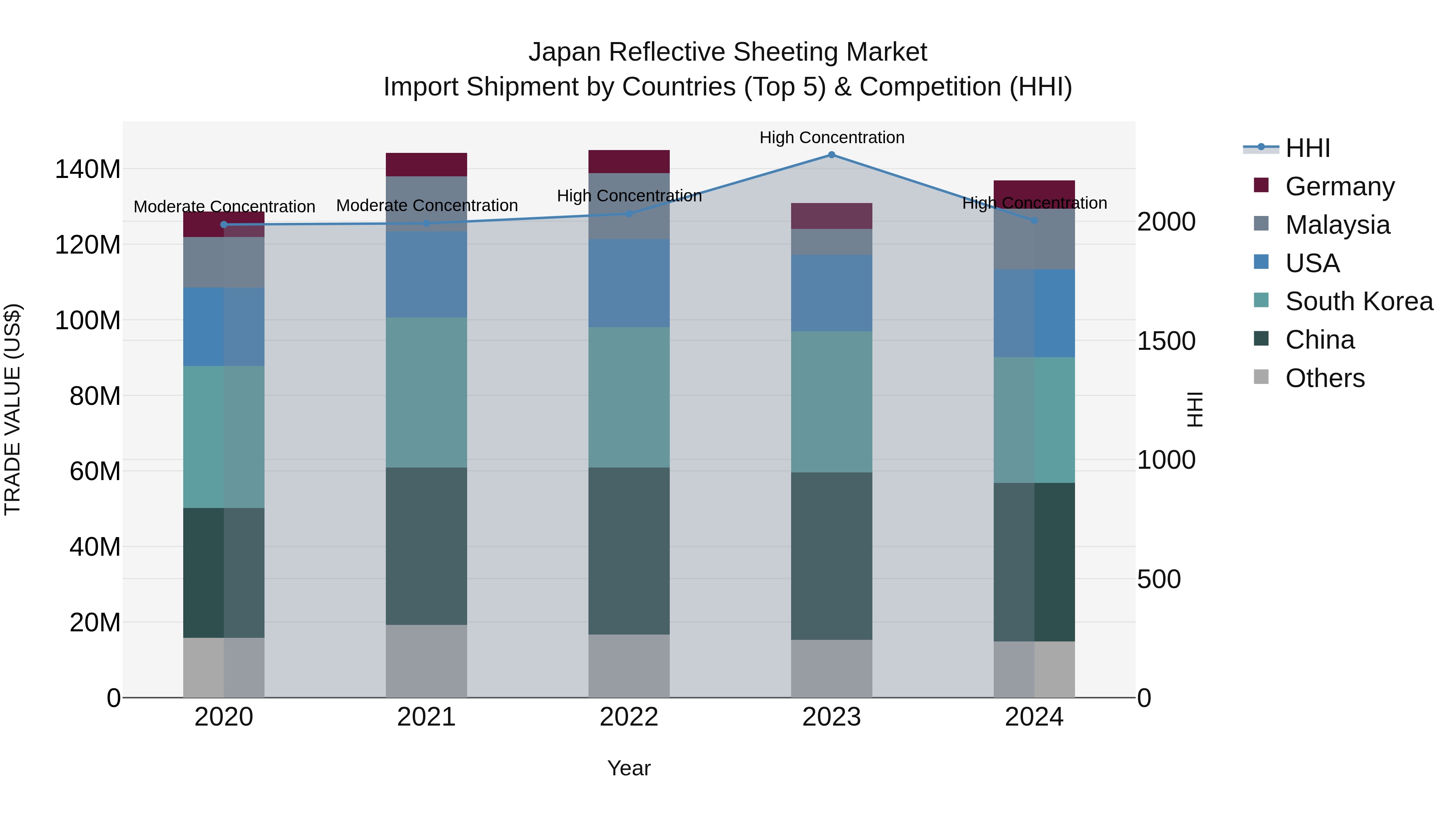
Japan Reflective Sheeting Market Import Shipment by Countries (Top 5) & Competition (HHI)
Reflective sheeting import shipments to Japan in 2024 saw top contributions from China, South Korea, USA, Malaysia, and Germany. The high concentration of the Herfindahl-Hirschman Index (HHI) indicates a competitive market landscape. With a steady compound annual growth rate (CAGR) of 1.58% from 2020 to 2024, the industry exhibited resilience. Notably, the growth rate surged to 4.59% in 2024, reflecting a positive momentum in the market. This data suggests a robust demand for reflective sheeting in Japan, with key exporters playing a significant role in meeting these needs.
Japan Reflective Sheeting Market Overview
The Japan reflective sheeting market is experiencing steady growth driven by the increasing emphasis on road safety measures and infrastructure development in the country. Reflective sheeting is widely used in traffic signs, vehicle markings, and high-visibility clothing to enhance visibility and ensure safety on roads. The market is also benefiting from the growing adoption of reflective materials in construction and industrial settings for safety and identification purposes. Key players in the Japan reflective sheeting market are focusing on product innovation, such as improved durability and weather resistance, to meet the evolving needs of customers. Government regulations promoting the use of reflective materials in transportation and infrastructure projects are further fueling market growth. Overall, the Japan reflective sheeting market is expected to continue to expand due to the increasing awareness of safety measures among the populace.
Japan Reflective Sheeting Market Trends
The Japan reflective sheeting market is experiencing a shift towards increased demand for advanced reflective materials that offer higher visibility and durability. With a focus on improving road safety and visibility in various applications such as traffic signs, vehicle markings, and personal protective equipment, there is a growing preference for reflective sheeting products that meet stringent quality standards and regulatory requirements. Additionally, there is a rising interest in eco-friendly and sustainable reflective materials, driving manufacturers to develop innovative solutions that are both effective and environmentally conscious. The market is also witnessing a trend towards customization, with manufacturers offering personalized designs and colors to cater to specific customer needs and preferences. Overall, the Japan reflective sheeting market is evolving to meet the evolving demands for safety, visibility, and sustainability.
Japan Reflective Sheeting Market Challenges
In the Japan reflective sheeting market, challenges include intense competition among key players leading to price wars, the need for constant innovation and technological advancements to meet changing regulatory requirements and consumer demands, and the impact of economic fluctuations on construction and transportation industries, which are major users of reflective sheeting products. Additionally, ensuring quality control and meeting stringent safety standards pose challenges for manufacturers. Moreover, the market may also face issues related to environmental sustainability and recycling of reflective materials. Overall, companies in the Japan reflective sheeting market need to navigate these challenges effectively to maintain a competitive edge and sustain growth in the industry.
Japan Reflective Sheeting Market Investment Opportunities
The Japan reflective sheeting market presents promising investment opportunities due to the increasing focus on road safety and infrastructure development in the country. With the growing demand for reflective materials in road signs, vehicle markings, and construction applications, there is a significant market potential for manufacturers and suppliers of high-quality reflective sheeting products. Additionally, the Japanese government`s initiatives to improve transportation systems and enhance visibility on roads further drive the demand for innovative and durable reflective sheeting solutions. Investing in this market can offer long-term growth potential, especially for companies that can provide advanced technologies, eco-friendly materials, and customized solutions to meet the evolving needs of the Japanese market. Overall, the Japan reflective sheeting market is poised for expansion and offers opportunities for investors looking to capitalize on the country`s infrastructure development and road safety initiatives.
Japan Reflective Sheeting Market Government Policy
In Japan, the government has implemented various policies to regulate the reflective sheeting market. The Ministry of Land, Infrastructure, Transport and Tourism (MLIT) has set standards for reflective sheeting used on roads and highways to ensure visibility and safety. Additionally, the Japan Industrial Standards (JIS) has established guidelines for the quality and performance of reflective sheeting products. The government also promotes the use of reflective sheeting in infrastructure projects to enhance road safety and visibility during nighttime and adverse weather conditions. Furthermore, there are regulations in place to monitor the manufacturing processes of reflective sheeting to ensure compliance with environmental and safety standards. Overall, the government`s policies aim to promote the use of high-quality reflective sheeting to improve road safety and visibility for drivers in Japan.
Japan Reflective Sheeting Market Future Outlook
The Japan reflective sheeting market is expected to witness steady growth in the coming years. Factors such as increasing government regulations mandating the use of reflective materials for road safety, growing awareness about the importance of visibility in reducing accidents, and a rise in infrastructure development projects are driving the demand for reflective sheeting in Japan. Additionally, technological advancements in reflective materials, such as improved durability and performance, are likely to further boost market growth. As the Japanese government continues to focus on enhancing road safety and visibility, the demand for reflective sheeting for traffic signs, vehicle markings, and high-visibility clothing is expected to increase. Overall, the Japan reflective sheeting market is poised for expansion in the foreseeable future.
Key Highlights of the Report:
- Japan Reflective Sheeting Market Outlook
- Market Size of Japan Reflective Sheeting Market,2024
- Forecast of Japan Reflective Sheeting Market, 2031
- Historical Data and Forecast of Japan Reflective Sheeting Revenues & Volume for the Period 2021-2031
- Japan Reflective Sheeting Market Trend Evolution
- Japan Reflective Sheeting Market Drivers and Challenges
- Japan Reflective Sheeting Price Trends
- Japan Reflective Sheeting Porter's Five Forces
- Japan Reflective Sheeting Industry Life Cycle
- Historical Data and Forecast of Japan Reflective Sheeting Market Revenues & Volume By Type for the Period 2021-2031
- Historical Data and Forecast of Japan Reflective Sheeting Market Revenues & Volume By Engineering Grade for the Period 2021-2031
- Historical Data and Forecast of Japan Reflective Sheeting Market Revenues & Volume By High-Intensity for the Period 2021-2031
- Historical Data and Forecast of Japan Reflective Sheeting Market Revenues & Volume By Diamond Grade for the Period 2021-2031
- Historical Data and Forecast of Japan Reflective Sheeting Market Revenues & Volume By Fluorescent for the Period 2021-2031
- Historical Data and Forecast of Japan Reflective Sheeting Market Revenues & Volume By Printable Sheeting for the Period 2021 - 2029
- Historical Data and Forecast of Japan Reflective Sheeting Market Revenues & Volume By Material for the Period 2021-2031
- Historical Data and Forecast of Japan Reflective Sheeting Market Revenues & Volume By Glass Beads, Acrylic for the Period 2021-2031
- Historical Data and Forecast of Japan Reflective Sheeting Market Revenues & Volume By Microprismatic Film for the Period 2021-2031
- Historical Data and Forecast of Japan Reflective Sheeting Market Revenues & Volume By Polymer Composite for the Period 2021-2031
- Historical Data and Forecast of Japan Reflective Sheeting Market Revenues & Volume By Vinyl, Polyester for the Period 2021-2031
- Historical Data and Forecast of Japan Reflective Sheeting Market Revenues & Volume By PVC, PET for the Period 2021 - 2029
- Historical Data and Forecast of Japan Reflective Sheeting Market Revenues & Volume By Application for the Period 2021-2031
- Historical Data and Forecast of Japan Reflective Sheeting Market Revenues & Volume By Traffic Signs, License Plates for the Period 2021-2031
- Historical Data and Forecast of Japan Reflective Sheeting Market Revenues & Volume By Road Safety Markings for the Period 2021-2031
- Historical Data and Forecast of Japan Reflective Sheeting Market Revenues & Volume By Vehicle Number Plates for the Period 2021-2031
- Historical Data and Forecast of Japan Reflective Sheeting Market Revenues & Volume By Warning Labels, Safety Gear for the Period 2021-2031
- Historical Data and Forecast of Japan Reflective Sheeting Market Revenues & Volume By Advertising, Branding for the Period 2021 - 2029
- Historical Data and Forecast of Japan Reflective Sheeting Market Revenues & Volume By End User for the Period 2021-2031
- Historical Data and Forecast of Japan Reflective Sheeting Market Revenues & Volume By Transportation for the Period 2021-2031
- Historical Data and Forecast of Japan Reflective Sheeting Market Revenues & Volume By Construction, Government for the Period 2021-2031
- Historical Data and Forecast of Japan Reflective Sheeting Market Revenues & Volume By Automotive for the Period 2021-2031
- Historical Data and Forecast of Japan Reflective Sheeting Market Revenues & Volume By Industrial Safety for the Period 2021-2031
- Historical Data and Forecast of Japan Reflective Sheeting Market Revenues & Volume By Retail, Media for the Period 2021 - 2029
- Historical Data and Forecast of Japan Reflective Sheeting Market Revenues & Volume By Technology for the Period 2021-2031
- Historical Data and Forecast of Japan Reflective Sheeting Market Revenues & Volume By Retro-Reflective for the Period 2021-2031
- Historical Data and Forecast of Japan Reflective Sheeting Market Revenues & Volume By Microprism Technology for the Period 2021-2031
- Historical Data and Forecast of Japan Reflective Sheeting Market Revenues & Volume By High-Reflective for the Period 2021-2031
- Historical Data and Forecast of Japan Reflective Sheeting Market Revenues & Volume By Light Absorption for the Period 2021 - 2029
- Historical Data and Forecast of Japan Reflective Sheeting Market Revenues & Volume By UV-Resistant Coating for the Period 2021 - 2029
- Japan Reflective Sheeting Import Export Trade Statistics
- Market Opportunity Assessment By Type
- Market Opportunity Assessment By Material
- Market Opportunity Assessment By Application
- Market Opportunity Assessment By End User
- Market Opportunity Assessment By Technology
- Japan Reflective Sheeting Top Companies Market Share
- Japan Reflective Sheeting Competitive Benchmarking By Technical and Operational Parameters
- Japan Reflective Sheeting Company Profiles
- Japan Reflective Sheeting Key Strategic Recommendations






































