Japan Retail And Wholesale Market Size, Share & Growth Rate
The Japan Retail And Wholesale Market was estimated at USD 223 Million in 2025 and is projected to reach USD 278 Million by 2032, growing at a CAGR of 3.2% from 2026 to 2032. This steady growth trajectory is driven by evolving consumer preferences that increasingly favor high-quality products and seamless shopping experiences, both online and offline. The rising trend towards health and wellness, coupled with an expanding e-commerce sector, further bolsters market prospects, positioning Japan as a pivotal player in the global retail landscape.
Japan Retail And Wholesale Market Year-wise Growth Rate and Key Drivers
This graph highlights how the Japan Retail And Wholesale Market has steadily grown over the years, supported by major growth factors.
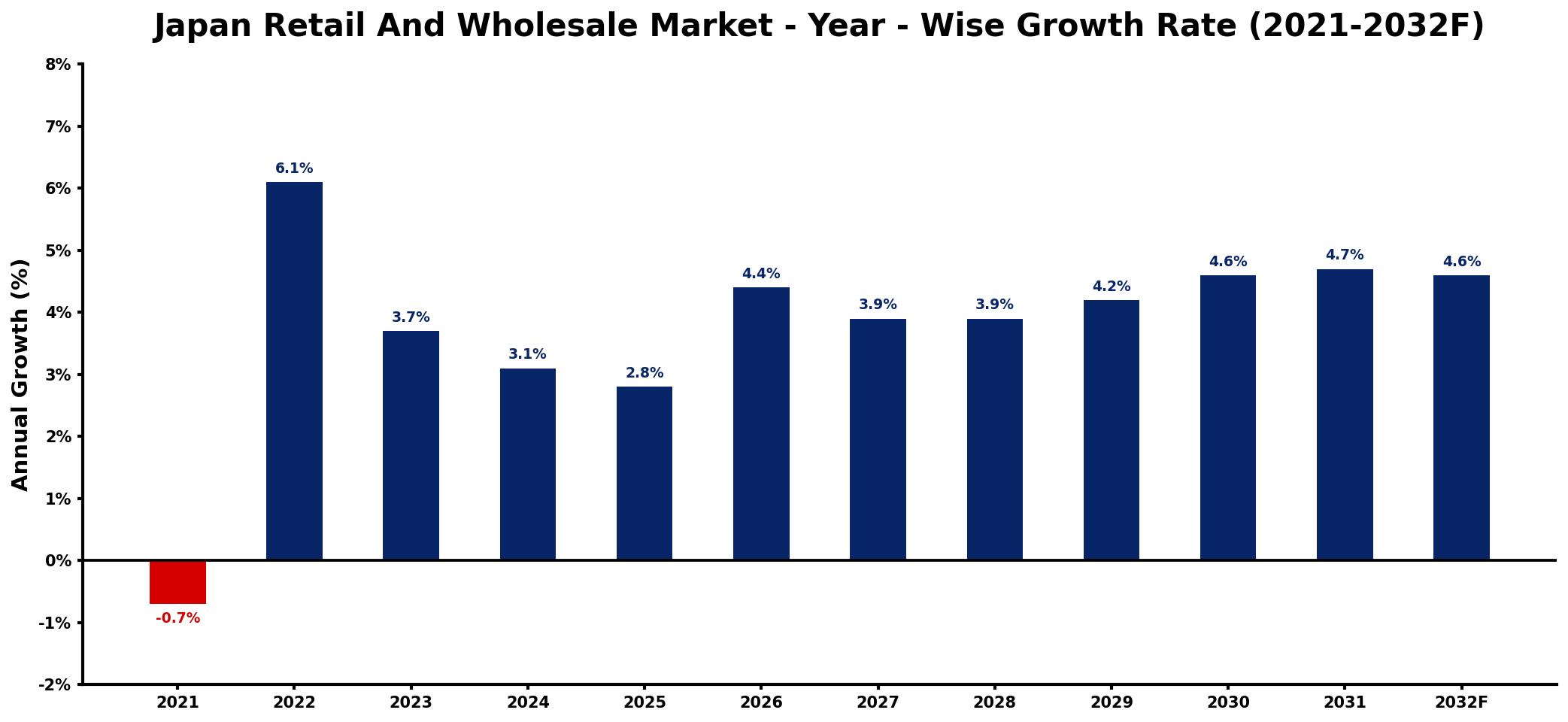
The table below presents the year‑wise growth rates along with the key drivers influencing the market
| Year | Growth Rate | Major Drivers |
| 2021 | -0.7% | decreased consumer spending patterns |
| 2022 | 6.1% | rising e-commerce platform usage |
| 2023 | 3.7% | increased demand for convenience |
| 2024 | 3.1% | growth in sustainable product offerings |
| 2025 | 2.8% | expansion of omnichannel strategies |
| 2026 | 4.4% | investment in digital transformation |
| 2027 | 3.9% | enhanced supply chain efficiencies |
| 2028 | 3.9% | increased focus on personalization |
| 2029 | 4.2% | growing popularity of local brands |
| 2030 | 4.6% | surge in experiential shopping trends |
| 2031 | 4.7% | enhanced customer loyalty programs |
| 2032 | 4.6% | growing emerging market penetration |
Note: Market size estimations and growth projections presented in this report are based on 6Wresearch's proprietary forecasting methodology, utilizing the latest available industry data, government publications, and primary research inputs.
Japan Retail And Wholesale Market Synopsis
The Japan Retail and Wholesale Market has displayed remarkable resilience, navigating through traditional sales channels while adapting to the rapid rise of digital platforms. While brick-and-mortar establishments continue to thrive, the shift toward e-commerce and omni-channel strategies reflects a significant transformation in consumer behavior.
Looking ahead, the market is expected to experience ongoing evolution, with an increasing emphasis on personalized shopping experiences and technology integration. As consumers demand convenience and sustainability, retailers are compelled to innovate, ensuring they remain competitive in a landscape characterized by both local and international players.
Japan Retail And Wholesale Market Key Takeaways
- The market is set for steady growth, driven by changing consumer preferences and technological advancements.
- There is a strong focus on omni-channel retailing, merging physical and digital shopping experiences seamlessly.
- Sustainability and ethical consumption are becoming critical factors influencing purchasing decisions.
- The presence of international retailers is intensifying competition, leading to a wider array of product offerings.
- Investment opportunities abound in e-commerce, luxury goods, and specialty retail sectors.
Evaluation of Restraints in Japan Retail And Wholesale Market
Despite its dynamic landscape, the Japan Retail and Wholesale Market faces several significant restraints. Intense competition from both domestic and international retailers creates a saturated environment, where differentiation is crucial for survival. Additionally, the demographic shift towards an aging population is reshaping spending habits, requiring retailers to adapt their strategies to cater to this evolving consumer base. High operating costs, stemming from expensive real estate and labor, present further challenges, compelling businesses to seek innovative solutions to maintain profitability.
Japan Retail And Wholesale Market Trends
Current trends in the Japan Retail and Wholesale Market underscore a transformative shift towards omni-channel retailing. Retailers are increasingly prioritizing seamless integration between physical stores and digital platforms, enhancing the consumer experience. Furthermore, there is a growing demand for health-conscious and eco-friendly products, prompting retailers to expand their offerings in these areas. Technologies such as AI and data analytics are also playing a pivotal role, helping businesses refine customer engagement strategies and streamline operations.
Japan Retail And Wholesale Market Opportunities
The Japan Retail and Wholesale Market presents lucrative investment opportunities, particularly within the e-commerce sector, which is experiencing exponential growth. Convenience stores, or "konbini," remain integral to daily life in Japan, representing a stable investment avenue. Additionally, niche markets such as luxury goods and specialty products like organic foods and cosmetics are rapidly gaining traction, reflecting shifting consumer interests towards quality and sustainability. Investors have ample prospects to capitalize on the countrys diverse and evolving consumer landscape.
Government Initiatives in the Japan Retail And Wholesale Market
The Japanese government has established several regulations and policies to support the retail and wholesale sectors, balancing market competitiveness with consumer protection. For instance, the Large-Scale Retail Store Law helps safeguard small and medium-sized enterprises from the market dominance of larger retailers. Additionally, consumer rights are protected through the Act on Specified Commercial Transactions, which regulates online commerce. Initiatives promoting e-commerce growth are also being introduced, aiming to foster innovation while ensuring fair competition across the market.
Future Insights of the Japan Retail And Wholesale Market
Looking to the future, the Japan Retail and Wholesale Market is poised for continued growth and innovation. Factors such as a robust economy and a tech-savvy consumer base are expected to propel market expansion, especially in the realms of e-commerce and premium product offerings. As retailers increasingly focus on customer experience and sustainability, the industry will likely witness a deeper integration of advanced technologies, setting the stage for a new era of retail.
Japan Retail And Wholesale Market Latest Developments (2025 - 2026)
In recent months, the Japan Retail and Wholesale Market has seen notable shifts towards enhanced digital retail strategies. Companies are increasingly adopting advanced technology solutions to streamline operations and improve customer engagement. There has also been a significant uptick in sustainable product offerings as consumer demand for ethical consumption continues to rise. Furthermore, collaboration between traditional retailers and tech companies is becoming more common, illustrating the growing recognition of technologys vital role in modern retail.
Japan Retail And Wholesale Market - Key Attractiveness of the Report
- 10 Years of Market Numbers
- Historical Data Starting from 2022 to 2025
- Base Year: 2025
- Forecast Data until 2032
- Key Performance Indicators Impacting the Market
- Major Upcoming Developments and Projects
Key Highlights of the Report:
- Japan Retail And Wholesale Market Outlook
- Market Size of Japan Retail And Wholesale Market, 2025
- Forecast of Japan Retail And Wholesale Market, 2032
- Historical Data and Forecast of Japan Retail And Wholesale Revenues & Volume for the Period 2022-2032F
- Japan Retail And Wholesale Market Trend Evolution
- Japan Retail And Wholesale Market Drivers and Challenges
- Japan Retail And Wholesale Price Trends
- Japan Retail And Wholesale Porter's Five Forces
- Japan Retail And Wholesale Industry Life Cycle
- Historical Data and Forecast of Japan Retail And Wholesale Market Revenues & Volume By Type for the Period 2022-2032F
- Historical Data and Forecast of Japan Retail And Wholesale Market Revenues & Volume By Retail for the Period 2022-2032F
- Historical Data and Forecast of Japan Retail And Wholesale Market Revenues & Volume By Wholesale for the Period 2022-2032F
- Historical Data and Forecast of Japan Retail And Wholesale Market Revenues & Volume By Ownership for the Period 2022-2032F
- Historical Data and Forecast of Japan Retail And Wholesale Market Revenues & Volume By Retail Chain/Wholesale Chain for the Period 2022-2032F
- Historical Data and Forecast of Japan Retail And Wholesale Market Revenues & Volume By Independent Retailer/Independent Wholesalers for the Period 2022-2032F
- Historical Data and Forecast of Japan Retail And Wholesale Market Revenues & Volume By Price Range for the Period 2022-2032F
- Historical Data and Forecast of Japan Retail And Wholesale Market Revenues & Volume By Premium for the Period 2022-2032F
- Historical Data and Forecast of Japan Retail And Wholesale Market Revenues & Volume By Mid-Range for the Period 2022-2032F
- Historical Data and Forecast of Japan Retail And Wholesale Market Revenues & Volume By Economy for the Period 2022-2032F
- Historical Data and Forecast of Japan Retail And Wholesale Market Revenues & Volume By Distribution Channel for the Period 2022-2032F
- Historical Data and Forecast of Japan Retail And Wholesale Market Revenues & Volume By Supermarkets/Hypermarkets for the Period 2022-2032F
- Historical Data and Forecast of Japan Retail And Wholesale Market Revenues & Volume By Convenience Stores for the Period 2022-2032F
- Historical Data and Forecast of Japan Retail And Wholesale Market Revenues & Volume By Department Stores for the Period 2022-2032F
- Historical Data and Forecast of Japan Retail And Wholesale Market Revenues & Volume By Specialty Stores for the Period 2022-2032F
- Japan Retail And Wholesale Import Export Trade Statistics
- Market Opportunity Assessment By Type
- Market Opportunity Assessment By Ownership
- Market Opportunity Assessment By Price Range
- Market Opportunity Assessment By Distribution Channel
- Japan Retail And Wholesale Top Companies Market Share
- Japan Retail And Wholesale Competitive Benchmarking By Technical and Operational Parameters
- Japan Retail And Wholesale Company Profiles
- Japan Retail And Wholesale Key Strategic Recommendations






































