Japan Smart Building Market Size, Share & Growth Rate
The Japan Smart Building Market was estimated at USD 116 Million in 2025 and is projected to reach USD 137 Million by 2032, growing at a CAGR of 2.4% from 2026 to 2032. This growth trajectory is underpinned by a surge in urbanization and technological innovation, with smart building solutions increasingly seen as essential in creating energy-efficient and sustainable environments. The Japanese governments focus on promoting smart city initiatives is further accelerating the market's development.
Japan Smart Building Market Year-wise Growth Rate and Key Drivers
This graph highlights how the Japan Smart Building Market has steadily grown over the years, supported by major growth factors.
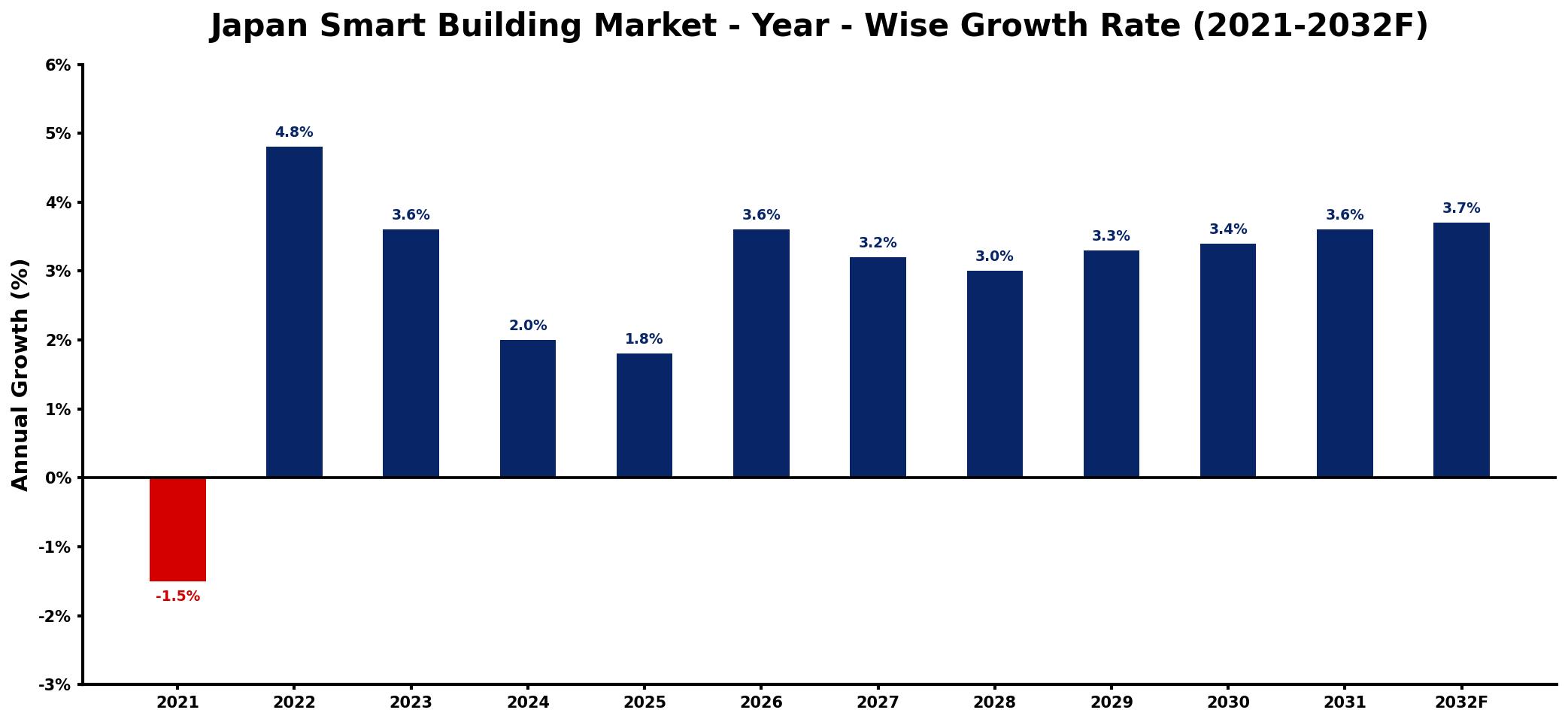
The table below presents the year‑wise growth rates along with the key drivers influencing the market
| Year | Growth Rate | Major Drivers |
| 2021 | -1.5% | decreased corporate investments in technology |
| 2022 | 4.8% | increased demand for automation solutions |
| 2023 | 3.6% | growth in renewable energy adoption |
| 2024 | 2.0% | expansion of IoT technology applications |
| 2025 | 1.8% | rise in energy efficiency initiatives |
| 2026 | 3.6% | increased focus on sustainability practices |
| 2027 | 3.2% | growing urbanization and infrastructure needs |
| 2028 | 3.0% | enhanced security system implementations |
| 2029 | 3.3% | strengthening international trade flows |
| 2030 | 3.4% | improved processing technologies adoption |
| 2031 | 3.6% | increased collaboration among industries |
| 2032 | 3.7% | strengthening underlying market demand |
Note: Market size estimations and growth projections presented in this report are based on 6Wresearch's proprietary forecasting methodology, utilizing the latest available industry data, government publications, and primary research inputs.
Japan Smart Building Market Synopsis
The primary force shaping the Japan Smart Building Market is the confluence of rapid urbanization and a deepening commitment to sustainability. This trend has led to the widespread adoption of smart building technologies that enhance operational efficiency, lower energy consumption, and significantly improve occupant comfort.
Alongside urban expansion, technological advancements, such as the Internet of Things (IoT) and artificial intelligence (AI), are reshaping the architectural landscape in Japan. These innovations are not only optimizing building operations but also aligning with governmental policies focused on energy efficiency and environmental stewardship.
Japan Smart Building Market Key Takeaways
- The market is fueled by increasing urbanization and a strong push for sustainability in building practices.
- Investment in IoT technology and smart energy management systems is on the rise among developers.
- Government initiatives are fostering an environment conducive to smart city developments.
- Adoption of AI and machine learning for predictive maintenance is gaining momentum.
- The market faces challenges related to high initial investment costs and a shortage of skilled professionals.
Evaluation of Restraints in Japan Smart Building Market
Despite its growth potential, the Japan Smart Building Market is hindered by significant constraints. The high initial investment required for adopting advanced smart technologies poses a barrier for many stakeholders, particularly smaller developers and businesses. Furthermore, the lack of standardized regulations creates uncertainty in the market, making it difficult for investors to navigate. Additionally, there is a pronounced shortage of professionals with the requisite skills for designing, implementing, and maintaining smart building systems, which impedes the widespread adoption of these technologies.
Japan Smart Building Market Trends
Current trends in the Japan Smart Building Market illustrate a growing inclination towards integrating IoT solutions to enhance energy efficiency and operational effectiveness. The emphasis on sustainability is driving interest in energy-saving technologies and eco-friendly materials. Moreover, the integration of AI and machine learning for building optimization and predictive maintenance is gaining traction, enabling owners to streamline operations and reduce costs while enhancing the overall user experience.
Japan Smart Building Market Opportunities
The Japan Smart Building Market presents notable investment opportunities, particularly in smart energy management solutions. IoT-enabled systems for real-time energy monitoring are attractive to investors looking to capitalize on the push for sustainability. Additionally, smart building automation systems that enhance operational efficiency and occupant comfort are pivotal areas for investment. With increasing government incentives and a shift towards integrated smart building platforms, stakeholders can leverage these trends for long-term growth.
Government Initiatives in the Japan Smart Building Market
The Japanese government is actively promoting energy efficiency and technological innovation within the Smart Building Market. Initiatives such as the Cool Japan initiative and the Building Energy Efficiency Labeling Program are designed to encourage the implementation of smart technologies. Financial incentives and subsidies are available to support businesses and building owners in adopting these solutions, fostering a conducive environment for the growth of smart buildings throughout the country.
Future Insights of the Japan Smart Building Market
Looking ahead to 2026-2032, the Japan Smart Building Market is poised for significant expansion. Factors driving this trajectory include rapid urbanization, heightened awareness of sustainability, and the adoption of advanced technologies such as IoT and AI. As more buildings begin to integrate smart technologies in response to infrastructure demands and environmental concerns, the market is likely to evolve toward more efficient and sophisticated solutions, creating new avenues for innovation and growth.
Japan Smart Building Market Latest Developments (2025 - 2026)
Recent developments in the Japan Smart Building Market highlight a continued shift towards integrating advanced technologies. Companies are increasingly focusing on creating smart automation systems that enhance energy efficiency while improving occupant experience. Additionally, there is a noticeable uptick in collaborations between technology firms and real estate developers to drive innovation in building management systems. The market is also seeing greater emphasis on sustainability practices, aligning with global trends toward eco-friendly construction.
Japan Smart Building Market - Key Attractiveness of the Report
- 10 Years of Market Numbers
- Historical Data Starting from 2022 to 2025
- Base Year: 2025
- Forecast Data until 2032
- Key Performance Indicators Impacting the Market
- Major Upcoming Developments and Projects
Key Highlights of the Report:
- Japan Smart Building Market Outlook
- Market Size of Japan Smart Building Market, 2025
- Forecast of Japan Smart Building Market, 2032
- Historical Data and Forecast of Japan Smart Building Revenues & Volume for the Period 2022-2032F
- Japan Smart Building Market Trend Evolution
- Japan Smart Building Market Drivers and Challenges
- Japan Smart Building Price Trends
- Japan Smart Building Porter's Five Forces
- Japan Smart Building Industry Life Cycle
- Historical Data and Forecast of Japan Smart Building Market Revenues & Volume By Component for the Period 2022-2032F
- Historical Data and Forecast of Japan Smart Building Market Revenues & Volume By Solution for the Period 2022-2032F
- Historical Data and Forecast of Japan Smart Building Market Revenues & Volume By Services for the Period 2022-2032F
- Historical Data and Forecast of Japan Smart Building Market Revenues & Volume By Application for the Period 2022-2032F
- Historical Data and Forecast of Japan Smart Building Market Revenues & Volume By Residential for the Period 2022-2032F
- Historical Data and Forecast of Japan Smart Building Market Revenues & Volume By Commercial for the Period 2022-2032F
- Japan Smart Building Import Export Trade Statistics
- Market Opportunity Assessment By Component
- Market Opportunity Assessment By Application
- Japan Smart Building Top Companies Market Share
- Japan Smart Building Competitive Benchmarking By Technical and Operational Parameters
- Japan Smart Building Company Profiles
- Japan Smart Building Key Strategic Recommendations






































