Japan Soft Drinks Packaging Market Size, Share & Growth Rate
The Japan Soft Drinks Packaging Market was estimated at USD 140 Million in 2025 and is projected to reach USD 150 Million by 2032, growing at a CAGR of 1.0% from 2026 to 2032. This growth trajectory is primarily driven by a surge in demand for sustainable packaging solutions, reflecting heightened consumer awareness of environmental issues. Additionally, the trend toward convenience packaging formats aligns perfectly with evolving consumer lifestyles, ensuring that manufacturers remain competitive in this dynamic landscape.
Japan Soft Drinks Packaging Market Year-wise Growth Rate and Key Drivers
This graph highlights how the Japan Soft Drinks Packaging Market has steadily grown over the years, supported by major growth factors.
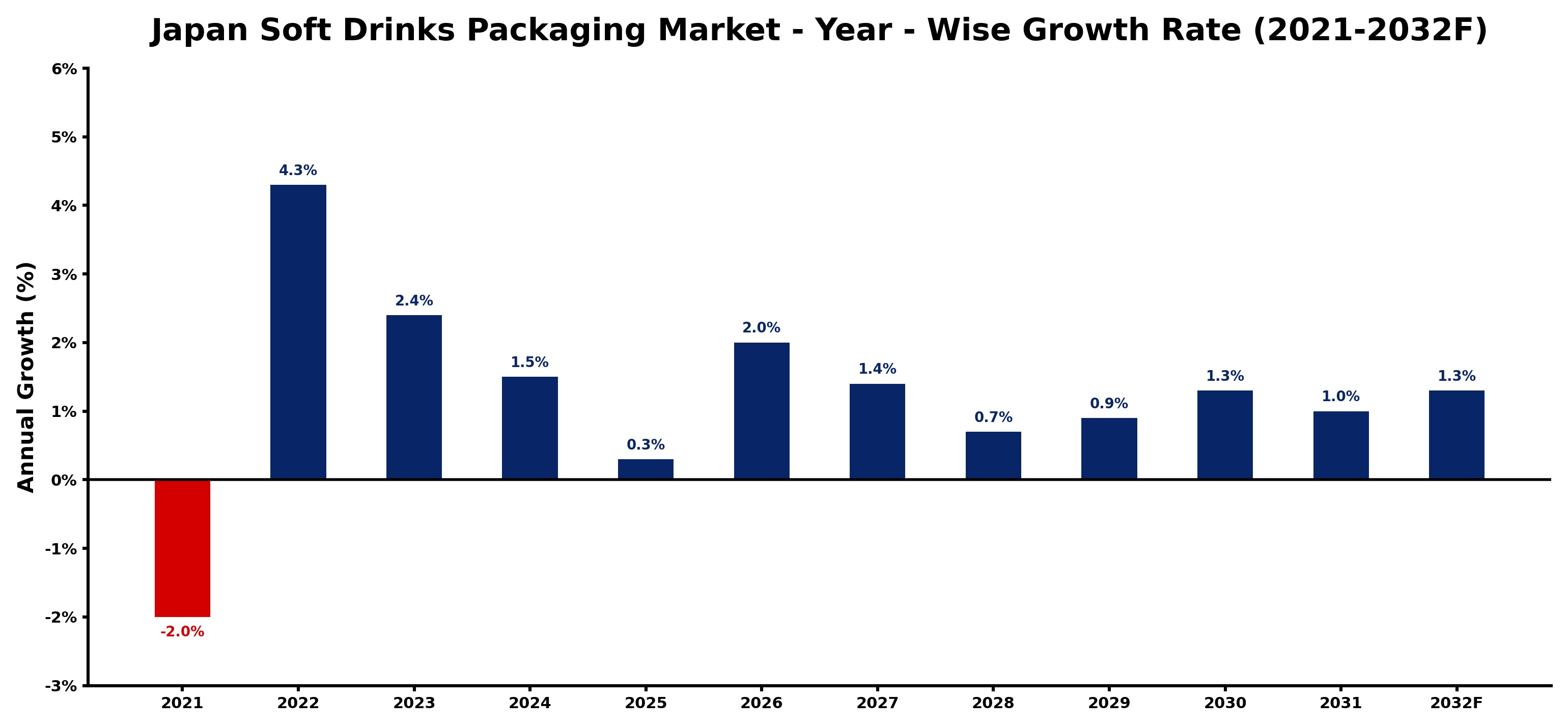
The table below presents the year‑wise growth rates along with the key drivers influencing the market
| Year | Growth Rate | Major Drivers |
| 2021 | -2.0% | Consumer spending decreased significantly |
| 2022 | 4.3% | Sustainability trends enhanced packaging |
| 2023 | 2.4% | Innovative designs attracted consumers |
| 2024 | 1.5% | Health-conscious choices drove demand |
| 2025 | 0.3% | E-commerce growth expanded reach |
| 2026 | 2.0% | Functional beverages gained popularity |
| 2027 | 1.4% | Local sourcing improved brand loyalty |
| 2028 | 0.7% | Convenience packaging attracted consumers |
| 2029 | 0.9% | Customization options increased sales |
| 2030 | 1.3% | Collaborations enhanced product offerings |
| 2031 | 1.0% | Technology integration improved efficiency |
| 2032 | 1.3% | Brand storytelling engaged customers |
Note - Market size estimations and growth projections presented in this report are based on 6Wresearch’s advanced forecasting approach, validated with industry datasets as of June 2026.
Japan Soft Drinks Packaging Market Synopsis
Sustainability is the most significant force reshaping the Japan Soft Drinks Packaging Market. As public awareness of environmental challenges grows, both consumers and companies are increasingly prioritizing eco-friendly packaging solutions. This shift is prompting soft drink manufacturers to innovate their packaging strategies to minimize plastic waste and utilize more sustainable materials.
Furthermore, the market is experiencing a noticeable increase in demand for portable packaging options. With the rise of on-the-go consumption habits, packaging formats like smaller cans and lightweight pouches are gaining traction among consumers, reinforcing the need for manufacturers to adapt quickly to these evolving preferences.
Japan Soft Drinks Packaging Market Key Takeaways
- The Japan Soft Drinks Packaging Market is projected to grow steadily due to rising consumer demand for convenience and sustainability.
- Innovations in packaging technologies are driving new solutions that enhance product freshness and consumer engagement.
- Government policies encouraging eco-friendly practices are further influencing market dynamics.
- Companies are increasingly investing in research and development to create attractive, functional packaging designs.
- Collaboration with soft drink manufacturers is key to developing customized solutions that enhance brand visibility.
Evaluation of Restraints in Japan Soft Drinks Packaging Market
While the Japan Soft Drinks Packaging Market is poised for growth, several restraints could impede its full potential. The urgent need for sustainable packaging options is placing significant pressure on manufacturers to revise their current practices. Balancing the demand for eco-friendly materials with the challenges of maintaining product integrity, cost-effectiveness, and compliance with regulatory standards is no easy feat. Additionally, the competitive nature of the market necessitates that companies continuously innovate, further complicating their ability to meet changing consumer demands without incurring additional costs.
Japan Soft Drinks Packaging Market Trends
The market is increasingly leaning towards sustainable packaging solutions, with a noticeable uptick in the use of recyclable PET bottles and biodegradable materials. This transition is a direct response to rising consumer awareness and regulatory pressures aimed at reducing plastic waste. Additionally, smaller, single-serve packaging formats are on the rise, driven by consumer lifestyles favoring convenience. Innovations in smart packaging technology are also coming to the forefront, enhancing product preservation and consumer interaction.
Japan Soft Drinks Packaging Market Opportunities
A wealth of investment opportunities exists in the Japan Soft Drinks Packaging Market, particularly in sustainable packaging solutions. Companies that prioritize the development of biodegradable and recyclable materials are well-positioned to capture the market's evolving landscape. The demand for on-the-go packaging formats further offers avenues for growth, with potential for innovations that focus on functionality and consumer appeal. Strategic partnerships with manufacturers to develop customized packaging can also provide significant competitive advantages.
Government Initiatives in the Japan Soft Drinks Packaging Market
The Japanese government has implemented several policies aimed at enhancing sustainability within the soft drinks packaging sector. Initiatives such as the Plastic Resource Recycling Strategy emphasize innovation in recycling technologies and encourage the use of recycled materials in packaging. The government has also set ambitious targets for increasing PET bottle collection and recycling rates, alongside regulatory measures promoting the adoption of eco-friendly packaging materials. These initiatives reflect a robust commitment to mitigating environmental impact and fostering sustainable practices in the industry.
Future Insights of the Japan Soft Drinks Packaging Market
Looking ahead to 2026-2032, the Japan Soft Drinks Packaging Market is expected to continue its steady growth trajectory. The focus will likely remain on developing sustainable and convenient packaging options, with manufacturers investing in recyclable and lightweight designs to minimize environmental impact. Innovations such as smart packaging will further enhance consumer engagement and product preservation. With increasing emphasis on health and wellness, the demand for functional packaging that extends shelf life is also expected to rise, shaping the future direction of the market.
Japan Soft Drinks Packaging Market Latest Developments (May 2025 - June 2026)
In recent months, the Japan Soft Drinks Packaging Market has witnessed a wave of innovations aimed at sustainability and convenience. Companies are exploring novel materials and designs to enhance product functionality while reducing environmental impact. Collaboration among manufacturers and packaging suppliers is becoming more common as stakeholders seek to meet regulatory standards and consumer expectations efficiently. These developments signal a promising trajectory for the market as it adapts to evolving demands.
Japan Soft Drinks Packaging Market - Key Attractiveness of the Report
- 10 Years of Market Numbers
- Historical Data Starting from 2022 to 2025
- Base Year: 2025
- Forecast Data until 2032
- Key Performance Indicators Impacting the Market
- Major Upcoming Developments and Projects
Key Highlights of the Report:
- Japan Soft Drinks Packaging Market Outlook
- Market Size of Japan Soft Drinks Packaging Market, 2025
- Forecast of Japan Soft Drinks Packaging Market, 2032
- Historical Data and Forecast of Japan Soft Drinks Packaging Revenues & Volume for the Period 2022-2032F
- Japan Soft Drinks Packaging Market Trend Evolution
- Japan Soft Drinks Packaging Market Drivers and Challenges
- Japan Soft Drinks Packaging Price Trends
- Japan Soft Drinks Packaging Porter's Five Forces
- Japan Soft Drinks Packaging Industry Life Cycle
- Historical Data and Forecast of Japan Soft Drinks Packaging Market Revenues & Volume By Material for the Period 2022-2032F
- Historical Data and Forecast of Japan Soft Drinks Packaging Market Revenues & Volume By Paper for the Period 2022-2032F
- Historical Data and Forecast of Japan Soft Drinks Packaging Market Revenues & Volume By Plastic for the Period 2022-2032F
- Historical Data and Forecast of Japan Soft Drinks Packaging Market Revenues & Volume By Metal for the Period 2022-2032F
- Historical Data and Forecast of Japan Soft Drinks Packaging Market Revenues & Volume By Glass for the Period 2022-2032F
- Historical Data and Forecast of Japan Soft Drinks Packaging Market Revenues & Volume By for the Period 2022-2032F
- Historical Data and Forecast of Japan Soft Drinks Packaging Market Revenues & Volume By for the Period 2022-2032F
- Historical Data and Forecast of Japan Soft Drinks Packaging Market Revenues & Volume By Product Type for the Period 2022-2032F
- Historical Data and Forecast of Japan Soft Drinks Packaging Market Revenues & Volume By Cans for the Period 2022-2032F
- Historical Data and Forecast of Japan Soft Drinks Packaging Market Revenues & Volume By Boxes for the Period 2022-2032F
- Historical Data and Forecast of Japan Soft Drinks Packaging Market Revenues & Volume By Bottles for the Period 2022-2032F
- Historical Data and Forecast of Japan Soft Drinks Packaging Market Revenues & Volume By Cartons for the Period 2022-2032F
- Historical Data and Forecast of Japan Soft Drinks Packaging Market Revenues & Volume By for the Period 2022-2032F
- Historical Data and Forecast of Japan Soft Drinks Packaging Market Revenues & Volume By for the Period 2022-2032F
- Historical Data and Forecast of Japan Soft Drinks Packaging Market Revenues & Volume By Capacity for the Period 2022-2032F
- Historical Data and Forecast of Japan Soft Drinks Packaging Market Revenues & Volume By Up to 100 ml for the Period 2022-2032F
- Historical Data and Forecast of Japan Soft Drinks Packaging Market Revenues & Volume By 100 to 250 ml for the Period 2022-2032F
- Historical Data and Forecast of Japan Soft Drinks Packaging Market Revenues & Volume By 250 to 500 ml for the Period 2022-2032F
- Historical Data and Forecast of Japan Soft Drinks Packaging Market Revenues & Volume By 500 to 1000 ml for the Period 2022-2032F
- Historical Data and Forecast of Japan Soft Drinks Packaging Market Revenues & Volume By 1000 to 2000 ml for the Period 2022-2032F
- Historical Data and Forecast of Japan Soft Drinks Packaging Market Revenues & Volume By Above 2000 ml for the Period 2022-2032F
- Historical Data and Forecast of Japan Soft Drinks Packaging Market Revenues & Volume By Application for the Period 2022-2032F
- Historical Data and Forecast of Japan Soft Drinks Packaging Market Revenues & Volume By Carbonated soft drinks for the Period 2022-2032F
- Historical Data and Forecast of Japan Soft Drinks Packaging Market Revenues & Volume By Functional Drinks for the Period 2022-2032F
- Historical Data and Forecast of Japan Soft Drinks Packaging Market Revenues & Volume By Sport Drinks for the Period 2022-2032F
- Historical Data and Forecast of Japan Soft Drinks Packaging Market Revenues & Volume By Energy Drinks for the Period 2022-2032F
- Historical Data and Forecast of Japan Soft Drinks Packaging Market Revenues & Volume By Others for the Period 2022-2032F
- Historical Data and Forecast of Japan Soft Drinks Packaging Market Revenues & Volume By Juices for the Period 2022-2032F
- Japan Soft Drinks Packaging Import Export Trade Statistics
- Market Opportunity Assessment By Material
- Market Opportunity Assessment By Product Type
- Market Opportunity Assessment By Capacity
- Market Opportunity Assessment By Application
- Japan Soft Drinks Packaging Top Companies Market Share
- Japan Soft Drinks Packaging Competitive Benchmarking By Technical and Operational Parameters
- Japan Soft Drinks Packaging Company Profiles
- Japan Soft Drinks Packaging Key Strategic Recommendations






































