Japan Stainless Steel Market Import Shipment by Countries (Top 5) & Competition (HHI)
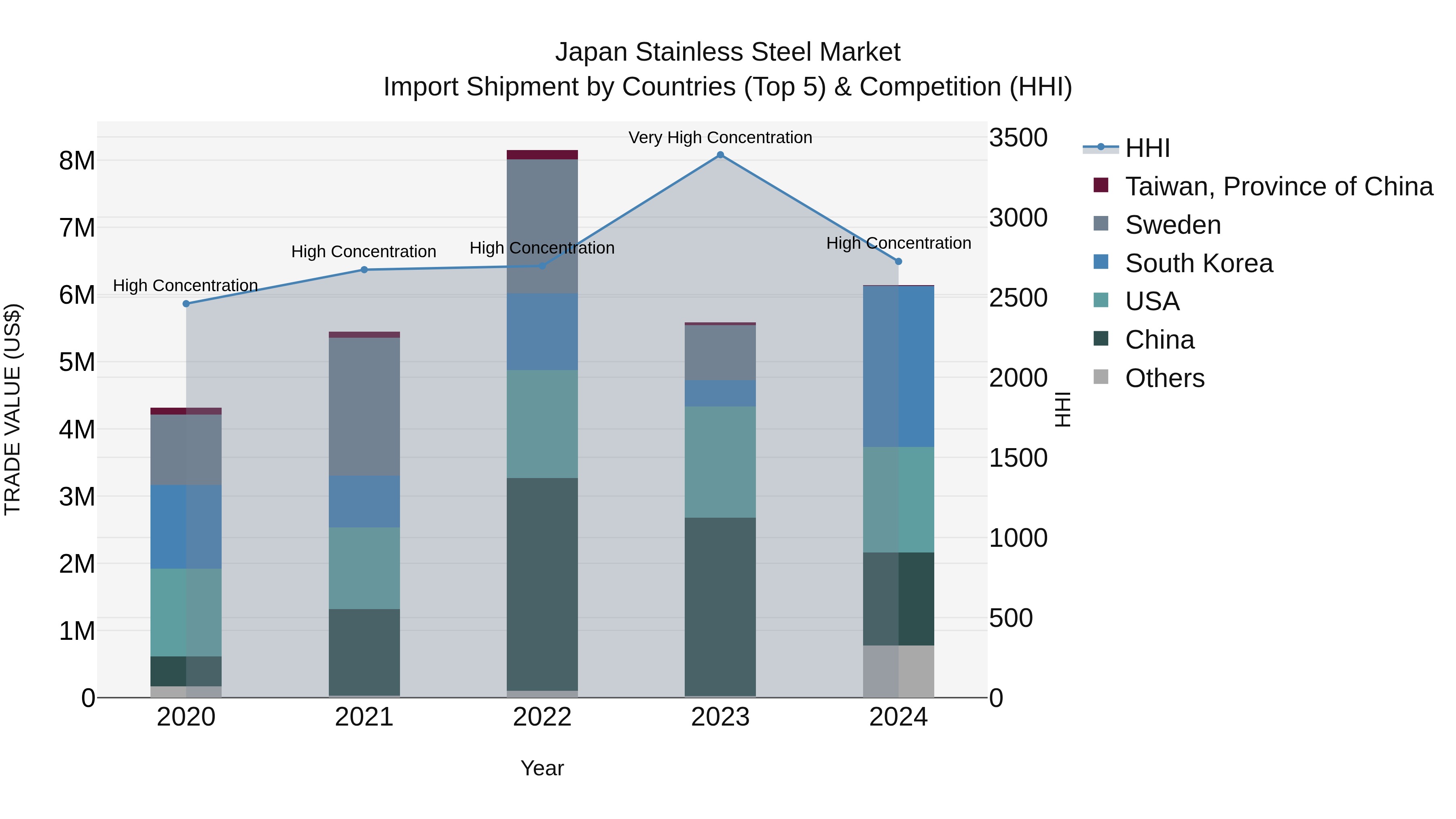
Japan's stainless steel import market in 2024 saw significant growth, with South Korea, USA, China, Italy, and Austria emerging as the top exporting countries. The market concentration, as measured by the HHI, remained high in 2024 after a very high concentration in the previous year. The compound annual growth rate (CAGR) from 2020 to 2024 stood at an impressive 9.22%, with a notable growth rate of 9.89% from 2023 to 2024. This data suggests a robust and dynamic market for stainless steel imports in Japan, driven by key players from around the globe.
Japan Stainless Steel Market Synopsis
The Japan stainless steel market is characterized by a strong demand across various industries such as automotive, construction, electronics, and machinery. The country is a major producer and consumer of stainless steel, with a significant portion of its production being exported to global markets. The market is driven by factors such as the growing infrastructure development projects, increasing demand for high-quality steel products in the automotive sector, and technological advancements in stainless steel production processes. Key players in the Japanese stainless steel market include Nippon Steel Corporation, JFE Steel Corporation, and Kobe Steel Ltd. The market is expected to witness steady growth in the coming years, supported by ongoing industrialization and urbanization trends in the country.
Japan Stainless Steel Market Trends
The Japan Stainless Steel Market is experiencing several key trends. One prominent trend is the increasing demand for stainless steel in the automotive sector, driven by the growing focus on lightweight materials for improved fuel efficiency and sustainability. Additionally, there is a rising preference for stainless steel in the construction industry due to its durability, corrosion resistance, and aesthetic appeal. Another notable trend is the shift towards higher grade stainless steel products, particularly in the food and beverage sector, as consumers become more conscious about product safety and hygiene. Moreover, advancements in technology and production processes are leading to the development of innovative stainless steel products with enhanced properties, further driving market growth. Overall, these trends indicate a positive outlook for the Japan Stainless Steel Market with opportunities for expansion and innovation.
Japan Stainless Steel Market Challenges
The Japan Stainless Steel Market faces several challenges, including fluctuating raw material prices, intense competition from global manufacturers, and the impact of economic uncertainties on demand. The market is also affected by changing trade policies and regulations, which can disrupt supply chains and increase costs for manufacturers. Additionally, Japanese stainless steel producers must continuously innovate and invest in research and development to stay competitive in the market. Meeting stringent quality standards and environmental regulations further add to the challenges faced by players in the Japan Stainless Steel Market. Overall, navigating these challenges requires strategic planning, strong market knowledge, and the ability to adapt quickly to changing market conditions.
Japan Stainless Steel Market Investment Opportunities
Investment opportunities in the Japan Stainless Steel Market include the growing demand for stainless steel in various industries such as automotive, construction, and electronics. With Japan being a major exporter of stainless steel products, there is potential for investors to capitalize on the country`s strong manufacturing capabilities and technological advancements in the stainless steel sector. Additionally, the increasing focus on sustainability and environmental regulations is driving the shift towards stainless steel, which is known for its durability and recyclability. Investing in companies involved in stainless steel production, distribution, or research and development could prove lucrative as the market continues to expand and innovate. Overall, the Japan Stainless Steel Market offers diverse investment prospects for those looking to benefit from the industry`s growth and potential.
Jordan Agar Market Government Policies
The Japanese government has implemented various policies to support the stainless steel market, aiming to enhance domestic production, ensure quality standards, and promote sustainable growth. These policies include providing subsidies and incentives for research and development in stainless steel technology, offering financial support for stainless steel manufacturers to improve production efficiency and reduce environmental impact, and implementing trade regulations to protect domestic producers from unfair competition. Additionally, the government has established industry associations and quality control measures to maintain high standards in the production and distribution of stainless steel products. Overall, these policies aim to strengthen the competitiveness of the Japanese stainless steel market, foster innovation, and ensure sustainable development in the industry.
Japan Stainless Steel Market Future Outlook
The Japan Stainless Steel Market is expected to witness steady growth in the coming years, driven by increasing demand from key end-use industries such as automotive, construction, and electronics. The government`s focus on infrastructure development and investments in advanced manufacturing technologies are also anticipated to support market growth. Additionally, rising awareness about the benefits of stainless steel, such as durability, corrosion resistance, and sustainability, is likely to boost its adoption across various applications. However, challenges such as fluctuations in raw material prices and competition from alternative materials may hinder market expansion. Overall, with ongoing technological advancements and evolving consumer preferences, the Japan Stainless Steel Market is poised for sustained growth and innovation in the foreseeable future.
Key Highlights of the Report:
- Japan Stainless Steel Market Outlook
- Market Size of Japan Stainless Steel Market, 2021
- Forecast of Japan Stainless Steel Market, 2031
- Historical Data and Forecast of Japan Stainless Steel Revenues & Volume for the Period 2018 - 2031
- Japan Stainless Steel Market Trend Evolution
- Japan Stainless Steel Market Drivers and Challenges
- Japan Stainless Steel Price Trends
- Japan Stainless Steel Porter's Five Forces
- Japan Stainless Steel Industry Life Cycle
- Historical Data and Forecast of Japan Stainless Steel Market Revenues & Volume By Product for the Period 2018 - 2031
- Historical Data and Forecast of Japan Stainless Steel Market Revenues & Volume By Long for the Period 2018 - 2031
- Historical Data and Forecast of Japan Stainless Steel Market Revenues & Volume By Flat for the Period 2018 - 2031
- Historical Data and Forecast of Japan Stainless Steel Market Revenues & Volume By Application for the Period 2018 - 2031
- Historical Data and Forecast of Japan Stainless Steel Market Revenues & Volume By Polish finishing for the Period 2018 - 2031
- Historical Data and Forecast of Japan Stainless Steel Market Revenues & Volume By Exhaust system for the Period 2018 - 2031
- Historical Data and Forecast of Japan Stainless Steel Market Revenues & Volume By Surgical instrument for the Period 2018 - 2031
- Historical Data and Forecast of Japan Stainless Steel Market Revenues & Volume By Others for the Period 2018 - 2031
- Historical Data and Forecast of Japan Stainless Steel Market Revenues & Volume By End User for the Period 2018 - 2031
- Historical Data and Forecast of Japan Stainless Steel Market Revenues & Volume By Consumer goods for the Period 2018 - 2031
- Historical Data and Forecast of Japan Stainless Steel Market Revenues & Volume By Automotive for the Period 2018 - 2031
- Historical Data and Forecast of Japan Stainless Steel Market Revenues & Volume By Food & beverage for the Period 2018 - 2031
- Historical Data and Forecast of Japan Stainless Steel Market Revenues & Volume By Oil & gas for the Period 2018 - 2031
- Historical Data and Forecast of Japan Stainless Steel Market Revenues & Volume By Others for the Period 2018 - 2031
- Japan Stainless Steel Import Export Trade Statistics
- Market Opportunity Assessment By Product
- Market Opportunity Assessment By Application
- Market Opportunity Assessment By End User
- Japan Stainless Steel Top Companies Market Share
- Japan Stainless Steel Competitive Benchmarking By Technical and Operational Parameters
- Japan Stainless Steel Company Profiles
- Japan Stainless Steel Key Strategic Recommendations






































