Japan Video Surveillance Market Size & Growth Rate
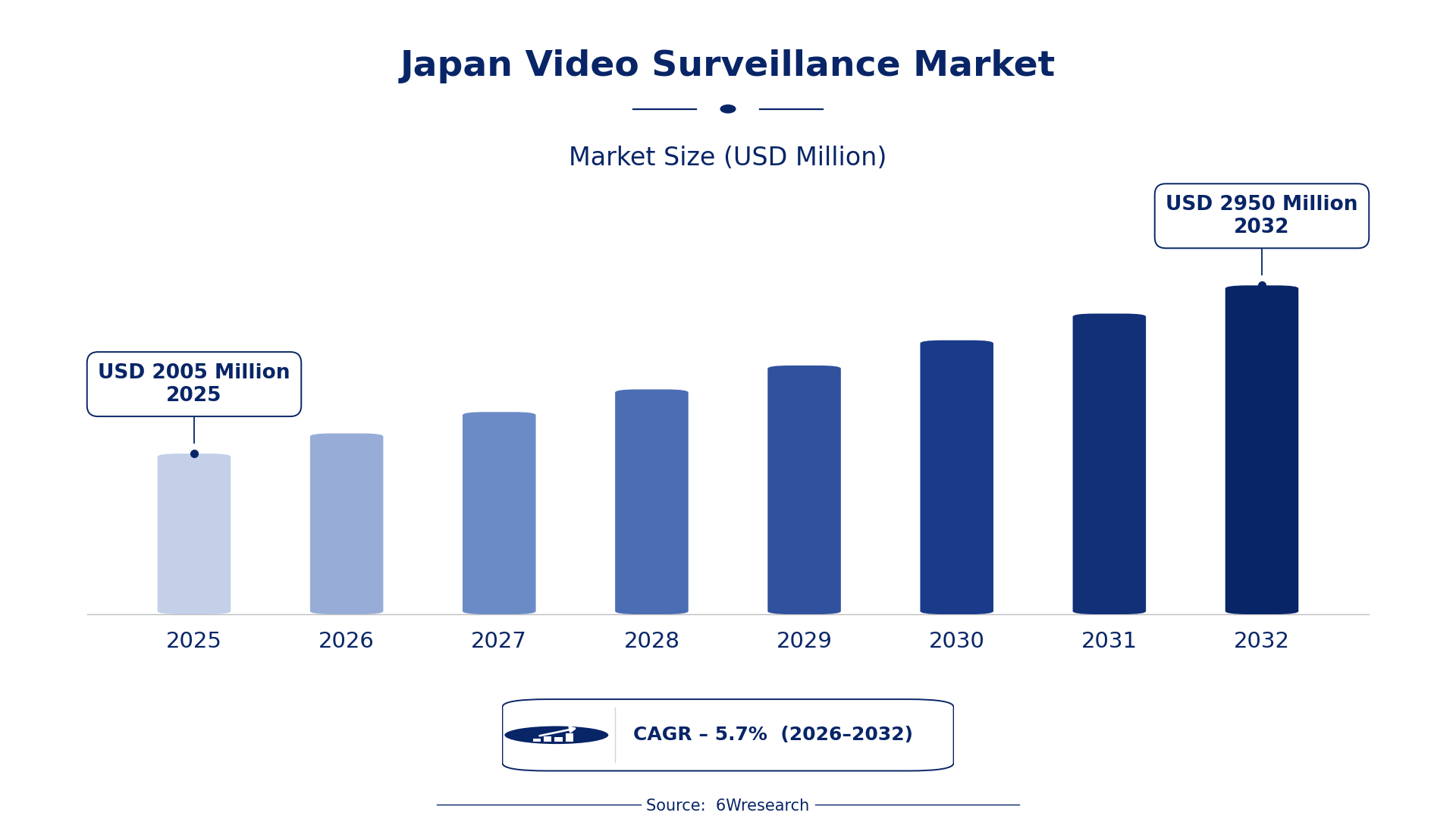
According to 6Wresearch internal database and industry insights, the Japan Video Surveillance Market was valued at USD 2,005 Million in 2025 and is projected to reach USD 2,950 Million by 2032, growing at a CAGR of approximately 5.7% during 2026–2032.
Japan Video Surveillance Market Highlights
| Report Metric | Details |
| Report Name | Japan Video Surveillance Market (2026-2032) |
| Market Size 2025 | USD 2,005 Million |
| Market Size 2032 | USD 2,950 Million |
| Absolute Growth 2025–2032 | USD 945 Million |
| CAGR 2026–2032 | 5.7% |
| Peak Annual Growth | 7.0% in 2026 |
| Forecast Period | 2026–2032 |
| Historical Data | 2022–2025 |
| Base Year | 2025 |
| Leading Offering, 2025 | Hardware (43% share) |
| Leading System, 2025 | Analog Video Surveillance Systems (50% share) |
| Leading Vertical, 2025 | Commercial (47% share) |
| Fastest-Growing Offering | Software (7.8% CAGR) |
| Fastest-Growing System | IP Video Surveillance Systems (7.9% CAGR) |
| Fastest-Growing Vertical | Infrastructure (7.4% CAGR) |
| Growing Sector | Residential |
| Key End Users | Commercial properties, public facilities, residential areas |
Japan Video Surveillance Market Year-wise Growth Rate and Key Drivers (2022–2032)
This graph illustrates the annual growth rates of the market from 2022 to 2032, highlighting a steady upward trajectory and projected market expansion over the forecast period.
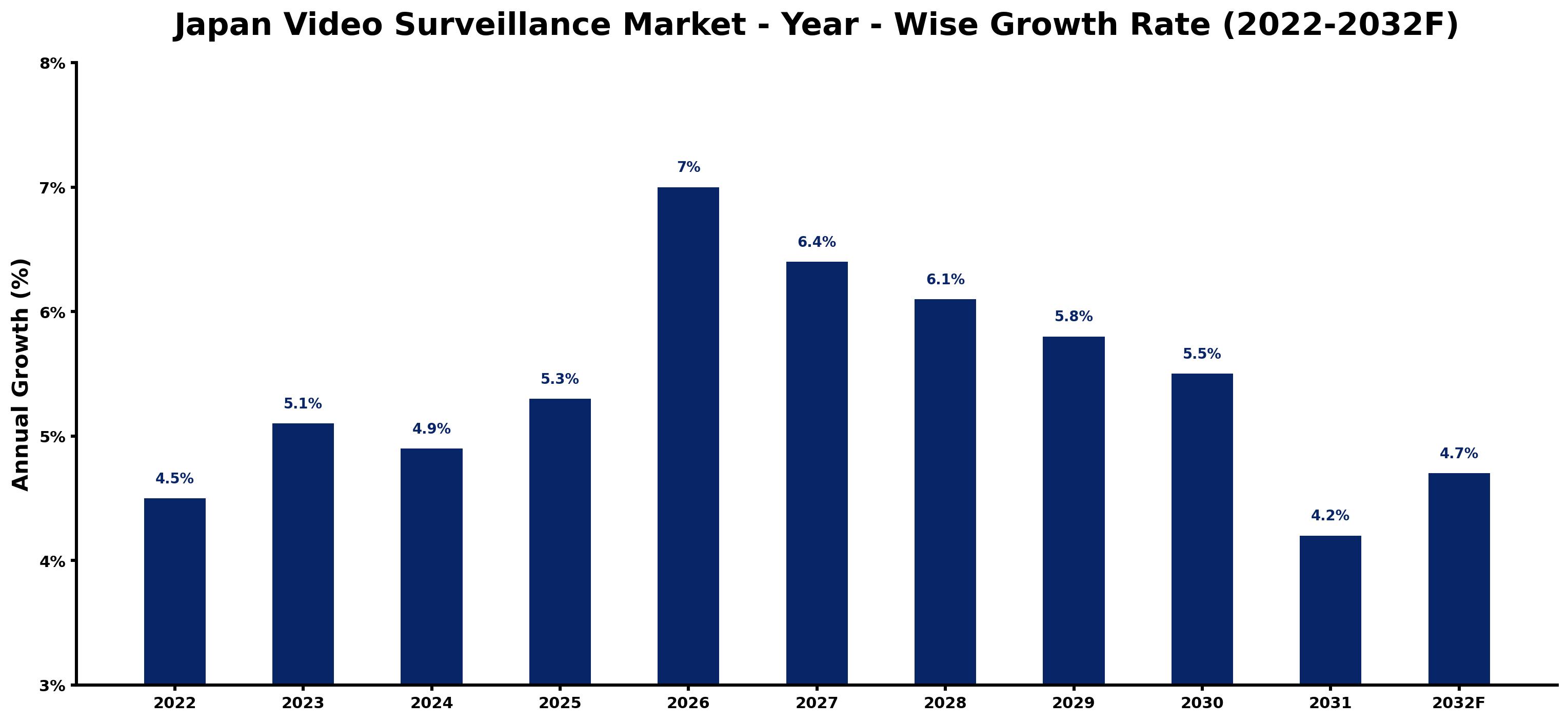
Year by year, the estimates below pair each growth rate with the development that shaped it.
| Year | Estimated Annual Growth (%) | Market Rationale |
| 2022 | 4.5 | The market experienced steady demand driven by urban security needs. |
| 2023 | 5.1 | Growth accelerated due to increased installations in public areas. |
| 2024 | 4.9 | Demand growth slowed as market saturation began to occur. |
| 2025 | 5.3 | The market saw renewed interest with new public safety initiatives. |
| 2026 | 7.0 | Growth peaked as urban areas invested heavily in surveillance systems. |
| 2027 | 6.4 | A slight slowdown occurred as installations reached a saturation point. |
| 2028 | 6.1 | Demand is expected to decelerate as the market stabilises. |
| 2029 | 5.8 | The market will maintain growth, supported by ongoing urbanisation. |
| 2030 | 5.5 | Growth will continue to slow as competition intensifies among providers. |
| 2031 | 4.2 | A continued slowdown is anticipated as the market matures. |
| 2032 | 4.7 | Demand is expected to rise again due to new technology adoption. |
Note: Market size estimations and growth projections presented in this report are based on 6Wresearch's proprietary forecasting methodology, utilizing the latest available industry data, government publications, and primary research inputs.
Japan Video Surveillance Market Synopsis
Video surveillance in Japan utilises advanced imaging technology for monitoring and securing areas, with applications in commercial, public, and residential sectors. The Japan Video Surveillance Market is growing due to rising urban security needs, supported by government initiatives and technological advancements. With over 1 million installed cameras and a projected 15% increase in installations in public areas in 2023, demand stems from public safety efforts and private sector investments in security systems.
Market Dynamics Impact Analysis (2026–2032)
| Factor | Type | Impact | Primary Segment Affected |
| Rising urbanisation and security concerns drive demand for surveillance systems. | Driver | High | Commercial |
| Technological advancements in imaging and analytics enhance system capabilities. | Driver | High | IP Video Surveillance Systems |
| Growing investment in public safety initiatives creates new opportunities for suppliers. | Opportunity | High | Public Facility |
| Increasing adoption of surveillance in residential areas presents a significant market gap. | Opportunity | High | Residential |
| High costs of advanced surveillance systems can limit widespread adoption. | Restraint | Medium | Hardware |
| Market saturation in urban areas may slow growth in certain segments. | Restraint | Medium | IP Video Surveillance Systems |
| Regulatory compliance can be complex and costly for producers. | Challenge | High | Software |
| Competition among providers may lead to price wars affecting profitability. | Challenge | Medium | Commercial |
Evaluation of Drivers in Japan Video Surveillance Market (2026–2032)
The factors lifting demand, and the evidence behind each, are summarised below.
| Drivers | Primary Segment Affected | Why It Matters (Evidence) |
| Increased urban crime rates necessitate security measures. | Commercial | The National Police Agency reported a 15% rise in installations in public areas, prompting businesses to invest in surveillance. |
| Advancements in camera technology improve monitoring capabilities. | IP Video Surveillance Systems | The average resolution of cameras in Japan is now 4K, attracting more buyers seeking improved security. |
| Government initiatives promote public safety through surveillance. | Public Facility | The Tokyo Metropolitan Government allocated ¥500 million for upgrading public facility surveillance systems in 2023. |
| Rising consumer awareness about home security drives demand. | Residential | The residential sector is expected to see a 20% increase in video surveillance adoption by 2025. |
| Integration of surveillance systems in various sectors enhances safety. | Industrial | The Industrial Safety and Health Agency promotes surveillance systems in factories, leading to increased installations. |
Spending rises because urban crime rates have increased, prompting businesses to invest in surveillance systems. Enhanced camera resolutions at 4K attract more buyers seeking better security. The residential sector is anticipated to experience a notable rise in video surveillance adoption as consumers become more aware of home security needs. Increased integration of surveillance systems across various sectors is also contributing to heightened demand.
Evaluation of Restraints in Japan Video Surveillance Market
Below are the constraints most often cited by buyers and suppliers, with the segment each affects.
| Market Restraint | Primary Segment Affected | Why It Matters (Evidence) |
| High costs of advanced surveillance systems can deter purchases. | Hardware | The average cost of a commercial video surveillance system is approximately ¥300,000, which may limit adoption. |
| Market saturation in urban areas may slow growth rates. | IP Video Surveillance Systems | As installations increase, the potential for new sales diminishes in already saturated markets. |
| Regulatory compliance can increase operational costs for software providers. | Software | Compliance with standards like ISO/IEC 27001 requires considerable investment in data security measures. |
| Limited awareness of surveillance benefits in rural areas restricts market expansion. | Residential | Many rural consumers remain unaware of the advantages of video surveillance systems. |
| Competition among providers can lead to price reductions, affecting margins. | Commercial | Intense competition may force companies to lower prices, impacting profitability. |
Japan Video Surveillance Market Challenges
In 2023, buyers face high costs as the average commercial video surveillance system is approximately ¥300,000, limiting their ability to invest in adequate security measures. Regulatory hurdles arise from the need to comply with ISO/IEC 27001, causing installation delays that can extend project timelines by up to six weeks for clinics and hospitals. Technology limitations persist as many systems still rely on outdated analog formats, restricting producers' ability to offer modern features like 4K resolution. Supply chain issues emerge as importers experience unpredictable component availability, leading to order fulfillment delays that impact urban buyers' security readiness.
Trends in the Japan Video Surveillance Market
Several trends are reshaping the Japan Video Surveillance Market; the most important are set out below.
- Expansion of Surveillance in Public Areas: In 2023, the Tokyo Metropolitan Government allocated ¥500 million for enhancing public facility surveillance systems, reflecting a commitment to improving urban safety.
- Transition to 4K Camera Technology: Since 2022, the average resolution of video surveillance cameras has increased to 4K, improving monitoring capabilities. This shift drives demand for higher-quality systems among commercial buyers.
- Rise in Residential Security Adoption: The residential sector is experiencing a notable shift towards video surveillance, with a projected 20% increase in adoption by 2025. This trend is driven by heightened consumer awareness of home security.
- Integration of AI in Surveillance Systems: The AI Promotion Act, established in 2025, encourages the integration of AI technology in surveillance systems. This change is anticipated to improve analytics capabilities, attracting more commercial users.
Investment Opportunities in the Japan Video Surveillance Market
The openings below show where demand in the Japan Video Surveillance Market is visible and how suppliers can enter.
- Urban Areas: With urban areas experiencing high security needs, suppliers can target these regions for growth. Collaborating with local installers can facilitate market entry and expand reach.
- Public Facilities: The Tokyo Metropolitan Government's allocation of ¥500 million for upgrades presents an opportunity for suppliers to provide advanced surveillance systems. Engaging with government contracts can open new avenues.
- Commercial Sector: The commercial sector is ripe for investment in advanced surveillance solutions, particularly in high-crime areas. Targeting businesses with tailored offerings can yield substantial returns.
- Industrial Facilities: The Industrial Safety and Health Agency's promotion of surveillance systems creates a demand gap in factories. Suppliers should consider partnerships with industrial safety consultants to penetrate this market.
Government Initiatives in the Japan Video Surveillance Market
The AI Promotion Act, established in 2025, enhances the regulatory framework for video surveillance by promoting the integration of artificial intelligence in monitoring systems. This law builds on the Industrial Safety and Health Act of 1972, which mandates safety measures in workplaces. The new act encourages producers to adopt advanced technologies, ensuring compliance with evolving standards and improving system efficiency, benefiting both manufacturers and users in the market.
The Digital Agency, established in September 2021, plays a critical role in approving and funding projects that enhance digital infrastructure, including video surveillance systems. It oversees initiatives aimed at improving public safety through technology, focusing on urban areas. In 2023, the agency allocated significant resources to support the installation of surveillance systems in high-crime zones, ensuring that public facilities meet safety standards and enhancing overall security.
Future Insight of the Japan Video Surveillance Market
By 2032, AI integration will significantly shift demand, enabling real-time monitoring capabilities that improve security effectiveness. The government plans to increase video surveillance in public transport systems by 30%, driving installations in urban areas. New standards like JIS X 0160 will improve quality and security in video surveillance systems, providing suppliers with opportunities to meet evolving market needs. The residential sector is projected to see a 20% increase in video surveillance adoption by 2025, creating additional demand for suppliers.
Market Segmentation Analysis
Japan Video Surveillance Market report covers a detailed analysis of the following market segments:
By Offering – Hardware Leads, Software Expected to Grow Fastest
According to Vasudha, AM at 6Wresearch, in 2025, Hardware led the offering split with a 43% share. Hardware holds the largest share as it is essential for the functionality of video surveillance systems. The significant investment in hardware is evidenced by the average cost of a commercial video surveillance system in Japan, which is approximately ¥300,000. Over 2026–2032, Software is expected to post the fastest growth, at a CAGR of 7.8%. Software is experiencing rapid growth due to its necessity for effective system management and analytics. The increasing demand for advanced data analysis in video surveillance is propelling software adoption forward. Suppliers must focus on developing software solutions to meet the growing demand for enhanced analytics in video surveillance.
By System – Analog Video Surveillance Systems Lead, IP Video Surveillance Systems Expected to Grow Fastest
The largest system category in 2025 was Analog Video Surveillance Systems, at 50% of revenue. Analog Video Surveillance Systems dominate the market owing to their extensive historical use across various applications, despite a gradual decline in adoption. Their established presence in many facilities continues to support their leading position. IP Video Surveillance Systems are set to record the highest CAGR in this split, 7.9% over 2026–2032. IP Video Surveillance Systems are growing quickly as they are increasingly preferred for modern security requirements, offering enhanced features and adaptability. The demand for high-resolution monitoring capabilities is significantly driving this growth. Buyers should invest in IP systems to ensure their surveillance infrastructure remains relevant and capable of meeting future security needs.
By Vertical – Commercial Leads, Infrastructure Expected to Grow Fastest
Commercial held 47% of the Japan Video Surveillance Market by vertical in 2025. The Commercial sector is the largest market segment as businesses are increasingly focused on implementing security measures to protect assets and personnel. This high demand for security solutions is reflected in the substantial number of installations across various commercial properties. Infrastructure is projected to grow fastest, at a CAGR of 7.4% during 2026–2032. Infrastructure is the fastest-growing vertical, driven by urgent needs for public safety and monitoring in urban areas. Government initiatives aimed at enhancing surveillance in public transport systems are significantly boosting growth in this sector. Suppliers should concentrate on infrastructure projects to capitalise on the rising investments in public safety and surveillance systems.
Key Attractiveness of the Report
- 10 Years of Market Numbers
- Historical Data Starting from 2022 to 2025
- Base Year 2025
- Forecast Data until 2032
- Key Performance Indicators Impacting the Market
- Major Upcoming Developments and Projects
Key Highlights of the Report:
- Japan Video Surveillance Market Outlook
- Market Size of Japan Video Surveillance Market, 2025
- Forecast of Japan Video Surveillance Market, 2032
- Historical Data and Forecast of Japan Video Surveillance Revenues & Volume for the Period 2022-2032
- Japan Video Surveillance Market Trend Evolution
- Japan Video Surveillance Market Drivers and Challenges
- Japan Video Surveillance Price Trends
- Japan Video Surveillance Porter's Five Forces
- Japan Video Surveillance Industry Life Cycle
- Historical Data and Forecast of Japan Video Surveillance Market Revenues & Volume By Offering for the Period 2022-2032
- Historical Data and Forecast of Japan Video Surveillance Market Revenues & Volume By Hardware for the Period 2022-2032
- Historical Data and Forecast of Japan Video Surveillance Market Revenues & Volume By Software for the Period 2022-2032
- Historical Data and Forecast of Japan Video Surveillance Market Revenues & Volume By Service for the Period 2022-2032
- Historical Data and Forecast of Japan Video Surveillance Market Revenues & Volume By System for the Period 2022-2032
- Historical Data and Forecast of Japan Video Surveillance Market Revenues & Volume By Analog Video Surveillance Systems for the Period 2022-2032
- Historical Data and Forecast of Japan Video Surveillance Market Revenues & Volume By IP Video Surveillance Systems for the Period 2022-2032
- Historical Data and Forecast of Japan Video Surveillance Market Revenues & Volume By Hybrid Video Surveillance Systems for the Period 2022-2032
- Historical Data and Forecast of Japan Video Surveillance Market Revenues & Volume By Vertical for the Period 2022-2032
- Historical Data and Forecast of Japan Video Surveillance Market Revenues & Volume By Commercial for the Period 2022-2032
- Historical Data and Forecast of Japan Video Surveillance Market Revenues & Volume By Infrastructure for the Period 2022-2032
- Historical Data and Forecast of Japan Video Surveillance Market Revenues & Volume By Military & Defense for the Period 2022-2032
- Historical Data and Forecast of Japan Video Surveillance Market Revenues & Volume By Residential for the Period 2022-2032
- Historical Data and Forecast of Japan Video Surveillance Market Revenues & Volume By Public Facility for the Period 2022-2032
- Historical Data and Forecast of Japan Video Surveillance Market Revenues & Volume By Industrial for the Period 2022-2032
- Japan Video Surveillance Import Export Trade Statistics
- Market Opportunity Assessment By Offering
- Market Opportunity Assessment By System
- Market Opportunity Assessment By Vertical
- Japan Video Surveillance Top Companies Market Share
- Japan Video Surveillance Competitive Benchmarking By Technical and Operational Parameters
- Japan Video Surveillance Company Profiles
- Japan Video Surveillance Key Strategic Recommendations
Market Covered
The following segment groups are covered in the report.
By Offering
- Hardware
- Software
- Service
By System
- Analog Video Surveillance Systems
- IP Video Surveillance Systems
- Hybrid Video Surveillance Systems
By Vertical
- Commercial
- Infrastructure
- Military & Defense
- Residential
- Public Facility
- Industrial






































