Japan Virtual Fitting Room Market Size & Growth Rate (2026-2032)
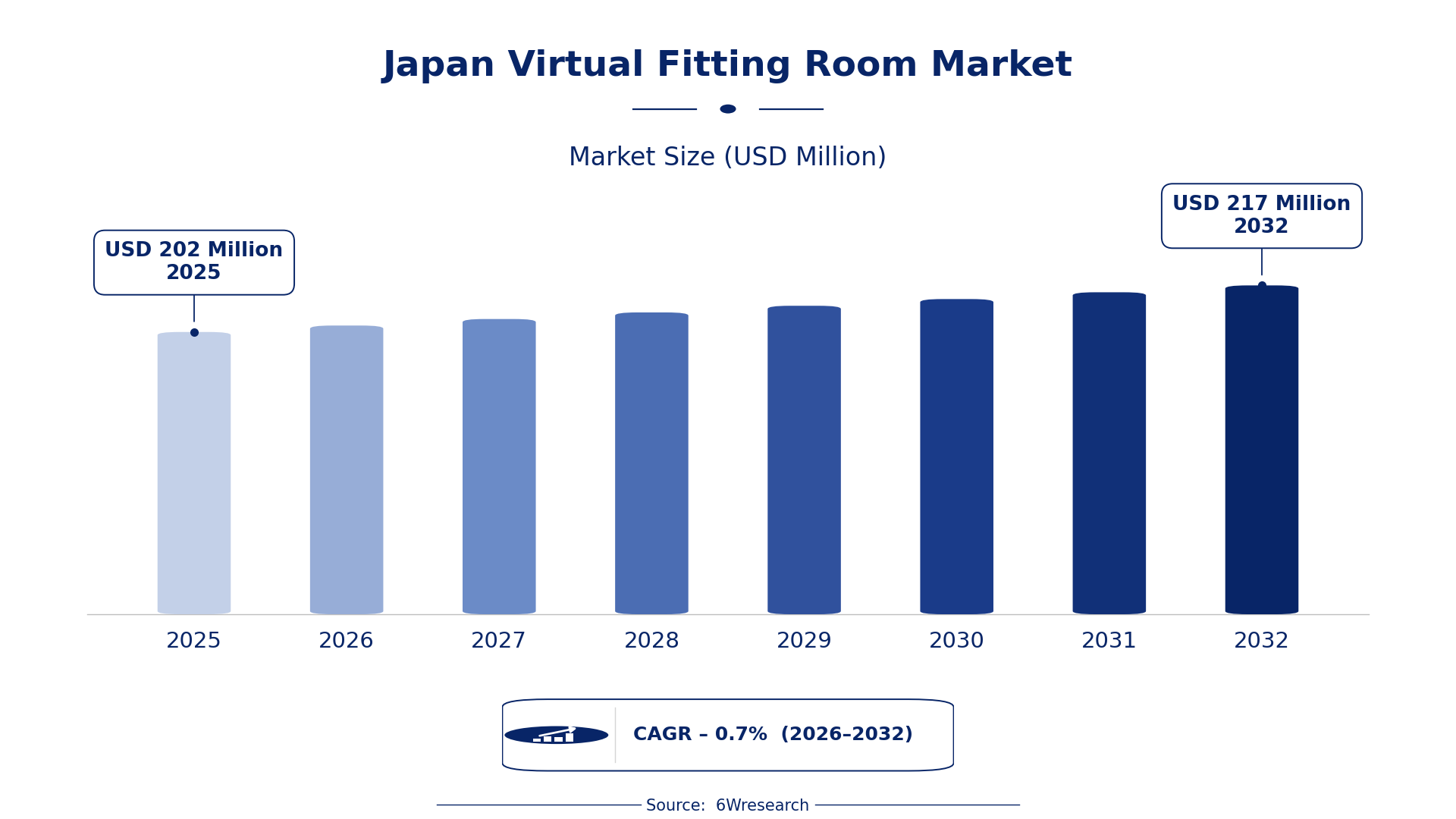
The Japan Virtual Fitting Room Market was estimated at USD 202 Million in 2025 and is projected to reach USD 217 Million by 2032, growing at a CAGR of 0.7% from 2026 to 2032.
Japan Virtual Fitting Room Market Synopsis
The Japan Virtual Fitting Room Market has gained traction as retailers increasingly adopt innovative technologies to enhance the customer shopping experience. As online shopping continues to grow, so does the demand for solutions that allow consumers to virtually try on clothing, bridging the gap between physical and digital retail.
Looking ahead, this market is on a trajectory of steady growth fueled by advancements in artificial intelligence and augmented reality. Retailers are prioritizing user engagement and experience, setting the stage for more sophisticated solutions that can reduce return rates and improve customer satisfaction.
Japan Virtual Fitting Room Market Year-wise Growth Rate and Key Drivers
This graph illustrates the annual growth rates of the Japan Virtual Fitting Room Market from 2021 to 2032, highlighting a steady upward trajectory and projected expansion over the forecast period.
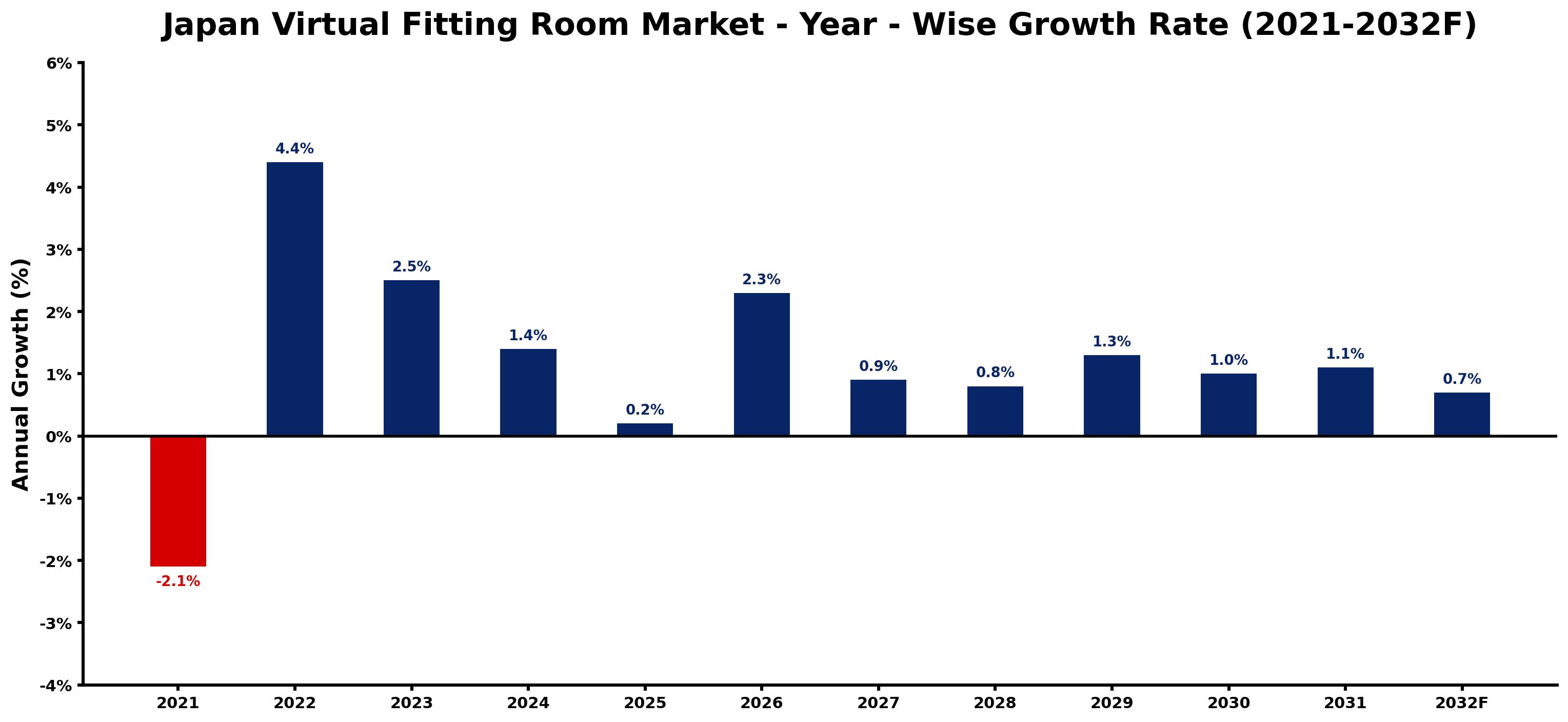
The table below presents the year‑wise growth rates along with the key drivers influencing the market
| Year | Growth Rate | Major Drivers |
| 2021 | -2.1% | Limited user adoption due to cultural fashion preferences. |
| 2022 | 4.4% | Increased smartphone penetration fostering AR apparel experiences |
| 2023 | 2.5% | Growth of remote shopping trends post-COVID-19 pandemic |
| 2024 | 1.4% | Partnerships between fashion retailers and tech startups |
| 2025 | 0.2% | Launch of nationwide digital literacy campaigns by government |
| 2026 | 2.3% | Surge in online consumer spending during seasonal sales |
| 2027 | 0.9% | Adoption of 5G enhancing real-time virtual fitting |
| 2028 | 0.8% | Rise in virtual influencer marketing in fashion sector |
| 2029 | 1.3% | Integration of AI-driven recommendations in retail apps |
| 2030 | 1.0% | Popularity of social media platforms featuring AR shopping |
| 2031 | 1.1% | Increased fashion sustainability discussions boosting virtual solutions |
| 2032 | 0.7% | Emerging interest in gamified shopping experiences among consumers |
Note: Market size estimations and growth projections presented in this report are based on 6Wresearch's proprietary forecasting methodology, utilizing the latest available industry data, government publications, and primary research inputs.
Japan Virtual Fitting Room Market Key Takeaways
Below are some of the specific key takeaways from the market, including:
- The market is driven by the rising trend of online shopping and demand for personalized experiences.
- Technological innovations, particularly in AI and AR, are enhancing virtual fitting room accuracy.
- There is a growing focus on reducing return rates and improving customer satisfaction.
- Government initiatives support technological integration in the retail sector.
- Investment opportunities exist in expanding virtual fitting solutions to other industries.
Evaluation of Restraints in Japan Virtual Fitting Room Market
Despite its potential, the Japan Virtual Fitting Room Market faces several obstacles. Technological limitations hinder the accurate simulation of clothing fit, particularly for diverse body types. Language barriers may alienate older consumers or those less familiar with technology, reducing adoption rates. on top of that, concerns regarding data privacy and security can erode consumer trust, particularly as many solutions require personal measurements. Small to medium-sized retailers also struggle with the high costs associated with implementing these advanced technologies.
Japan Virtual Fitting Room Market Trends
The current trend in the Japan Virtual Fitting Room Market reflects a shift toward integrating augmented reality and artificial intelligence to create more immersive shopping experiences. Retailers are increasingly using these technologies to provide accurate sizing recommendations and customization options, enhancing the overall virtual try-on experience. The impact of the COVID-19 pandemic has also accelerated the demand for contactless shopping solutions, further solidifying the place of virtual fitting rooms in the retail environment.
Japan Virtual Fitting Room Market Opportunities
Investment opportunities abound within the Japan Virtual Fitting Room Market. With the surge in online shopping, retailers are keen on adopting technologies that enhance customer engagement. There’s potential for growth not only in the fashion sector but also in adjacent industries such as healthcare, where virtual try-ons can apply to eyewear, and fitness apparel. Partnering with technology providers to develop tailored solutions can yield long-term benefits and market differentiation.
Government Initiatives in the Japan Virtual Fitting Room Market
Government policies are crucial in shaping the Japan Virtual Fitting Room Market, as they promote technological innovation and enhance the retail experience. The Japanese government has prioritized initiatives that encourage public-private partnerships in technological research, fostering a regulatory environment conducive to innovation. Compliance with data privacy regulations remains a top priority, ensuring consumer trust in virtual fitting technologies.
- A recently completed initiative focused on funding R&D for retail technology has bolstered the market's innovation capacity.
- A currently ongoing public-private partnership aims to develop a national digital infrastructure to support e-commerce platforms.
- Planned regulatory frameworks are set to be introduced in 2026, mandating enhanced data protection measures for virtual fitting technologies.
- Ongoing training programs for retailers are being implemented to facilitate better adoption of virtual fitting room solutions.
- Future initiatives include potential subsidies for small retailers to encourage the integration of virtual fitting technologies.
Future Insights of the Japan Virtual Fitting Room Market
Looking ahead to 2026-2032, the Japan Virtual Fitting Room Market is expected to grow steadily, driven by the increasing adoption of online shopping and the consumer demand for personalized experiences. As retailers continue to invest in advanced technologies, the virtual fitting room will evolve to offer even more accurate and engaging experiences. The focus will remain on reducing return rates and enhancing customer satisfaction, ensuring that this market remains vibrant and competitive.
Japan Virtual Fitting Room Market Latest Developments
In the last 12-14 months, the Japan Virtual Fitting Room Market has seen a flurry of activity, with companies pushing boundaries in technology and user experience. Retailers are increasingly recognizing the importance of these solutions as part of their digital strategy, leading to significant investments in infrastructure and technology. This momentum suggests a commitment to staying ahead of consumer expectations in an increasingly competitive environment.
- A major technology vendor launched an enhanced virtual fitting room solution in Q1 2025, incorporating advanced AR capabilities.
- An ongoing partnership between a fashion retailer and a tech firm is developing a new AI-driven sizing algorithm, expected to be completed by mid-2026.
- Upcoming initiatives include a multi-brand virtual fitting platform set to launch in late 2026, targeting a wider consumer base.
- A regional operator is currently upgrading its existing virtual fitting room technology, with completion projected for early 2026.
- By Q3 2025, a new initiative aimed at expanding virtual fitting room access to smaller retailers is set to begin.
Japan Virtual Fitting Room Market - Key Attractiveness of the Report
- 10 Years of Market Numbers
- Historical Data Starting from 2022 to 2025
- Base Year: 2025
- Forecast Data until 2032
- Key Performance Indicators Impacting the Market
- Major Upcoming Developments and Projects
Government initiatives support technological innovation in retail, with funding for R&D and regulations aimed at enhancing data privacy, which is critical for consumer trust in virtual fitting technologies.
Key Highlights of the Report:
- Japan Virtual Fitting Room Market Outlook
- Market Size of Japan Virtual Fitting Room Market, 2025
- Forecast of Japan Virtual Fitting Room Market, 2032
- Historical Data and Forecast of Japan Virtual Fitting Room Revenues & Volume for the Period 2022-2032F
- Japan Virtual Fitting Room Market Trend Evolution
- Japan Virtual Fitting Room Market Drivers and Challenges
- Japan Virtual Fitting Room Price Trends
- Japan Virtual Fitting Room Porter's Five Forces
- Japan Virtual Fitting Room Industry Life Cycle
- Historical Data and Forecast of Japan Virtual Fitting Room Market Revenues & Volume By Component for the Period 2022-2032F
- Historical Data and Forecast of Japan Virtual Fitting Room Market Revenues & Volume By Hardware for the Period 2022-2032F
- Historical Data and Forecast of Japan Virtual Fitting Room Market Revenues & Volume By Software for the Period 2022-2032F
- Historical Data and Forecast of Japan Virtual Fitting Room Market Revenues & Volume By Services for the Period 2022-2032F
- Historical Data and Forecast of Japan Virtual Fitting Room Market Revenues & Volume By End-User for the Period 2022-2032F
- Historical Data and Forecast of Japan Virtual Fitting Room Market Revenues & Volume By Physical Store for the Period 2022-2032F
- Historical Data and Forecast of Japan Virtual Fitting Room Market Revenues & Volume By Virtual Store for the Period 2022-2032F
- Historical Data and Forecast of Japan Virtual Fitting Room Market Revenues & Volume By Use Case for the Period 2022-2032F
- Historical Data and Forecast of Japan Virtual Fitting Room Market Revenues & Volume By Apparel for the Period 2022-2032F
- Historical Data and Forecast of Japan Virtual Fitting Room Market Revenues & Volume By Accessories for the Period 2022-2032F
- Historical Data and Forecast of Japan Virtual Fitting Room Market Revenues & Volume By Eye Wear for the Period 2022-2032F
- Historical Data and Forecast of Japan Virtual Fitting Room Market Revenues & Volume By Jewelry and Watches for the Period 2022-2032F
- Historical Data and Forecast of Japan Virtual Fitting Room Market Revenues & Volume By Beauty and Cosmetics for the Period 2022-2032F
- Historical Data and Forecast of Japan Virtual Fitting Room Market Revenues & Volume By Others for the Period 2022-2032F
- Historical Data and Forecast of Japan Virtual Fitting Room Market Revenues & Volume By End User for the Period 2022-2032F
- Historical Data and Forecast of Japan Virtual Fitting Room Market Revenues & Volume By Physical store for the Period 2022-2032F
- Historical Data and Forecast of Japan Virtual Fitting Room Market Revenues & Volume By Virtual Store for the Period 2022-2032F
- Japan Virtual Fitting Room Import Export Trade Statistics
- Market Opportunity Assessment By Component
- Market Opportunity Assessment By End-User
- Market Opportunity Assessment By Use Case
- Market Opportunity Assessment By End User
- Japan Virtual Fitting Room Top Companies Market Share
- Japan Virtual Fitting Room Competitive Benchmarking By Technical and Operational Parameters
- Japan Virtual Fitting Room Company Profiles
- Japan Virtual Fitting Room Key Strategic Recommendations






































