Japan Visual Analytics Market Size & Growth Rate (2026-2032)
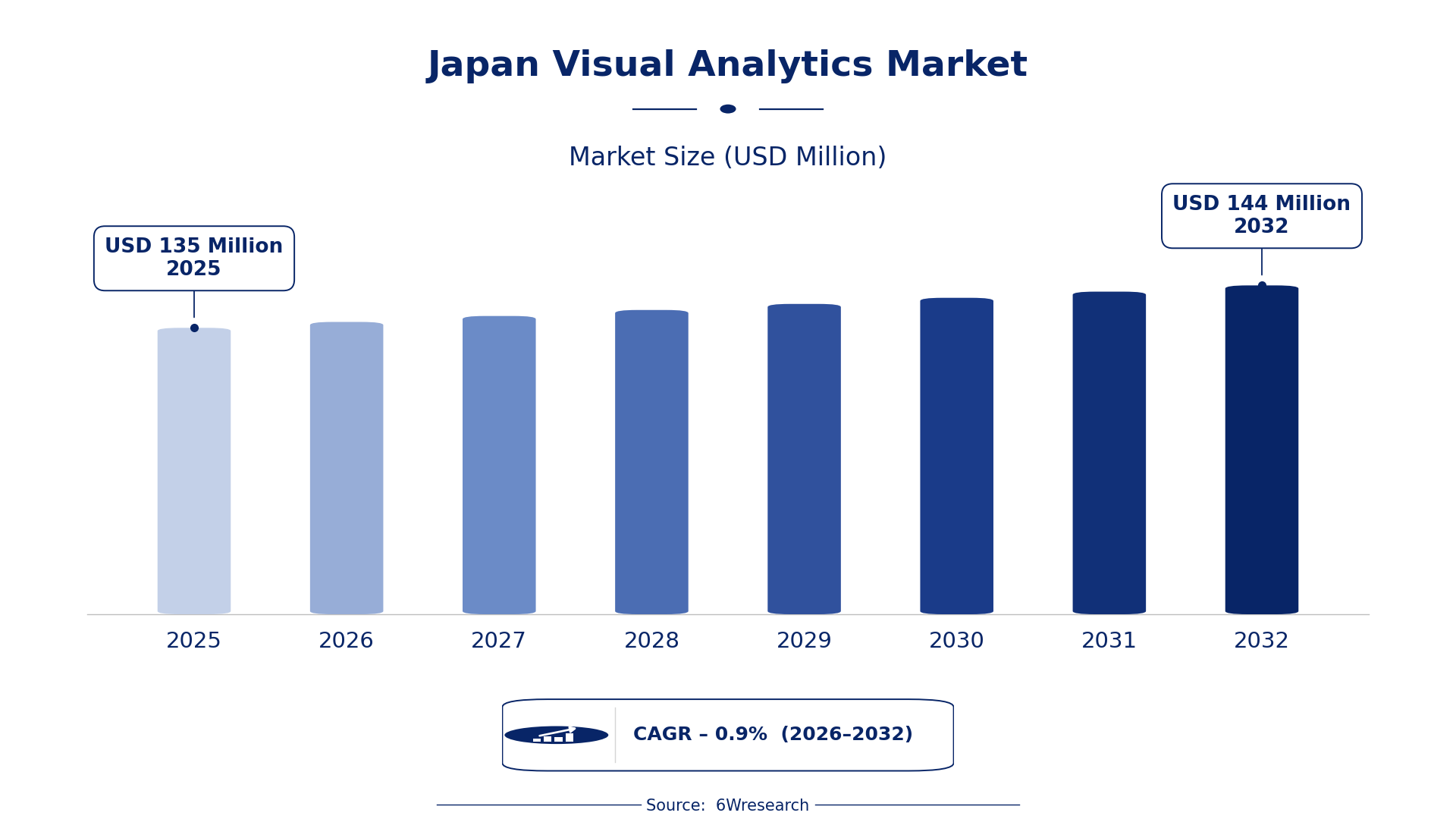
The Japan Visual Analytics Market was estimated at USD 135 Million in 2025 and is projected to reach USD 144 Million by 2032, growing at a CAGR of 0.9% from 2026 to 2032.
Japan Visual Analytics Market Synopsis
In recent years, the Japan Visual Analytics Market has gained momentum, driven by an increasing demand for data-driven decision-making across multiple sectors. As organizations strive for agility and responsiveness, visual analytics tools have become essential for transforming complex data into actionable insights.
Looking ahead, the market is expected to evolve with advancements in technology, particularly in artificial intelligence and machine learning. These developments will enhance the functionality of visual analytics tools, further supporting businesses in their quest for real-time insights and improved operational efficiency.
Japan Visual Analytics Market Year-wise Growth Rate and Key Drivers
This graph illustrates the annual growth rates of the Japan Visual Analytics Market from 2021 to 2032, highlighting a steady upward trajectory and projected expansion over the forecast period.
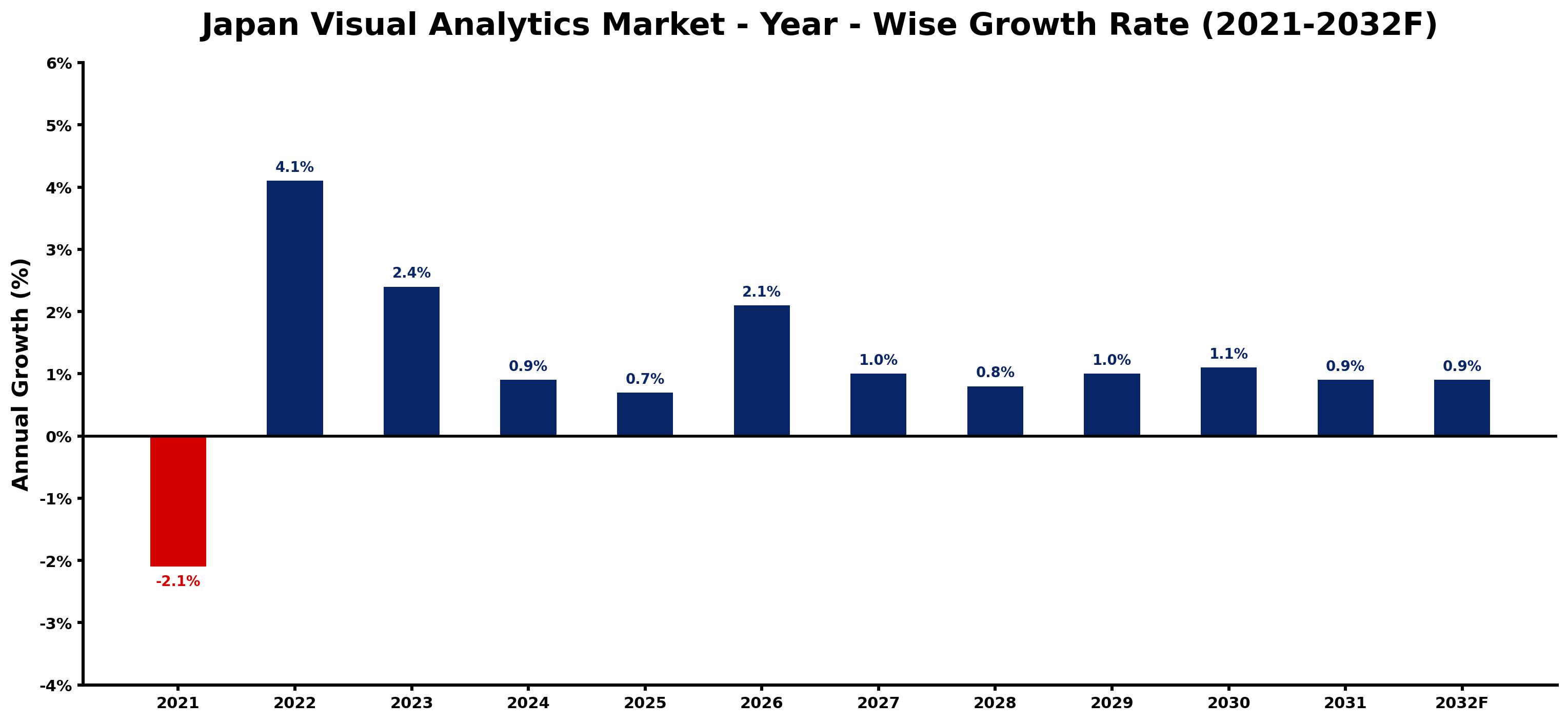
The table below presents the year‑wise growth rates along with the key drivers influencing the market
| Year | Growth Rate | Major Drivers |
| 2021 | -2.1% | Government delay in digital transformation initiatives. |
| 2022 | 4.1% | Increased investment in AI-driven analytics technologies. |
| 2023 | 2.4% | Government initiatives promoting smart manufacturing analytics adoption. |
| 2024 | 0.9% | Growing interest in visualizing big data insights. |
| 2025 | 0.7% | Emergence of tech startups enhancing data storytelling capabilities. |
| 2026 | 2.1% | Boost in telework leading to data visualization needs. |
| 2027 | 1.0% | Focus on healthcare analytics improving patient care services. |
| 2028 | 0.8% | Rise of urban planning projects utilizing geospatial data. |
| 2029 | 1.0% | Cultural appreciation for design enhancing data presentation. |
| 2030 | 1.1% | Need for climate data analytics driving visualization tools. |
| 2031 | 0.9% | Corporate demand for visual KPIs in sustainability reporting. |
| 2032 | 0.9% | Shift towards data-driven decision making in education sector. |
Note: Market size estimations and growth projections presented in this report are based on 6Wresearch's proprietary forecasting methodology, utilizing the latest available industry data, government publications, and primary research inputs.
Japan Visual Analytics Market Key Takeaways
Below are some of the specific key takeaways from the market, including:
- The market is experiencing a shift towards cloud-based visual analytics solutions, driven by scalability and cost-effectiveness.
- Industries such as healthcare, finance, and retail are leading the way in adopting visual analytics tools for operational improvements.
- Real-time analytics and user-friendly interfaces are becoming critical components for organizations to empower non-technical users.
- AI and machine learning integration are set to redefine data visualization capabilities and enhance decision-making processes.
- Investment opportunities abound, particularly in software development and consultancy focused on visual analytics solutions.
Evaluation of Restraints in Japan Visual Analytics Market
Despite the market's growth trajectory, several challenges hinder its progress. The complexity of data sources presents a significant barrier, as many organizations struggle to integrate diverse datasets effectively. Cultural resistance to change also plays a role, with traditional business practices often clashing with innovative analytics methodologies. on top of that, a shortage of skilled professionals in the field limits the full utilization of visual analytics tools, making it essential for companies to invest in talent development and training initiatives.
Japan Visual Analytics Market Trends
The demand for advanced data visualization technologies is on the rise in Japan, with businesses increasingly seeking interactive dashboards that deliver deeper insights. The integration of AI and machine learning capabilities is a prominent trend, enhancing the analytical power of visual tools. Additionally, the push for real-time analytics is driving organizations to prioritize speed and accuracy in their decision-making processes. Another significant trend is the growing emphasis on user-centric design, enabling non-technical users to engage more effectively with data.
Japan Visual Analytics Market Opportunities
Investment opportunities within the Japan Visual Analytics Market are substantial, particularly due to the rising demand for real-time insights across various sectors. Key areas for potential growth include software firms specializing in visual analytics solutions and consultancy services focused on data strategy. As organizations continue to prioritize digital transformation, the integration of advanced analytics tools will be critical for maintaining competitive advantages.
Government Initiatives in the Japan Visual Analytics Market
The Japanese government is actively encouraging the adoption of visual analytics technologies to foster innovation and drive economic growth. Initiatives aimed at integrating advanced technologies into various sectors are critical for enhancing productivity and addressing societal challenges. This regulatory environment, along with public-sector priorities, is vital for advancing the Japan Visual Analytics Market.
- A recently completed initiative focused on funding research and development projects in visual analytics, fostering collaboration between academia and industry.
- Currently ongoing efforts include the implementation of a national digital infrastructure upgrade programme to enhance data accessibility.
- A planned public-private partnership aims to develop a framework for ethical data usage and promote transparency in visual analytics by 2028.
- Ongoing workshops and training programs are being conducted to develop a skilled workforce capable of utilizing visual analytics tools effectively.
- Upcoming legislation is set to establish standards for data security and privacy in visual analytics applications, expected to roll out in late 2026.
Future Insights of the Japan Visual Analytics Market
As we move towards 2032, the Japan Visual Analytics Market is set to flourish, driven by the urgent need for data-driven insights in fast-paced industries. The focus on real-time analytics will only intensify, as businesses seek to enhance their decision-making capabilities. The integration of AI technologies will further revolutionize how organizations interpret data, leading to smarter and more informed strategies. With an increasing emphasis on operational efficiency and customer experience, investment in visual analytics tools will likely become a priority for Japanese companies.
Japan Visual Analytics Market Latest Developments
In the past year, the Japan Visual Analytics Market has seen notable activity as companies adapt to changing demands for data analysis and visualization. The push for enhanced capabilities has prompted numerous initiatives, partnerships, and technology rollouts aimed at improving analytics solutions.
- A major technology vendor launched a new cloud-based visual analytics platform in early 2025, designed to enhance user engagement and interactivity.
- In Q3 2025, an initiative began to integrate machine learning algorithms into existing visual analytics tools, currently underway to boost predictive capabilities.
- Upcoming in mid-2026 is a rollout of an innovative data visualization tool aimed at the healthcare sector, expected to enhance patient care analytics.
- A partnership formed in late 2024 between analytics firms aims to develop a suite of collaborative tools for real-time data sharing among businesses, with deployment in early 2026.
- Recently, a workshop series was launched to address the skills gap in the visual analytics space, with sessions scheduled throughout 2025.
Japan Visual Analytics Market - Key Attractiveness of the Report
- 10 Years of Market Numbers
- Historical Data Starting from 2022 to 2025
- Base Year: 2025
- Forecast Data until 2032
- Key Performance Indicators Impacting the Market
- Major Upcoming Developments and Projects
The government is promoting visual analytics through funding for R&D projects, implementing infrastructure upgrades, and establishing ethical data usage frameworks.
Key Highlights of the Report:
- Japan Visual Analytics Market Outlook
- Market Size of Japan Visual Analytics Market, 2025
- Forecast of Japan Visual Analytics Market, 2032
- Historical Data and Forecast of Japan Visual Analytics Revenues & Volume for the Period 2022-2032F
- Japan Visual Analytics Market Trend Evolution
- Japan Visual Analytics Market Drivers and Challenges
- Japan Visual Analytics Price Trends
- Japan Visual Analytics Porter's Five Forces
- Japan Visual Analytics Industry Life Cycle
- Historical Data and Forecast of Japan Visual Analytics Market Revenues & Volume By Component for the Period 2022-2032F
- Historical Data and Forecast of Japan Visual Analytics Market Revenues & Volume By Software for the Period 2022-2032F
- Historical Data and Forecast of Japan Visual Analytics Market Revenues & Volume By Services for the Period 2022-2032F
- Historical Data and Forecast of Japan Visual Analytics Market Revenues & Volume By Deployment Model for the Period 2022-2032F
- Historical Data and Forecast of Japan Visual Analytics Market Revenues & Volume By On-Premises for the Period 2022-2032F
- Historical Data and Forecast of Japan Visual Analytics Market Revenues & Volume By On-Demand for the Period 2022-2032F
- Historical Data and Forecast of Japan Visual Analytics Market Revenues & Volume By Business Function for the Period 2022-2032F
- Historical Data and Forecast of Japan Visual Analytics Market Revenues & Volume By IT for the Period 2022-2032F
- Historical Data and Forecast of Japan Visual Analytics Market Revenues & Volume By Sales and marketing for the Period 2022-2032F
- Historical Data and Forecast of Japan Visual Analytics Market Revenues & Volume By Supply chain for the Period 2022-2032F
- Historical Data and Forecast of Japan Visual Analytics Market Revenues & Volume By Finance for the Period 2022-2032F
- Historical Data and Forecast of Japan Visual Analytics Market Revenues & Volume By Human resources (HR) for the Period 2022-2032F
- Historical Data and Forecast of Japan Visual Analytics Market Revenues & Volume By Others for the Period 2022-2032F
- Historical Data and Forecast of Japan Visual Analytics Market Revenues & Volume By Industry for the Period 2022-2032F
- Historical Data and Forecast of Japan Visual Analytics Market Revenues & Volume By Banking, Financial Services, and Insurance (BFSI) for the Period 2022-2032F
- Historical Data and Forecast of Japan Visual Analytics Market Revenues & Volume By Telecom and IT for the Period 2022-2032F
- Historical Data and Forecast of Japan Visual Analytics Market Revenues & Volume By Retail and Consumer goods for the Period 2022-2032F
- Historical Data and Forecast of Japan Visual Analytics Market Revenues & Volume By Healthcare and Life Sciences for the Period 2022-2032F
- Historical Data and Forecast of Japan Visual Analytics Market Revenues & Volume By Manufacturing for the Period 2022-2032F
- Historical Data and Forecast of Japan Visual Analytics Market Revenues & Volume By Government and Defense for the Period 2022-2032F
- Historical Data and Forecast of Japan Visual Analytics Market Revenues & Volume By Energy and utilities for the Period 2022-2032F
- Historical Data and Forecast of Japan Visual Analytics Market Revenues & Volume By Media and entertainment for the Period 2022-2032F
- Historical Data and Forecast of Japan Visual Analytics Market Revenues & Volume By Organization Size for the Period 2022-2032F
- Historical Data and Forecast of Japan Visual Analytics Market Revenues & Volume By Small and Medium-sized Enterprises (SMEs) for the Period 2022-2032F
- Historical Data and Forecast of Japan Visual Analytics Market Revenues & Volume By Large Enterprises for the Period 2022-2032F
- Japan Visual Analytics Import Export Trade Statistics
- Market Opportunity Assessment By Component
- Market Opportunity Assessment By Deployment Model
- Market Opportunity Assessment By Business Function
- Market Opportunity Assessment By Industry
- Market Opportunity Assessment By Organization Size
- Japan Visual Analytics Top Companies Market Share
- Japan Visual Analytics Competitive Benchmarking By Technical and Operational Parameters
- Japan Visual Analytics Company Profiles
- Japan Visual Analytics Key Strategic Recommendations






































