Jordan Small Mammal and Reptile Food Market Size, Share & Growth Rate
The Jordan Small Mammal and Reptile Food Market was estimated at USD 1129 Million in 2025 and is projected to reach USD 1603 Million by 2032, growing at a CAGR of 5.1% from 2026 to 2032. This growth trajectory can be attributed to the increasing trend of pet ownership within Jordanian households, particularly among small mammals and reptiles. As consumer awareness regarding proper nutrition rises, the market's expansion is further fueled by an evolving preference for premium, specialized food products tailored to meet the unique dietary needs of these pets.
Jordan Small Mammal and Reptile Food Market Year-wise Growth Rate and Key Drivers
This graph highlights how the Jordan Small Mammal and Reptile Food Market has steadily grown over the years, supported by major growth factors.
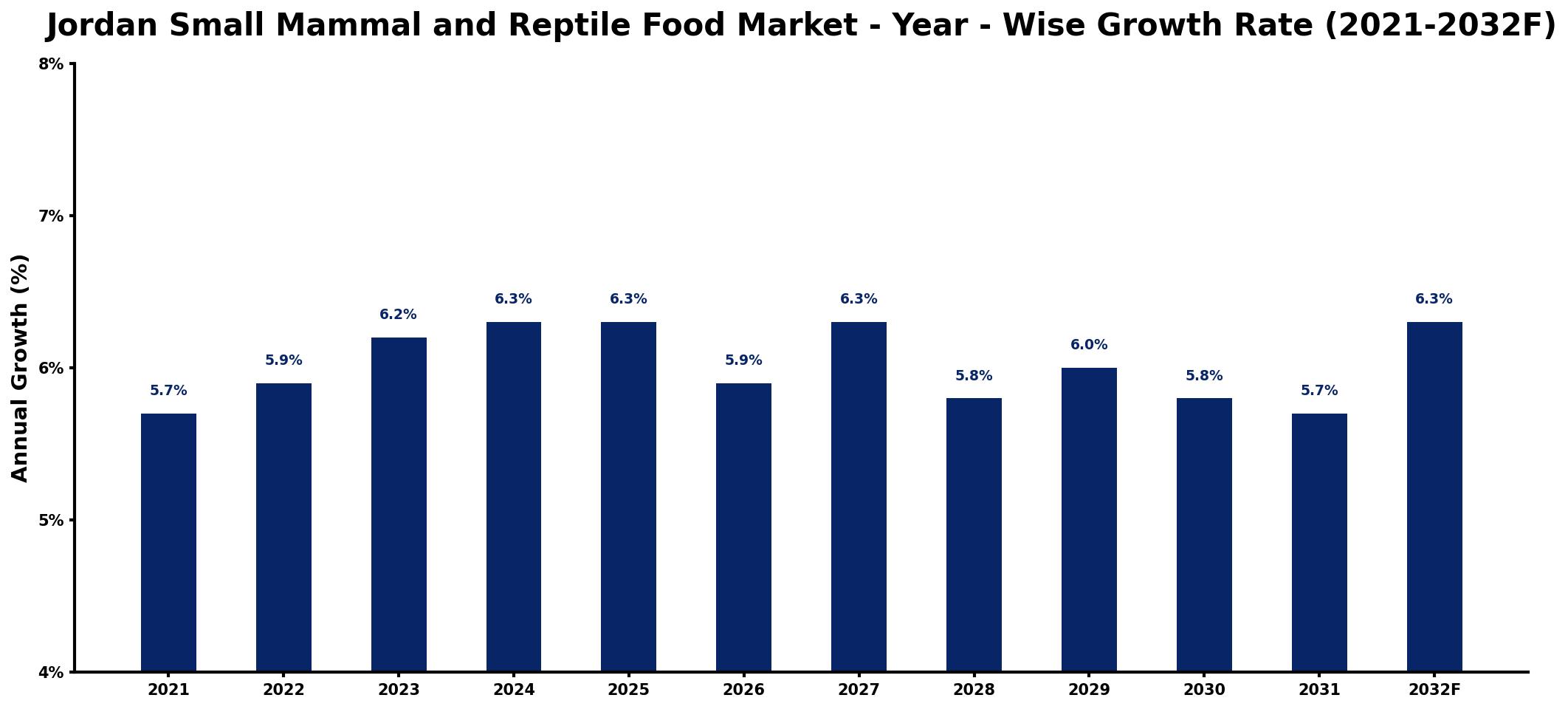
The table below presents the year‑wise growth rates along with the key drivers influencing the market
| Year | Growth Rate | Major Drivers |
| 2021 | 5.7% | Rising pet ownership trends |
| 2022 | 5.9% | Increased disposable income levels |
| 2023 | 6.2% | Growing awareness of nutrition |
| 2024 | 6.3% | Expansion of retail distribution channels |
| 2025 | 6.3% | Higher consumer spending on pets |
| 2026 | 5.9% | Emergence of premium product lines |
| 2027 | 6.3% | Surge in online shopping preferences |
| 2028 | 5.8% | Innovations in packaging solutions |
| 2029 | 6.0% | Strengthening of local supply chains |
| 2030 | 5.8% | growing commercial sector adoption |
| 2031 | 5.7% | Increased focus on sustainability initiatives |
| 2032 | 6.3% | Growth in specialized product offerings |
Note: Market size estimations and growth projections presented in this report are based on 6Wresearch's proprietary forecasting methodology, utilizing the latest available industry data, government publications, and primary research inputs.
Jordan Small Mammal and Reptile Food Market Synopsis
The Jordan Small Mammal and Reptile Food Market is witnessing significant growth as a result of the rising popularity of small pets, including hamsters, guinea pigs, and various reptiles. Pet owners are becoming increasingly mindful of their pets' nutritional requirements, driving demand for specialized food blends, treats, and supplements designed to enhance the health and well-being of these animals.
With a diverse range of products available, from natural and organic ingredients to customizable feeding solutions, the market is evolving rapidly. Retail formats are expanding, encompassing local pet stores as well as online platforms, thus catering to a broader customer base seeking high-quality food options for their small companions.
Jordan Small Mammal and Reptile Food Market Key Takeaways
- Growing pet ownership among Jordanian households is a primary driver of market growth.
- Increasing demand for premium, specialized food products tailored to the dietary needs of small mammals and reptiles is shaping market offerings.
- Emerging trends towards natural, organic ingredients reflect consumer preferences for healthier, more sustainable options.
- Challenges in consumer awareness and distribution can be addressed through strategic marketing and expanded product availability.
- Investment opportunities exist in product innovation, manufacturing, and education campaigns targeting pet owners.
Evaluation of Restraints in Jordan Small Mammal and Reptile Food Market
Despite its promising growth trajectory, the Jordan Small Mammal and Reptile Food Market encounters several significant restraints. Limited consumer awareness regarding the importance of proper nutrition remains a critical challenge, hindering the demand for specialized food products. Furthermore, the availability of diverse and high-quality food options is still limited, resulting in a reliance on generic products that do not adequately meet the nutritional needs of small mammals and reptiles. Distribution challenges also contribute to market constraints, as many retail outlets do not carry specialized offerings. Economic factors could further impact consumer spending, influencing their willingness to invest in premium pet food.
Jordan Small Mammal and Reptile Food Market Trends
A noticeable trend in the Jordan Small Mammal and Reptile Food Market is the shift towards natural and organic ingredients. This mirrors a broader consumer movement seeking healthier and more sustainable products. Additionally, there is increasing interest in customizable feeding solutions that allow pet owners to adapt their pets' diets based on individual preferences and requirements. Eco-friendly packaging and transparent sourcing practices are also gaining traction, aligning with the values of environmentally conscious consumers who prioritize ethical consumption.
Jordan Small Mammal and Reptile Food Market Opportunities
The market presents lucrative investment opportunities, particularly as pet ownership continues to rise across Jordan. There is a distinct opportunity to develop and manufacture high-quality, nutritious food products specifically tailored for small mammals and reptiles. Establishing comprehensive distribution channels that encompass pet stores and veterinary clinics will also enhance market penetration. Additionally, targeted marketing initiatives aimed at educating pet owners about the benefits of premium food options can stimulate demand further. Innovation in product development and unique packaging designs can help attract a larger share of this niche market.
Government Initiatives in the Jordan Small Mammal and Reptile Food Market
The Jordanian government is actively involved in regulating the Small Mammal and Reptile Food Market to ensure product safety and quality. Policies include stringent food safety standards and licensing requirements for businesses within the industry. Regular inspections are conducted to monitor compliance, safeguarding the welfare of animals used in food production. Additionally, transparency in labeling practices is promoted to inform consumers about the nutritional content and sourcing of products, ensuring a responsible market environment.
Future Insights of the Jordan Small Mammal and Reptile Food Market
Looking ahead to 2026-2032, the Jordan Small Mammal and Reptile Food Market is poised for continued expansion as pet ownership becomes increasingly entrenched in Jordanian culture. As awareness about the importance of proper nutrition grows among pet owners, demand for specialized products will likely increase. Companies that are agile in adapting to evolving consumer preferences by offering a diverse range of high-quality food options will be well-positioned to thrive in this dynamic market landscape.
Jordan Small Mammal and Reptile Food Market Latest Developments (2025 - 2026)
Recently, there has been a notable uptick in the launch of new product lines aimed at small mammals and reptiles, focusing on nutritional innovation and enhanced formulations. Industry stakeholders are increasingly emphasizing the importance of ethical sourcing and transparency, responding to consumer demand for responsible pet food options. Marketing strategies have shifted to include educational campaigns, aiming to inform pet owners about the critical role nutrition plays in their pets' health. Theres also a marked increase in online retail platforms, making these specialized products more accessible to consumers across the region.
Jordan Small Mammal and Reptile Food Market - Key Attractiveness of the Report
- 10 Years of Market Numbers
- Historical Data Starting from 2022 to 2025
- Base Year: 2025
- Forecast Data until 2032
- Key Performance Indicators Impacting the Market
- Major Upcoming Developments and Projects
Key Highlights of the Report:
- Jordan Small Mammal and Reptile Food Market Outlook
- Market Size of Jordan Small Mammal and Reptile Food Market, 2025
- Forecast of Jordan Small Mammal and Reptile Food Market, 2032
- Historical Data and Forecast of Jordan Small Mammal and Reptile Food Revenues & Volume for the Period 2022-2032F
- Jordan Small Mammal and Reptile Food Market Trend Evolution
- Jordan Small Mammal and Reptile Food Market Drivers and Challenges
- Jordan Small Mammal and Reptile Food Price Trends
- Jordan Small Mammal and Reptile Food Porter's Five Forces
- Jordan Small Mammal and Reptile Food Industry Life Cycle
- Historical Data and Forecast of Jordan Small Mammal and Reptile Food Market Revenues & Volume By Type for the Period 2022-2032F
- Historical Data and Forecast of Jordan Small Mammal and Reptile Food Market Revenues & Volume By Rabbits Food for the Period 2022-2032F
- Historical Data and Forecast of Jordan Small Mammal and Reptile Food Market Revenues & Volume By Rodents Food for the Period 2022-2032F
- Historical Data and Forecast of Jordan Small Mammal and Reptile Food Market Revenues & Volume By Small Reptiles Food for the Period 2022-2032F
- Historical Data and Forecast of Jordan Small Mammal and Reptile Food Market Revenues & Volume By Other for the Period 2022-2032F
- Historical Data and Forecast of Jordan Small Mammal and Reptile Food Market Revenues & Volume By Application for the Period 2022-2032F
- Historical Data and Forecast of Jordan Small Mammal and Reptile Food Market Revenues & Volume By Pet-Speciality Stores for the Period 2022-2032F
- Historical Data and Forecast of Jordan Small Mammal and Reptile Food Market Revenues & Volume By Supermarkets and Hypermarkets for the Period 2022-2032F
- Historical Data and Forecast of Jordan Small Mammal and Reptile Food Market Revenues & Volume By Convenience Stores for the Period 2022-2032F
- Historical Data and Forecast of Jordan Small Mammal and Reptile Food Market Revenues & Volume By Other for the Period 2022-2032F
- Jordan Small Mammal and Reptile Food Import Export Trade Statistics
- Market Opportunity Assessment By Type
- Market Opportunity Assessment By Application
- Jordan Small Mammal and Reptile Food Top Companies Market Share
- Jordan Small Mammal and Reptile Food Competitive Benchmarking By Technical and Operational Parameters
- Jordan Small Mammal and Reptile Food Company Profiles
- Jordan Small Mammal and Reptile Food Key Strategic Recommendations






































