Kazakhstan Base Metals Market Size, Share & Growth Rate
The Kazakhstan Base Metals Market was estimated at USD 259 Million in 2025 and is projected to reach USD 345 Million by 2032, growing at a CAGR of 4.2% from 2026 to 2032. This growth is primarily driven by the surging demand for base metals in construction, automotive, and electronics, which are essential for infrastructure development. Additionally, advancements in mining technology and an increasing focus on renewable energy projects are expected to further propel the market.
Kazakhstan Base Metals Market Year-wise Growth Rate and Key Drivers
This graph highlights how the Kazakhstan Base Metals Market has steadily grown over the years, supported by major growth factors.
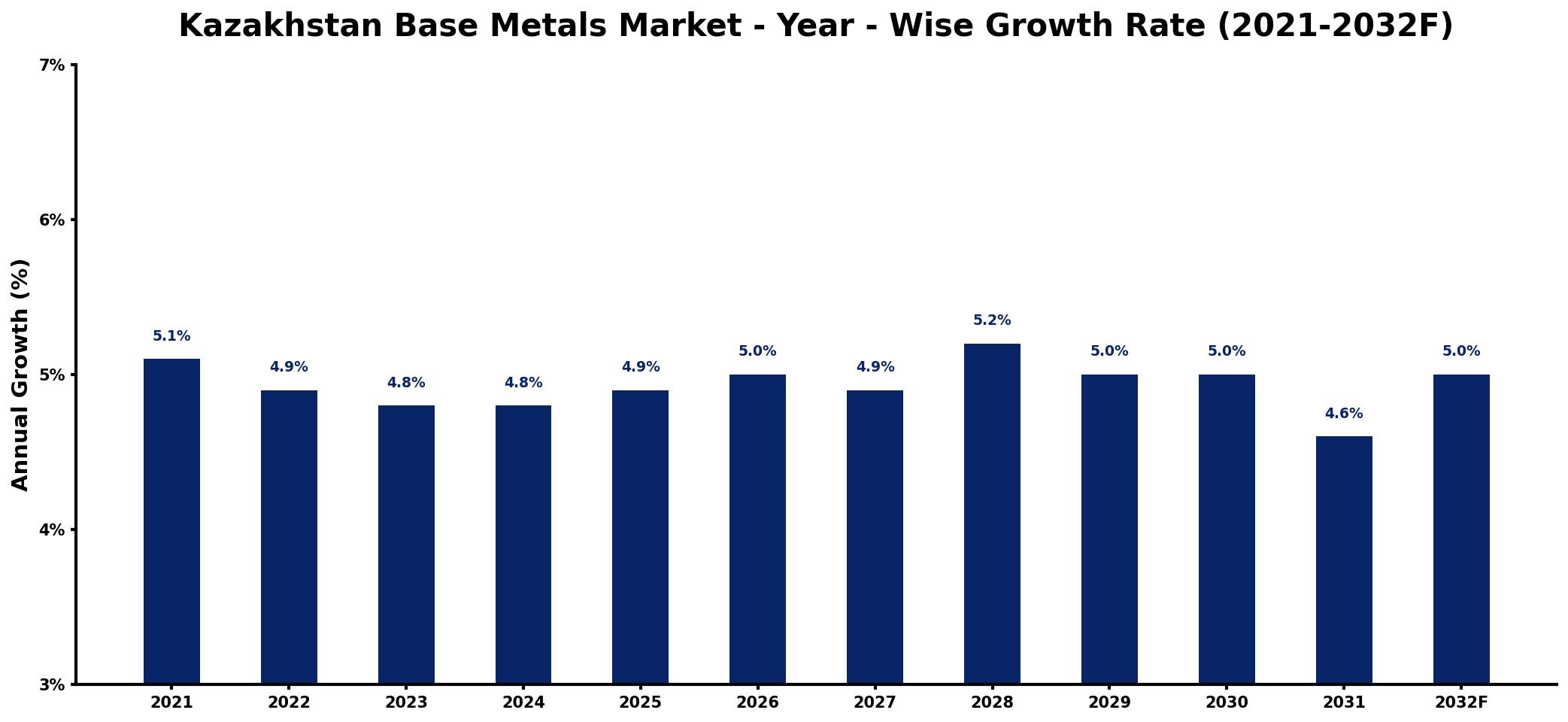
The table below presents the year‑wise growth rates along with the key drivers influencing the market
| Year | Growth Rate | Major Drivers |
| 2021 | 5.1% | Increased construction sector investments |
| 2022 | 4.9% | Rising renewable energy projects demand |
| 2023 | 4.8% | Growth in automotive industry production |
| 2024 | 4.8% | Expansion of infrastructure development initiatives |
| 2025 | 4.9% | Boost in technology sector investments |
| 2026 | 5.0% | Surge in electric vehicle manufacturing |
| 2027 | 4.9% | Increase in global mining activities |
| 2028 | 5.2% | Growing demand for sustainable solutions |
| 2029 | 5.0% | Rise in consumer electronics production |
| 2030 | 5.0% | growing downstream application demand |
| 2031 | 4.6% | Stabilization in global trade conditions |
| 2032 | 5.0% | increased capital investment inflows |
Note: Market size estimations and growth projections presented in this report are based on 6Wresearch's proprietary forecasting methodology, utilizing the latest available industry data, government publications, and primary research inputs.
Kazakhstan Base Metals Market Synopsis
Currently, the most powerful force shaping the Kazakhstan Base Metals Market is the burgeoning demand for copper and zinc, which are vital for ongoing industrialization efforts. The government's initiatives to support the mining sector and improve infrastructure have created an environment conducive to investment and growth.
Kazakhstans vast mineral wealth positions it as a significant player in the global market, with substantial reserves attracting both domestic and foreign investments. Nonetheless, the market must navigate challenges including fluctuating prices and increasing environmental concerns to maintain this positive momentum.
Kazakhstan Base Metals Market Key Takeaways
- The Kazakhstan Base Metals Market is projected to grow at a CAGR of 4.2% from 2026 to 2032.
- Infrastructure development and renewable energy projects are primary growth drivers.
- Kazakhstan's strategic location facilitates access to key European and Asian markets.
- There is a growing emphasis on sustainable mining practices and cleaner production technologies.
- Regulatory support and investment incentives are enhancing the investment landscape.
Evaluation of Restraints in Kazakhstan Base Metals Market
While the Kazakhstan Base Metals Market has significant growth potential, it is not without its challenges. Fluctuating global demand and commodity prices can create uncertainties that impact revenue streams for mining companies. Additionally, logistical hurdles, particularly in transporting base metals from remote mining sites to processing facilities, can impede efficiency. Regulatory uncertainties may also arise, affecting operational stability and long-term planning. Moreover, the competitive landscape from other mining regions necessitates continuous innovation and investment to stay ahead.
Kazakhstan Base Metals Market Trends
The market is witnessing notable trends such as a heightened focus on environmental sustainability and technological innovations in mining practices. Companies are increasingly investing in cleaner production techniques and resource-efficient methodologies to meet global standards. Furthermore, the growing integration of advanced technologies, including automation and artificial intelligence, is enhancing operational efficiencies and productivity within the sector. The rising demand for electric vehicles and renewable energy solutions is also driving interest in base metals, particularly copper and zinc.
Kazakhstan Base Metals Market Opportunities
Investment opportunities in the Kazakhstan Base Metals Market are abundant, particularly due to the country's significant reserves of copper, zinc, lead, and nickel. With global consumption of these metals on the rise, there is a compelling case for investors to engage with the mining sector. The government's proactive approach to attracting foreign investment, coupled with ongoing infrastructure enhancements, further boosts the attractiveness of the market. Establishing international trade partnerships presents another avenue for companies to leverage Kazakhstans strategic location for wider market access.
Government Initiatives in the Kazakhstan Base Metals Market
The Kazakhstan government has implemented a series of initiatives aimed at bolstering the base metals market. These include tax incentives designed to encourage domestic production and attract foreign investment. Streamlined regulatory processes and infrastructure development are also key focuses. Policies promoting technology transfer and local employment are in place, ensuring that the mining sector benefits the local economy while adhering to environmental standards. Such initiatives create a favorable business environment for companies looking to operate in this sector.
Future Insights of the Kazakhstan Base Metals Market
Looking ahead to 2026-2032, the Kazakhstan Base Metals Market appears poised for continued growth. Rising industrialization and infrastructure development will sustain the demand for essential base metals. The country's rich mineral resources, particularly in copper, zinc, and lead, will solidify Kazakhstan's position as a key player on the global stage. Despite potential external challenges, ongoing investments and improved regulatory frameworks are expected to bolster the market's long-term prospects. As the focus on sustainability intensifies, the integration of cleaner technologies will likely play a significant role in shaping the future of the market.
Kazakhstan Base Metals Market Latest Developments (2025 - 2026)
Recent developments in the Kazakhstan Base Metals Market reflect a strong shift towards sustainable mining practices, with several initiatives launched to enhance environmental responsibility. The government has taken steps to improve infrastructure, which is crucial for facilitating smoother logistics and better access to international markets. Additionally, increased collaboration between mining companies and technology providers is fostering innovation in resource extraction and processing methods. These developments indicate a market increasingly aligned with global trends towards sustainability and efficiency.
Kazakhstan Base Metals Market - Key Attractiveness of the Report
- 10 Years of Market Numbers
- Historical Data Starting from 2022 to 2025
- Base Year: 2025
- Forecast Data until 2032
- Key Performance Indicators Impacting the Market
- Major Upcoming Developments and Projects
Key Highlights of the Report:
- Kazakhstan Base Metals Market Outlook
- Market Size of Kazakhstan Base Metals Market, 2025
- Forecast of Kazakhstan Base Metals Market, 2032
- Historical Data and Forecast of Kazakhstan Base Metals Revenues & Volume for the Period 2022-2032F
- Kazakhstan Base Metals Market Trend Evolution
- Kazakhstan Base Metals Market Drivers and Challenges
- Kazakhstan Base Metals Price Trends
- Kazakhstan Base Metals Porter's Five Forces
- Kazakhstan Base Metals Industry Life Cycle
- Historical Data and Forecast of Kazakhstan Base Metals Market Revenues & Volume By Type for the Period 2022-2032F
- Historical Data and Forecast of Kazakhstan Base Metals Market Revenues & Volume By Copper for the Period 2022-2032F
- Historical Data and Forecast of Kazakhstan Base Metals Market Revenues & Volume By Zinc for the Period 2022-2032F
- Historical Data and Forecast of Kazakhstan Base Metals Market Revenues & Volume By Lead for the Period 2022-2032F
- Historical Data and Forecast of Kazakhstan Base Metals Market Revenues & Volume By Nickel for the Period 2022-2032F
- Historical Data and Forecast of Kazakhstan Base Metals Market Revenues & Volume By Aluminum for the Period 2022-2032F
- Historical Data and Forecast of Kazakhstan Base Metals Market Revenues & Volume By Tin for the Period 2022-2032F
- Historical Data and Forecast of Kazakhstan Base Metals Market Revenues & Volume By End-user Industry for the Period 2022-2032F
- Historical Data and Forecast of Kazakhstan Base Metals Market Revenues & Volume By Construction for the Period 2022-2032F
- Historical Data and Forecast of Kazakhstan Base Metals Market Revenues & Volume By Automotive and Transportation for the Period 2022-2032F
- Historical Data and Forecast of Kazakhstan Base Metals Market Revenues & Volume By Electrical and Electronics for the Period 2022-2032F
- Historical Data and Forecast of Kazakhstan Base Metals Market Revenues & Volume By Consumer Products for the Period 2022-2032F
- Historical Data and Forecast of Kazakhstan Base Metals Market Revenues & Volume By Medical Devices for the Period 2022-2032F
- Historical Data and Forecast of Kazakhstan Base Metals Market Revenues & Volume By Others for the Period 2022-2032F
- Kazakhstan Base Metals Import Export Trade Statistics
- Market Opportunity Assessment By Type
- Market Opportunity Assessment By End-user Industry
- Kazakhstan Base Metals Top Companies Market Share
- Kazakhstan Base Metals Competitive Benchmarking By Technical and Operational Parameters
- Kazakhstan Base Metals Company Profiles
- Kazakhstan Base Metals Key Strategic Recommendations






































