Kazakhstan Certificate Authority Market Size & Growth Rate (2026-2032)
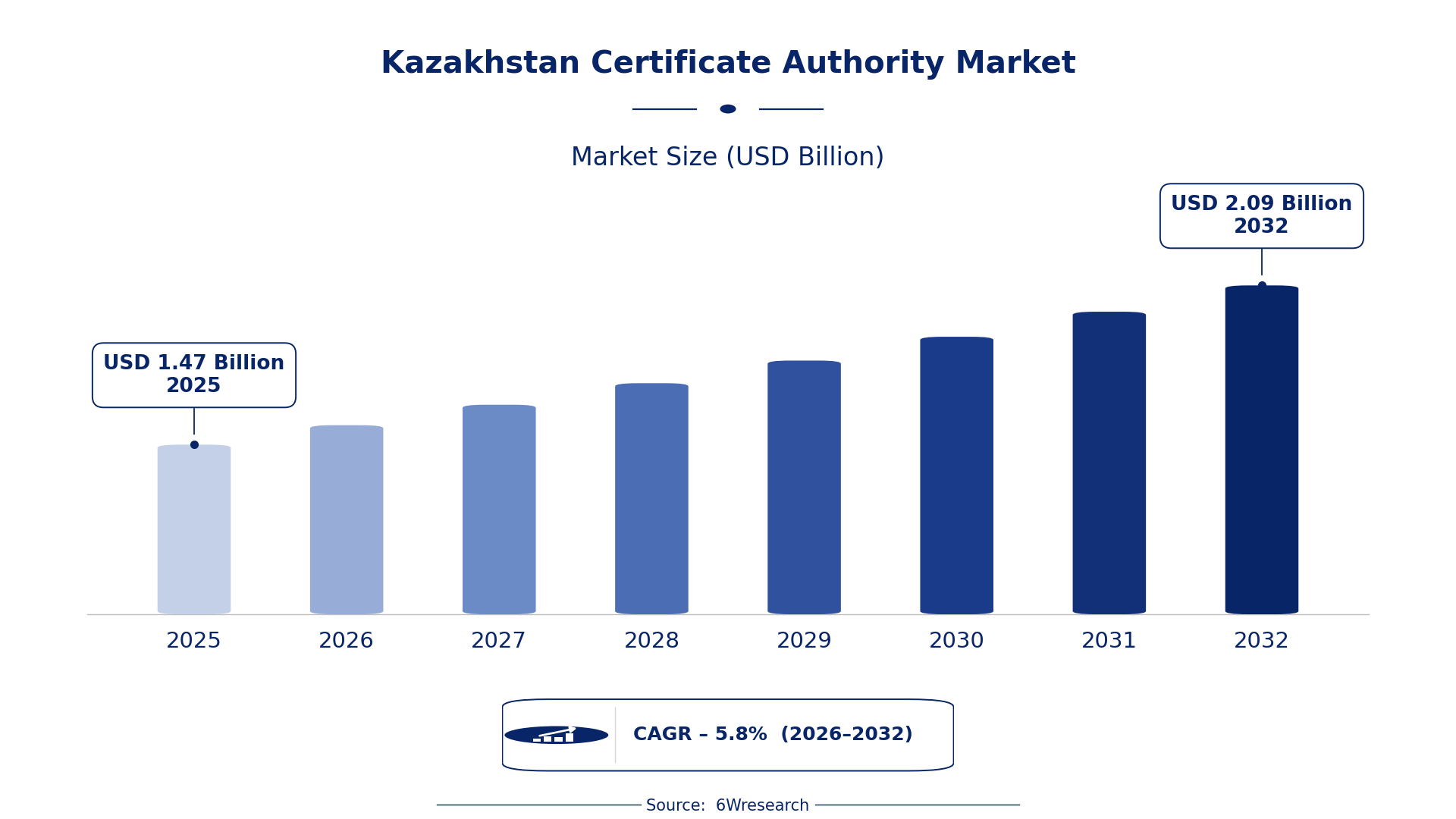
The Kazakhstan Certificate Authority Market was estimated at USD 1472 Million in 2025 and is projected to reach USD 2094 Million by 2032, growing at a CAGR of 5.8% from 2026 to 2032.
Kazakhstan Certificate Authority Market Synopsis
In Kazakhstan, the demand for digital certificates is being driven by an increasing reliance on secure online transactions. Businesses and government bodies alike are prioritizing cybersecurity, leading to a growing recognition of the necessity for digital certificates to protect sensitive information.
With the government implementing policies aimed at enhancing the cybersecurity infrastructure, the Certificate Authority market is set for continued expansion. This growth is further supported by a rising adoption of managed Public Key Infrastructure (PKI) services, allowing for more efficient management of certificate lifecycle processes.
Kazakhstan Certificate Authority Market Year-wise Growth Rate and Key Drivers
This graph illustrates the annual growth rates of the Kazakhstan Certificate Authority Market from 2021 to 2032, highlighting a steady upward trajectory and projected expansion over the forecast period.
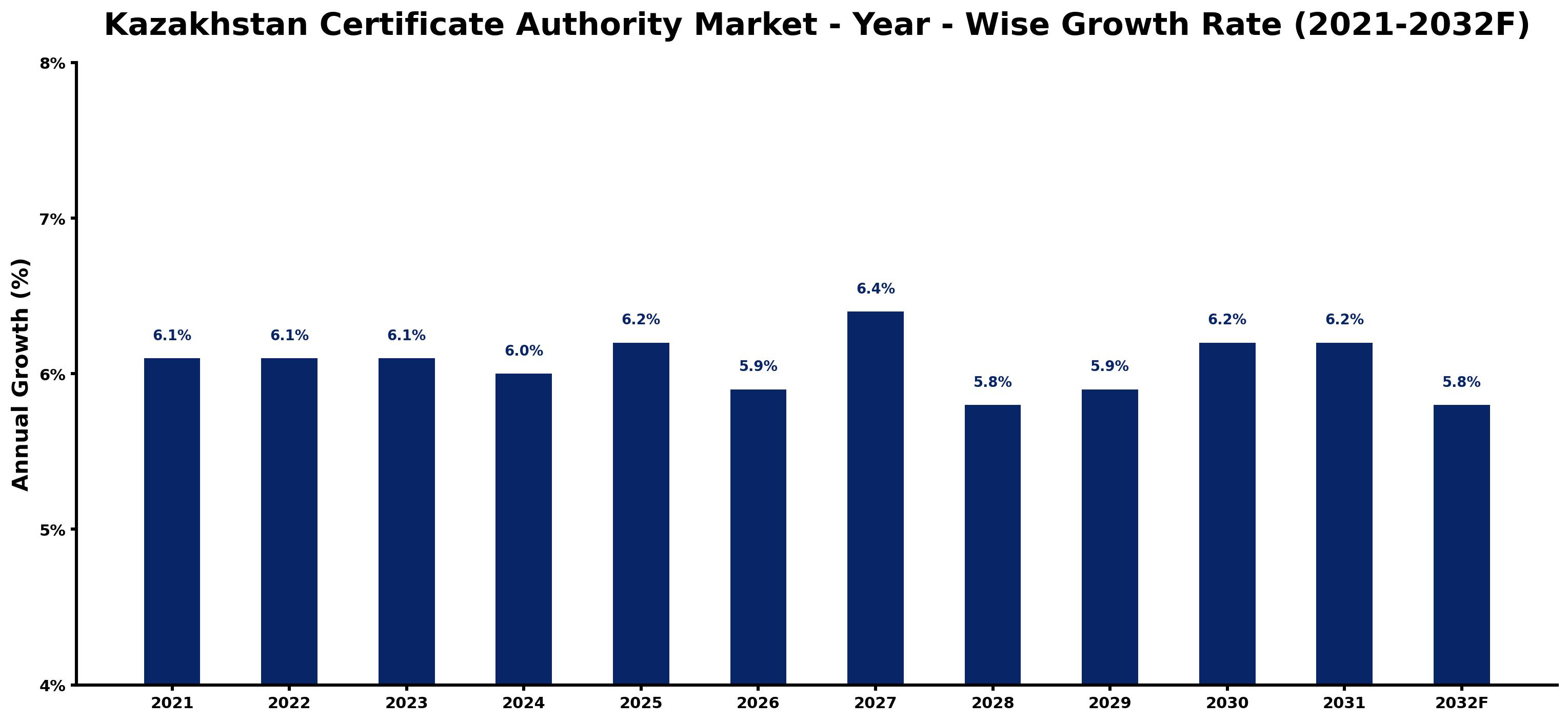
The table below presents the year‑wise growth rates along with the key drivers influencing the market
| Year | Growth Rate | Major Drivers |
| 2021 | 6.1% | Implementation of Kazakhstan's e-Government initiative. |
| 2022 | 6.1% | Increased demand for digital signatures in public services. |
| 2023 | 6.1% | Adoption of stricter cybersecurity laws enhancing certification needs. |
| 2024 | 6.0% | Growing reliance on secure online transactions in banking. |
| 2025 | 6.2% | Expanded use of biometrics in national identification programs. |
| 2026 | 5.9% | Enhanced regulatory framework for digital identity verification. |
| 2027 | 6.4% | Increased private sector focus on securing digital communications. |
| 2028 | 5.8% | Rising awareness of data protection regulations among businesses. |
| 2029 | 5.9% | Government push for digitalizing health records and services. |
| 2030 | 6.2% | Boost in remote work necessitating strong authentication measures. |
| 2031 | 6.2% | Growth in online education requiring secure access systems. |
| 2032 | 5.8% | Increased investments in blockchain technology for secure transactions. |
Note: Market size estimations and growth projections presented in this report are based on 6Wresearch's proprietary forecasting methodology, utilizing the latest available industry data, government publications, and primary research inputs.
Kazakhstan Certificate Authority Market Key Takeaways
Below are some of the specific key takeaways from the market, including:
- Increased awareness of cybersecurity is driving up demand for digital certificates in Kazakhstan.
- Managed PKI services are becoming increasingly popular for streamlining certificate management.
- Government initiatives to enhance cybersecurity are creating opportunities for market growth.
- The adoption of cloud-based certificate management solutions is on the rise.
- International Certificate Authorities pose competition, challenging local providers.
Evaluation of Restraints in Kazakhstan Certificate Authority Market
The Kazakhstan Certificate Authority market faces several hurdles, primarily stemming from a lack of awareness regarding the importance of digital certificates among businesses and consumers. This knowledge gap hampers the overall demand for CA services. Additionally, local providers struggle against established international Certificate Authorities, complicating competitive dynamics. on top of that, navigating regulatory compliance presents additional challenges for CA providers, further constraining market potential.
Kazakhstan Certificate Authority Market Trends
As the digital economy in Kazakhstan expands, the market is witnessing a surge in the uptake of SSL/TLS certificates. Companies are increasingly recognizing these certificates' role in encrypting online communications to protect user data and build consumer trust. There's also a notable shift towards cloud-based solutions, allowing businesses to manage certificates more flexibly and efficiently. This trend reflects a broader digital transformation within the country.
Kazakhstan Certificate Authority Market Opportunities
Investment opportunities in the Kazakhstan Certificate Authority market are significant as organizations prioritize cybersecurity measures. Companies seeking to enhance their digital security can explore partnerships with existing Certificate Authorities or create new ventures tailored to the burgeoning demand for encryption and authentication services. Collaborations with public agencies can also unlock avenues for growth, as government entities ramp up their cybersecurity initiatives.
Government Initiatives in the Kazakhstan Certificate Authority Market
The Kazakhstan government has taken proactive measures to regulate the Certificate Authority market, focusing on securing digital transactions and safeguarding data integrity. The implementation of stringent guidelines for CA operations is designed to foster trust within the digital economy, crucial for attracting both local and foreign investment.
- A national cybersecurity framework established in 2025 mandates strict adherence to data protection standards among Certificate Authorities.
- Ongoing audits are being conducted to ensure compliance with emerging regulatory requirements related to digital certificates.
- The introduction of a public initiative aimed at upgrading national digital infrastructure is expected to enhance CA services by mid-2026.
- Future plans for a cybersecurity awareness campaign are in the works, aiming to educate businesses and consumers about the importance of digital certificates.
Future Insights of the Kazakhstan Certificate Authority Market
Looking ahead to 2026-2032, the Kazakhstan Certificate Authority market is likely to experience sustained growth fueled by the rapid digitalization of business operations. As more enterprises recognize the value of secure online transactions, demand for digital certificates will continue to rise. Additionally, regulatory measures promoting encryption technologies will further bolster this trend, making it essential for companies to adapt to the changing landscape to remain competitive.
Kazakhstan Certificate Authority Market Latest Developments
Recent months have seen noteworthy developments in the Kazakhstan Certificate Authority market, reflecting an increasing commitment to cybersecurity from both private entities and governmental bodies. The market is evolving as companies implement new solutions to meet the growing demands of secure online transactions.
- A leading regional operator launched a new cloud-based PKI service in Q1 2025, aimed at improving certificate management for businesses.
- In late 2025, a major technology vendor announced a partnership with local CA providers to enhance security features in their digital offerings.
- Currently underway is an initiative to upgrade the digital infrastructure across key sectors, expected to complete by Q3 2026.
- A planned rollout of a comprehensive training program for local businesses focused on cybersecurity practices is set for 2027.
Kazakhstan Certificate Authority Market - Key Attractiveness of the Report
- 10 Years of Market Numbers
- Historical Data Starting from 2022 to 2025
- Base Year: 2025
- Forecast Data until 2032
- Key Performance Indicators Impacting the Market
- Major Upcoming Developments and Projects
Key Highlights of the Report:
- Kazakhstan Certificate Authority Market Outlook
- Market Size of Kazakhstan Certificate Authority Market, 2025
- Forecast of Kazakhstan Certificate Authority Market, 2032
- Historical Data and Forecast of Kazakhstan Certificate Authority Revenues & Volume for the Period 2022-2032F
- Kazakhstan Certificate Authority Market Trend Evolution
- Kazakhstan Certificate Authority Market Drivers and Challenges
- Kazakhstan Certificate Authority Price Trends
- Kazakhstan Certificate Authority Porter's Five Forces
- Kazakhstan Certificate Authority Industry Life Cycle
- Historical Data and Forecast of Kazakhstan Certificate Authority Market Revenues & Volume By Component for the Period 2022-2032F
- Historical Data and Forecast of Kazakhstan Certificate Authority Market Revenues & Volume By Certificate Types for the Period 2022-2032F
- Historical Data and Forecast of Kazakhstan Certificate Authority Market Revenues & Volume By Services for the Period 2022-2032F
- Historical Data and Forecast of Kazakhstan Certificate Authority Market Revenues & Volume By SSL Certification Validation Type for the Period 2022-2032F
- Historical Data and Forecast of Kazakhstan Certificate Authority Market Revenues & Volume By Domain Validation for the Period 2022-2032F
- Historical Data and Forecast of Kazakhstan Certificate Authority Market Revenues & Volume By Organization Validation for the Period 2022-2032F
- Historical Data and Forecast of Kazakhstan Certificate Authority Market Revenues & Volume By Extended Validation for the Period 2022-2032F
- Historical Data and Forecast of Kazakhstan Certificate Authority Market Revenues & Volume By Organization Size for the Period 2022-2032F
- Historical Data and Forecast of Kazakhstan Certificate Authority Market Revenues & Volume By Large Enterprises for the Period 2022-2032F
- Historical Data and Forecast of Kazakhstan Certificate Authority Market Revenues & Volume By SMEs for the Period 2022-2032F
- Historical Data and Forecast of Kazakhstan Certificate Authority Market Revenues & Volume By Vertical for the Period 2022-2032F
- Historical Data and Forecast of Kazakhstan Certificate Authority Market Revenues & Volume By BFSI for the Period 2022-2032F
- Historical Data and Forecast of Kazakhstan Certificate Authority Market Revenues & Volume By Retail and eCommerce for the Period 2022-2032F
- Historical Data and Forecast of Kazakhstan Certificate Authority Market Revenues & Volume By Government and Defense for the Period 2022-2032F
- Historical Data and Forecast of Kazakhstan Certificate Authority Market Revenues & Volume By Healthcare and Life Sciences for the Period 2022-2032F
- Historical Data and Forecast of Kazakhstan Certificate Authority Market Revenues & Volume By IT and Telecom for the Period 2022-2032F
- Historical Data and Forecast of Kazakhstan Certificate Authority Market Revenues & Volume By Travel and Hospitality for the Period 2022-2032F
- Historical Data and Forecast of Kazakhstan Certificate Authority Market Revenues & Volume By Education for the Period 2022-2032F
- Historical Data and Forecast of Kazakhstan Certificate Authority Market Revenues & Volume By Other verticals (transportation and logistics, media and entertainment, and manufacturing) for the Period 2022-2032F
- Kazakhstan Certificate Authority Import Export Trade Statistics
- Market Opportunity Assessment By Component
- Market Opportunity Assessment By SSL Certification Validation Type
- Market Opportunity Assessment By Organization Size
- Market Opportunity Assessment By Vertical
- Kazakhstan Certificate Authority Top Companies Market Share
- Kazakhstan Certificate Authority Competitive Benchmarking By Technical and Operational Parameters
- Kazakhstan Certificate Authority Company Profiles
- Kazakhstan Certificate Authority Key Strategic Recommendations






































