Kazakhstan Cranes Market: Import Trend Analysis
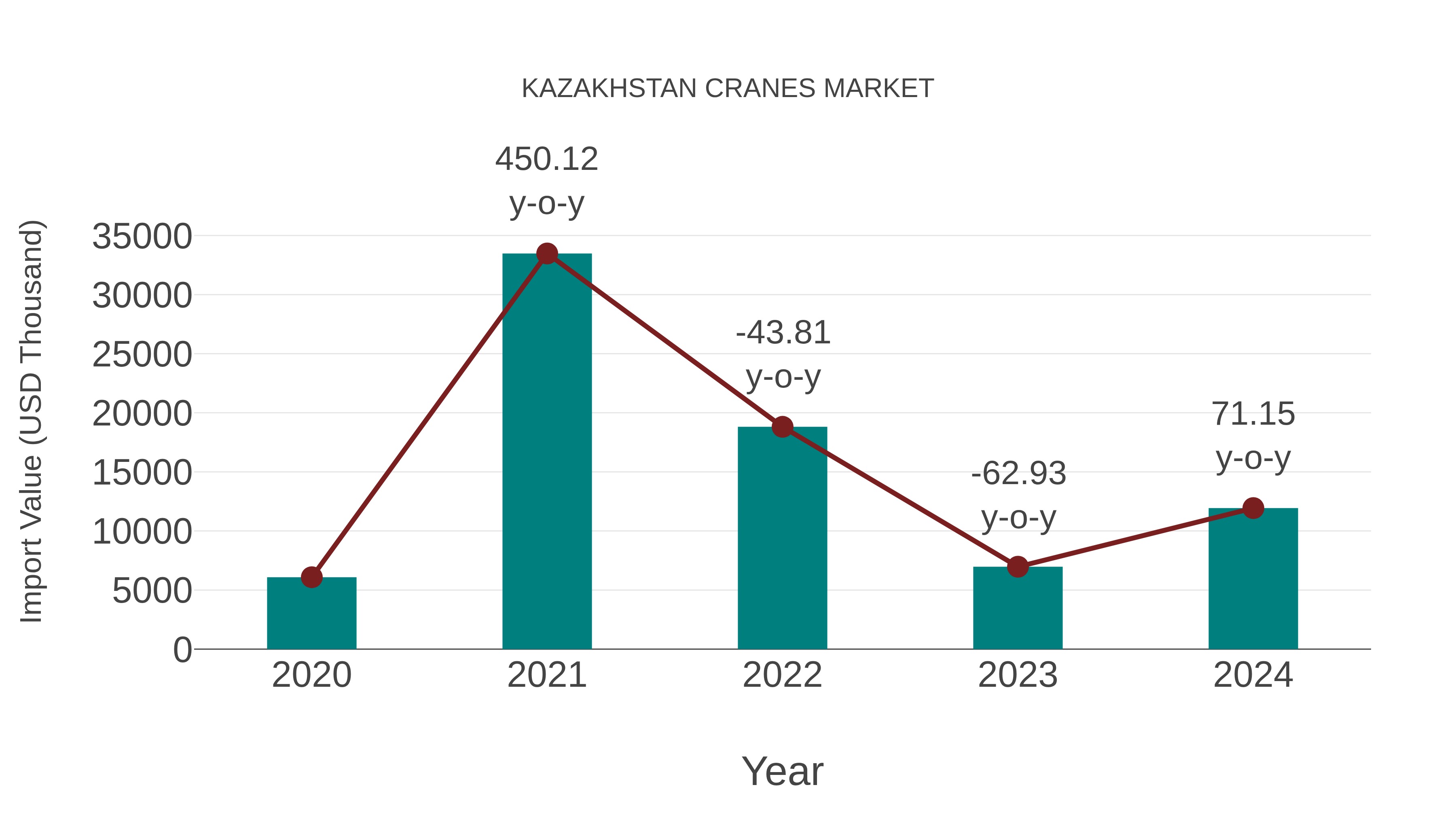
In the Kazakhstan cranes market, imports experienced a notable upward trajectory from 2023 to 2024, with a growth rate of 71.15%. The compound annual growth rate (CAGR) for imports during the period of 2020-2024 stood at 18.34%. This surge in import momentum can be attributed to a significant demand shift towards advanced crane technologies and increased infrastructure development projects in the region.
Cranes Market: Kazakhstan vs Top 5 Major Economies in 2027 (Asia)
By 2027, Kazakhstan's Cranes market is forecasted to achieve a growing growth rate of 7.74%, with China leading the Asia region, followed by India, Japan, Australia and South Korea.

Kazakhstan Cranes Market Overview
The cranes market in Kazakhstan is driven by infrastructure development projects across sectors such as construction, mining, and oil and gas. Cranes play a crucial role in lifting and transporting heavy materials and equipment, making them indispensable in various industrial applications. With increasing investments in infrastructure projects and industrial expansion, demand for cranes is expected to remain strong in Kazakhstan. The market is competitive, with both domestic and international manufacturers offering a variety of crane types and configurations to meet the specific requirements of different industries.
Drivers of the market
The cranes market in Kazakhstan is experiencing significant growth due to ongoing infrastructure development projects across the country. Rapid urbanization, coupled with government initiatives to improve transportation networks and industrial facilities, has led to an increased demand for cranes in construction, manufacturing, and logistics sectors. Moreover, the introduction of technologically advanced cranes with enhanced efficiency and safety features is further driving market growth, as companies seek to optimize their operations and minimize downtime.
Challenges of the market
The cranes market in Kazakhstan faces challenges related to the high initial investment and maintenance costs associated with crane equipment. Economic volatility and fluctuations in the construction and infrastructure sectors can lead to inconsistent demand. Additionally, there are regulatory requirements for safety and operation standards that must be adhered to, which can increase operational costs.
Government Policy of the market
Kazakhstan infrastructure development plans include support for the cranes market, with government incentives for purchasing modern and efficient cranes. Training programs for operators are also funded to ensure safety and efficiency.
Key Highlights of the Report:
- Kazakhstan Cranes Market Outlook
- Market Size of Kazakhstan Cranes Market, 2024
- Forecast of Kazakhstan Cranes Market, 2031
- Historical Data and Forecast of Kazakhstan Cranes Revenues & Volume for the Period 2018 - 2031
- Kazakhstan Cranes Market Trend Evolution
- Kazakhstan Cranes Market Drivers and Challenges
- Kazakhstan Cranes Price Trends
- Kazakhstan Cranes Porter's Five Forces
- Kazakhstan Cranes Industry Life Cycle
- Historical Data and Forecast of Kazakhstan Cranes Market Revenues & Volume By Product Type for the Period 2018 - 2031
- Historical Data and Forecast of Kazakhstan Cranes Market Revenues & Volume By Mobile for the Period 2018 - 2031
- Historical Data and Forecast of Kazakhstan Cranes Market Revenues & Volume By Fixed for the Period 2018 - 2031
- Historical Data and Forecast of Kazakhstan Cranes Market Revenues & Volume By Marine for the Period 2018 - 2031
- Historical Data and Forecast of Kazakhstan Cranes Market Revenues & Volume By End-User for the Period 2018 - 2031
- Historical Data and Forecast of Kazakhstan Cranes Market Revenues & Volume By Construction for the Period 2018 - 2031
- Historical Data and Forecast of Kazakhstan Cranes Market Revenues & Volume By Mining for the Period 2018 - 2031
- Historical Data and Forecast of Kazakhstan Cranes Market Revenues & Volume By Industrial for the Period 2018 - 2031
- Historical Data and Forecast of Kazakhstan Cranes Market Revenues & Volume By Oil & Gas for the Period 2018 - 2031
- Historical Data and Forecast of Kazakhstan Cranes Market Revenues & Volume By Others for the Period 2018 - 2031
- Kazakhstan Cranes Import Export Trade Statistics
- Market Opportunity Assessment By Product Type
- Market Opportunity Assessment By End-User
- Kazakhstan Cranes Top Companies Market Share
- Kazakhstan Cranes Competitive Benchmarking By Technical and Operational Parameters
- Kazakhstan Cranes Company Profiles
- Kazakhstan Cranes Key Strategic Recommendations






































