Kazakhstan E-wallet Market Size, Share & Growth Rate
The Kazakhstan E-wallet Market was estimated at USD 930 Million in 2025 and is projected to reach USD 1355 Million by 2032, growing at a CAGR of 5.5% from 2026 to 2032. This impressive trajectory can be attributed to the increasing adoption of digital payment solutions, along with a significant rise in smartphone usage and internet connectivity throughout the country. As consumers become more accustomed to the convenience of mobile payments, the e-wallet segment is poised for remarkable expansion.
Kazakhstan E-wallet Market Year-wise Growth Rate and Key Drivers
This graph highlights how the Kazakhstan E-wallet Market has steadily grown over the years, supported by major growth factors.
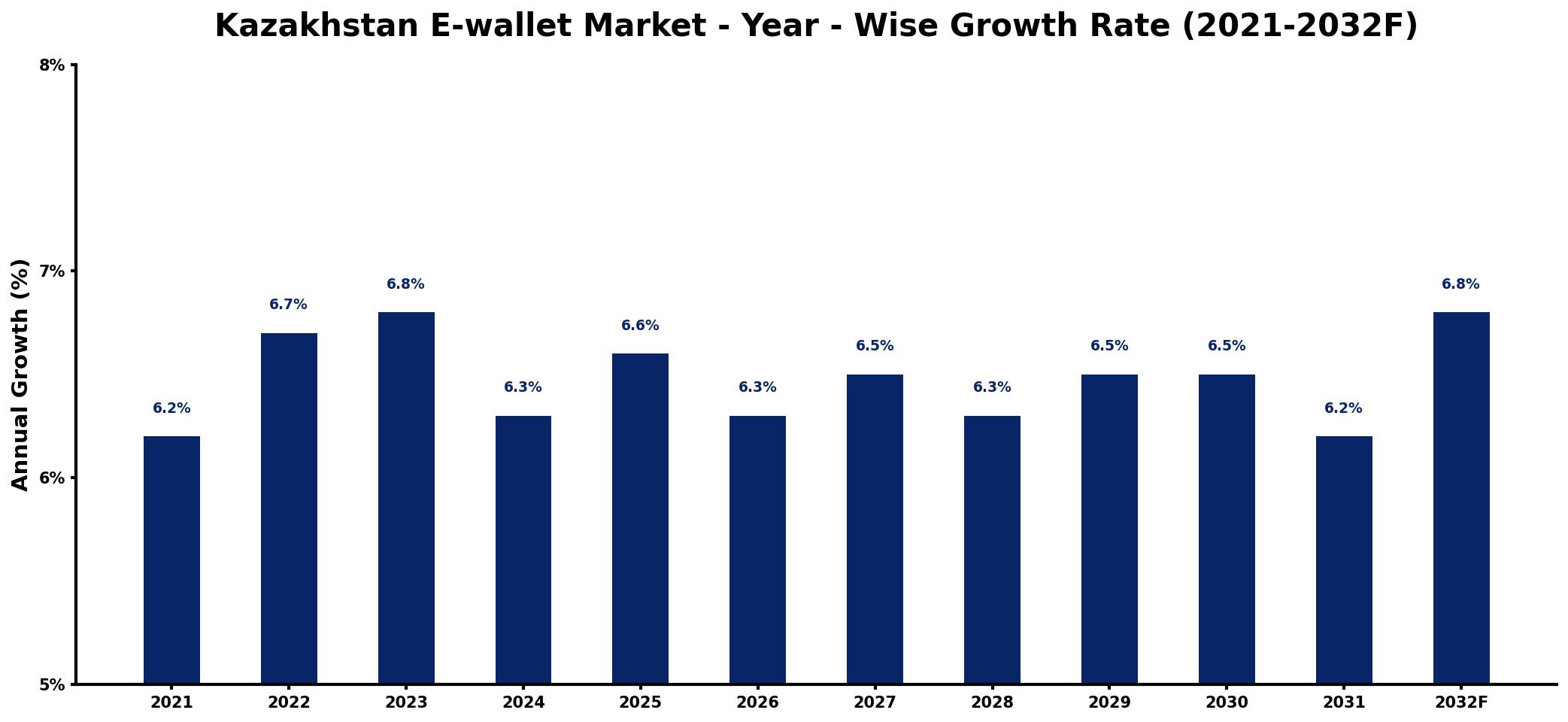
The table below presents the year‑wise growth rates along with the key drivers influencing the market
| Year | Growth Rate | Major Drivers |
| 2021 | 6.2% | Rising digital payment adoption |
| 2022 | 6.7% | Increased smartphone penetration rate |
| 2023 | 6.8% | Growing e-commerce market demand |
| 2024 | 6.3% | Expansion of fintech startups ecosystem |
| 2025 | 6.6% | Adoption of contactless payment solutions |
| 2026 | 6.3% | Investment in digital infrastructure growth |
| 2027 | 6.5% | Enhancement of consumer trust levels |
| 2028 | 6.3% | Emergence of new payment technologies |
| 2029 | 6.5% | Growth in cross-border transactions |
| 2030 | 6.5% | Increased merchant acceptance rates |
| 2031 | 6.2% | Development of loyalty reward programs |
| 2032 | 6.8% | Surge in mobile banking usage |
Note: Market size estimations and growth projections presented in this report are based on 6Wresearch's proprietary forecasting methodology, utilizing the latest available industry data, government publications, and primary research inputs.
Kazakhstan E-wallet Market Synopsis
The strongest force currently shaping the Kazakhstan E-wallet Market is the rising demand for digital payment methods. With the proliferation of e-commerce and online services, users are seeking secure and efficient ways to conduct transactions, driving the need for versatile e-wallet solutions. As a result, service providers are actively enhancing their offerings to meet these evolving consumer preferences.
Additionally, government initiatives aimed at promoting cashless transactions are further propelling market growth. These efforts not only bolster user confidence in digital payments but also facilitate wider financial inclusion, bringing previously underserved populations into the fold of the digital economy.
Kazakhstan E-wallet Market Key Takeaways
- The market is driven by increasing smartphone penetration and digital literacy.
- Collaboration among financial institutions, technology providers, and banks is enhancing service offerings.
- Government policies are pivotal in promoting security, privacy, and innovation in fintech.
- Consumer demand for convenience and security continues to rise, leading to greater e-wallet adoption.
- The market is expected to see significant growth through enhanced regulatory frameworks and educational initiatives.
Evaluation of Restraints in Kazakhstan E-wallet Market
Despite its growth, the Kazakhstan E-wallet Market encounters significant restraints related to regulatory compliance and consumer trust. Adhering to financial regulations and anti-money laundering laws is paramount for market players, posing a challenge in terms of operational costs and resource allocation. Furthermore, in regions with lower digital literacy rates, fostering consumer confidence in e-wallets remains a critical barrier to achieving widespread adoption. The apprehension surrounding online transactions necessitates robust security measures and educational initiatives to build user trust.
Kazakhstan E-wallet Market Trends
Emerging trends within the Kazakhstan E-wallet Market include a pronounced shift toward integrated financial services, where e-wallets offer more than just payment solutions. Features like budgeting tools, loyalty programs, and investment opportunities are becoming increasingly popular. Moreover, the integration of advanced technologies such as biometrics and artificial intelligence for enhanced security measures is gaining traction, promising improved user experiences and reduced fraud.
Furthermore, as the demand for cashless transactions surges, partnerships between e-wallet providers and various retail and service sectors are on the rise, facilitating seamless payment experiences and expanding the ecosystem of digital commerce.
Kazakhstan E-wallet Market Opportunities
There are significant growth opportunities in the Kazakhstan E-wallet Market, particularly in untapped segments such as rural areas where mobile penetration is accelerating. By focusing on developing user-friendly applications and educational campaigns tailored for less digitally literate populations, service providers can effectively expand their user base. Moreover, as small and medium-sized enterprises (SMEs) increasingly embrace digital transactions, e-wallets stand to gain a foothold in business solutions, offering invoicing and payment collection features tailored to this demographic.
Government Initiatives in the Kazakhstan E-wallet Market
The government of Kazakhstan is actively promoting policies that support the growth of the e-wallet market. Initiatives include the encouragement of cashless transactions through public awareness campaigns and the establishment of regulations that enhance security and consumer protection. Furthermore, efforts to promote financial literacy are in place, aimed at ensuring that more citizens understand and trust digital financial solutions. These government-backed programs are essential in driving the momentum of e-wallet adoption across the country.
Future Insights of the Kazakhstan E-wallet Market
Looking ahead to 2026-2032, the Kazakhstan E-wallet Market is poised for sustained growth, driven by the continuous evolution of digital payment technologies and changing consumer behaviors. As more users recognize the advantages of e-wallets for everyday transactions, market dynamics are expected to shift toward enhanced personalization and integration of additional services. The focus on security, user experience, and regulatory compliance will remain crucial for players aiming to solidify their positions in this competitive landscape.
Kazakhstan E-wallet Market Latest Developments (2025 - 2026)
Recent developments in the Kazakhstan E-wallet Market indicate a growing trend towards partnerships and collaborations aimed at expanding service offerings. Providers are increasingly aligning with local businesses to create integrated payment solutions that enhance user convenience. Moreover, technology advancements are being leveraged to improve transaction security, addressing one of the main concerns of potential users. These trends illustrate a dynamic market responding proactively to consumer needs and regulatory expectations.
Kazakhstan E-wallet Market - Key Attractiveness of the Report
- 10 Years of Market Numbers
- Historical Data Starting from 2022 to 2025
- Base Year: 2025
- Forecast Data until 2032
- Key Performance Indicators Impacting the Market
- Major Upcoming Developments and Projects
Key Highlights of the Report:
- Kazakhstan E-wallet Market Outlook
- Market Size of Kazakhstan E-wallet Market, 2025
- Forecast of Kazakhstan E-wallet Market, 2032
- Historical Data and Forecast of Kazakhstan E-wallet Revenues & Volume for the Period 2022-2032F
- Kazakhstan E-wallet Market Trend Evolution
- Kazakhstan E-wallet Market Drivers and Challenges
- Kazakhstan E-wallet Price Trends
- Kazakhstan E-wallet Porter's Five Forces
- Kazakhstan E-wallet Industry Life Cycle
- Historical Data and Forecast of Kazakhstan E-wallet Market Revenues & Volume By Application for the Period 2022-2032F
- Historical Data and Forecast of Kazakhstan E-wallet Market Revenues & Volume By Restaurants for the Period 2022-2032F
- Historical Data and Forecast of Kazakhstan E-wallet Market Revenues & Volume By Transportation for the Period 2022-2032F
- Historical Data and Forecast of Kazakhstan E-wallet Market Revenues & Volume By Banking for the Period 2022-2032F
- Historical Data and Forecast of Kazakhstan E-wallet Market Revenues & Volume By Retail for the Period 2022-2032F
- Historical Data and Forecast of Kazakhstan E-wallet Market Revenues & Volume By Type for the Period 2022-2032F
- Historical Data and Forecast of Kazakhstan E-wallet Market Revenues & Volume By Closed E Wallets for the Period 2022-2032F
- Historical Data and Forecast of Kazakhstan E-wallet Market Revenues & Volume By Semi Closed E Wallets for the Period 2022-2032F
- Historical Data and Forecast of Kazakhstan E-wallet Market Revenues & Volume By Open E Wallets for the Period 2022-2032F
- Historical Data and Forecast of Kazakhstan E-wallet Market Revenues & Volume By Mode for the Period 2022-2032F
- Historical Data and Forecast of Kazakhstan E-wallet Market Revenues & Volume By Online for the Period 2022-2032F
- Historical Data and Forecast of Kazakhstan E-wallet Market Revenues & Volume By M Wallet for the Period 2022-2032F
- Historical Data and Forecast of Kazakhstan E-wallet Market Revenues & Volume By Mode for the Period 2022-2032F
- Historical Data and Forecast of Kazakhstan E-wallet Market Revenues & Volume By Online for the Period 2022-2032F
- Historical Data and Forecast of Kazakhstan E-wallet Market Revenues & Volume By M Wallet for the Period 2022-2032F
- Kazakhstan E-wallet Import Export Trade Statistics
- Market Opportunity Assessment By Application
- Market Opportunity Assessment By Type
- Market Opportunity Assessment By Mode
- Kazakhstan E-wallet Top Companies Market Share
- Kazakhstan E-wallet Competitive Benchmarking By Technical and Operational Parameters
- Kazakhstan E-wallet Company Profiles
- Kazakhstan E-wallet Key Strategic Recommendations






































