Kazakhstan Edible Oil Market Size Growth Rate
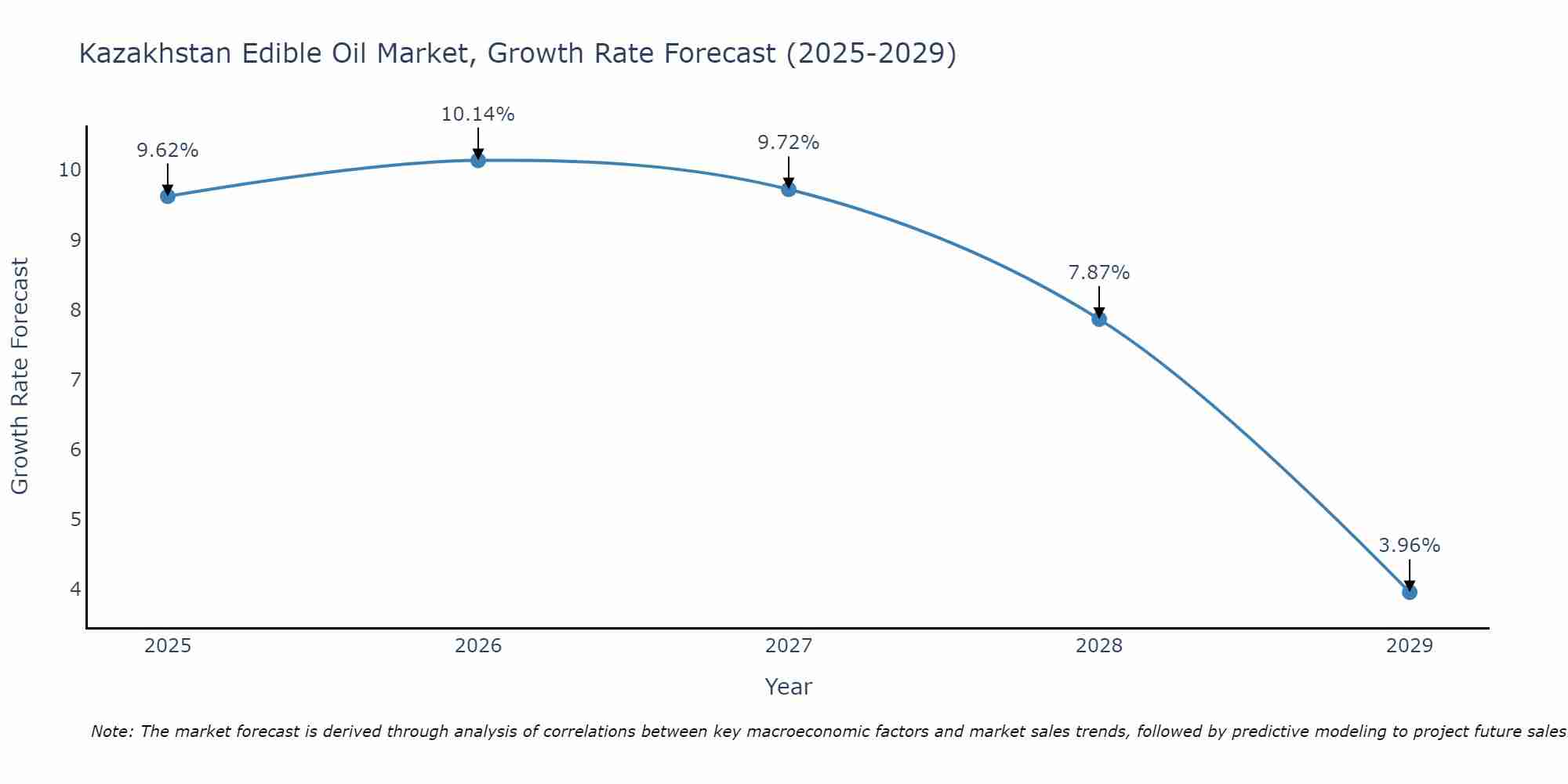
The Kazakhstan Edible Oil Market is projected to witness mixed growth rate patterns during 2025 to 2029. Starting at 9.62% in 2025, the market peaks at 10.14% in 2026, and settles at 3.96% by 2029.
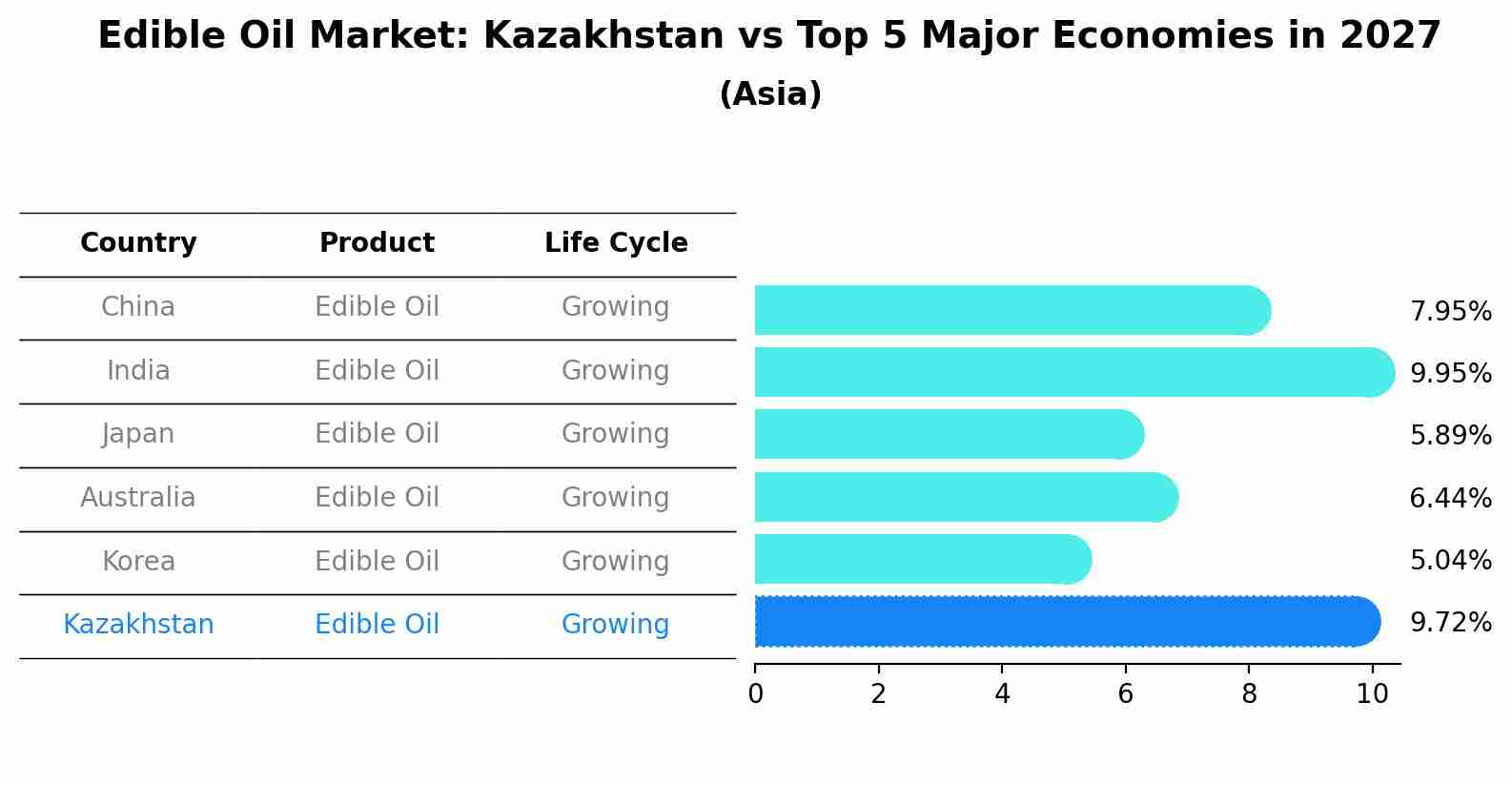
Edible Oil Market: Kazakhstan vs Top 5 Major Economies in 2027 (Asia)
Kazakhstan's Edible Oil market is anticipated to experience a growing growth rate of 9.72% by 2027, reflecting trends observed in the largest economy China, followed by India, Japan, Australia and South Korea.
Kazakhstan Edible Oil Market Overview
The Kazakhstan edible oil market is witnessing steady growth driven by factors such as increasing health consciousness among consumers, rising disposable income, and a growing food industry. Sunflower oil is the most commonly consumed edible oil in Kazakhstan, with a significant portion of the population preferring locally produced oils. The market is also seeing a shift towards healthier oil options like olive oil and other vegetable oils due to changing dietary preferences. Key players in the market include EFKO Group, KazOil, and Kusto Group, among others. The market is competitive, with players focusing on product innovation, quality, and expanding distribution networks to maintain their market share. Overall, the Kazakhstan edible oil market is poised for further growth with opportunities for both domestic and international players to capitalize on the evolving consumer preferences.
Kazakhstan Edible Oil Market Trends
The Kazakhstan Edible Oil Market is experiencing several key trends. Firstly, there is a growing preference for healthier oil options such as olive oil and sunflower oil, driven by increasing health awareness among consumers. Additionally, there is a rising demand for organic and sustainable edible oils, reflecting a broader global trend towards more environmentally friendly products. The market is also seeing a shift towards convenient packaging formats, with a growing preference for smaller and more portable oil containers. Lastly, there is an increasing focus on product innovation and differentiation, with manufacturers introducing new flavors and blends to cater to changing consumer preferences. Overall, these trends indicate a dynamic and evolving landscape in the Kazakhstan Edible Oil Market.
Kazakhstan Edible Oil Market Challenges
In the Kazakhstan Edible Oil Market, several challenges are prevalent. One major challenge is the increasing competition from imported edible oils, which often come at lower prices due to economies of scale in production. This can put pressure on local edible oil producers to lower their prices, impacting their profit margins. Additionally, fluctuations in global commodity prices can affect the cost of raw materials for edible oil production, leading to uncertainty in pricing strategies. Another challenge is the need for continuous innovation and product development to meet changing consumer preferences and demand for healthier oil options. Furthermore, logistical challenges in transportation and distribution infrastructure can also hinder the smooth supply chain operations in the market. Overall, navigating these challenges requires strategic planning and adaptation for edible oil companies in Kazakhstan.
Kazakhstan Edible Oil Market Investment Opportunities
The Kazakhstan Edible Oil Market presents attractive investment opportunities due to the country`s growing economy and increasing consumer demand for healthy cooking oils. With a rising middle-class population and changing dietary preferences towards healthier options, there is a growing market for high-quality edible oils such as sunflower oil, soybean oil, and olive oil. Investing in local production facilities or distribution networks can capitalize on the market potential. Additionally, investing in research and development to introduce innovative products or packaging solutions that cater to the evolving consumer preferences can further enhance market presence and profitability. Partnering with local suppliers or exploring strategic alliances with distribution channels can also provide a competitive advantage in this evolving market landscape.
Kazakhstan Edible Oil Market Government Policy
The Kazakhstan government has implemented various policies to support the edible oil market in the country. These policies include import tariffs and trade regulations to protect domestic producers, subsidies for local farmers to boost production of oilseeds, and quality control measures to ensure the safety and standards of edible oil products. Additionally, the government has focused on promoting sustainable practices in the industry to enhance food security and reduce reliance on imports. Overall, the government`s policies aim to stimulate growth in the Kazakhstan edible oil market, support local businesses, and safeguard consumer interests through regulatory measures.
Kazakhstan Edible Oil Market Future Outlook
The future outlook for the Kazakhstan Edible Oil Market is positive with steady growth anticipated in the coming years. Factors such as increasing consumer awareness about the health benefits of using edible oils, rising disposable incomes, and a growing trend towards healthier cooking oils are expected to drive market expansion. Additionally, the rising demand for convenience foods and the growing food processing industry in Kazakhstan are likely to further boost the market. Key players in the industry are focusing on product innovation, expanding their distribution networks, and adopting sustainable practices to stay competitive in the market. Overall, the Kazakhstan Edible Oil Market is poised for growth, with opportunities for both domestic and international players to capitalize on the evolving consumer preferences and market dynamics.
Key Highlights of the Report:
- Kazakhstan Edible Oil Market Outlook
- Market Size of Kazakhstan Edible Oil Market, 2021
- Forecast of Kazakhstan Edible Oil Market, 2031
- Historical Data and Forecast of Kazakhstan Edible Oil Revenues & Volume for the Period 2018 - 2031
- Kazakhstan Edible Oil Market Trend Evolution
- Kazakhstan Edible Oil Market Drivers and Challenges
- Kazakhstan Edible Oil Price Trends
- Kazakhstan Edible Oil Porter's Five Forces
- Kazakhstan Edible Oil Industry Life Cycle
- Historical Data and Forecast of Kazakhstan Edible Oil Market Revenues & Volume By Type for the Period 2018 - 2031
- Historical Data and Forecast of Kazakhstan Edible Oil Market Revenues & Volume By Palm Oil for the Period 2018 - 2031
- Historical Data and Forecast of Kazakhstan Edible Oil Market Revenues & Volume By Soybean Oil for the Period 2018 - 2031
- Historical Data and Forecast of Kazakhstan Edible Oil Market Revenues & Volume By Mustard Oil for the Period 2018 - 2031
- Historical Data and Forecast of Kazakhstan Edible Oil Market Revenues & Volume By Sunflower Oil for the Period 2018 - 2031
- Historical Data and Forecast of Kazakhstan Edible Oil Market Revenues & Volume By Others for the Period 2018 - 2031
- Historical Data and Forecast of Kazakhstan Edible Oil Market Revenues & Volume By for the Period 2018 - 2031
- Historical Data and Forecast of Kazakhstan Edible Oil Market Revenues & Volume By Packaging Type for the Period 2018 - 2031
- Historical Data and Forecast of Kazakhstan Edible Oil Market Revenues & Volume By Pouches for the Period 2018 - 2031
- Historical Data and Forecast of Kazakhstan Edible Oil Market Revenues & Volume By Jars for the Period 2018 - 2031
- Historical Data and Forecast of Kazakhstan Edible Oil Market Revenues & Volume By Cans for the Period 2018 - 2031
- Historical Data and Forecast of Kazakhstan Edible Oil Market Revenues & Volume By Bottles for the Period 2018 - 2031
- Historical Data and Forecast of Kazakhstan Edible Oil Market Revenues & Volume By for the Period 2018 - 2031
- Historical Data and Forecast of Kazakhstan Edible Oil Market Revenues & Volume By Pack Size for the Period 2018 - 2031
- Historical Data and Forecast of Kazakhstan Edible Oil Market Revenues & Volume By Less than 1 Litres for the Period 2018 - 2031
- Historical Data and Forecast of Kazakhstan Edible Oil Market Revenues & Volume By 1 Litres for the Period 2018 - 2031
- Historical Data and Forecast of Kazakhstan Edible Oil Market Revenues & Volume By 1 Litres - 5 litres for the Period 2018 - 2031
- Historical Data and Forecast of Kazakhstan Edible Oil Market Revenues & Volume By 5 Litres - 10 Litres for the Period 2018 - 2031
- Historical Data and Forecast of Kazakhstan Edible Oil Market Revenues & Volume By 10 Litres and Above for the Period 2018 - 2031
- Historical Data and Forecast of Kazakhstan Edible Oil Market Revenues & Volume By for the Period 2018 - 2031
- Historical Data and Forecast of Kazakhstan Edible Oil Market Revenues & Volume By Packaging Material for the Period 2018 - 2031
- Historical Data and Forecast of Kazakhstan Edible Oil Market Revenues & Volume By Metal for the Period 2018 - 2031
- Historical Data and Forecast of Kazakhstan Edible Oil Market Revenues & Volume By Plastic for the Period 2018 - 2031
- Historical Data and Forecast of Kazakhstan Edible Oil Market Revenues & Volume By Paper for the Period 2018 - 2031
- Historical Data and Forecast of Kazakhstan Edible Oil Market Revenues & Volume By Others for the Period 2018 - 2031
- Historical Data and Forecast of Kazakhstan Edible Oil Market Revenues & Volume By Application for the Period 2018 - 2031
- Historical Data and Forecast of Kazakhstan Edible Oil Market Revenues & Volume By HoReCa for the Period 2018 - 2031
- Historical Data and Forecast of Kazakhstan Edible Oil Market Revenues & Volume By Home Users for the Period 2018 - 2031
- Historical Data and Forecast of Kazakhstan Edible Oil Market Revenues & Volume By Food Processing Industry for the Period 2018 - 2031
- Historical Data and Forecast of Kazakhstan Edible Oil Market Revenues & Volume By for the Period 2018 - 2031
- Historical Data and Forecast of Kazakhstan Edible Oil Market Revenues & Volume By Distribution Channel for the Period 2018 - 2031
- Historical Data and Forecast of Kazakhstan Edible Oil Market Revenues & Volume By Direct/Institutional Sales for the Period 2018 - 2031
- Historical Data and Forecast of Kazakhstan Edible Oil Market Revenues & Volume By Supermarkets and Hypermarkets for the Period 2018 - 2031
- Historical Data and Forecast of Kazakhstan Edible Oil Market Revenues & Volume By Convenience Stores for the Period 2018 - 2031
- Historical Data and Forecast of Kazakhstan Edible Oil Market Revenues & Volume By Online for the Period 2018 - 2031
- Historical Data and Forecast of Kazakhstan Edible Oil Market Revenues & Volume By Others for the Period 2018 - 2031
- Kazakhstan Edible Oil Import Export Trade Statistics
- Market Opportunity Assessment By Type
- Market Opportunity Assessment By Packaging Type
- Market Opportunity Assessment By Pack Size
- Market Opportunity Assessment By Packaging Material
- Market Opportunity Assessment By Application
- Market Opportunity Assessment By Distribution Channel
- Kazakhstan Edible Oil Top Companies Market Share
- Kazakhstan Edible Oil Competitive Benchmarking By Technical and Operational Parameters
- Kazakhstan Edible Oil Company Profiles
- Kazakhstan Edible Oil Key Strategic Recommendations






































