Kazakhstan Fish and Seafood Market Size, Share & Growth Rate
The Kazakhstan Fish and Seafood Market was estimated at USD 382 Million in 2025 and is projected to reach USD 522 Million by 2032, growing at a CAGR of 4.6% from 2026 to 2032. This growth trajectory is fueled by increasing consumer awareness about the health benefits of seafood, alongside a growing inclination towards protein-rich diets. As domestic production struggles to keep pace, the reliance on imports ensures a diverse array of products is available, further driving market expansion.
Kazakhstan Fish and Seafood Market Year-wise Growth Rate and Key Drivers
This graph highlights how the Kazakhstan Fish and Seafood Market has steadily grown over the years, supported by major growth factors.
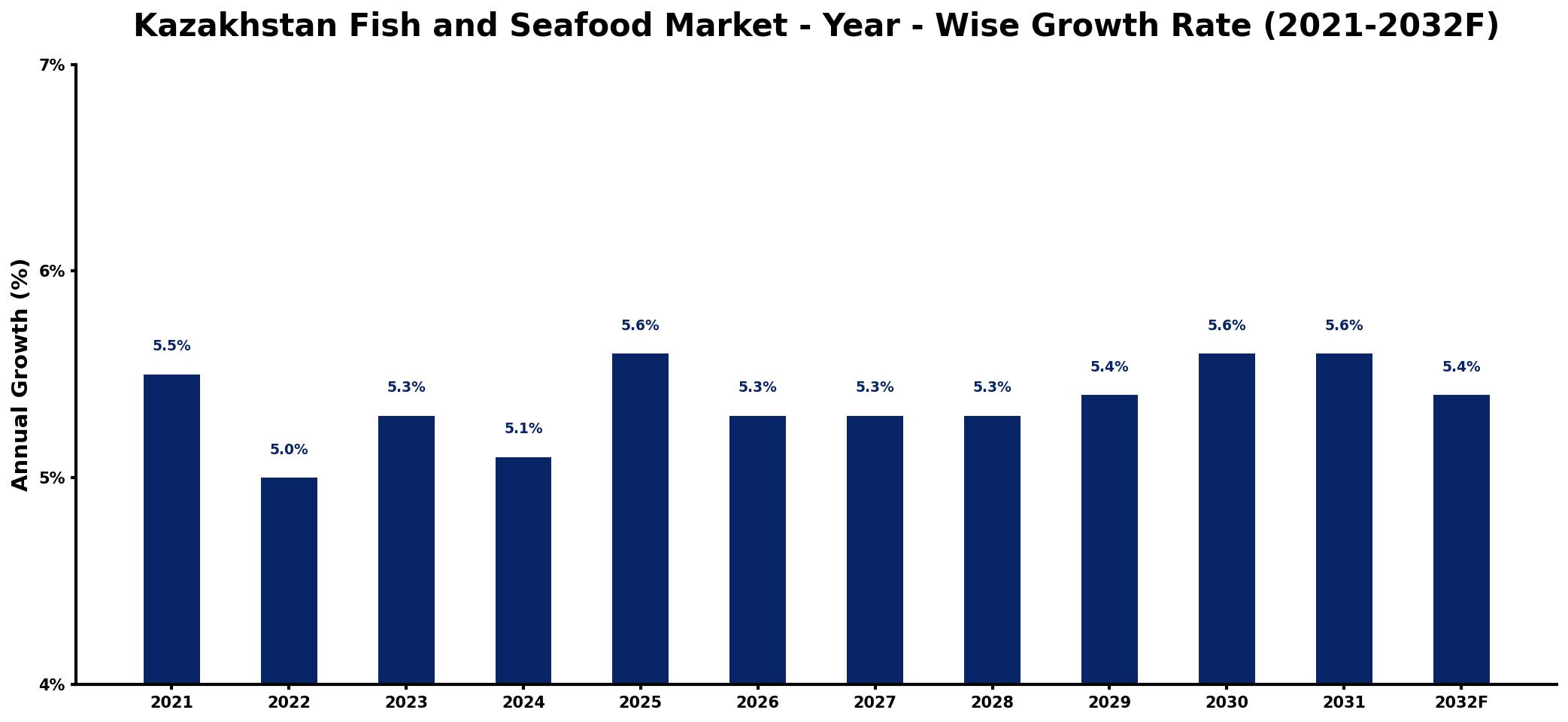
The table below presents the year‑wise growth rates along with the key drivers influencing the market
| Year | Growth Rate | Major Drivers |
| 2021 | 5.5% | Rising consumer health awareness |
| 2022 | 5.0% | Increased domestic production capacity |
| 2023 | 5.3% | Expansion of export markets |
| 2024 | 5.1% | Growing popularity of sustainability |
| 2025 | 5.6% | Investment in aquaculture technologies |
| 2026 | 5.3% | Enhanced distribution network efficiency |
| 2027 | 5.3% | Surge in online retail channels |
| 2028 | 5.3% | Growth of local culinary trends |
| 2029 | 5.4% | Rising disposable income levels |
| 2030 | 5.6% | Increased focus on nutrition |
| 2031 | 5.6% | Adoption of innovative packaging solutions |
| 2032 | 5.4% | Strengthened regulatory support framework |
Note: Market size estimations and growth projections presented in this report are based on 6Wresearch's proprietary forecasting methodology, utilizing the latest available industry data, government publications, and primary research inputs.
Kazakhstan Fish and Seafood Market Synopsis
Recently, the Kazakhstan Fish and Seafood Market has demonstrated steady momentum; however, significant opportunities remain for growth in the coming years. With rising disposable incomes and a shift towards healthier eating habits, the market is set for transformation, moving from a predominantly import-driven landscape to one that increasingly values local offerings and sustainability.
As consumer preferences evolve, the market is likely to see a greater emphasis on premium, high-quality seafood products, alongside innovative distribution channels that cater to the modern consumers needs. By focusing on sustainability and local sourcing, stakeholders can better align with the shifting consumer sentiment towards food quality and environmental consciousness.
Kazakhstan Fish and Seafood Market Key Takeaways
- The market is increasingly influenced by a consumer shift towards health and wellness, driving demand for seafood.
- Premium and sustainable seafood products are gaining traction among Kazakhstan's growing middle-class population.
- Key distribution channels include retail outlets, supermarkets, and an emerging e-commerce segment.
- Logistical challenges due to the landlocked nature of the country remain a critical concern for freshness and availability.
- Government initiatives are actively promoting sustainable fishing practices and market access for local producers.
Evaluation of Restraints in Kazakhstan Fish and Seafood Market
Despite the potential for growth, the Kazakhstan Fish and Seafood Market faces distinct challenges that may hinder its progress. The landlocked nature of the country poses significant logistical and transportation issues, affecting the freshness and availability of seafood products. These hurdles are compounded by concerns regarding the sustainability of local fisheries and the risk of overfishing, which could lead to both product shortages and price volatility. Furthermore, ensuring compliance with quality control and food safety standards presents an ongoing challenge, particularly for imported seafood. Addressing these limitations will require targeted strategies to enhance domestic capabilities and regulatory frameworks.
Kazakhstan Fish and Seafood Market Trends
Current trends in the Kazakhstan Fish and Seafood Market indicate a significant shift towards premium and sustainably sourced seafood products. There is an increasing consumer preference for fresh, high-quality fish varieties such as salmon and trout, reflecting a growing health consciousness. Additionally, the convenience factor is rising; consumers are seeking ready-to-cook and ready-to-eat seafood solutions that fit into their busy lifestyles. The adoption of e-commerce platforms has also gained momentum, allowing customers to access a broader selection of seafood products with ease.
Kazakhstan Fish and Seafood Market Opportunities
The Kazakhstan Fish and Seafood Market presents numerous investment opportunities as consumer demand for quality seafood continues to rise. With a burgeoning middle class and increased disposable income, the market is ripe for development in areas such as aquaculture and processing facilities. Establishing more efficient distribution networks will also be crucial in ensuring that high-quality seafood reaches consumers quickly and effectively. Furthermore, investments in logistics infrastructure could greatly enhance the supply chain, addressing current limitations and unlocking further growth potential.
Government Initiatives in the Kazakhstan Fish and Seafood Market
The Kazakhstan government has implemented a range of policies aimed at enhancing the Fish and Seafood Market. These initiatives focus on promoting sustainable fishing practices, improving food safety and quality standards, and facilitating better market access for local producers. Additionally, the government offers financial incentives and support to encourage investment in fishery enterprises. By fostering international cooperation within the fishing sector, Kazakhstan is working to enhance the competitiveness and sustainability of its seafood industry.
Future Insights of the Kazakhstan Fish and Seafood Market
Looking ahead, the Kazakhstan Fish and Seafood Market is on track for steady growth from 2026 to 2032. The increasing awareness of the health benefits associated with seafood consumption, coupled with rising disposable incomes, is expected to further stimulate market demand. The governments focus on promoting aquaculture and enhancing fishing practices will likely contribute to a more sustainable seafood supply. As urbanization continues and Western dietary habits become more prevalent, the demand for diverse seafood products is set to rise, presenting exciting opportunities for market participants.
Kazakhstan Fish and Seafood Market Latest Developments (2025 - 2026)
Recent developments in the Kazakhstan Fish and Seafood Market indicate a growing emphasis on sustainability and innovation. There has been a notable increase in the introduction of new premium seafood products aimed at health-conscious consumers. Additionally, retailers are expanding their online platforms to enhance convenience and product accessibility. Collaborative efforts between the government and private sector are also underway, focusing on improving fishing practices and local production capabilities to meet the rising demand.
Kazakhstan Fish and Seafood Market - Key Attractiveness of the Report
- 10 Years of Market Numbers
- Historical Data Starting from 2022 to 2025
- Base Year: 2025
- Forecast Data until 2032
- Key Performance Indicators Impacting the Market
- Major Upcoming Developments and Projects
Key Highlights of the Report:
- Kazakhstan Fish and Seafood Market Outlook
- Market Size of Kazakhstan Fish and Seafood Market, 2025
- Forecast of Kazakhstan Fish and Seafood Market, 2032
- Historical Data and Forecast of Kazakhstan Fish and Seafood Revenues & Volume for the Period 2022-2032F
- Kazakhstan Fish and Seafood Market Trend Evolution
- Kazakhstan Fish and Seafood Market Drivers and Challenges
- Kazakhstan Fish and Seafood Price Trends
- Kazakhstan Fish and Seafood Porter's Five Forces
- Kazakhstan Fish and Seafood Industry Life Cycle
- Historical Data and Forecast of Kazakhstan Fish and Seafood Market Revenues & Volume By Product Types for the Period 2022-2032F
- Historical Data and Forecast of Kazakhstan Fish and Seafood Market Revenues & Volume By Fresh Fish and Seafood for the Period 2022-2032F
- Historical Data and Forecast of Kazakhstan Fish and Seafood Market Revenues & Volume By Canned Fish and Seafood for the Period 2022-2032F
- Historical Data and Forecast of Kazakhstan Fish and Seafood Market Revenues & Volume By Frozen Fish and Seafood for the Period 2022-2032F
- Historical Data and Forecast of Kazakhstan Fish and Seafood Market Revenues & Volume By Other Fish and Seafood for the Period 2022-2032F
- Kazakhstan Fish and Seafood Import Export Trade Statistics
- Market Opportunity Assessment By Product Types
- Kazakhstan Fish and Seafood Top Companies Market Share
- Kazakhstan Fish and Seafood Competitive Benchmarking By Technical and Operational Parameters
- Kazakhstan Fish and Seafood Company Profiles
- Kazakhstan Fish and Seafood Key Strategic Recommendations






































