Kazakhstan Functional Apparel Market Size, Share & Growth Rate
The Kazakhstan Functional Apparel Market was estimated at USD 205 Million in 2025 and is projected to reach USD 281 Million by 2032, growing at a CAGR of 4.6% from 2026 to 2032. This growth trajectory is primarily driven by an increasingly health-conscious population and a surge in outdoor activities. As more consumers embrace fitness and adventure, the demand for specialized apparel that enhances performance and comfort continues to rise.
Kazakhstan Functional Apparel Market Year-wise Growth Rate and Key Drivers
This graph highlights how the Kazakhstan Functional Apparel Market has steadily grown over the years, supported by major growth factors.
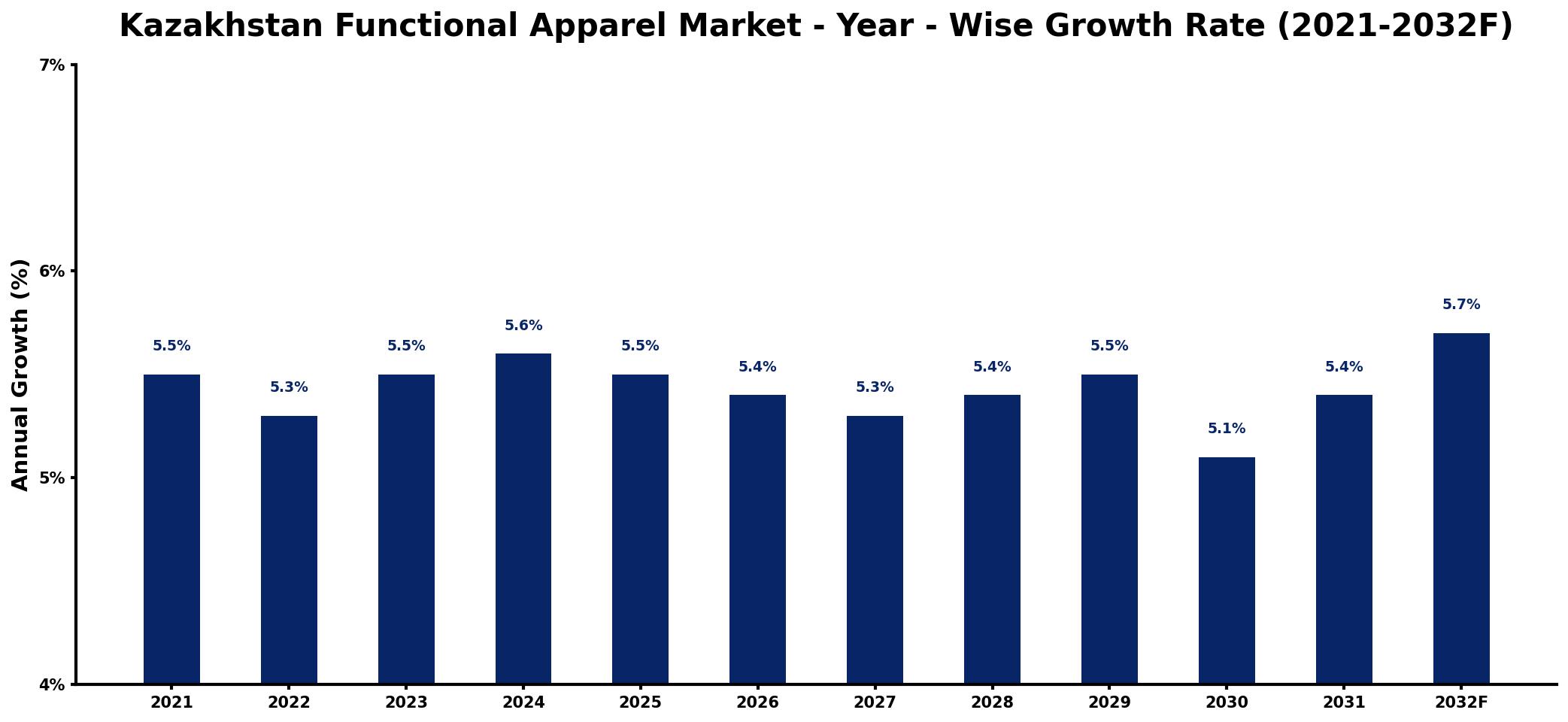
The table below presents the year‑wise growth rates along with the key drivers influencing the market
| Year | Growth Rate | Major Drivers |
| 2021 | 5.5% | Rising interest in outdoor activities |
| 2022 | 5.3% | Increased health and wellness awareness |
| 2023 | 5.5% | Growth in e-commerce platforms |
| 2024 | 5.6% | Expansion of fitness centers |
| 2025 | 5.5% | Surge in environmental sustainability focus |
| 2026 | 5.4% | Technological advancements in materials |
| 2027 | 5.3% | Growing urban population demand |
| 2028 | 5.4% | Strengthened local manufacturing initiatives |
| 2029 | 5.5% | Enhanced marketing strategies effectiveness |
| 2030 | 5.1% | Emergence of smart technology integration |
| 2031 | 5.4% | Boost in youth lifestyle trends |
| 2032 | 5.7% | improved raw material availability |
Note: Market size estimations and growth projections presented in this report are based on 6Wresearch's proprietary forecasting methodology, utilizing the latest available industry data, government publications, and primary research inputs.
Kazakhstan Functional Apparel Market Synopsis
The Kazakhstan Functional Apparel Market is experiencing a transformative shift as consumers gravitate towards clothing that combines functionality with style. This evolution reflects broader lifestyle changes, characterized by a growing emphasis on health, wellness, and outdoor recreational activities.
Moreover, innovations in material technology have enabled the creation of performance-oriented apparel that caters to specific needs—such as moisture-wicking properties, thermal insulation, and UV protection—making functional apparel increasingly desirable among consumers in Kazakhstan.
Kazakhstan Functional Apparel Market Key Takeaways
- The market is on a robust growth path due to rising consumer health awareness and outdoor activity participation.
- Advancements in fabric technology are significantly enhancing the functionality and comfort of apparel.
- Consumers are increasingly merging their active lifestyles with fashion trends, propelling the athleisure segment.
- Local manufacturers are supported by government initiatives promoting innovation in high-performance textiles.
- Despite challenges, the market presents numerous opportunities for expansion through targeted branding and innovation.
Evaluation of Restraints in Kazakhstan Functional Apparel Market
While the Kazakhstan Functional Apparel Market holds significant potential, it grapples with several constraints that can impede growth. High production costs are a major barrier, stemming from the advanced materials and technologies required to manufacture high-performance apparel. Additionally, there exists a relatively low level of consumer awareness regarding the benefits of functional clothing, limiting market penetration. Compounding these issues is intense competition from established international brands that boast extensive product lines and considerable brand recognition.
Kazakhstan Functional Apparel Market Trends
Emerging trends within the Kazakhstan Functional Apparel Market indicate a growing inclination towards eco-friendly materials and sustainable production practices. As global awareness of environmental issues intensifies, consumers are increasingly seeking products that reflect their values. Additionally, the fusion of technology and apparel—such as smart textiles that monitor physical activity—appears to be gaining traction, attracting tech-savvy consumers.
Kazakhstan Functional Apparel Market Opportunities
The landscape is ripe with opportunities for market expansion, particularly in the realms of innovation and local production. By focusing on developing unique product offerings that address specific consumer needs, businesses can carve out a competitive advantage. Furthermore, leveraging social media and influencer marketing can enhance brand visibility and consumer engagement, effectively tapping into the growing trend of athleisure.
Government Initiatives in the Kazakhstan Functional Apparel Market
The government of Kazakhstan is actively fostering the growth of the functional apparel market through various initiatives aimed at encouraging innovation and local production. Policies include funding for research in high-performance textiles, as well as providing incentives for apparel manufacturers to boost local output. These efforts are designed to enhance Kazakhstan's presence in global markets and to develop the domestic apparel sector.
Future Insights of the Kazakhstan Functional Apparel Market
Looking ahead to 2026-2032, the Kazakhstan Functional Apparel Market is poised for significant advancements. With increasing health and fitness trends, a growing preference for multifunctional apparel, and ongoing government support for innovation, the market is expected to witness sustained growth. The integration of technology into functional apparel will likely enhance consumer experience, making products not just desirable but essential for those leading active lifestyles.
Kazakhstan Functional Apparel Market Latest Developments (2025 - 2026)
Recent developments indicate a strong shift towards the adoption of smart textiles in the functional apparel sector. Innovations are emerging in the form of garments that not only enhance performance but also provide real-time feedback on physical activities. Additionally, there is a noticeable rise in partnerships between local manufacturers and research institutions aimed at developing sustainable fabric technologies, further aligning with global environmental trends.
Kazakhstan Functional Apparel Market - Key Attractiveness of the Report
- 10 Years of Market Numbers
- Historical Data Starting from 2022 to 2025
- Base Year: 2025
- Forecast Data until 2032
- Key Performance Indicators Impacting the Market
- Major Upcoming Developments and Projects
Key Highlights of the Report:
- Kazakhstan Functional Apparel Market Outlook
- Market Size of Kazakhstan Functional Apparel Market, 2025
- Forecast of Kazakhstan Functional Apparel Market, 2032
- Historical Data and Forecast of Kazakhstan Functional Apparel Revenues & Volume for the Period 2022-2032F
- Kazakhstan Functional Apparel Market Trend Evolution
- Kazakhstan Functional Apparel Market Drivers and Challenges
- Kazakhstan Functional Apparel Price Trends
- Kazakhstan Functional Apparel Porter's Five Forces
- Kazakhstan Functional Apparel Industry Life Cycle
- Historical Data and Forecast of Kazakhstan Functional Apparel Market Revenues & Volume By Product Type for the Period 2022-2032F
- Historical Data and Forecast of Kazakhstan Functional Apparel Market Revenues & Volume By Sportswear for the Period 2022-2032F
- Historical Data and Forecast of Kazakhstan Functional Apparel Market Revenues & Volume By Activewear for the Period 2022-2032F
- Historical Data and Forecast of Kazakhstan Functional Apparel Market Revenues & Volume By Protective Clothing for the Period 2022-2032F
- Historical Data and Forecast of Kazakhstan Functional Apparel Market Revenues & Volume By Others for the Period 2022-2032F
- Historical Data and Forecast of Kazakhstan Functional Apparel Market Revenues & Volume By Application for the Period 2022-2032F
- Historical Data and Forecast of Kazakhstan Functional Apparel Market Revenues & Volume By Sports Industry for the Period 2022-2032F
- Historical Data and Forecast of Kazakhstan Functional Apparel Market Revenues & Volume By Outdoor Clothing for the Period 2022-2032F
- Historical Data and Forecast of Kazakhstan Functional Apparel Market Revenues & Volume By Healthcare sector for the Period 2022-2032F
- Historical Data and Forecast of Kazakhstan Functional Apparel Market Revenues & Volume By Distribution Channel for the Period 2022-2032F
- Historical Data and Forecast of Kazakhstan Functional Apparel Market Revenues & Volume By Offline Store for the Period 2022-2032F
- Historical Data and Forecast of Kazakhstan Functional Apparel Market Revenues & Volume By Online Store for the Period 2022-2032F
- Kazakhstan Functional Apparel Import Export Trade Statistics
- Market Opportunity Assessment By Product Type
- Market Opportunity Assessment By Application
- Market Opportunity Assessment By Distribution Channel
- Kazakhstan Functional Apparel Top Companies Market Share
- Kazakhstan Functional Apparel Competitive Benchmarking By Technical and Operational Parameters
- Kazakhstan Functional Apparel Company Profiles
- Kazakhstan Functional Apparel Key Strategic Recommendations






































