Kazakhstan Gold Bullion Market Size, Share & Growth Rate
The Kazakhstan Gold Bullion Market was estimated at USD 424 Million in 2025 and is projected to reach USD 555 Million by 2032, growing at a CAGR of 3.9% from 2026 to 2032. This growth trajectory is driven by rising global economic uncertainties, which prompt both individual and institutional investors to seek safe-haven assets like gold. Furthermore, government policies aimed at bolstering local gold production and enhancing market transparency are likely to sustain investor confidence in this sector.
Kazakhstan Gold Bullion Market Year-wise Growth Rate and Key Drivers
This graph highlights how the Kazakhstan Gold Bullion Market has steadily grown over the years, supported by major growth factors.
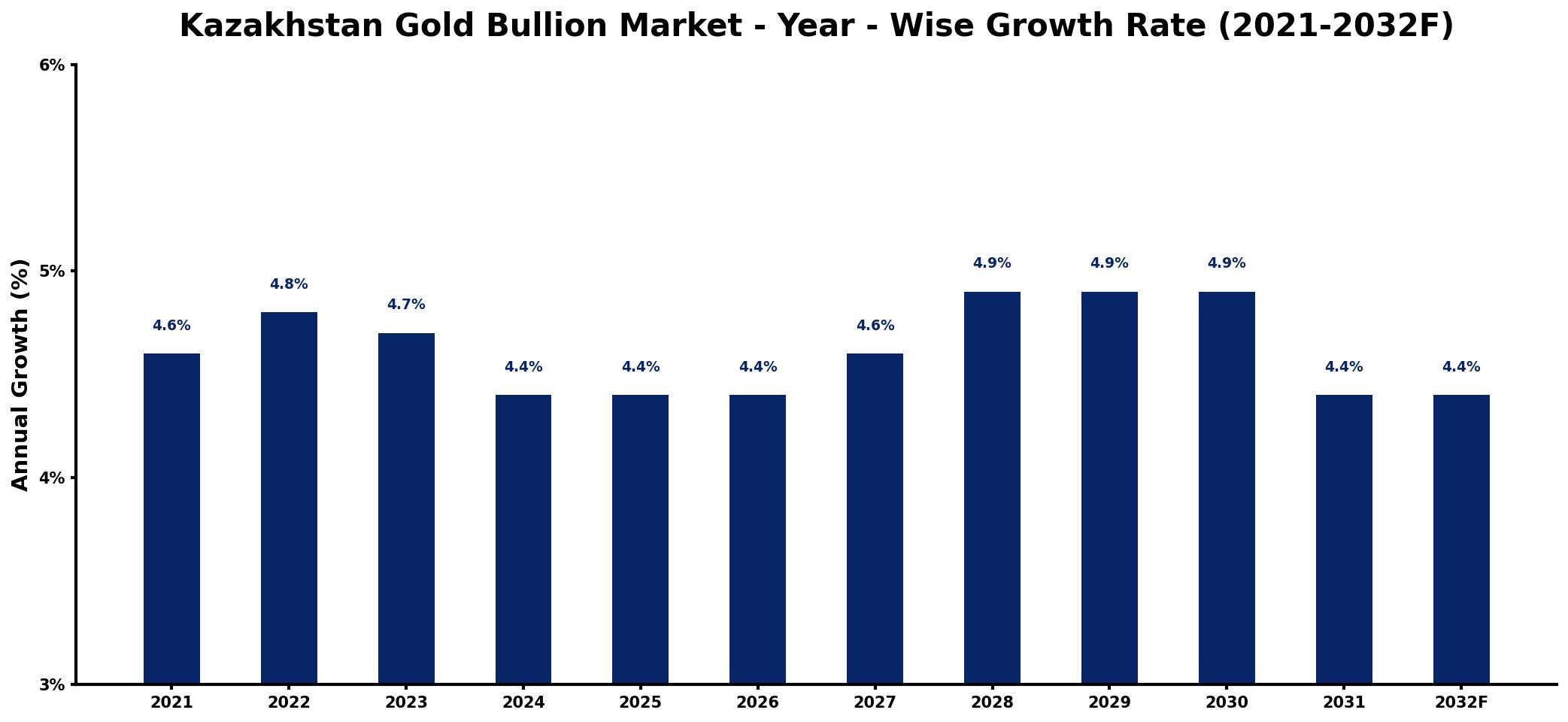
The table below presents the year‑wise growth rates along with the key drivers influencing the market
| Year | Growth Rate | Major Drivers |
| 2021 | 4.6% | Increased investment in safe havens |
| 2022 | 4.8% | Rising demand for luxury items |
| 2023 | 4.7% | Growing interest in sustainable assets |
| 2024 | 4.4% | Expansion of wealth management services |
| 2025 | 4.4% | Higher consumer confidence levels |
| 2026 | 4.4% | Increased global economic stability |
| 2027 | 4.6% | increased capital investment inflows |
| 2028 | 4.9% | rising end-use demand growth |
| 2029 | 4.9% | Increased diversification strategies adopted |
| 2030 | 4.9% | strengthening underlying market demand |
| 2031 | 4.4% | Heightened interest in financial security |
| 2032 | 4.4% | enhanced product quality standards |
Note: Market size estimations and growth projections presented in this report are based on 6Wresearch's proprietary forecasting methodology, utilizing the latest available industry data, government publications, and primary research inputs.
Kazakhstan Gold Bullion Market Synopsis
The Kazakhstan Gold Bullion Market is witnessing a notable uptick in demand as geopolitical tensions and economic instability fuel interest in gold as a protective investment. Investors are increasingly viewing physical gold as a viable hedge against inflation and currency fluctuations, highlighting its enduring allure as a safe store of value.
Additionally, Kazakhstan's robust gold mining sector plays a critical role in the availability of bullion. As one of the worlds top gold producers, the country benefits from its rich mineral resources and governmental support for the mining industry, further solidifying its position within the global precious metals market.
Kazakhstan Gold Bullion Market Key Takeaways
- The Kazakhstan Gold Bullion Market is poised for significant growth, with a projected market size of USD 555 Million by 2032.
- Increased consumer interest in gold as a hedge against inflation is driving demand among individual investors.
- The government is actively promoting domestic gold production, enhancing market stability and transparency.
- Geopolitical uncertainties globally are reinforcing golds status as a safe-haven asset.
- Kazakhstans strategic location fosters its role as a central hub for gold trading between Europe and Asia.
Evaluation of Restraints in Kazakhstan Gold Bullion Market
Despite the robust growth potential, the Kazakhstan Gold Bullion Market faces several limitations. Regulatory uncertainties can hinder operational predictability for investors, while a lack of transparent pricing in gold transactions complicates decision-making. These factors may deter new market entrants and curtail investment flows, highlighting the need for enhanced regulatory frameworks and clearer transaction guidelines. Addressing these issues will be paramount to solidifying investor trust and ensuring sustainable market growth.
Kazakhstan Gold Bullion Market Trends
Several trends are currently shaping the Kazakhstan Gold Bullion Market. First, there is an increasing inclination among retail investors to diversify portfolios through gold investments, largely fueled by ongoing economic volatility. Second, technological advancements in mining and processing are optimizing production efficiencies, thus increasing the availability of gold bullion. Lastly, the growing awareness among citizens regarding the benefits of gold ownership, prompted by government initiatives, is further boosting market demand.
Kazakhstan Gold Bullion Market Opportunities
Investment opportunities abound in the Kazakhstan Gold Bullion Market, primarily through the purchase of physical gold bars or coins. Additionally, investors may consider engaging with gold exchange-traded funds (ETFs) or trading gold futures on the Kazakhstan Stock Exchange. As local gold production ramps up, investing in domestic gold mining companies also presents a viable avenue for investors seeking exposure to the gold market. These opportunities are particularly enticing given the increasing demand for gold as a reliable asset amidst global economic uncertainties.
Government Initiatives in the Kazakhstan Gold Bullion Market
The government of Kazakhstan has instituted a series of initiatives aimed at fostering the growth and stability of the Gold Bullion Market. Central to these efforts is the establishment of the National Bank of Kazakhstan as the principal regulatory body overseeing gold operations. Additionally, policies are in place to enhance market transparency by requiring comprehensive reporting of gold bullion transactions. This regulatory framework, coupled with incentives for local producers, aims to stimulate domestic gold production and ensure a favorable investment climate.
Future Insights of the Kazakhstan Gold Bullion Market
Looking ahead, the Kazakhstan Gold Bullion Market is expected to experience continued growth driven by persistent global economic uncertainties and geopolitical strife. As more investors turn to gold for portfolio diversification and protection against inflation, the market is likely to witness increased trading volumes. With the supportive government policies and strategic location of Kazakhstan facilitating gold trade between Europe and Asia, the market is well-positioned to attract both domestic and international investors, promising an optimistic outlook from 2026 to 2032.
Kazakhstan Gold Bullion Market Latest Developments (2025 - 2026)
Recent developments in the Kazakhstan Gold Bullion Market indicate a strategic push toward enhancing local production capabilities. The government has announced initiatives aimed at improving mining technologies and increasing investment in gold exploration projects. These measures are expected to bolster the supply of locally sourced gold, making it more accessible for both consumers and investors. Additionally, ongoing dialogues with international trading partners are anticipated to enhance Kazakhstan's position in the global gold market.
Kazakhstan Gold Bullion Market - Key Attractiveness of the Report
- 10 Years of Market Numbers
- Historical Data Starting from 2022 to 2025
- Base Year: 2025
- Forecast Data until 2032
- Key Performance Indicators Impacting the Market
- Major Upcoming Developments and Projects
Key Highlights of the Report:
- Kazakhstan Gold Bullion Market Outlook
- Market Size of Kazakhstan Gold Bullion Market, 2025
- Forecast of Kazakhstan Gold Bullion Market, 2032
- Historical Data and Forecast of Kazakhstan Gold Bullion Revenues & Volume for the Period 2022-2032F
- Kazakhstan Gold Bullion Market Trend Evolution
- Kazakhstan Gold Bullion Market Drivers and Challenges
- Kazakhstan Gold Bullion Price Trends
- Kazakhstan Gold Bullion Porter's Five Forces
- Kazakhstan Gold Bullion Industry Life Cycle
- Historical Data and Forecast of Kazakhstan Gold Bullion Market Revenues & Volume By Type for the Period 2022-2032F
- Historical Data and Forecast of Kazakhstan Gold Bullion Market Revenues & Volume By Gold Bar for the Period 2022-2032F
- Historical Data and Forecast of Kazakhstan Gold Bullion Market Revenues & Volume By Gold Coin for the Period 2022-2032F
- Historical Data and Forecast of Kazakhstan Gold Bullion Market Revenues & Volume By Distribution Channel for the Period 2022-2032F
- Historical Data and Forecast of Kazakhstan Gold Bullion Market Revenues & Volume By Online for the Period 2022-2032F
- Historical Data and Forecast of Kazakhstan Gold Bullion Market Revenues & Volume By Offline for the Period 2022-2032F
- Kazakhstan Gold Bullion Import Export Trade Statistics
- Market Opportunity Assessment By Type
- Market Opportunity Assessment By Distribution Channel
- Kazakhstan Gold Bullion Top Companies Market Share
- Kazakhstan Gold Bullion Competitive Benchmarking By Technical and Operational Parameters
- Kazakhstan Gold Bullion Company Profiles
- Kazakhstan Gold Bullion Key Strategic Recommendations






































