Kazakhstan Hafnium Market: Import Trend Analysis
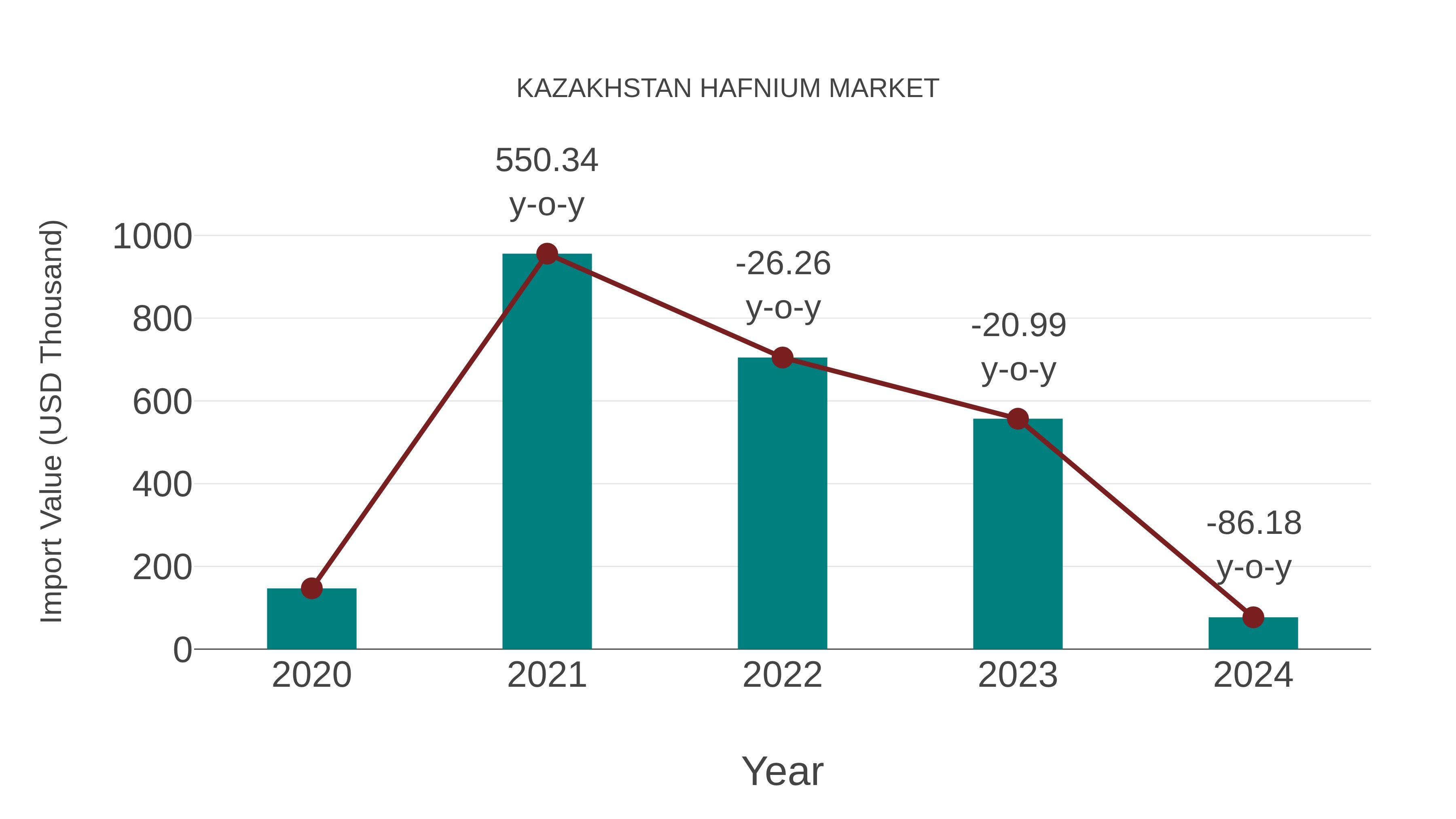
The import trend for hafnium in the Kazakhstan market experienced a significant decline from 2023 to 2024, with a growth rate of -86.18%. The compound annual growth rate (CAGR) for the period 2020-2024 stood at -14.93%. This sharp decrease could be attributed to shifting demands, changes in trade policies, or market instability during this period.
Kazakhstan Hafnium Market Overview
The Kazakhstan Hafnium market is experiencing steady growth due to the increasing demand for hafnium in various industries such as aerospace, electronics, and nuclear energy. Kazakhstan is a significant producer of hafnium, with key companies like Ulba Metallurgical Plant playing a crucial role in the market. Hafnium`s unique properties, such as high melting point and corrosion resistance, make it a valuable material in the manufacturing of superalloys, semiconductors, and nuclear reactor control rods. The market is also influenced by factors like technological advancements, government regulations, and international trade policies. Overall, the Kazakhstan Hafnium market presents opportunities for growth and innovation in the coming years as industries continue to rely on hafnium for various applications.
Kazakhstan Hafnium Market Trends
The Hafnium market in Kazakhstan is witnessing steady growth due to the increasing demand for hafnium in various high-tech applications, such as aerospace, electronics, and nuclear energy. Kazakhstan is one of the leading producers of hafnium globally, with major companies investing in the exploration and extraction of hafnium deposits in the country. The market is also benefiting from the rising adoption of hafnium-based alloys in the manufacturing of superalloys and other advanced materials. Additionally, the government`s initiatives to promote domestic hafnium production and export are further fueling the market growth. Overall, the Kazakhstan Hafnium market is poised for expansion in the coming years, driven by the growing industrial applications and favorable market dynamics.
Kazakhstan Hafnium Market Challenges
In the Kazakhstan Hafnium market, some of the key challenges faced include limited global supply sources, which can lead to supply chain disruptions and price volatility. Additionally, the lack of domestic production facilities for hafnium in Kazakhstan may result in dependence on imports, making the market susceptible to fluctuations in international trade policies and regulations. Furthermore, the relatively niche market for hafnium products means that there is a limited pool of suppliers and buyers, leading to intense competition and potentially affecting market stability. Overall, these challenges highlight the importance of strategic planning, diversification of supply sources, and market intelligence in navigating the Kazakhstan Hafnium market effectively.
Kazakhstan Hafnium Market Investment Opportunities
The Kazakhstan Hafnium market presents promising investment opportunities due to the country`s significant reserves of hafnium, a rare and valuable metal used in various high-tech applications such as aerospace, electronics, and nuclear energy. Investors could consider opportunities in hafnium mining and exploration companies operating in Kazakhstan, leveraging the country`s abundant natural resources. Additionally, with the increasing global demand for hafnium, particularly in the rapidly growing semiconductor industry, investing in hafnium production facilities or partnering with local manufacturers could yield profitable returns. It is essential for investors to conduct thorough market research, assess potential risks, and stay informed about industry trends and regulations to make informed investment decisions in the Kazakhstan Hafnium market.
Kazakhstan Hafnium Market Government Policy
Kazakhstan does not have specific government policies targeting the hafnium market. However, the country`s overall mining and mineral resources policies, as outlined in the Code on Subsurface and Subsurface Use, impact the hafnium market. Kazakhstan aims to attract foreign investment in its mining sector through transparent regulations and tax incentives. The government also emphasizes local processing and value addition to mineral resources, which could potentially impact hafnium production and exports. Additionally, Kazakhstan is a member of the Eurasian Economic Union (EAEU), which has trade policies that may influence hafnium market dynamics within the union. Overall, while there are no direct policies focused solely on hafnium, the broader mining and trade regulations in Kazakhstan play a role in shaping the hafnium market within the country and the EAEU.
Kazakhstan Hafnium Market Future Outlook
The future outlook for the Kazakhstan Hafnium market appears promising due to the increasing demand for hafnium in various industries such as aerospace, nuclear energy, and electronics. Kazakhstan is known to have significant reserves of hafnium, making it a key player in the global market. With ongoing technological advancements and the growing focus on sustainable energy sources, the demand for hafnium is expected to rise in the coming years. Additionally, the government`s initiatives to promote the mining and production of hafnium in Kazakhstan are likely to further boost the market growth. Overall, the Kazakhstan Hafnium market is anticipated to experience steady growth and present lucrative opportunities for both domestic and international investors in the foreseeable future.
Key Highlights of the Report:
- Kazakhstan Hafnium Market Outlook
- Market Size of Kazakhstan Hafnium Market, 2025
- Forecast of Kazakhstan Hafnium Market, 2032
- Historical Data and Forecast of Kazakhstan Hafnium Revenues & Volume for the Period 2022 - 2032F
- Kazakhstan Hafnium Market Trend Evolution
- Kazakhstan Hafnium Market Drivers and Challenges
- Kazakhstan Hafnium Price Trends
- Kazakhstan Hafnium Porter's Five Forces
- Kazakhstan Hafnium Industry Life Cycle
- Historical Data and Forecast of Kazakhstan Hafnium Market Revenues & Volume By Type for the Period 2022 - 2032F
- Historical Data and Forecast of Kazakhstan Hafnium Market Revenues & Volume By Hafnium Oxide for the Period 2022 - 2032F
- Historical Data and Forecast of Kazakhstan Hafnium Market Revenues & Volume By Hafnium Carbide for the Period 2022 - 2032F
- Historical Data and Forecast of Kazakhstan Hafnium Market Revenues & Volume By Other for the Period 2022 - 2032F
- Historical Data and Forecast of Kazakhstan Hafnium Market Revenues & Volume By Application for the Period 2022 - 2032F
- Historical Data and Forecast of Kazakhstan Hafnium Market Revenues & Volume By Super Alloy for the Period 2022 - 2032F
- Historical Data and Forecast of Kazakhstan Hafnium Market Revenues & Volume By Optical Coating for the Period 2022 - 2032F
- Historical Data and Forecast of Kazakhstan Hafnium Market Revenues & Volume By Nuclear for the Period 2022 - 2032F
- Historical Data and Forecast of Kazakhstan Hafnium Market Revenues & Volume By Plasma Cutting for the Period 2022 - 2032F
- Historical Data and Forecast of Kazakhstan Hafnium Market Revenues & Volume By Other for the Period 2022 - 2032F
- Kazakhstan Hafnium Import Export Trade Statistics
- Market Opportunity Assessment By Type
- Market Opportunity Assessment By Application
- Kazakhstan Hafnium Top Companies Market Share
- Kazakhstan Hafnium Competitive Benchmarking By Technical and Operational Parameters
- Kazakhstan Hafnium Company Profiles
- Kazakhstan Hafnium Key Strategic Recommendations






































