Kazakhstan Industrial Fasteners Market Size Growth Rate
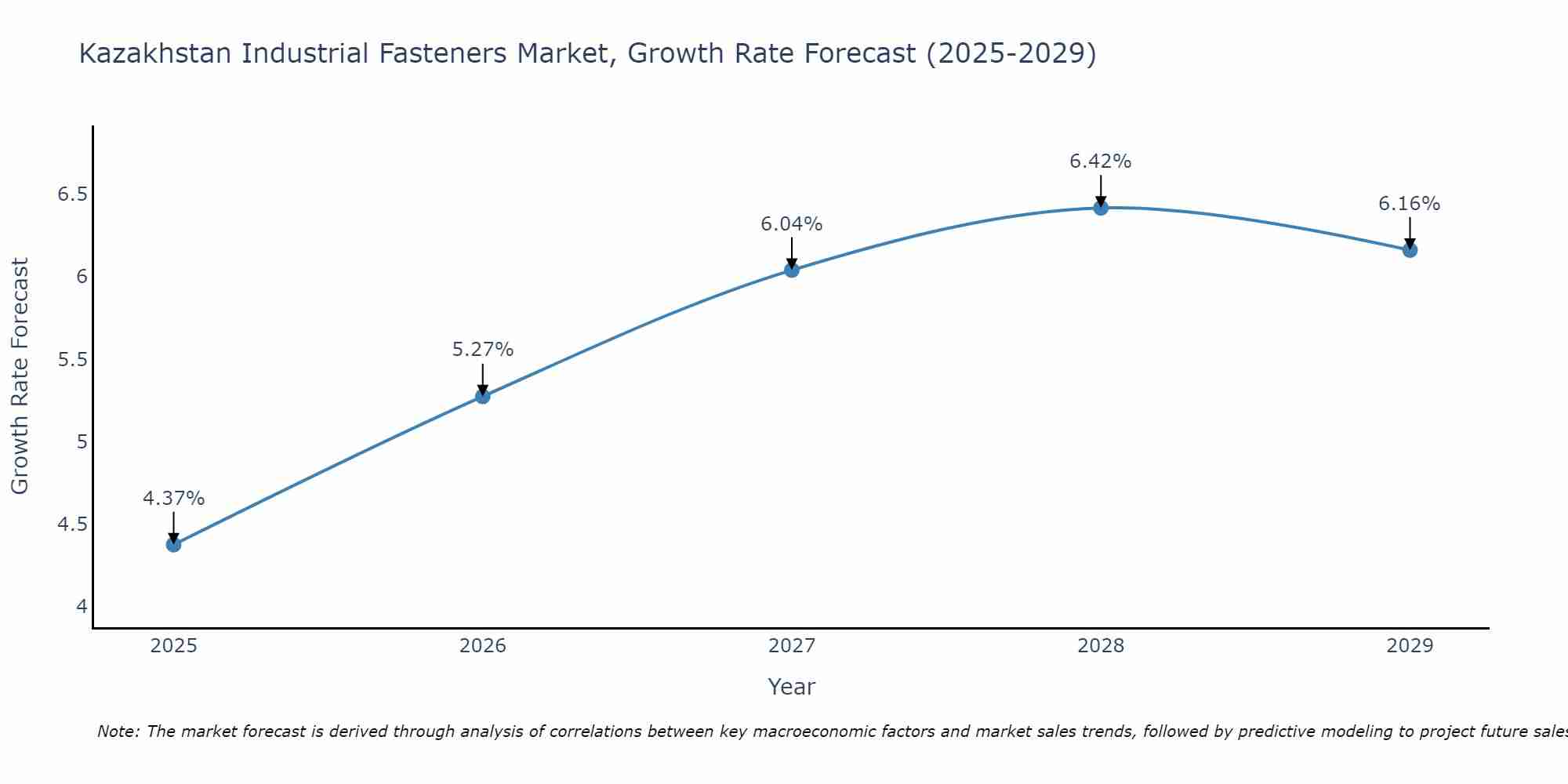
The Kazakhstan Industrial Fasteners Market is projected to witness mixed growth rate patterns during 2025 to 2029. Starting at 4.37% in 2025, the market peaks at 6.42% in 2028, and settles at 6.16% by 2029.
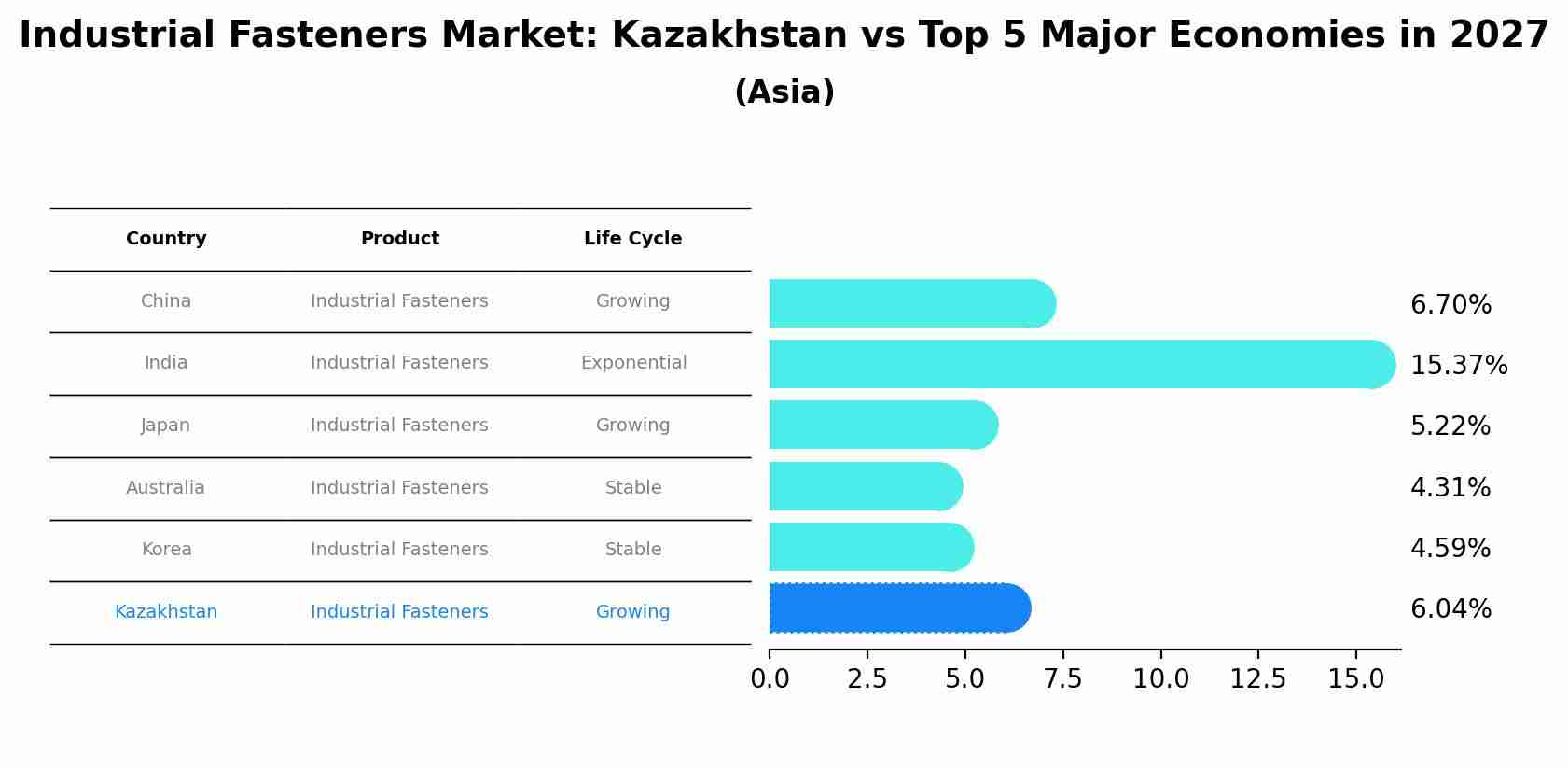
Industrial Fasteners Market: Kazakhstan vs Top 5 Major Economies in 2027 (Asia)
In the Asia region, the Industrial Fasteners market in Kazakhstan is projected to expand at a growing growth rate of 6.04% by 2027. The largest economy is China, followed by India, Japan, Australia and South Korea.
Kazakhstan Industrial Fasteners Market Overview
Fasteners are foundational components in construction, manufacturing, and infrastructure projects. In Kazakhstan, the industrial fasteners market is buoyed by robust construction activities and industrial development initiatives. High-quality fasteners, including bolts, nuts, and screws, are in demand to ensure the structural integrity and reliability of various industrial applications.
Drivers of the market
The industrial fasteners market in Kazakhstan is expanding due to the growing demand for reliable and durable fastening solutions in various industries. Fasteners are essential components in the construction, automotive, and manufacturing sectors. The increasing industrial activities and the focus on improving the quality and performance of industrial products are driving the demand for industrial fasteners.
Challenges of the market
Challenges in the industrial fasteners market include the need for fasteners that meet stringent performance and reliability requirements in diverse industrial applications. Moreover, ensuring compliance with industry standards and regulations poses challenges for fastener manufacturers.
Government Policy of the market
To support manufacturing efficiency, the Kazakh government promotes the use of high-quality industrial fasteners. Policies include standards for fastener quality and durability, as well as incentives for companies adopting innovative fastening solutions that improve operational efficiency and safety.
Key Highlights of the Report:
- Kazakhstan Industrial Fasteners Market Outlook
- Market Size of Kazakhstan Industrial Fasteners Market, 2024
- Forecast of Kazakhstan Industrial Fasteners Market, 2031
- Historical Data and Forecast of Kazakhstan Industrial Fasteners Revenues & Volume for the Period 2018 - 2031
- Kazakhstan Industrial Fasteners Market Trend Evolution
- Kazakhstan Industrial Fasteners Market Drivers and Challenges
- Kazakhstan Industrial Fasteners Price Trends
- Kazakhstan Industrial Fasteners Porter's Five Forces
- Kazakhstan Industrial Fasteners Industry Life Cycle
- Historical Data and Forecast of Kazakhstan Industrial Fasteners Market Revenues & Volume By Raw Material for the Period 2018 - 2031
- Historical Data and Forecast of Kazakhstan Industrial Fasteners Market Revenues & Volume By Plastic for the Period 2018 - 2031
- Historical Data and Forecast of Kazakhstan Industrial Fasteners Market Revenues & Volume By Metal for the Period 2018 - 2031
- Historical Data and Forecast of Kazakhstan Industrial Fasteners Market Revenues & Volume By Product for the Period 2018 - 2031
- Historical Data and Forecast of Kazakhstan Industrial Fasteners Market Revenues & Volume By Externally Threaded for the Period 2018 - 2031
- Historical Data and Forecast of Kazakhstan Industrial Fasteners Market Revenues & Volume By Internally Threaded for the Period 2018 - 2031
- Historical Data and Forecast of Kazakhstan Industrial Fasteners Market Revenues & Volume By Non-threaded for the Period 2018 - 2031
- Historical Data and Forecast of Kazakhstan Industrial Fasteners Market Revenues & Volume By Aerospace Grade for the Period 2018 - 2031
- Historical Data and Forecast of Kazakhstan Industrial Fasteners Market Revenues & Volume By Application for the Period 2018 - 2031
- Historical Data and Forecast of Kazakhstan Industrial Fasteners Market Revenues & Volume By Automotive for the Period 2018 - 2031
- Historical Data and Forecast of Kazakhstan Industrial Fasteners Market Revenues & Volume By Aerospace for the Period 2018 - 2031
- Historical Data and Forecast of Kazakhstan Industrial Fasteners Market Revenues & Volume By Building & Construction for the Period 2018 - 2031
- Historical Data and Forecast of Kazakhstan Industrial Fasteners Market Revenues & Volume By Industrial Machinery for the Period 2018 - 2031
- Historical Data and Forecast of Kazakhstan Industrial Fasteners Market Revenues & Volume By Lawn and Garden for the Period 2018 - 2031
- Historical Data and Forecast of Kazakhstan Industrial Fasteners Market Revenues & Volume By Plumbing Products for the Period 2018 - 2031
- Historical Data and Forecast of Kazakhstan Industrial Fasteners Market Revenues & Volume By Others for the Period 2018 - 2031
- Kazakhstan Industrial Fasteners Import Export Trade Statistics
- Market Opportunity Assessment By Raw Material
- Market Opportunity Assessment By Product
- Market Opportunity Assessment By Application
- Kazakhstan Industrial Fasteners Top Companies Market Share
- Kazakhstan Industrial Fasteners Competitive Benchmarking By Technical and Operational Parameters
- Kazakhstan Industrial Fasteners Company Profiles
- Kazakhstan Industrial Fasteners Key Strategic Recommendations






































