Kazakhstan Industrial Sugar Market Size, Share & Growth Rate
The Kazakhstan Industrial Sugar Market was estimated at USD 207 Million in 2025 and is projected to reach USD 228 Million by 2032, growing at a CAGR of 1.4% from 2026 to 2032. This growth is primarily driven by the robust expansion of the food and beverage sector, alongside an upsurge in the confectionery industry, which increasingly relies on industrial sugar for various applications. The commitment of market players to enhance production capacities and optimize supply chains is essential for meeting the rising demands across diverse industries.
Kazakhstan Industrial Sugar Market Year-wise Growth Rate and Key Drivers
This graph highlights how the Kazakhstan Industrial Sugar Market has steadily grown over the years, supported by major growth factors.
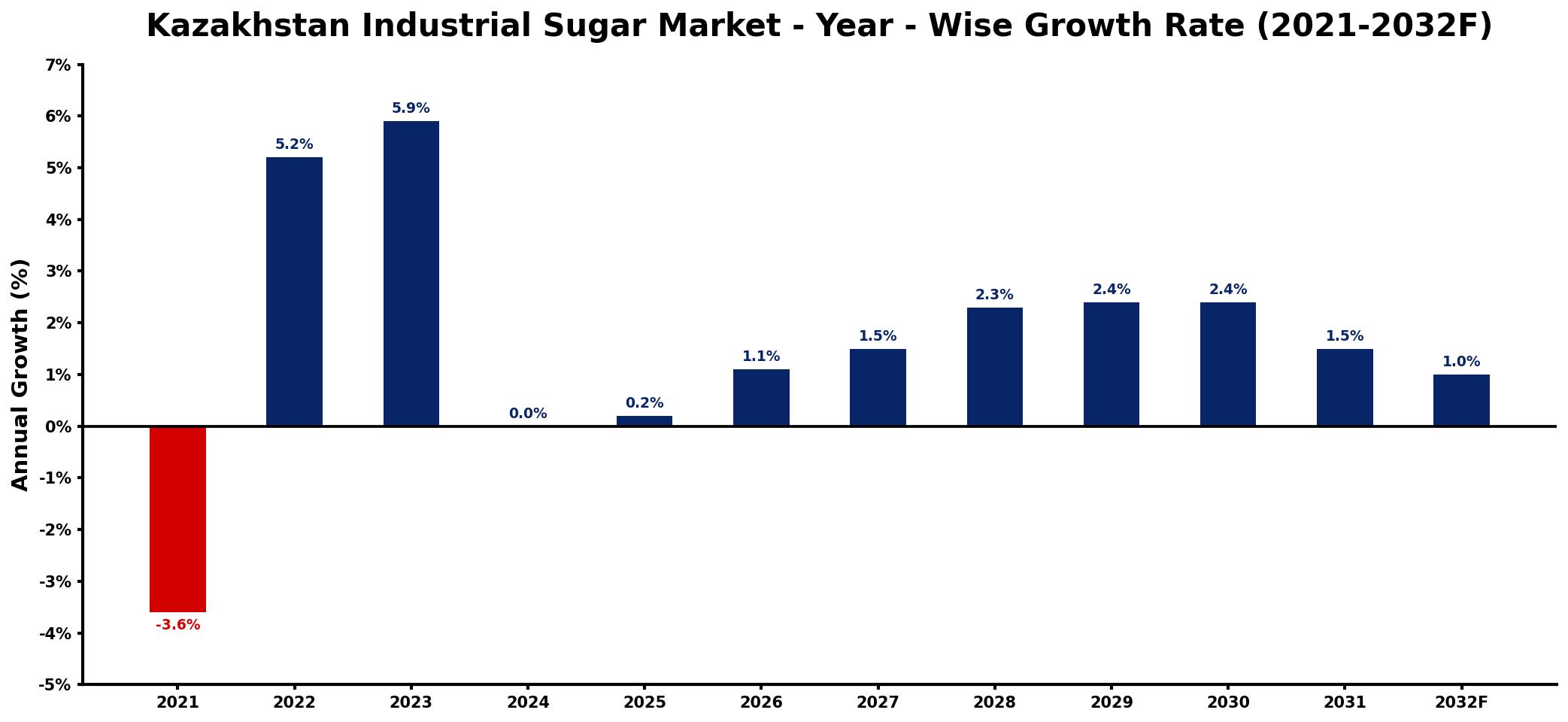
The table below presents the year‑wise growth rates along with the key drivers influencing the market
| Year | Growth Rate | Major Drivers |
| 2021 | -3.6% | decreased consumer spending trends |
| 2022 | 5.2% | rising demand from food sector |
| 2023 | 5.9% | increased exports to neighboring markets |
| 2024 | 0.0% | expansion of local production facilities |
| 2025 | 0.2% | growing investment in infrastructure |
| 2026 | 1.1% | enhanced distribution network efficiency |
| 2027 | 1.5% | rising interest in sustainable practices |
| 2028 | 2.3% | growing popularity of alternative applications |
| 2029 | 2.4% | increased focus on health trends |
| 2030 | 2.4% | expansion into new market segments |
| 2031 | 1.5% | strengthening regional trade agreements |
| 2032 | 1.0% | growing consumer awareness initiatives |
Note: Market size estimations and growth projections presented in this report are based on 6Wresearch's proprietary forecasting methodology, utilizing the latest available industry data, government publications, and primary research inputs.
Kazakhstan Industrial Sugar Market Synopsis
Kazakhstan's industrial sugar market is witnessing a notable transformation as it adapts to the evolving needs of food and beverage manufacturers. With a growing appetite for processed foods, the sector is set to experience sustained demand for sugar, particularly in confectionery and bakery applications.
Recent trends indicate that players in the market are prioritizing efficiency and sustainability. Investments aimed at modernizing production facilities are becoming more commonplace as companies seek to maintain competitive pricing and high-quality standards amidst a backdrop of increasing regulatory scrutiny.
Kazakhstan Industrial Sugar Market Key Takeaways
- The market is supported by a solid base of food and beverage industries that are consistently increasing their consumption of industrial sugar.
- Government initiatives aimed at agricultural enhancement are playing a critical role in bolstering local production.
- Fluctuations in global sugar prices present challenges that domestic producers must navigate to remain profitable.
- Innovation in production technologies is essential for improving supply chain efficiencies and meeting consumer demand.
- The expansion of the confectionery sector in Kazakhstan is a significant driver of market growth.
Evaluation of Restraints in Kazakhstan Industrial Sugar Market
Despite the optimistic growth trajectory, the Kazakhstan industrial sugar market grapples with several constraints. A key concern is the reliance on imports, which can destabilize pricing and availability. Domestic producers face challenges in achieving price competitiveness against imported sugar, which can fluctuate dramatically due to global market influences. Additionally, as regulations around food safety and quality evolve, ensuring compliance while maintaining production efficiency can prove to be a complex balancing act for stakeholders in the market.
Kazakhstan Industrial Sugar Market Trends
Emerging trends within the Kazakhstan industrial sugar market include a heightened focus on sustainability and health-conscious consumer preferences. As public awareness regarding dietary impacts grows, manufacturers are exploring alternative sweetening solutions and sugar reduction strategies. Additionally, advancements in production technology, including automation and digitalization, are reshaping operational efficiencies, allowing for better resource management and cost reductions.
Kazakhstan Industrial Sugar Market Opportunities
Opportunities for growth in the Kazakhstan industrial sugar market lie primarily in diversifying product offerings and enhancing production methods. The burgeoning confectionery sector presents lucrative avenues for collaboration, while a shift towards more sustainable farming practices opens doors for innovation in sourcing raw materials. By investing in modern agricultural technologies, stakeholders can significantly increase yield efficiencies, thereby strengthening their market position.
Government Initiatives in the Kazakhstan Industrial Sugar Market
The government of Kazakhstan is actively promoting initiatives to enhance domestic sugar production through various policies aimed at agricultural development. These initiatives include providing subsidies for the modernization of production facilities and promoting incentives for implementing sustainable farming practices. Such support is crucial for strengthening the industrial sugar market and ensuring it meets the growing demands of local industries.
Future Insights of the Kazakhstan Industrial Sugar Market
Looking ahead to the 2026-2032 period, the Kazakhstan industrial sugar market is poised for gradual yet steady growth. Factors such as an increasing focus on local production, technological advancements in sugar processing, and a stronger alignment with consumer trends will drive this evolution. Additionally, as the government continues to support the agricultural sector, local producers may find renewed strength in their operations, allowing them to compete more effectively against imported products.
Kazakhstan Industrial Sugar Market Latest Developments (2025 - 2026)
Recent developments in the Kazakhstan industrial sugar market reflect a proactive approach to addressing both production and quality challenges. Stakeholders are increasingly investing in state-of-the-art technologies aimed at improving operational efficiencies and output. Additionally, there is a discernible shift towards collaborative partnerships among producers to enhance resource sharing and strengthen supply chains, crucial for meeting the burgeoning demands of various industrial applications.
Kazakhstan Industrial Sugar Market - Key Attractiveness of the Report
- 10 Years of Market Numbers
- Historical Data Starting from 2022 to 2025
- Base Year: 2025
- Forecast Data until 2032
- Key Performance Indicators Impacting the Market
- Major Upcoming Developments and Projects
Key Highlights of the Report:
- Kazakhstan Industrial Sugar Market Outlook
- Market Size of Kazakhstan Industrial Sugar Market, 2025
- Forecast of Kazakhstan Industrial Sugar Market, 2032
- Historical Data and Forecast of Kazakhstan Industrial Sugar Revenues & Volume for the Period 2022-2032F
- Kazakhstan Industrial Sugar Market Trend Evolution
- Kazakhstan Industrial Sugar Market Drivers and Challenges
- Kazakhstan Industrial Sugar Price Trends
- Kazakhstan Industrial Sugar Porter's Five Forces
- Kazakhstan Industrial Sugar Industry Life Cycle
- Historical Data and Forecast of Kazakhstan Industrial Sugar Market Revenues & Volume By Type for the Period 2022-2032F
- Historical Data and Forecast of Kazakhstan Industrial Sugar Market Revenues & Volume By White sugar for the Period 2022-2032F
- Historical Data and Forecast of Kazakhstan Industrial Sugar Market Revenues & Volume By Brown sugar for the Period 2022-2032F
- Historical Data and Forecast of Kazakhstan Industrial Sugar Market Revenues & Volume By Liquid sugar for the Period 2022-2032F
- Historical Data and Forecast of Kazakhstan Industrial Sugar Market Revenues & Volume By Form for the Period 2022-2032F
- Historical Data and Forecast of Kazakhstan Industrial Sugar Market Revenues & Volume By Granulated for the Period 2022-2032F
- Historical Data and Forecast of Kazakhstan Industrial Sugar Market Revenues & Volume By Powdered for the Period 2022-2032F
- Historical Data and Forecast of Kazakhstan Industrial Sugar Market Revenues & Volume By Syrup for the Period 2022-2032F
- Historical Data and Forecast of Kazakhstan Industrial Sugar Market Revenues & Volume By Application for the Period 2022-2032F
- Historical Data and Forecast of Kazakhstan Industrial Sugar Market Revenues & Volume By Dairy for the Period 2022-2032F
- Historical Data and Forecast of Kazakhstan Industrial Sugar Market Revenues & Volume By Bakery for the Period 2022-2032F
- Historical Data and Forecast of Kazakhstan Industrial Sugar Market Revenues & Volume By Confectionery for the Period 2022-2032F
- Historical Data and Forecast of Kazakhstan Industrial Sugar Market Revenues & Volume By Beverage for the Period 2022-2032F
- Historical Data and Forecast of Kazakhstan Industrial Sugar Market Revenues & Volume By Canned & frozen foods for the Period 2022-2032F
- Historical Data and Forecast of Kazakhstan Industrial Sugar Market Revenues & Volume By Pharmaceuticals for the Period 2022-2032F
- Historical Data and Forecast of Kazakhstan Industrial Sugar Market Revenues & Volume By Other food items for the Period 2022-2032F
- Historical Data and Forecast of Kazakhstan Industrial Sugar Market Revenues & Volume By Source for the Period 2022-2032F
- Historical Data and Forecast of Kazakhstan Industrial Sugar Market Revenues & Volume By Cane sugar for the Period 2022-2032F
- Historical Data and Forecast of Kazakhstan Industrial Sugar Market Revenues & Volume By Beet sugar for the Period 2022-2032F
- Kazakhstan Industrial Sugar Import Export Trade Statistics
- Market Opportunity Assessment By Type
- Market Opportunity Assessment By Form
- Market Opportunity Assessment By Application
- Market Opportunity Assessment By Source
- Kazakhstan Industrial Sugar Top Companies Market Share
- Kazakhstan Industrial Sugar Competitive Benchmarking By Technical and Operational Parameters
- Kazakhstan Industrial Sugar Company Profiles
- Kazakhstan Industrial Sugar Key Strategic Recommendations






































