Kazakhstan Insulated Glass Market Size, Share & Growth Rate
The Kazakhstan Insulated Glass Market was estimated at USD 267 Million in 2025 and is projected to reach USD 360 Million by 2032, growing at a CAGR of 4.4% from 2026 to 2032. This growth trajectory is driven by the burgeoning construction sectors demand for energy-efficient materials, spurred by rising urbanization and government-led sustainability initiatives. Enhanced consumer awareness regarding the benefits of insulated glass, particularly in terms of thermal insulation and soundproofing, further augments market momentum.
Kazakhstan Insulated Glass Market Year-wise Growth Rate and Key Drivers
This graph highlights how the Kazakhstan Insulated Glass Market has steadily grown over the years, supported by major growth factors.
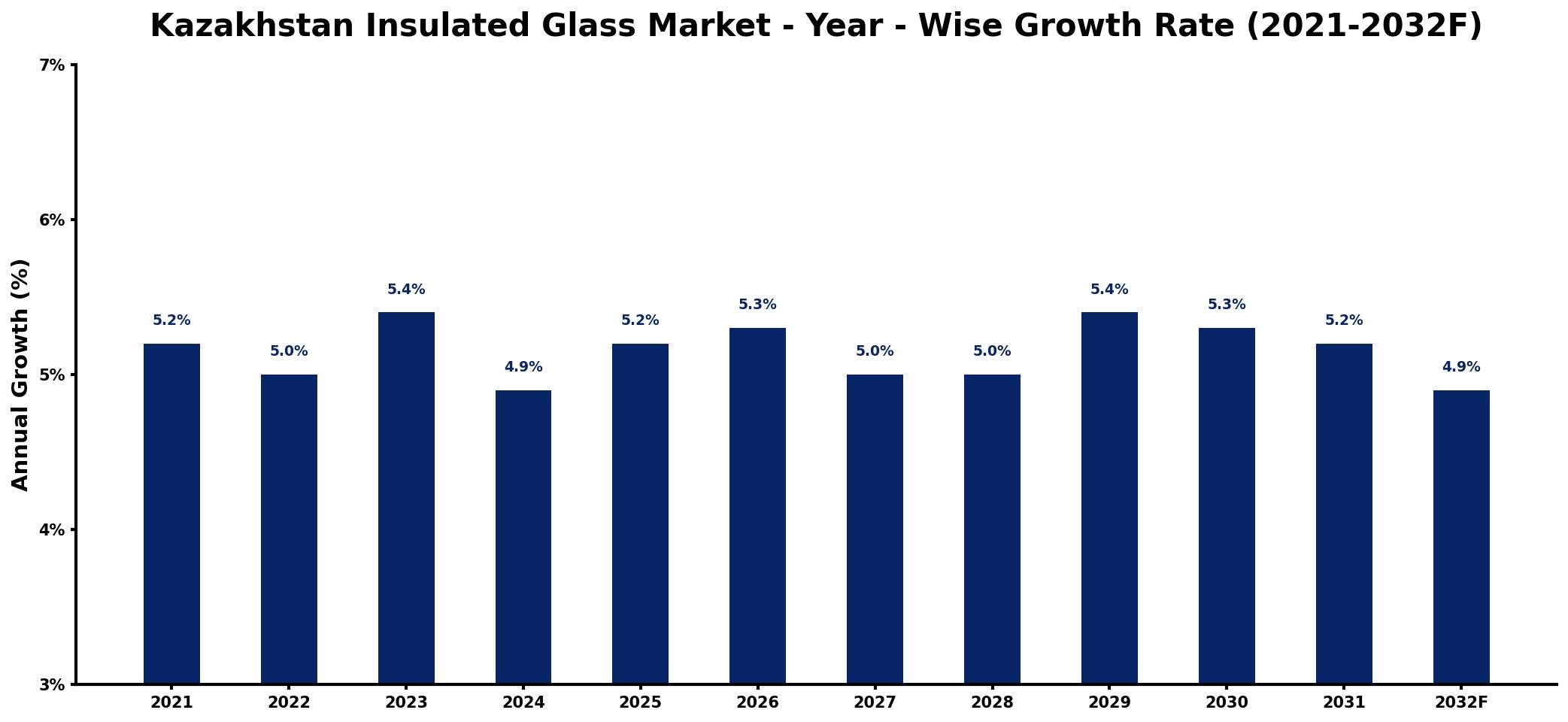
The table below presents the year‑wise growth rates along with the key drivers influencing the market
| Year | Growth Rate | Major Drivers |
| 2021 | 5.2% | Rising construction sector investments |
| 2022 | 5.0% | Increased energy efficiency regulations |
| 2023 | 5.4% | Growing demand for sustainable materials |
| 2024 | 4.9% | Urban development projects expanding |
| 2025 | 5.2% | Technological advancements in manufacturing |
| 2026 | 5.3% | Emerging architectural design trends |
| 2027 | 5.0% | Strengthening residential renovation market |
| 2028 | 5.0% | Government incentives for energy upgrades |
| 2029 | 5.4% | Expanding commercial real estate developments |
| 2030 | 5.3% | Rising awareness of environmental impacts |
| 2031 | 5.2% | Increased focus on building aesthetics |
| 2032 | 4.9% | Growing interest in eco-friendly solutions |
Note: Market size estimations and growth projections presented in this report are based on 6Wresearch's proprietary forecasting methodology, utilizing the latest available industry data, government publications, and primary research inputs.
Kazakhstan Insulated Glass Market Synopsis
The Kazakhstan Insulated Glass Market has recently gained significant momentum due to the construction industry's shift towards sustainable practices. This transition is expected to catalyze the adoption of insulated glass products that align with contemporary architectural demands. Looking ahead, the market is poised for sustained growth, fueled by technological advancements and a strong emphasis on energy efficiency in construction projects.
As companies innovate and improve product offerings, the focus on eco-friendly solutions is likely to redefine market dynamics. Increased urbanization and the rising aesthetic appeal of larger glass facades will drive further adoption of insulated glass, making it an essential element in modern architecture across Kazakhstan.
Kazakhstan Insulated Glass Market Key Takeaways
- The market is experiencing significant growth due to increased demand for energy-efficient building materials.
- Technological innovations, such as low-emissivity coatings, are enhancing the performance properties of insulated glass.
- Government policies promoting sustainability and energy efficiency are supportive of market growth.
- Investors are encouraged to explore partnerships with local manufacturers for innovative solutions.
- Consumer demand for aesthetically appealing and functional insulated glass products continues to rise.
Evaluation of Restraints in Kazakhstan Insulated Glass Market
While the Kazakhstan Insulated Glass Market is primed for growth, several restraints could hinder its full potential. Fluctuations in raw material prices create uncertainty for manufacturers, while the prevailing production costs can be higher due to limited technological advancements. The presence of inconsistent quality standards poses a challenge, particularly with increased competition from imported products. Additionally, a shortage of skilled labor in the manufacturing sector further complicates the landscape, necessitating strategic adjustments from local companies.
Kazakhstan Insulated Glass Market Trends
Several key trends are shaping the Kazakhstan Insulated Glass Market. A marked shift towards eco-friendly solutions is evident, as construction entities increasingly prioritize sustainability. This is coupled with heightened awareness of the thermal and acoustic benefits of insulated glass, driving demand across residential, commercial, and industrial sectors. Furthermore, the trend towards larger glass facades in modern architecture highlights a blend of aesthetics and functionality, propelling the use of insulated glass units.
Kazakhstan Insulated Glass Market Opportunities
The market offers enticing investment opportunities for those looking to capitalize on Kazakhstan's evolving construction landscape. The drive towards sustainable development has created a robust demand for high-performance insulated glass products. Investors can enhance their positioning by forging alliances with local manufacturers to introduce cutting-edge technologies and expand production capabilities. Additionally, collaborations with construction firms and architects will be vital in promoting and integrating insulated glass solutions in various projects.
Government Initiatives in the Kazakhstan Insulated Glass Market
Kazakhstans government is actively promoting energy efficiency and sustainability within the construction sector through various policies. These initiatives encourage the integration of insulated glass products in new buildings, aiming to reduce energy consumption and lower greenhouse gas emissions. The government also supports quality standards enhancement for insulated glass to ensure safety and durability. By fostering research and development in this field, Kazakhstan aims to spur innovation and bolster its insulated glass market.
Future Insights of the Kazakhstan Insulated Glass Market
The future of the Kazakhstan Insulated Glass Market appears bright, with steady growth projected between 2026 and 2032. Factors such as urbanization, an expanding construction industry, and a robust focus on energy-efficient building solutions are expected to drive demand. Government initiatives advocating for sustainable practices and increased consumer awareness about insulated glass benefits will likely solidify this market's expansion. Industry players are anticipated to continue investing in research and innovation to align their offerings with the evolving construction landscape.
Kazakhstan Insulated Glass Market Latest Developments (2025 - 2026)
Recent developments in the Kazakhstan Insulated Glass Market indicate a strong push towards product innovation and technological adoption. Companies are increasingly exploring advanced coatings and gas-filled units to enhance energy efficiency. Furthermore, strategic partnerships are being formed to expand distribution networks and improve market reach. Notable focus is being placed on aligning product offerings with the governments sustainability goals, reflecting an industry-wide commitment to eco-friendly practices.
Kazakhstan Insulated Glass Market - Key Attractiveness of the Report
- 10 Years of Market Numbers
- Historical Data Starting from 2022 to 2025
- Base Year: 2025
- Forecast Data until 2032
- Key Performance Indicators Impacting the Market
- Major Upcoming Developments and Projects
Key Highlights of the Report:
- Kazakhstan Insulated Glass Market Outlook
- Market Size of Kazakhstan Insulated Glass Market, 2025
- Forecast of Kazakhstan Insulated Glass Market, 2032
- Historical Data and Forecast of Kazakhstan Insulated Glass Revenues & Volume for the Period 2022-2032F
- Kazakhstan Insulated Glass Market Trend Evolution
- Kazakhstan Insulated Glass Market Drivers and Challenges
- Kazakhstan Insulated Glass Price Trends
- Kazakhstan Insulated Glass Porter's Five Forces
- Kazakhstan Insulated Glass Industry Life Cycle
- Historical Data and Forecast of Kazakhstan Insulated Glass Market Revenues & Volume By Type for the Period 2022-2032F
- Historical Data and Forecast of Kazakhstan Insulated Glass Market Revenues & Volume By Heated Insulating Glass for the Period 2022-2032F
- Historical Data and Forecast of Kazakhstan Insulated Glass Market Revenues & Volume By Tempering Insulating Glass for the Period 2022-2032F
- Historical Data and Forecast of Kazakhstan Insulated Glass Market Revenues & Volume By Custom Insulated Glass for the Period 2022-2032F
- Historical Data and Forecast of Kazakhstan Insulated Glass Market Revenues & Volume By Other Glasses for the Period 2022-2032F
- Historical Data and Forecast of Kazakhstan Insulated Glass Market Revenues & Volume By Application for the Period 2022-2032F
- Historical Data and Forecast of Kazakhstan Insulated Glass Market Revenues & Volume By Doors & Partitions for the Period 2022-2032F
- Historical Data and Forecast of Kazakhstan Insulated Glass Market Revenues & Volume By Kitchen Appliances & Cabinets for the Period 2022-2032F
- Historical Data and Forecast of Kazakhstan Insulated Glass Market Revenues & Volume By Floors & Ceilings for the Period 2022-2032F
- Historical Data and Forecast of Kazakhstan Insulated Glass Market Revenues & Volume By Furniture & Curtain Walls for the Period 2022-2032F
- Historical Data and Forecast of Kazakhstan Insulated Glass Market Revenues & Volume By Railings & Bolted Structures for the Period 2022-2032F
- Historical Data and Forecast of Kazakhstan Insulated Glass Market Revenues & Volume By Automotive Glasses for the Period 2022-2032F
- Historical Data and Forecast of Kazakhstan Insulated Glass Market Revenues & Volume By End User for the Period 2022-2032F
- Historical Data and Forecast of Kazakhstan Insulated Glass Market Revenues & Volume By Residential Buildings for the Period 2022-2032F
- Historical Data and Forecast of Kazakhstan Insulated Glass Market Revenues & Volume By Commercial & Institutional Buildings for the Period 2022-2032F
- Historical Data and Forecast of Kazakhstan Insulated Glass Market Revenues & Volume By Industrial Users for the Period 2022-2032F
- Kazakhstan Insulated Glass Import Export Trade Statistics
- Market Opportunity Assessment By Type
- Market Opportunity Assessment By Application
- Market Opportunity Assessment By End User
- Kazakhstan Insulated Glass Top Companies Market Share
- Kazakhstan Insulated Glass Competitive Benchmarking By Technical and Operational Parameters
- Kazakhstan Insulated Glass Company Profiles
- Kazakhstan Insulated Glass Key Strategic Recommendations






































