Kazakhstan Lithium Iron Phosphate Batteries Market Size, Share & Growth Rate
The Kazakhstan Lithium Iron Phosphate Batteries Market was estimated at USD 1106 Million in 2025 and is projected to reach USD 1575 Million by 2032, growing at a CAGR of 5.2% from 2026 to 2032. This growth trajectory is primarily fueled by the burgeoning electric vehicle sector and an increased focus on renewable energy sources. Moreover, advancements in battery technology, coupled with a rising need for efficient and reliable energy storage solutions, further elevate the demand for lithium iron phosphate batteries in Kazakhstan.
Kazakhstan Lithium Iron Phosphate Batteries Market Year-wise Growth Rate and Key Drivers
This graph highlights how the Kazakhstan Lithium Iron Phosphate Batteries Market has steadily grown over the years, supported by major growth factors.
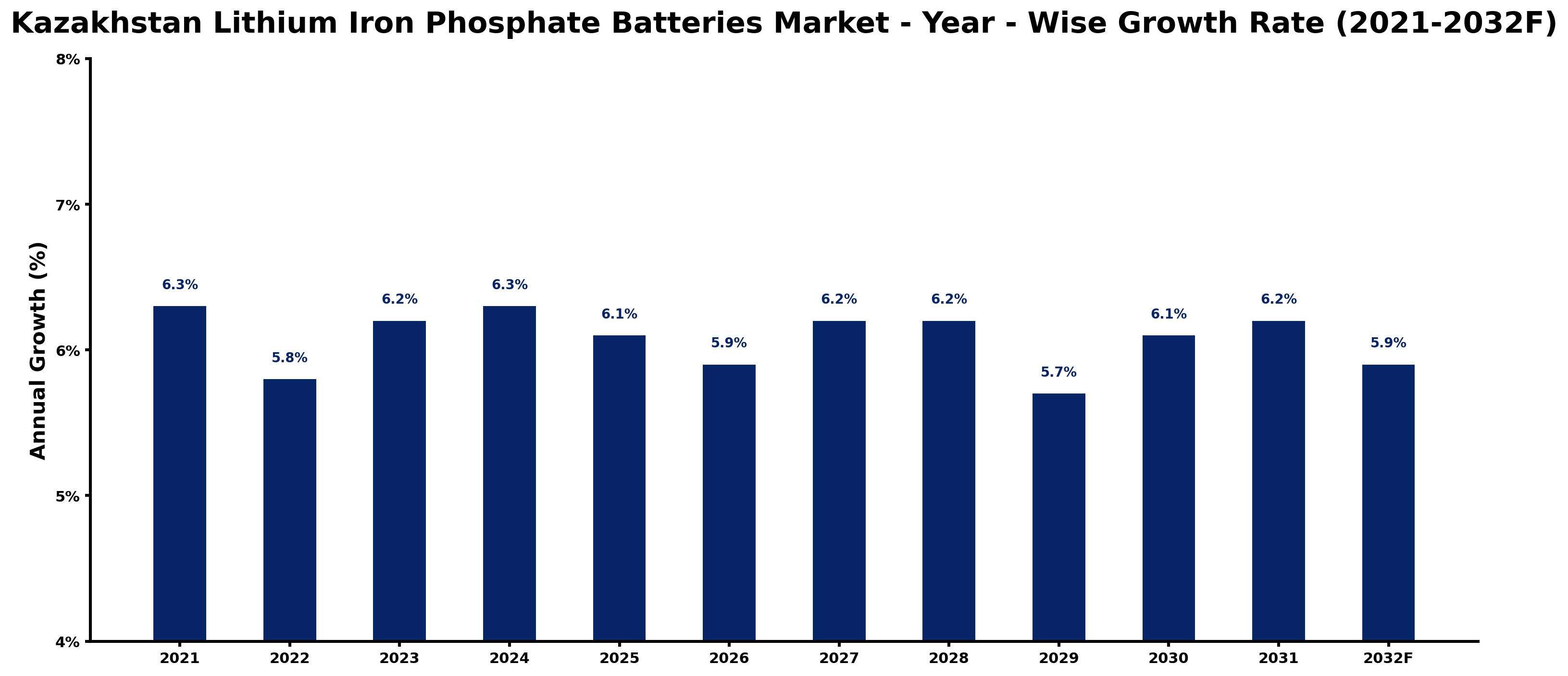
The table below presents the year‑wise growth rates along with the key drivers influencing the market
| Year | Growth Rate | Major Drivers |
| 2021 | 6.3% | Rising demand from renewable energy |
| 2022 | 5.8% | Increased investments in technology |
| 2023 | 6.2% | Expansion in electric vehicle market |
| 2024 | 6.3% | Growth in energy storage solutions |
| 2025 | 6.1% | Surge in consumer electronics market |
| 2026 | 5.9% | Enhanced government sustainability initiatives |
| 2027 | 6.2% | Growing industrial automation applications |
| 2028 | 6.2% | Development of smart grid technologies |
| 2029 | 5.7% | Emergence of new energy sectors |
| 2030 | 6.1% | Increased focus on energy efficiency |
| 2031 | 6.2% | Rising popularity of green initiatives |
| 2032 | 5.9% | Expansion of recycling programs |
Note: Market size estimations and growth projections presented in this report are based on 6Wresearch's proprietary forecasting methodology, utilizing the latest available industry data, government publications, and primary research inputs.
Kazakhstan Lithium Iron Phosphate Batteries Market Synopsis
In Kazakhstan, the shift toward lithium iron phosphate batteries is notably influenced by government initiatives aimed at promoting clean energy solutions. The country's commitment to reducing carbon emissions aligns with the environmental benefits that LFP batteries offer, making them an attractive alternative to traditional energy storage systems.
Additionally, the integration of LFP batteries in electric vehicles is becoming increasingly prevalent as consumers and manufacturers alike prioritize safety and longevity in battery performance. This shift is expected to accelerate as more renewable energy projects are commissioned, further driving the demand for sustainable energy solutions across the nation.
Kazakhstan Lithium Iron Phosphate Batteries Market Key Takeaways
- Significant growth anticipated due to rising electric vehicle adoption.
- Government policies are increasingly supporting domestic LFP battery production.
- Environmental sustainability is a key driver of market expansion.
- Longer lifespan of LiFePO4 batteries compared to conventional batteries enhances their appeal.
- Investment in battery recycling initiatives is gaining traction, reducing environmental impact.
Evaluation of Restraints in Kazakhstan Lithium Iron Phosphate Batteries Market
Despite the promising growth potential, the Kazakhstan Lithium Iron Phosphate Batteries Market faces several limitations that could hinder its overall development. The higher initial costs associated with LiFePO4 batteries in comparison to traditional lead-acid batteries serve as a barrier to widespread adoption, particularly in price-sensitive segments. Furthermore, the limited local manufacturing capabilities and the reliance on imported components can disrupt supply chains and contribute to elevated costs, which may slow down market penetration and adoption rates.
Kazakhstan Lithium Iron Phosphate Batteries Market Trends
Emerging trends in the Kazakhstan lithium iron phosphate batteries market reflect a growing interest in innovative battery technologies that enhance performance and efficiency. The increasing incorporation of smart battery management systems is becoming a focal point, enabling more effective monitoring and control of battery health and usage. Additionally, as electric vehicle infrastructure expands, the synergy between charging stations and LFP technology is likely to amplify, encouraging more consumers to make the switch to electric mobility.
Kazakhstan Lithium Iron Phosphate Batteries Market Opportunities
There is a significant opportunity for stakeholders within the Kazakhstan Lithium Iron Phosphate Batteries Market to tap into the growing demand for energy storage solutions in residential and commercial sectors. As energy costs continue to fluctuate, the use of LFP batteries for energy management is poised to gain traction. Additionally, collaboration with renewable energy developers can facilitate the integration of these batteries in large-scale solar and wind projects, further diversifying their application potential.
Government Initiatives in the Kazakhstan Lithium Iron Phosphate Batteries Market
The government of Kazakhstan is actively pursuing initiatives aimed at boosting the domestic lithium iron phosphate batteries market. This includes the potential implementation of financial incentives to encourage local production and R&D investments in battery technologies. Furthermore, policies promoting battery recycling and sustainable practices are being explored to address environmental concerns, showcasing the governments commitment to fostering a greener economy while supporting market growth.
Future Insights of the Kazakhstan Lithium Iron Phosphate Batteries Market
Looking ahead to 2026-2032, the Kazakhstan lithium iron phosphate batteries market is expected to evolve substantially, propelled by advancements in battery technologies and increasing collaborations among industry players. The integration of these batteries into electric vehicles and renewable energy systems will likely become more sophisticated, enhancing their performance and operational reliability. Additionally, as the market matures, it is anticipated that competitive pricing strategies will emerge, further supporting broader adoption across various sectors.
Kazakhstan Lithium Iron Phosphate Batteries Market Latest Developments (2025 - 2026)
In recent months, there has been a notable increase in partnerships focused on developing localized supply chains for lithium iron phosphate battery components. Additionally, several initiatives aimed at enhancing recycling processes for LFP batteries have gained traction, indicating a shift towards more sustainable practices within the industry. As the market continues to adapt to evolving consumer preferences, innovations in battery technology and management systems are being prioritized to meet future demand effectively.
Kazakhstan Lithium Iron Phosphate Batteries Market - Key Attractiveness of the Report
- 10 Years of Market Numbers
- Historical Data Starting from 2022 to 2025
- Base Year: 2025
- Forecast Data until 2032
- Key Performance Indicators Impacting the Market
- Major Upcoming Developments and Projects
Key Highlights of the Report:
- Kazakhstan Lithium Iron Phosphate Batteries Market Outlook
- Market Size of Kazakhstan Lithium Iron Phosphate Batteries Market, 2025
- Forecast of Kazakhstan Lithium Iron Phosphate Batteries Market, 2032
- Historical Data and Forecast of Kazakhstan Lithium Iron Phosphate Batteries Revenues & Volume for the Period 2022-2032F
- Kazakhstan Lithium Iron Phosphate Batteries Market Trend Evolution
- Kazakhstan Lithium Iron Phosphate Batteries Market Drivers and Challenges
- Kazakhstan Lithium Iron Phosphate Batteries Price Trends
- Kazakhstan Lithium Iron Phosphate Batteries Porter's Five Forces
- Kazakhstan Lithium Iron Phosphate Batteries Industry Life Cycle
- Historical Data and Forecast of Kazakhstan Lithium Iron Phosphate Batteries Market Revenues & Volume By Power Capacity for the Period 2022-2032F
- Historical Data and Forecast of Kazakhstan Lithium Iron Phosphate Batteries Market Revenues & Volume By 0??16,250 mAh for the Period 2022-2032F
- Historical Data and Forecast of Kazakhstan Lithium Iron Phosphate Batteries Market Revenues & Volume By 16,251??50,000 mAh for the Period 2022-2032F
- Historical Data and Forecast of Kazakhstan Lithium Iron Phosphate Batteries Market Revenues & Volume By 50,001??100,000 mAh for the Period 2022-2032F
- Historical Data and Forecast of Kazakhstan Lithium Iron Phosphate Batteries Market Revenues & Volume By 100,001??540,000 mAh for the Period 2022-2032F
- Historical Data and Forecast of Kazakhstan Lithium Iron Phosphate Batteries Market Revenues & Volume By Industry for the Period 2022-2032F
- Historical Data and Forecast of Kazakhstan Lithium Iron Phosphate Batteries Market Revenues & Volume By Automotive for the Period 2022-2032F
- Historical Data and Forecast of Kazakhstan Lithium Iron Phosphate Batteries Market Revenues & Volume By Power for the Period 2022-2032F
- Historical Data and Forecast of Kazakhstan Lithium Iron Phosphate Batteries Market Revenues & Volume By Industrial for the Period 2022-2032F
- Historical Data and Forecast of Kazakhstan Lithium Iron Phosphate Batteries Market Revenues & Volume By Others for the Period 2022-2032F
- Historical Data and Forecast of Kazakhstan Lithium Iron Phosphate Batteries Market Revenues & Volume By Application for the Period 2022-2032F
- Historical Data and Forecast of Kazakhstan Lithium Iron Phosphate Batteries Market Revenues & Volume By Portable for the Period 2022-2032F
- Historical Data and Forecast of Kazakhstan Lithium Iron Phosphate Batteries Market Revenues & Volume By Stationary for the Period 2022-2032F
- Kazakhstan Lithium Iron Phosphate Batteries Import Export Trade Statistics
- Market Opportunity Assessment By Power Capacity
- Market Opportunity Assessment By Industry
- Kazakhstan Lithium Iron Phosphate Batteries Top Companies Market Share
- Kazakhstan Lithium Iron Phosphate Batteries Competitive Benchmarking By Technical and Operational Parameters
- Kazakhstan Lithium Iron Phosphate Batteries Company Profiles
- Kazakhstan Lithium Iron Phosphate Batteries Key Strategic Recommendations






































