Kazakhstan Meningococcal Vaccines Market Size, Share & Growth Rate
The Kazakhstan Meningococcal Vaccines Market was estimated at USD 390 Million in 2025 and is projected to reach USD 526 Million by 2032, growing at a CAGR of 4.4% from 2026 to 2032. This trajectory is fueled by a significant increase in public awareness surrounding meningococcal diseases, further driven by governmental initiatives aimed at enhancing vaccination coverage. As the healthcare infrastructure expands and the population becomes more educated on vaccine-preventable diseases, the market is poised for robust growth.
Kazakhstan Meningococcal Vaccines Market Year-wise Growth Rate and Key Drivers
This graph highlights how the Kazakhstan Meningococcal Vaccines Market has steadily grown over the years, supported by major growth factors.
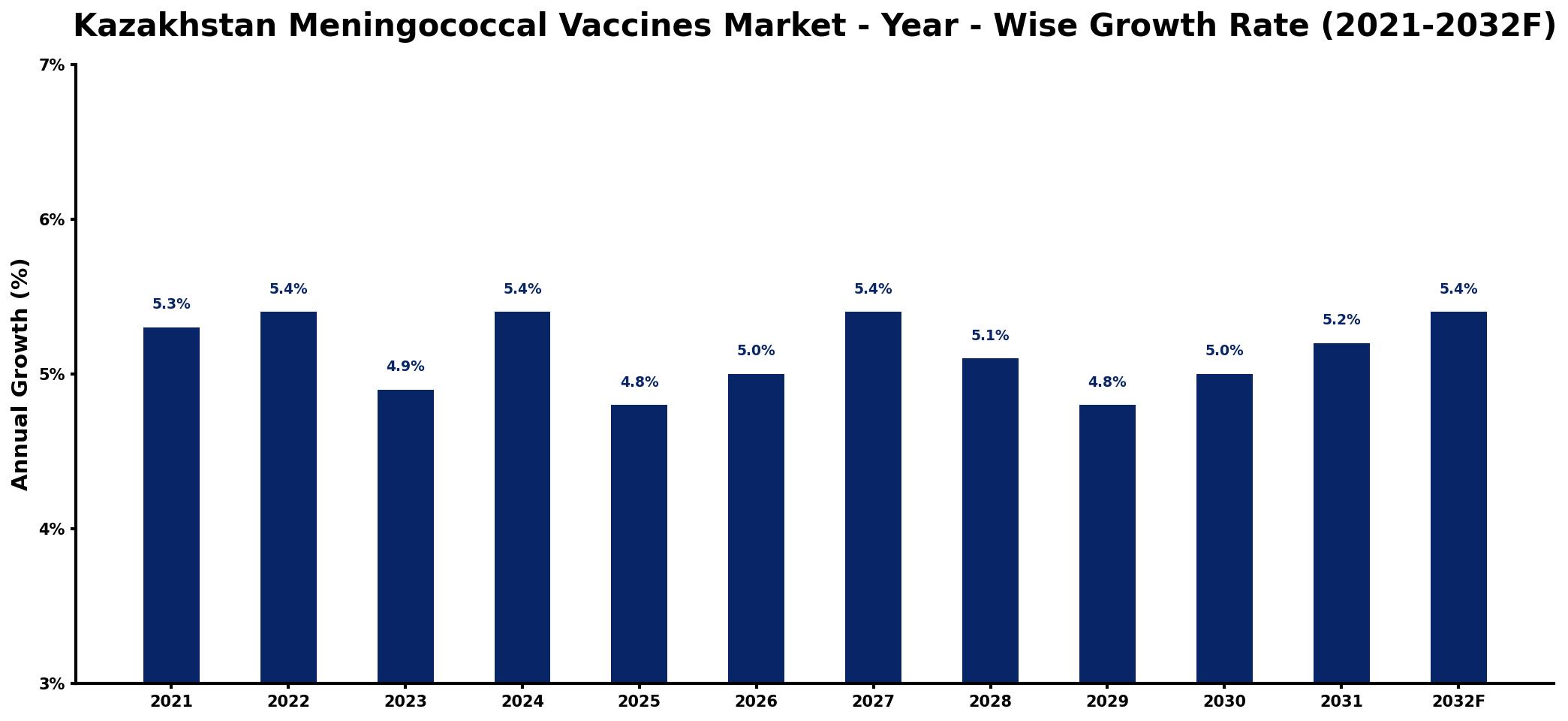
The table below presents the year‑wise growth rates along with the key drivers influencing the market
| Year | Growth Rate | Major Drivers |
| 2021 | 5.3% | Increased public health awareness |
| 2022 | 5.4% | Government funding for immunization programs |
| 2023 | 4.9% | Rising incidence of infectious diseases |
| 2024 | 5.4% | Expansion of healthcare infrastructure |
| 2025 | 4.8% | Growing private sector investments |
| 2026 | 5.0% | Improved access to healthcare services |
| 2027 | 5.4% | Strengthened disease prevention initiatives |
| 2028 | 5.1% | Enhanced collaboration with NGOs |
| 2029 | 4.8% | Increased demand for preventive care |
| 2030 | 5.0% | Advancements in healthcare technology |
| 2031 | 5.2% | Wider distribution networks established |
| 2032 | 5.4% | Focus on global health partnerships |
Note: Market size estimations and growth projections presented in this report are based on 6Wresearch's proprietary forecasting methodology, utilizing the latest available industry data, government publications, and primary research inputs.
Kazakhstan Meningococcal Vaccines Market Synopsis
In recent years, the landscape of the meningococcal vaccines market in Kazakhstan has evolved significantly, characterized by a shift in public health priorities and policies. The governments active role in promoting vaccination has led to increased accessibility and awareness among the population, effectively reducing the incidence of meningococcal diseases.
Recent studies indicate that vaccination rates are improving, highlighting a collective effort between government bodies, healthcare providers, and international organizations to combat infectious diseases. As campaigns intensify and vaccine hesitancy decreases, the market outlook remains promising.
Kazakhstan Meningococcal Vaccines Market Key Takeaways
- The Kazakhstan meningococcal vaccines market is experiencing robust growth driven by increased public awareness and government initiatives.
- Key challenges include ensuring vaccine efficacy and overcoming logistical hurdles in distribution.
- Public policies are focused on enhancing vaccination programs in schools and healthcare facilities.
- Collaborations with international health organizations are crucial for improving vaccine availability and disease surveillance.
- Future market prospects indicate a strong upward trajectory, supported by continuous investments in public health.
Evaluation of Restraints in Kazakhstan Meningococcal Vaccines Market
Despite the positive trends, the Kazakhstan meningococcal vaccines market faces several notable constraints. Vaccine development and production challenges remain at the forefront, often influenced by resource availability and the need for advanced technologies. Furthermore, accessibility can be hampered for vulnerable populations due to logistical issues, which complicate distribution. Regulatory compliance adds another layer of complexity, as stakeholders must navigate a landscape of evolving guidelines to ensure the safety and efficacy of vaccines. Such hurdles necessitate coordinated efforts among manufacturers, healthcare providers, and government entities to optimize vaccination campaigns and meet public health objectives.
Kazakhstan Meningococcal Vaccines Market Trends
Current trends in the Kazakhstan meningococcal vaccines market reflect an increasing reliance on technology to enhance immunization efforts. Digital health initiatives, such as mobile applications for vaccine scheduling and tracking, are gaining traction, making it easier for the public to access immunization services. Additionally, educational campaigns are becoming more targeted, utilizing social media and community outreach to address vaccine hesitancy. Emerging partnerships between local healthcare facilities and international health organizations are further shaping the demand, focusing on sustainable practices in vaccine distribution and administration.
Kazakhstan Meningococcal Vaccines Market Opportunities
The landscape for growth within the Kazakhstan meningococcal vaccines market is rich with opportunities. Investment in advanced manufacturing capabilities presents a chance to enhance vaccine production efficiency, while expanding public-private partnerships can foster innovation in immunization strategies. Additionally, as the government prioritizes health initiatives, sectors such as schools and universities represent fertile ground for targeted vaccination programs. Overall, the integration of new technologies and collaborative efforts are likely to create significant value for stakeholders invested in this market.
Government Initiatives in the Kazakhstan Meningococcal Vaccines Market
To combat public health concerns surrounding meningococcal disease, the Kazakhstani government has enacted various policies aimed at promoting widespread vaccination. These initiatives include subsidizing vaccine costs, organizing vaccination campaigns in educational institutions, and enhancing public awareness regarding the importance of immunization. Additionally, collaboration with international health organizations plays a vital role in ensuring the availability of vaccines and reinforcing disease surveillance efforts across the country. Such policies are instrumental in improving public health outcomes and fostering a culture of proactive health management.
Future Insights of the Kazakhstan Meningococcal Vaccines Market
Looking ahead to the period between 2026 and 2032, the Kazakhstan meningococcal vaccines market is set to experience dynamic growth driven by ongoing public health initiatives and technological advancements. As vaccination coverage increases, it is likely that the incidence of meningococcal diseases will decline, reinforcing the significance of immunization. Enhanced collaboration between governmental bodies and international health organizations will further support vaccine accessibility. Consequently, stakeholders can expect a landscape characterized by increased demand, innovative vaccine solutions, and a continued emphasis on public health education.
Kazakhstan Meningococcal Vaccines Market Latest Developments (2025 - 2026)
In the latest developments, the Kazakhstan meningococcal vaccines market is witnessing an uptick in collaborative efforts between government and health organizations to streamline vaccine distribution. Recent campaigns have prioritized educational outreach, focusing on communities with historically lower vaccination rates. Furthermore, advancements in vaccine technology are beginning to influence production strategies, potentially leading to more effective and widely accepted vaccines. These initiatives are crucial in bolstering the healthcare infrastructure and ensuring that the population remains informed and protected against meningococcal diseases.
Kazakhstan Meningococcal Vaccines Market - Key Attractiveness of the Report
- 10 Years of Market Numbers
- Historical Data Starting from 2022 to 2025
- Base Year: 2025
- Forecast Data until 2032
- Key Performance Indicators Impacting the Market
- Major Upcoming Developments and Projects
Key Highlights of the Report:
- Kazakhstan Meningococcal Vaccines Market Outlook
- Market Size of Kazakhstan Meningococcal Vaccines Market, 2025
- Forecast of Kazakhstan Meningococcal Vaccines Market, 2032
- Historical Data and Forecast of Kazakhstan Meningococcal Vaccines Revenues & Volume for the Period 2022-2032F
- Kazakhstan Meningococcal Vaccines Market Trend Evolution
- Kazakhstan Meningococcal Vaccines Market Drivers and Challenges
- Kazakhstan Meningococcal Vaccines Price Trends
- Kazakhstan Meningococcal Vaccines Porter's Five Forces
- Kazakhstan Meningococcal Vaccines Industry Life Cycle
- Historical Data and Forecast of Kazakhstan Meningococcal Vaccines Market Revenues & Volume By Product for the Period 2022-2032F
- Historical Data and Forecast of Kazakhstan Meningococcal Vaccines Market Revenues & Volume By Polysaccharide for the Period 2022-2032F
- Historical Data and Forecast of Kazakhstan Meningococcal Vaccines Market Revenues & Volume By Conjugate for the Period 2022-2032F
- Historical Data and Forecast of Kazakhstan Meningococcal Vaccines Market Revenues & Volume By Age Group for the Period 2022-2032F
- Historical Data and Forecast of Kazakhstan Meningococcal Vaccines Market Revenues & Volume By Infants for the Period 2022-2032F
- Historical Data and Forecast of Kazakhstan Meningococcal Vaccines Market Revenues & Volume By Children for the Period 2022-2032F
- Historical Data and Forecast of Kazakhstan Meningococcal Vaccines Market Revenues & Volume By Adolescents & Young Adults for the Period 2022-2032F
- Historical Data and Forecast of Kazakhstan Meningococcal Vaccines Market Revenues & Volume By Adults for the Period 2022-2032F
- Historical Data and Forecast of Kazakhstan Meningococcal Vaccines Market Revenues & Volume By Distribution Channel for the Period 2022-2032F
- Historical Data and Forecast of Kazakhstan Meningococcal Vaccines Market Revenues & Volume By Pharmacies for the Period 2022-2032F
- Historical Data and Forecast of Kazakhstan Meningococcal Vaccines Market Revenues & Volume By Community Clinics for the Period 2022-2032F
- Historical Data and Forecast of Kazakhstan Meningococcal Vaccines Market Revenues & Volume By Public Health Agencies for the Period 2022-2032F
- Historical Data and Forecast of Kazakhstan Meningococcal Vaccines Market Revenues & Volume By Others for the Period 2022-2032F
- Kazakhstan Meningococcal Vaccines Import Export Trade Statistics
- Market Opportunity Assessment By Product
- Market Opportunity Assessment By Age Group
- Market Opportunity Assessment By Distribution Channel
- Kazakhstan Meningococcal Vaccines Top Companies Market Share
- Kazakhstan Meningococcal Vaccines Competitive Benchmarking By Technical and Operational Parameters
- Kazakhstan Meningococcal Vaccines Company Profiles
- Kazakhstan Meningococcal Vaccines Key Strategic Recommendations






































