Kazakhstan Metal Slabs Market Summary
The kazakhstan metal slabs market was estimated at USD 309 Million in 2025 and is projected to reach USD 420 Million by 2032, growing at a CAGR of 5.5% from 2026 to 2032.
Kazakhstan Metal Slabs Market Year-wise Growth Rate and Key Drivers
This graph highlights how the Kazakhstan Metal Slabs Market has steadily grown over the past five years, supported by major growth factors.
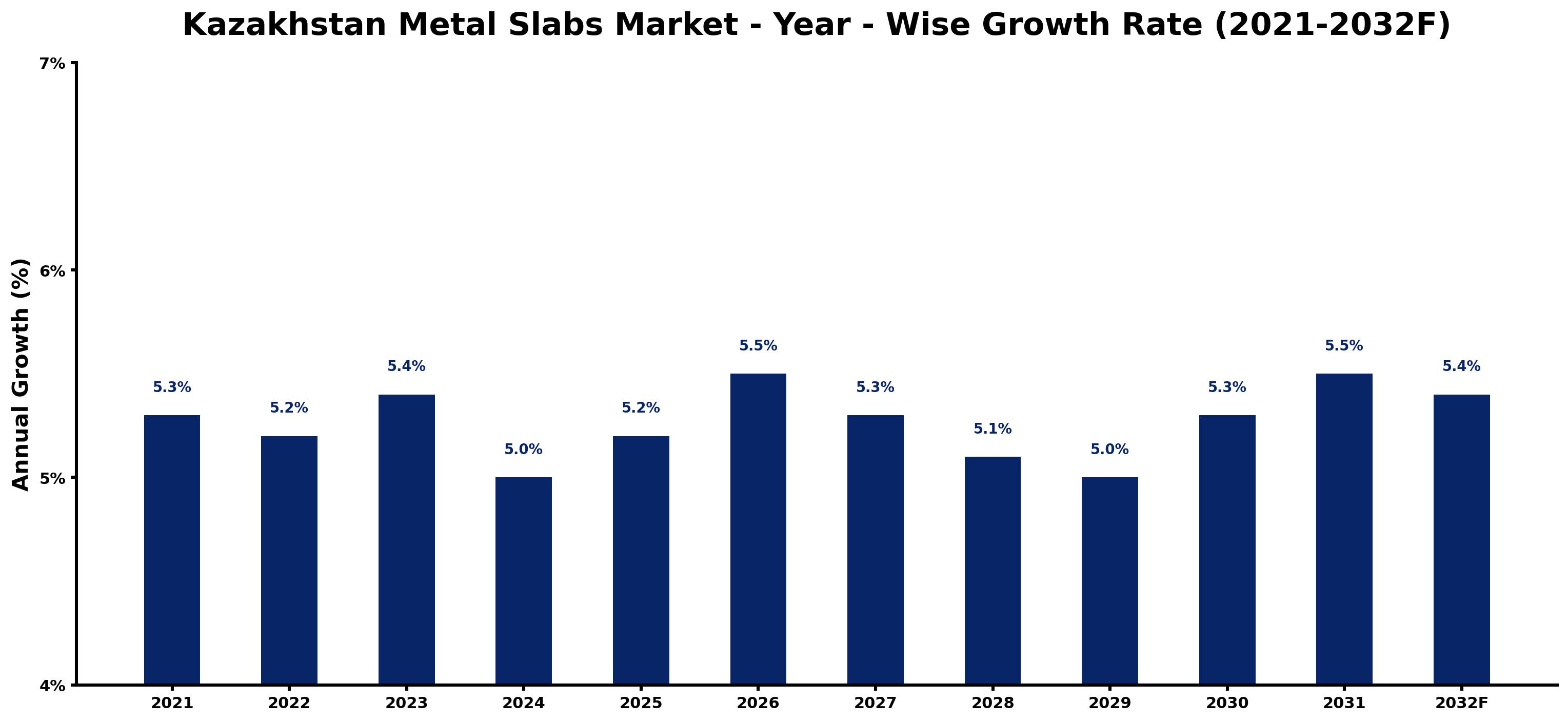
The table below presents the year wise growth rates along with the key drivers influencing the market
| Year | Growth Rate | Major Drivers |
| 2021 | 5.3% | Global economic recovery created increased demand for construction materials in Kazakhstan. |
| 2022 | 5.2% | Local industries upgraded production capabilities, enhancing output quality of metal slabs. |
| 2023 | 5.4% | Infrastructure projects initiated under national development plans generated significant market activity. |
| 2024 | 5.0% | Rising urbanization rates fueled demand for residential and commercial building supplies. |
| 2025 | 5.2% | Investment in renewable energy projects required high-quality metal slabs for construction. |
| 2026 | 5.5% | Regional trade agreements opened export opportunities for Kazakhstan's metal slab producers. |
| 2027 | 5.3% | Technological advancements improved manufacturing efficiency, lowering costs for producers. |
| 2028 | 5.1% | Sustainability trends pushed demand for eco-friendly metal production methods upward. |
| 2029 | 5.0% | Increased automotive manufacturing in Kazakhstan created a demand for specialized metal slabs. |
| 2030 | 5.3% | Construction of transport infrastructure projects stimulated significant growth in metal slab consumption. |
| 2031 | 5.5% | Investment in mining operations expanded the base for raw materials critical for production. |
| 2032 | 5.4% | The emergence of smart cities increased the need for high-strength, lightweight metal slabs. |
Note - Market size estimations and growth projections presented in this report are based on 6Wresearch's advanced forecasting approach, validated with industry datasets as of June 2026.
Kazakhstan Metal Slabs Market Synopsis
The Kazakhstan Metal Slabs Market is projected to reach 5.5% and witness significant growth during the forecast period (2026-2032). Over this period, the market is expected to benefit from a robust steel industry, driven primarily by escalating demands from both the construction and manufacturing sectors. The ongoing modernization of infrastructure across Kazakhstan serves as a catalyst for increased consumption of metal slabs, highlighting the sector's critical role in the country's economic development.
Kazakhstan Metal Slabs Market Growth Drivers
Several critical factors are fueling the growth of the Kazakhstan Metal Slabs Market. First, the expansion of the steel industry is significantly increasing the demand for metal slabs. As Kazakhstan aims to enhance its production capabilities, the need for raw materials will continue to rise.
- Government initiatives aimed at industrial modernization are likely to generate further investments in steel production, creating new opportunities in the metal slabs sector.
- The growing construction sector necessitates the use of metal slabs for various applications, including structural frameworks and infrastructure projects.
- International trade agreements are expanding market access, enabling local producers to tap into foreign markets while increasing competition domestically.
- Technological advancements in production processes are enhancing the quality and variety of metal slabs available, meeting diverse consumer needs.
- Sustainability trends are prompting manufacturers to innovate and adopt eco-friendly practices, giving rise to new environmentally conscious product lines.
Kazakhstan Metal Slabs Market Trends and Opportunities
The Kazakhstan Metal Slabs Market is experiencing various trends that are shaping its future trajectory. A pivotal trend is the modernization of manufacturing facilities which is projected to improve efficiency and output quality. Additionally, international collaborations are becoming increasingly common, providing local producers with advanced technologies and best practices.
- The integration of smart manufacturing technologies is gaining momentum, leading to enhanced production capabilities and a reduction in operational costs.
- There is a noticeable shift towards producing high-value-added products, positioning the market to meet specialized sector demands such as automotive and aerospace.
- Consumer preferences are leaning towards customized solutions, prompting manufacturers to adapt their offerings to meet specific project requirements.
- Increased research and development investments are fostering innovation, paving the way for new products and materials that cater to evolving market needs.
- Capacity expansion initiatives are prevalent among producers seeking to capture a larger share of the burgeoning domestic and international markets.
Kazakhstan Metal Slabs Market Challenges and Restraints
Despite the positive outlook for the Kazakhstan Metal Slabs Market, several challenges could impede growth. The volatility in raw material prices continues to pose a risk to profit margins, compelling manufacturers to adopt more strategic sourcing practices.
- Regulatory changes can create uncertainties, leading to increased compliance costs and operational complexities for producers.
- Competition from imported metal slabs may pressure local manufacturers, necessitating a focus on quality and cost competitiveness to retain market share.
- Supply chain disruptions, particularly those influenced by global economic conditions, can impact production timelines and logistics.
- Skilled labor shortages in specialized areas of manufacturing may hinder production capabilities and innovation efforts.
- Market saturation in certain segments may result in diminishing returns, necessitating diversification strategies among manufacturers.
Kazakhstan Metal Slabs Market Government Investment and Initiatives
The Kazakhstani government has implemented several strategic initiatives aimed at enhancing the industrial landscape, which directly benefits the Metal Slabs Market. The "Project Kazakhstan 2030" program is a key initiative designed to elevate the country's industrial modernization and infrastructure capabilities.
- Public spending in infrastructure projects is expected to increase significantly, directly translating into heightened demand for metal slabs used in construction.
- Investment incentives are being offered to domestic producers, encouraging the modernization of facilities and the adoption of new technologies.
- Government policies promoting export opportunities are assisting local manufacturers in gaining access to international markets, thereby increasing competitiveness.
- Environmental regulations are encouraging the development of sustainable practices within the metal industry, prompting investments in green technologies.
- Industry partnerships and collaborations fostered by government initiatives are facilitating knowledge transfer and skill development in the sector.
Kazakhstan Metal Slabs Market Latest Developments (May 2025 - June 2026)
In the period between May 2025 and June 2026, the Kazakhstan Metal Slabs Market has witnessed notable developments. The government's focus on infrastructure projects has led to increased public investment, significantly driving up the demand for metal slabs. Furthermore, advancements in production technologies have allowed producers to enhance the quality and efficiency of metal slab manufacturing.
- Several local manufacturers have initiated capacity expansion projects to cater to the growing domestic and international demand.
- Collaboration between industry stakeholders has intensified, with research institutions and manufacturers working together on innovative product development.
- Market players have been actively exploring sustainable practices, integrating eco-friendly technologies into their production processes.
- International partnerships have emerged, allowing local producers to adopt global best practices and improve their competitive edge.
- The overall sentiment in the market remains positive, driven by ongoing government support and an upward trend in construction and manufacturing activities.
Kazakhstan Metal Slabs Market - Key Attractiveness of the Report
- 10 Years of Market Numbers
- Historical Data Starting from 2022 to 2025
- Base Year: 2025
- Forecast Data until 2032
- Key Performance Indicators Impacting the Market
- Major Upcoming Developments and Projects
Key Highlights of the Report:
- Kazakhstan Metal Slabs Market Outlook
- Market Size of Kazakhstan Metal Slabs Market, 2025
- Forecast of Kazakhstan Metal Slabs Market, 2032F
- Historical Data and Forecast of Kazakhstan Metal Slabs Revenues & Volume for the Period 2022-2032F
- Kazakhstan Metal Slabs Market Trend Evolution
- Kazakhstan Metal Slabs Market Drivers and Challenges
- Kazakhstan Metal Slabs Price Trends
- Kazakhstan Metal Slabs Porter's Five Forces
- Kazakhstan Metal Slabs Industry Life Cycle
- Historical Data and Forecast of Kazakhstan Metal Slabs Market Revenues & Volume By Size Types for the Period 2022-2032F
- Historical Data and Forecast of Kazakhstan Metal Slabs Market Revenues & Volume By Small for the Period 2022-2032F
- Historical Data and Forecast of Kazakhstan Metal Slabs Market Revenues & Volume By Medium for the Period 2022-2032F
- Historical Data and Forecast of Kazakhstan Metal Slabs Market Revenues & Volume By Large for the Period 2022-2032F
- Historical Data and Forecast of Kazakhstan Metal Slabs Market Revenues & Volume By End-users for the Period 2022-2032F
- Historical Data and Forecast of Kazakhstan Metal Slabs Market Revenues & Volume By Commercial for the Period 2022-2032F
- Historical Data and Forecast of Kazakhstan Metal Slabs Market Revenues & Volume By Residential for the Period 2022-2032F
- Historical Data and Forecast of Kazakhstan Metal Slabs Market Revenues & Volume By Industrial for the Period 2022-2032F
- Historical Data and Forecast of Kazakhstan Metal Slabs Market Revenues & Volume By Product Types for the Period 2022-2032F
- Historical Data and Forecast of Kazakhstan Metal Slabs Market Revenues & Volume By Worktops for the Period 2022-2032F
- Historical Data and Forecast of Kazakhstan Metal Slabs Market Revenues & Volume By Window Sills for the Period 2022-2032F
- Historical Data and Forecast of Kazakhstan Metal Slabs Market Revenues & Volume By Floor Step for the Period 2022-2032F
- Historical Data and Forecast of Kazakhstan Metal Slabs Market Revenues & Volume By Others for the Period 2022-2032F
- Kazakhstan Metal Slabs Import Export Trade Statistics
- Market Opportunity Assessment By Size Types
- Market Opportunity Assessment By End-users
- Market Opportunity Assessment By Product Types
- Kazakhstan Metal Slabs Top Companies Market Share
- Kazakhstan Metal Slabs Competitive Benchmarking By Technical and Operational Parameters
- Kazakhstan Metal Slabs Company Profiles
- Kazakhstan Metal Slabs Key Strategic Recommendations






































