Kazakhstan Plastic Bottles Market Size, Share & Growth Rate
The Kazakhstan Plastic Bottles Market was estimated at USD 195 Million in 2025 and is projected to reach USD 268 Million by 2032, growing at a CAGR of 4.6% from 2026 to 2032. This growth trajectory is primarily fueled by the increasing consumer demand for bottled beverages and personal care products, alongside an expanding packaging industry. As urbanization accelerates and disposable incomes rise, the shift towards convenient, on-the-go products will further propel the market.
Kazakhstan Plastic Bottles Market Year-wise Growth Rate and Key Drivers
This graph highlights how the Kazakhstan Plastic Bottles Market has steadily grown over the years, supported by major growth factors.
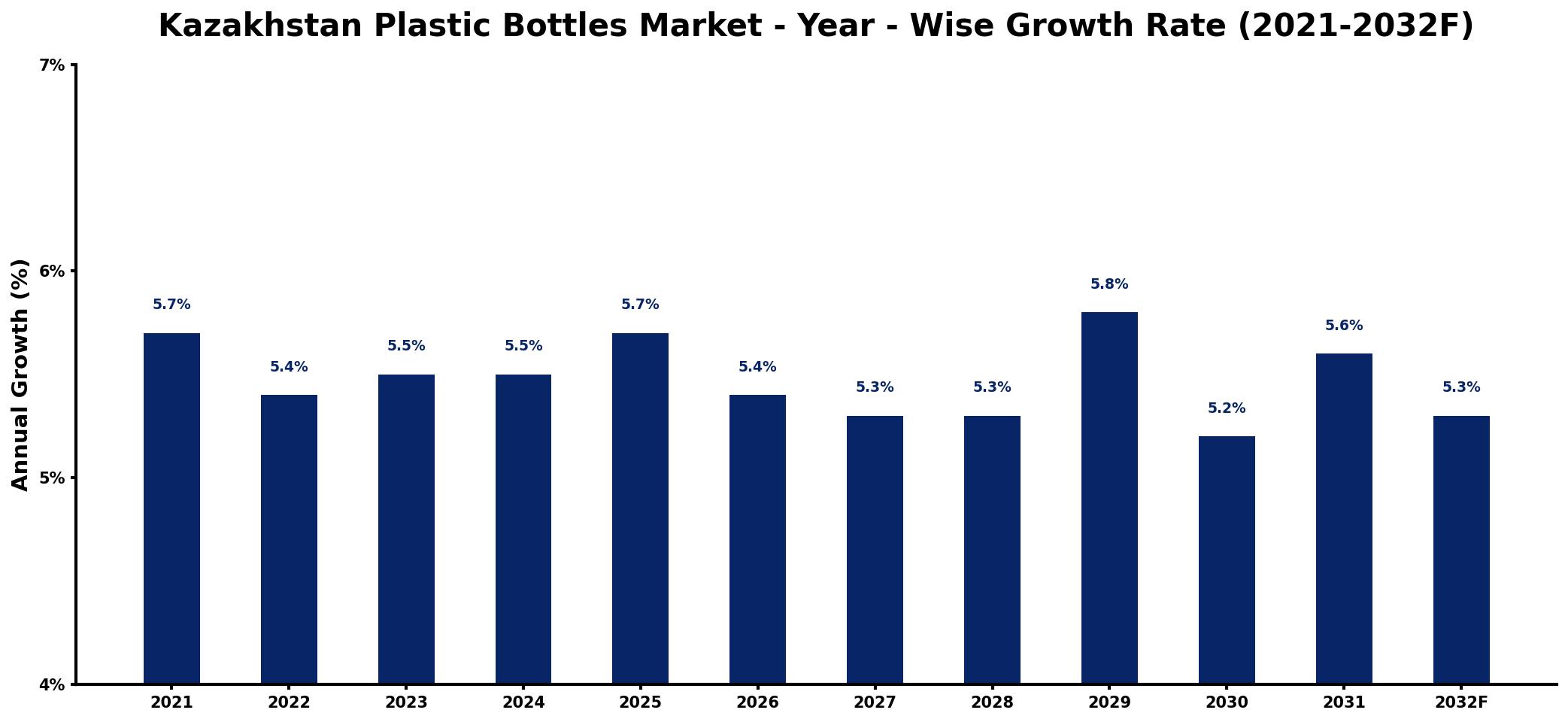
The table below presents the year‑wise growth rates along with the key drivers influencing the market
| Year | Growth Rate | Major Drivers |
| 2021 | 5.7% | Rising beverage sector demand |
| 2022 | 5.4% | Increased production capacity investments |
| 2023 | 5.5% | Growth in food packaging requirements |
| 2024 | 5.5% | Expansion of retail distribution networks |
| 2025 | 5.7% | Surge in e-commerce packaging needs |
| 2026 | 5.4% | Higher consumer awareness for sustainability |
| 2027 | 5.3% | Demand from healthcare industry rising |
| 2028 | 5.3% | Investments in recycling technologies increasing |
| 2029 | 5.8% | Emergence of new market players |
| 2030 | 5.2% | Shift towards lightweight packaging solutions |
| 2031 | 5.6% | enhanced product quality standards |
| 2032 | 5.3% | Technological advancements in manufacturing |
Note: Market size estimations and growth projections presented in this report are based on 6Wresearch's proprietary forecasting methodology, utilizing the latest available industry data, government publications, and primary research inputs.
Kazakhstan Plastic Bottles Market Synopsis
The demand for plastic bottles in Kazakhstan is sharply influenced by the food and beverage sector, where the preference for bottled drinks continues to rise. This trend reflects broader global consumption patterns, with consumers increasingly valuing convenience and portability.
In response to evolving market dynamics, manufacturers are gravitating towards PET bottles, celebrated for their lightweight nature, durability, and recyclability. This focus on sustainable packaging solutions aligns with growing consumer preferences for environmentally friendly products.
Kazakhstan Plastic Bottles Market Key Takeaways
- Shift towards eco-friendly PET bottles highlights consumer demand for sustainable packaging.
- Urbanization and rising disposable incomes are key growth drivers in the beverage sector.
- Innovation in product design is essential for capturing changing consumer preferences.
- Collaboration with local manufacturers enhances market penetration and distribution.
- Government initiatives are paving the way for improved recycling practices and sustainability.
Evaluation of Restraints in Kazakhstan Plastic Bottles Market
Despite promising growth, the Kazakhstan Plastic Bottles Market faces significant restraints. Increasing competition from alternative packaging solutions, particularly glass and aluminum, poses a challenge to market expansion. Additionally, fluctuations in raw material costs, primarily driven by volatile oil prices, can squeeze profit margins for manufacturers. Environmental concerns surrounding plastic waste and pollution are compelling the industry to adapt rapidly, yet inadequate recycling infrastructure and limited consumer awareness complicate efforts to pivot toward sustainable practices.
Kazakhstan Plastic Bottles Market Trends
Key trends shaping the Kazakhstan Plastic Bottles Market include a pronounced shift toward sustainable and biodegradable packaging options. Manufacturers are increasingly focused on innovation, creating lightweight bottles with improved designs that enhance user convenience. There is also a growing adoption of online retail channels, necessitating smaller-sized bottles tailored for e-commerce. These trends underscore the importance of flexibility and responsiveness in product offerings to align with consumer demands.
Kazakhstan Plastic Bottles Market Opportunities
The Kazakhstan Plastic Bottles Market presents abundant investment opportunities. As urbanization fuels the demand for packaged goods, especially beverages and personal care items, investors can tap into advanced manufacturing technologies that prioritize sustainability. Moreover, the increasing emphasis on recycling and waste management solutions represents a strategic avenue for development. Establishing partnerships with local players and building a robust distribution network can further unlock potential in this growing market.
Government Initiatives in the Kazakhstan Plastic Bottles Market
The Kazakh government has implemented a series of initiatives aimed at fostering sustainability within the plastic bottles market. Key among these is the Extended Producer Responsibility (EPR) framework, mandating producers to oversee the collection and recycling of their products. Additionally, initiatives to raise public awareness about the environmental impacts of plastic consumption are gaining traction, fostering a culture of responsibility among consumers. The imposition of taxes on plastic products incentivizes producers to explore more eco-friendly alternatives.
Future Insights of the Kazakhstan Plastic Bottles Market
Looking ahead to 2026-2032, the Kazakhstan Plastic Bottles Market is positioned for sustained growth. As consumer preferences shift towards packaged beverages and personal care products, coupled with rising disposable incomes, demand is anticipated to soar. The market will likely see continued advancements in manufacturing technology, fostering enhanced product quality and cost efficiencies. Furthermore, the trend towards sustainability will shape the landscape, with an increasing number of companies investing in biodegradable and recycled packaging solutions.
Kazakhstan Plastic Bottles Market Latest Developments (2025 - 2026)
Recent developments in the Kazakhstan Plastic Bottles Market indicate a heightened focus on innovation and sustainability among manufacturers. Many companies are exploring new materials and production methods to align with consumer demands for eco-friendly packaging. Additionally, industry players are increasingly collaborating with local governments to enhance recycling initiatives and raise public awareness about the importance of sustainable practices in plastic consumption.
Kazakhstan Plastic Bottles Market - Key Attractiveness of the Report
- 10 Years of Market Numbers
- Historical Data Starting from 2022 to 2025
- Base Year: 2025
- Forecast Data until 2032
- Key Performance Indicators Impacting the Market
- Major Upcoming Developments and Projects
Key Highlights of the Report:
- Kazakhstan Plastic Bottles Market Outlook
- Market Size of Kazakhstan Plastic Bottles Market, 2025
- Forecast of Kazakhstan Plastic Bottles Market, 2032
- Historical Data and Forecast of Kazakhstan Plastic Bottles Revenues & Volume for the Period 2022-2032F
- Kazakhstan Plastic Bottles Market Trend Evolution
- Kazakhstan Plastic Bottles Market Drivers and Challenges
- Kazakhstan Plastic Bottles Price Trends
- Kazakhstan Plastic Bottles Porter's Five Forces
- Kazakhstan Plastic Bottles Industry Life Cycle
- Historical Data and Forecast of Kazakhstan Plastic Bottles Market Revenues & Volume By Raw Material Type for the Period 2022-2032F
- Historical Data and Forecast of Kazakhstan Plastic Bottles Market Revenues & Volume By Polyethylene Terephthalate (PET) for the Period 2022-2032F
- Historical Data and Forecast of Kazakhstan Plastic Bottles Market Revenues & Volume By Poly Propylene (PP) for the Period 2022-2032F
- Historical Data and Forecast of Kazakhstan Plastic Bottles Market Revenues & Volume By Low-density Polyethylene (LDPE) for the Period 2022-2032F
- Historical Data and Forecast of Kazakhstan Plastic Bottles Market Revenues & Volume By High-density Polyethylene (HDPE) for the Period 2022-2032F
- Historical Data and Forecast of Kazakhstan Plastic Bottles Market Revenues & Volume By Other Raw Materials for the Period 2022-2032F
- Historical Data and Forecast of Kazakhstan Plastic Bottles Market Revenues & Volume By End-user for the Period 2022-2032F
- Historical Data and Forecast of Kazakhstan Plastic Bottles Market Revenues & Volume By Beverage for the Period 2022-2032F
- Historical Data and Forecast of Kazakhstan Plastic Bottles Market Revenues & Volume By Food for the Period 2022-2032F
- Historical Data and Forecast of Kazakhstan Plastic Bottles Market Revenues & Volume By Cosmetics for the Period 2022-2032F
- Historical Data and Forecast of Kazakhstan Plastic Bottles Market Revenues & Volume By Pharmaceutical for the Period 2022-2032F
- Historical Data and Forecast of Kazakhstan Plastic Bottles Market Revenues & Volume By Household Care for the Period 2022-2032F
- Historical Data and Forecast of Kazakhstan Plastic Bottles Market Revenues & Volume By Other for the Period 2022-2032F
- Kazakhstan Plastic Bottles Import Export Trade Statistics
- Market Opportunity Assessment By Raw Material Type
- Market Opportunity Assessment By End-user
- Kazakhstan Plastic Bottles Top Companies Market Share
- Kazakhstan Plastic Bottles Competitive Benchmarking By Technical and Operational Parameters
- Kazakhstan Plastic Bottles Company Profiles
- Kazakhstan Plastic Bottles Key Strategic Recommendations






































