Kazakhstan Potassium chlorate Market Size, Share & Growth Rate
The Kazakhstan Potassium chlorate Market was estimated at USD 368 Million in 2025 and is projected to reach USD 488 Million by 2032, growing at a CAGR of 4.1% from 2026 to 2032. This growth trajectory is primarily driven by the rising agricultural sector, where potassium chlorate is increasingly utilized as a critical component in fertilizers to enhance soil quality and crop yield. Additionally, the expanding applications of potassium chlorate in pharmaceuticals and industrial chemicals contribute significantly to market expansion, further supported by governmental initiatives promoting local production.
Kazakhstan Potassium chlorate Market Year-wise Growth Rate and Key Drivers
This graph highlights how the Kazakhstan Potassium chlorate Market has steadily grown over the years, supported by major growth factors.
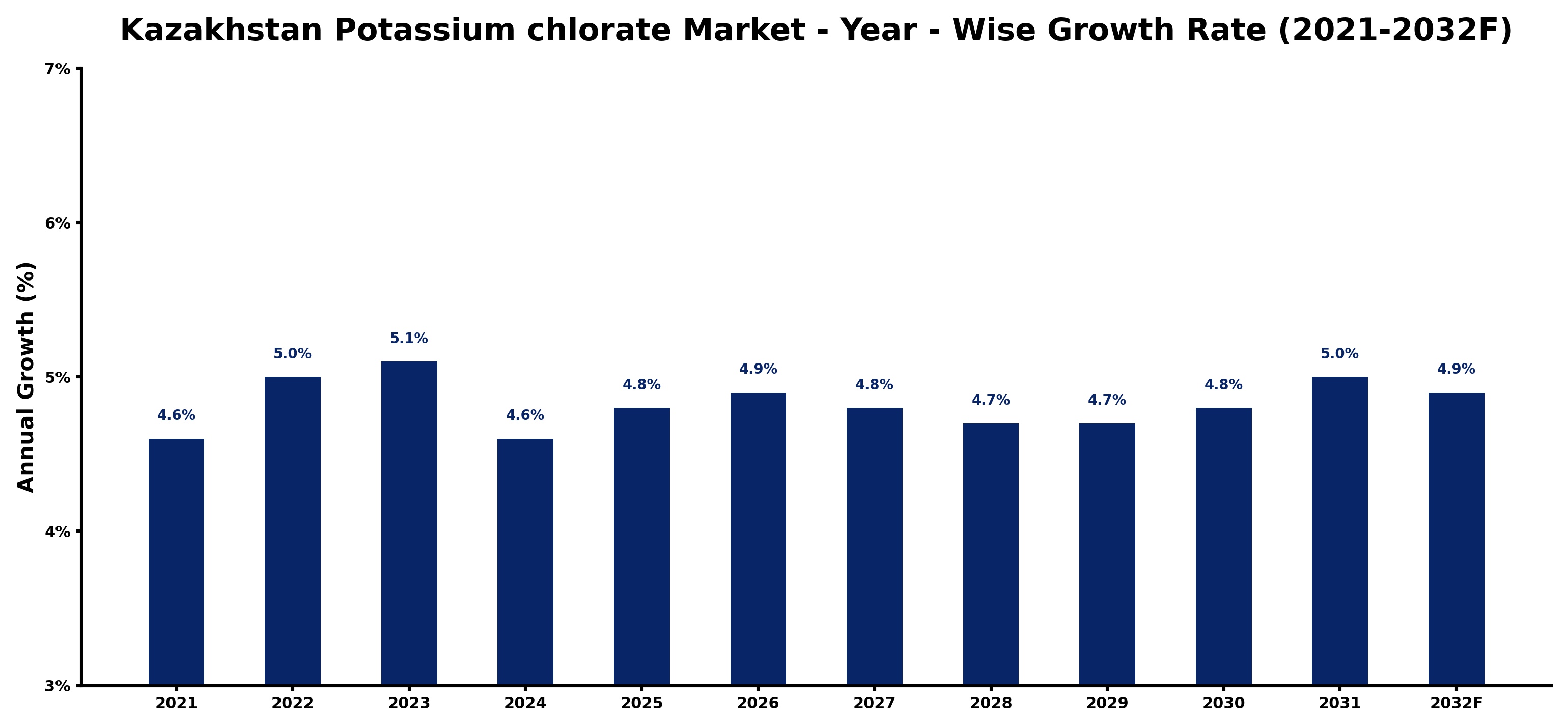
The table below presents the year‑wise growth rates along with the key drivers influencing the market
| Year | Growth Rate | Major Drivers |
| 2021 | 4.6% | Infrastructure upgrades boost potassium chlorate production efficiency and output |
| 2022 | 5.0% | New potassium chlorate production facilities enhance local manufacturing capacity |
| 2023 | 5.1% | New facility investments boost potassium chlorate production capacity utilization |
| 2024 | 4.6% | Production capacity upgrades bolstered potassium chlorate supply chain efficiency |
| 2025 | 4.8% | Kazakhstan's infrastructure development boosts potassium chlorate manufacturing capacity |
| 2026 | 4.9% | Technology adoption in potassium chlorate production enhances operational efficiency |
| 2027 | 4.8% | Infrastructure investments boosted potassium chlorate production capacity expansion |
| 2028 | 4.7% | Domestic fertilizer manufacturing drives potassium chlorate production capacity optimization |
| 2029 | 4.7% | Automation upgrades in chemical plants boosted potassium chlorate output |
| 2030 | 4.8% | Strategic investment in local facilities boosts potassium chlorate production efficiency |
| 2031 | 5.0% | Manufacturing investment in potassium chlorate boosts regional export capabilities |
| 2032 | 4.9% | Domestic chemical manufacturers invest in modern potassium chlorate production facilities |
Note - Market size estimations and growth projections presented in this report are based on 6Wresearch's advanced forecasting approach, validated with industry datasets as of June 2026.
Kazakhstan Potassium chlorate Market Synopsis
While the Kazakhstan Potassium chlorate market has seen steady growth in recent years, the future promises even greater potential due to expanding applications across multiple sectors. Enhanced agricultural practices and a burgeoning demand in pharmaceuticals are reshaping the landscape, positioning Kazakhstan as a significant player in this market.
However, this positive momentum is juxtaposed with ongoing challenges, particularly concerning stringent regulatory requirements. As the market grows, stakeholders must navigate a complex regulatory framework while seeking innovative solutions to satisfy increasing demand and environmental standards.
Kazakhstan Potassium chlorate Market Key Takeaways
- The Kazakhstan Potassium chlorate market is poised for significant growth with a projected CAGR of 4.1% from 2026 to 2032.
- Demand in agriculture, particularly for fertilizer applications, is a major driver of market expansion.
- Regulatory compliance poses challenges that must be managed by companies within the market.
- The government's support for domestic production provides a conducive environment for market players.
- Investment opportunities are emerging in light of the country's vast potassium chloride reserves.
Evaluation of Restraints in Kazakhstan Potassium chlorate Market
One notable restraint in the Kazakhstan Potassium chlorate market stems from stringent regulations surrounding chemical production and usage. These regulations can elevate operational costs for manufacturers, impacting pricing strategies and market entry for new players. Additionally, volatility in the prices of key raw materials, such as potassium chloride, may further complicate production costs. Companies must also contend with the necessity for continuous innovation in product development to stay competitive amidst rising environmental concerns and alternative product offerings.
Kazakhstan Potassium chlorate Market Trends
Current trends indicate a strong inclination towards sustainable agricultural practices, catalyzing the demand for potassium chlorate in fertilizers and herbicides. This shift aligns with global movements towards eco-friendly farming methods. Additionally, the expanding use of potassium chlorate in the chemical industry—specifically in the synthesis of various materials—is creating new avenues for growth. Manufacturers are now focusing on expanding production capabilities to meet the diverse needs across these sectors.
Kazakhstan Potassium chlorate Market Opportunities
The Kazakhstan Potassium chlorate market is ripe with investment opportunities, especially given the country's abundant reserves of potassium chloride. As a key player in global potassium chloride export, Kazakhstan holds a strategic advantage for potential investors looking to tap into the potassium chlorate production landscape. The growing demand across agriculture, pharmaceuticals, and electronics sectors highlights the necessity for enhanced production facilities, promising substantial returns for investors. Furthermore, government initiatives aimed at fostering foreign investment and enhancing domestic production amplify the market's attractiveness for long-term engagement.
Government Initiatives in the Kazakhstan Potassium chlorate Market
The Kazakhstan government has instituted various policies to regulate the production, export, and pricing of potassium chlorate. Emphasizing the stability and competitiveness of the industry, the government sets production quotas for manufacturers while managing export regulations to ensure a balanced market flow. Additionally, price control measures are implemented to prevent unfair pricing practices, fostering a level playing field for all market participants. These initiatives are essential for supporting both producers and consumers while enhancing the overall sustainability of the potassium chlorate market.
Future Insights of the Kazakhstan Potassium chlorate Market
Looking ahead to 2026-2032, the Kazakhstan Potassium chlorate market appears set for continued growth, bolstered by increasing demand from diverse end-use sectors. The agricultural sector's continued adoption of potassium chlorate as a vital ingredient in fertilizers and herbicides is expected to remain a significant driver of market development. As technological advancements facilitate more efficient production processes, the market is anticipated to evolve further, despite regulatory and environmental challenges that may necessitate a focus on sustainable practices.
Kazakhstan Potassium chlorate Market Latest Developments (May 2025 - June 2026)
Recent developments in the Kazakhstan Potassium chlorate market indicate a strong emphasis on enhancing production capacities to accommodate increasing demand. Companies are actively exploring innovations in manufacturing processes to improve sustainability and efficiency. Additionally, collaborations between local producers and international investors are gaining traction, aiming to strengthen the overall market position of potassium chlorate within both domestic and export frameworks.
Kazakhstan Potassium chlorate Market - Key Attractiveness of the Report
- 10 Years of Market Numbers
- Historical Data Starting from 2022 to 2025
- Base Year: 2025
- Forecast Data until 2032
- Key Performance Indicators Impacting the Market
- Major Upcoming Developments and Projects
Key Highlights of the Report:
- Kazakhstan Potassium chlorate Market Outlook
- Market Size of Kazakhstan Potassium chlorate Market, 2025
- Forecast of Kazakhstan Potassium chlorate Market, 2032
- Historical Data and Forecast of Kazakhstan Potassium chlorate Revenues & Volume for the Period 2022-2032F
- Kazakhstan Potassium chlorate Market Trend Evolution
- Kazakhstan Potassium chlorate Market Drivers and Challenges
- Kazakhstan Potassium chlorate Price Trends
- Kazakhstan Potassium chlorate Porter's Five Forces
- Kazakhstan Potassium chlorate Industry Life Cycle
- Historical Data and Forecast of Kazakhstan Potassium chlorate Market Revenues & Volume By Product type for the Period 2022-2032F
- Historical Data and Forecast of Kazakhstan Potassium chlorate Market Revenues & Volume By Pharmaceutical Grade for the Period 2022-2032F
- Historical Data and Forecast of Kazakhstan Potassium chlorate Market Revenues & Volume By Chemical Grade for the Period 2022-2032F
- Historical Data and Forecast of Kazakhstan Potassium chlorate Market Revenues & Volume By End-use for the Period 2022-2032F
- Historical Data and Forecast of Kazakhstan Potassium chlorate Market Revenues & Volume By Explosives for the Period 2022-2032F
- Historical Data and Forecast of Kazakhstan Potassium chlorate Market Revenues & Volume By Matches for the Period 2022-2032F
- Historical Data and Forecast of Kazakhstan Potassium chlorate Market Revenues & Volume By Disinfectants for the Period 2022-2032F
- Historical Data and Forecast of Kazakhstan Potassium chlorate Market Revenues & Volume By Bleaches for the Period 2022-2032F
- Historical Data and Forecast of Kazakhstan Potassium chlorate Market Revenues & Volume By Medical for the Period 2022-2032F
- Kazakhstan Potassium chlorate Import Export Trade Statistics
- Market Opportunity Assessment By Product type
- Market Opportunity Assessment By End-use
- Kazakhstan Potassium chlorate Top Companies Market Share
- Kazakhstan Potassium chlorate Competitive Benchmarking By Technical and Operational Parameters
- Kazakhstan Potassium chlorate Company Profiles
- Kazakhstan Potassium chlorate Key Strategic Recommendations






































