Kazakhstan Printed Signage Market: Import Trend Analysis
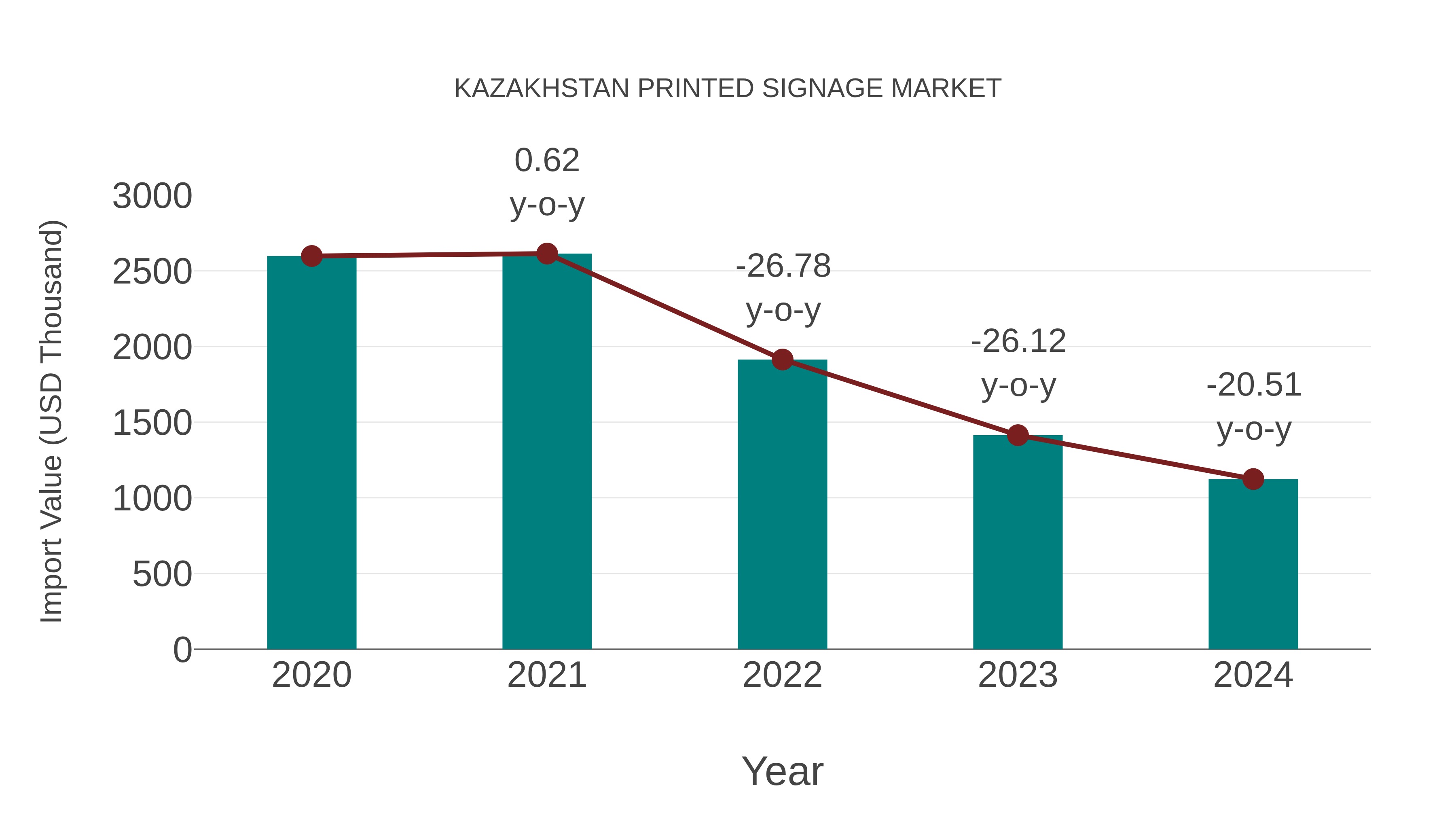
In the Kazakhstan printed signage market, the import trend experienced a decline, with a growth rate of -20.51% from 2023 to 2024. The compound annual growth rate (CAGR) for imports from 2020 to 2024 stood at -18.9%. This negative import momentum may be attributed to shifts in demand patterns or changes in trade policies impacting market stability.
Kazakhstan Printed Signage Market Synopsis
The Kazakhstan Printed Signage Market is witnessing steady growth driven by increasing investments in infrastructure development, retail sectors, and the rising demand for advertising and promotional activities. The market offers a wide range of printed signage solutions such as banners, posters, billboards, and vehicle wraps, catering to various industries including retail, transportation, and hospitality. Factors such as urbanization, economic growth, and the increasing adoption of digital printing technologies are further fueling market expansion. Key players in the Kazakhstan Printed Signage Market are focusing on product innovation, customization, and sustainability to stay competitive in this growing market. With the growing emphasis on brand visibility and marketing strategies, the demand for printed signage solutions is expected to continue to rise in Kazakhstan.
Kazakhstan Printed Signage Market Trends
In the Kazakhstan Printed Signage Market, there is a noticeable shift towards digital signage solutions due to their dynamic content capabilities and interactive features. Businesses are increasingly investing in digital signage to enhance customer engagement and deliver targeted messages. Additionally, there is a growing focus on sustainability, with a preference for eco-friendly materials and printing techniques. Personalized and customized signage options are also gaining popularity as companies seek to differentiate themselves and create unique brand experiences. As technology continues to advance, we can expect to see further integration of digital signage with data analytics and automation for more efficient and effective marketing strategies in the Kazakhstan Printed Signage Market.
Kazakhstan Printed Signage Market Challenges
In the Kazakhstan Printed Signage Market, one of the main challenges faced is the increasing competition from digital signage solutions. As technology continues to advance, many businesses are opting for digital displays over traditional printed signage due to their interactive capabilities and ability to provide real-time updates. This trend poses a threat to the printed signage market as businesses may shift their advertising budgets towards digital solutions. Additionally, economic factors and fluctuations in the market can impact the demand for printed signage, affecting the revenue and growth potential of companies operating in this sector. To stay competitive, companies in the Kazakhstan Printed Signage Market must innovate, offer unique value propositions, and adapt to changing customer preferences and technological advancements.
Kazakhstan Printed Signage Market Investment Opportunities
The Kazakhstan Printed Signage Market presents promising investment opportunities due to the country`s growing economy and increasing demand for advertising and promotional materials. With the rapid development of industries such as retail, hospitality, and real estate, there is a rising need for high-quality and visually appealing printed signage to attract customers and enhance brand visibility. Investing in state-of-the-art printing technology, innovative design capabilities, and sustainable materials can help companies capitalize on this market growth. Additionally, providing value-added services such as customization, installation, and maintenance can enable businesses to differentiate themselves and capture a larger market share. Overall, the Kazakhstan Printed Signage Market offers a favorable environment for investors looking to tap into the country`s expanding advertising and marketing sector.
Jordan Agar Market Government Policies
In Kazakhstan, the government has implemented policies related to the Printed Signage Market primarily to ensure compliance with safety and environmental standards. Regulations require signage to be clear, legible, and not obstructive to public safety. Additionally, there are guidelines in place regarding the placement of signage to maintain the aesthetic appeal of public spaces. The government also emphasizes the use of environmentally friendly materials and practices in the production of printed signage to reduce ecological impact. Overall, these policies aim to promote responsible and sustainable practices within the Printed Signage Market in Kazakhstan.
Kazakhstan Printed Signage Market Future Outlook
The future outlook for the Kazakhstan Printed Signage Market appears promising, driven by the country`s growing economy, increasing urbanization, and expanding retail and commercial sectors. The demand for printed signage is expected to rise as businesses focus on branding, marketing, and enhancing customer experiences. Technological advancements in printing techniques and materials are likely to offer more innovative and customizable signage solutions, catering to the evolving needs of industries such as retail, hospitality, and transportation. Additionally, the government`s infrastructure development projects, upcoming events, and investments in tourism are anticipated to further boost the demand for printed signage across various sectors. Overall, the Kazakhstan Printed Signage Market is poised for steady growth in the coming years, presenting opportunities for both local and international signage companies to expand their presence and offerings in the region.
Key Highlights of the Report:
- Kazakhstan Printed Signage Market Outlook
- Market Size of Kazakhstan Printed Signage Market, 2025
- Forecast of Kazakhstan Printed Signage Market, 2032
- Historical Data and Forecast of Kazakhstan Printed Signage Revenues & Volume for the Period 2022 - 2032F
- Kazakhstan Printed Signage Market Trend Evolution
- Kazakhstan Printed Signage Market Drivers and Challenges
- Kazakhstan Printed Signage Price Trends
- Kazakhstan Printed Signage Porter's Five Forces
- Kazakhstan Printed Signage Industry Life Cycle
- Historical Data and Forecast of Kazakhstan Printed Signage Market Revenues & Volume By Product for the Period 2022 - 2032F
- Historical Data and Forecast of Kazakhstan Printed Signage Market Revenues & Volume By Billboard for the Period 2022 - 2032F
- Historical Data and Forecast of Kazakhstan Printed Signage Market Revenues & Volume By Backlit Display for the Period 2022 - 2032F
- Historical Data and Forecast of Kazakhstan Printed Signage Market Revenues & Volume By Pop Display for the Period 2022 - 2032F
- Historical Data and Forecast of Kazakhstan Printed Signage Market Revenues & Volume By Banner for the Period 2022 - 2032F
- Historical Data and Forecast of Kazakhstan Printed Signage Market Revenues & Volume By Corporate Graphics for the Period 2022 - 2032F
- Historical Data and Forecast of Kazakhstan Printed Signage Market Revenues & Volume By Others for the Period 2022 - 2032F
- Historical Data and Forecast of Kazakhstan Printed Signage Market Revenues & Volume By Type for the Period 2022 - 2032F
- Historical Data and Forecast of Kazakhstan Printed Signage Market Revenues & Volume By Indoor Printed Signage for the Period 2022 - 2032F
- Historical Data and Forecast of Kazakhstan Printed Signage Market Revenues & Volume By Outdoor Printed Signage for the Period 2022 - 2032F
- Historical Data and Forecast of Kazakhstan Printed Signage Market Revenues & Volume By End-user Vertical for the Period 2022 - 2032F
- Historical Data and Forecast of Kazakhstan Printed Signage Market Revenues & Volume By BFSI for the Period 2022 - 2032F
- Historical Data and Forecast of Kazakhstan Printed Signage Market Revenues & Volume By Retail for the Period 2022 - 2032F
- Historical Data and Forecast of Kazakhstan Printed Signage Market Revenues & Volume By Sports and Leisure for the Period 2022 - 2032F
- Historical Data and Forecast of Kazakhstan Printed Signage Market Revenues & Volume By Entertainment for the Period 2022 - 2032F
- Historical Data and Forecast of Kazakhstan Printed Signage Market Revenues & Volume By Transportation and Logistics for the Period 2022 - 2032F
- Historical Data and Forecast of Kazakhstan Printed Signage Market Revenues & Volume By Healthcare for the Period 2022 - 2032F
- Historical Data and Forecast of Kazakhstan Printed Signage Market Revenues & Volume By Others for the Period 2022 - 2032F
- Kazakhstan Printed Signage Import Export Trade Statistics
- Market Opportunity Assessment By Product
- Market Opportunity Assessment By Type
- Market Opportunity Assessment By End-user Vertical
- Kazakhstan Printed Signage Top Companies Market Share
- Kazakhstan Printed Signage Competitive Benchmarking By Technical and Operational Parameters
- Kazakhstan Printed Signage Company Profiles
- Kazakhstan Printed Signage Key Strategic Recommendations






































