Latvia Printed Signage Market Top 5 Importing Countries and Market Competition (HHI) Analysis
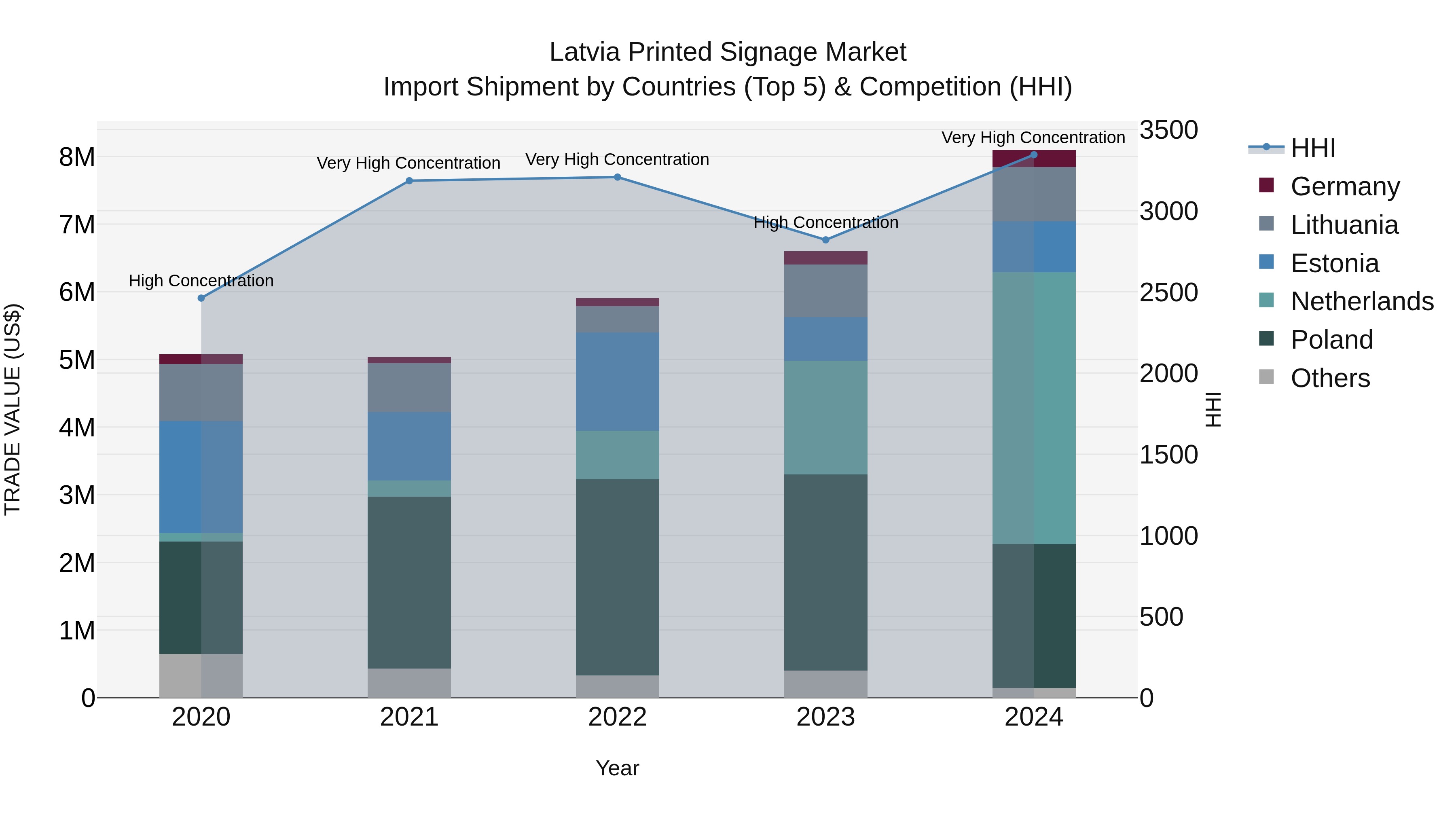
The printed signage import shipments to Latvia in 2024 saw significant growth, with top exporting countries being the Netherlands, Poland, Lithuania, Estonia, and Germany. The market concentration, as measured by the HHI, increased from high to very high in 2024, indicating a more consolidated market. The impressive CAGR of 12.36% from 2020 to 2024 and a remarkable growth rate of 22.63% from 2023 to 2024 reflect a thriving market with strong demand for printed signage imports in Latvia.
Latvia Printed Signage Market Synopsis
The Latvia Printed Signage Market is experiencing steady growth driven by the increasing demand for visually appealing and informative signage across various industries such as retail, hospitality, and transportation. The market is characterized by a wide range of printed signage products including banners, posters, billboards, and vehicle wraps, with a growing trend towards digital and interactive signage solutions. Key factors contributing to the market growth include the rise in promotional activities, events, and exhibitions, as well as the emphasis on enhancing brand visibility and customer engagement. The presence of established printing companies and technological advancements in printing techniques are further fueling the market expansion. However, price competition and environmental concerns regarding the disposal of printed signage materials are some challenges that the market faces. Overall, the Latvia Printed Signage Market is poised for continued growth with a focus on innovation and sustainability.
Latvia Printed Signage Market Trends
Currently, the Latvia Printed Signage Market is experiencing a shift towards more sustainable and eco-friendly solutions, with a growing demand for signage materials that are recyclable and environmentally friendly. Digital printing technology is also gaining popularity in the market due to its versatility, cost-effectiveness, and ability to produce high-quality, customized signage. Personalized and interactive signage solutions are in demand as businesses look for innovative ways to engage with their customers. Additionally, there is a rising trend towards the use of LED and other energy-efficient lighting options in signage to reduce operating costs and enhance visibility. Overall, the market is evolving towards more modern, sustainable, and technologically advanced printed signage solutions to meet the changing needs of businesses and consumers in Latvia.
Latvia Printed Signage Market Challenges
In the Latvia Printed Signage Market, some key challenges include increasing competition from digital signage solutions, price pressure due to the availability of cheaper alternatives, and the need to constantly innovate to meet changing consumer preferences. Additionally, the industry faces challenges related to environmental regulations and sustainability concerns regarding the materials used in printed signage. Another challenge is the need to adapt to technological advancements and offer more personalized and interactive signage solutions to stay competitive in the market. Overall, companies operating in the Latvia Printed Signage Market need to navigate these challenges effectively to maintain their market position and drive growth in the industry.
Latvia Printed Signage Market Investment Opportunities
The Latvia Printed Signage Market offers attractive investment opportunities due to the growing demand for signage solutions across various industries such as retail, hospitality, and transportation. With the increasing focus on branding and advertising, businesses are seeking innovative and eye-catching signage to attract customers, driving the market`s growth. Investing in state-of-the-art printing technology and materials to offer high-quality and customizable signage options can be a lucrative opportunity in this market. Additionally, there is potential for expansion into digital signage solutions to cater to the evolving needs of businesses looking for dynamic and interactive advertising platforms. Overall, the Latvia Printed Signage Market presents a promising investment landscape for those looking to capitalize on the growing demand for effective visual communication solutions.
Jordan Agar Market Government Policies
In Latvia, the Printed Signage Market is subject to various government policies aimed at regulating advertising, signage placement, and environmental impact. The government has implemented strict rules regarding the size, placement, and content of printed signage to ensure aesthetics and public safety. Additionally, there are regulations in place to promote environmentally friendly practices, such as the use of eco-friendly materials and energy-efficient signage. Businesses operating in the Printed Signage Market in Latvia must comply with these policies to avoid fines and penalties. Overall, the government`s policies in Latvia aim to strike a balance between promoting businesses` visibility through printed signage while also preserving the environment and maintaining aesthetic standards in public spaces.
Latvia Printed Signage Market Future Outlook
The future outlook for the Latvia Printed Signage Market appears promising, driven by increasing demand for visually appealing and informative signage across various industries such as retail, hospitality, and corporate sectors. With the growing emphasis on brand visibility and marketing communication, businesses are investing in high-quality printed signage to attract customers and enhance brand recognition. Advancements in printing technology, such as digital printing and UV printing, are expected to offer more customization options and faster turnaround times, further fueling market growth. Additionally, the rising trend of environmentally friendly and sustainable signage solutions is likely to create opportunities for eco-conscious manufacturers in the Latvia Printed Signage Market. Overall, the market is anticipated to expand steadily as businesses continue to recognize the significance of effective signage in driving customer engagement and increasing foot traffic.
Key Highlights of the Report:
- Latvia Printed Signage Market Outlook
- Market Size of Latvia Printed Signage Market, 2024
- Forecast of Latvia Printed Signage Market, 2031
- Historical Data and Forecast of Latvia Printed Signage Revenues & Volume for the Period 2021- 2031
- Latvia Printed Signage Market Trend Evolution
- Latvia Printed Signage Market Drivers and Challenges
- Latvia Printed Signage Price Trends
- Latvia Printed Signage Porter's Five Forces
- Latvia Printed Signage Industry Life Cycle
- Historical Data and Forecast of Latvia Printed Signage Market Revenues & Volume By Product for the Period 2021- 2031
- Historical Data and Forecast of Latvia Printed Signage Market Revenues & Volume By Billboard for the Period 2021- 2031
- Historical Data and Forecast of Latvia Printed Signage Market Revenues & Volume By Backlit Display for the Period 2021- 2031
- Historical Data and Forecast of Latvia Printed Signage Market Revenues & Volume By Pop Display for the Period 2021- 2031
- Historical Data and Forecast of Latvia Printed Signage Market Revenues & Volume By Banner for the Period 2021- 2031
- Historical Data and Forecast of Latvia Printed Signage Market Revenues & Volume By Corporate Graphics for the Period 2021- 2031
- Historical Data and Forecast of Latvia Printed Signage Market Revenues & Volume By Others for the Period 2021- 2031
- Historical Data and Forecast of Latvia Printed Signage Market Revenues & Volume By Type for the Period 2021- 2031
- Historical Data and Forecast of Latvia Printed Signage Market Revenues & Volume By Indoor Printed Signage for the Period 2021- 2031
- Historical Data and Forecast of Latvia Printed Signage Market Revenues & Volume By Outdoor Printed Signage for the Period 2021- 2031
- Historical Data and Forecast of Latvia Printed Signage Market Revenues & Volume By End-user Vertical for the Period 2021- 2031
- Historical Data and Forecast of Latvia Printed Signage Market Revenues & Volume By BFSI for the Period 2021- 2031
- Historical Data and Forecast of Latvia Printed Signage Market Revenues & Volume By Retail for the Period 2021- 2031
- Historical Data and Forecast of Latvia Printed Signage Market Revenues & Volume By Sports and Leisure for the Period 2021- 2031
- Historical Data and Forecast of Latvia Printed Signage Market Revenues & Volume By Entertainment for the Period 2021- 2031
- Historical Data and Forecast of Latvia Printed Signage Market Revenues & Volume By Transportation and Logistics for the Period 2021- 2031
- Historical Data and Forecast of Latvia Printed Signage Market Revenues & Volume By Healthcare for the Period 2021- 2031
- Historical Data and Forecast of Latvia Printed Signage Market Revenues & Volume By Others for the Period 2021- 2031
- Latvia Printed Signage Import Export Trade Statistics
- Market Opportunity Assessment By Product
- Market Opportunity Assessment By Type
- Market Opportunity Assessment By End-user Vertical
- Latvia Printed Signage Top Companies Market Share
- Latvia Printed Signage Competitive Benchmarking By Technical and Operational Parameters
- Latvia Printed Signage Company Profiles
- Latvia Printed Signage Key Strategic Recommendations






































