Kazakhstan Process Automation And Instrumentation Market Size, Share & Growth Rate
The Kazakhstan Process Automation And Instrumentation Market was estimated at USD 373 Million in 2025 and is projected to reach USD 632 Million by 2032, growing at a CAGR of 7.8% from 2026 to 2032. This significant growth trajectory is largely attributed to the country's ongoing digital transformation initiatives and the increasing embrace of Industry 4.0 technologies across various sectors. Enhanced operational efficiency, a critical driver of this trend, is being realized through the deployment of advanced automation solutions such as PLCs, SCADA, and DCS systems.
Kazakhstan Process Automation And Instrumentation Market Year-wise Growth Rate and Key Drivers
This graph highlights how the Kazakhstan Process Automation And Instrumentation Market has steadily grown over the years, supported by major growth factors.
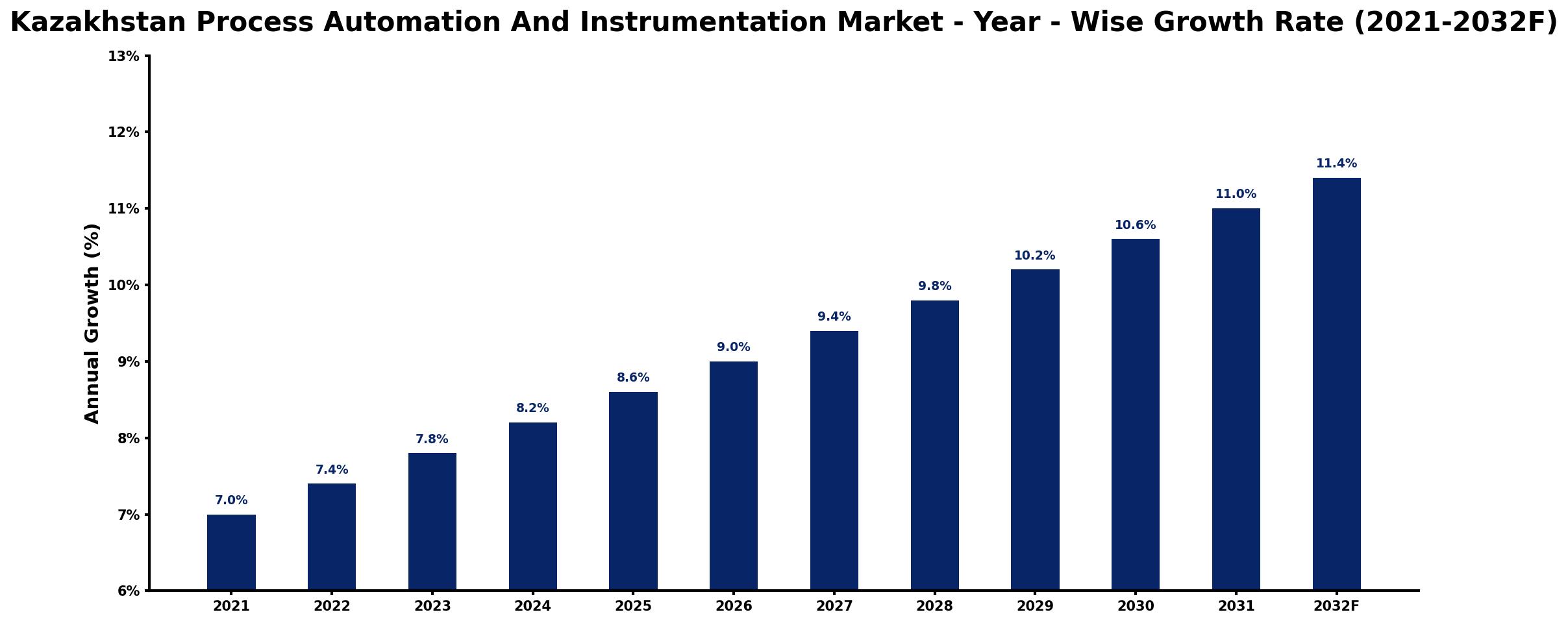
The table below presents the year‑wise growth rates along with the key drivers influencing the market
| Year | Growth Rate | Major Drivers |
| 2021 | 7.0% | Rising industrial sector investments |
| 2022 | 7.4% | Growing demand for efficiency solutions |
| 2023 | 7.8% | Increased focus on digital transformation |
| 2024 | 8.2% | Expanding energy sector projects |
| 2025 | 8.6% | Higher adoption of smart technologies |
| 2026 | 9.0% | Boost in manufacturing capabilities |
| 2027 | 9.4% | Surge in infrastructure development |
| 2028 | 9.8% | Emergence of renewable energy initiatives |
| 2029 | 10.2% | Strengthening regulatory compliance requirements |
| 2030 | 10.6% | Advancements in data analytics applications |
| 2031 | 11.0% | Growing emphasis on sustainability practices |
| 2032 | 11.4% | Rising global market competitiveness |
Note: Market size estimations and growth projections presented in this report are based on 6Wresearch's proprietary forecasting methodology, utilizing the latest available industry data, government publications, and primary research inputs.
Kazakhstan Process Automation And Instrumentation Market Synopsis
Kazakhstan is witnessing a heightened demand for process automation technologies, primarily fueled by the modernization of its manufacturing facilities and the broader push for industrialization. As companies aim to improve productivity, automation solutions are being viewed not just as an option but as a necessity for staying competitive in the global market.
In addition, the integration of IoT and AI technologies into process instrumentation is transforming traditional methodologies. This shift allows industries to harness predictive maintenance and advanced analytics, ultimately leading to reduced downtime and increased throughput across the board.
Kazakhstan Process Automation And Instrumentation Market Key Takeaways
- Robust growth expected as the market transitions towards more sophisticated automation solutions.
- Integration of AI and IoT technologies is revolutionizing operational capabilities in Kazakhstan.
- Government initiatives are promoting investment and training in the automation sector.
- High implementation costs and a shortage of skilled labor are notable challenges to growth.
- Predictive maintenance solutions are gaining traction, enhancing efficiency and reliability.
Evaluation of Restraints in Kazakhstan Process Automation And Instrumentation Market
Despite the promising outlook, the Kazakhstan Process Automation and Instrumentation Market faces several constraints. Notably, the high costs associated with advanced automation systems can deter smaller companies from making necessary investments. Coupled with a pronounced lack of technical expertise in the workforce, this poses a significant barrier to the market's full potential. Furthermore, the challenge of integrating new automation technologies with existing systems can prove complex and financially burdensome, hindering overall market advancement.
Kazakhstan Process Automation And Instrumentation Market Trends
Current trends in the Kazakhstan Process Automation and Instrumentation Market indicate a notable shift towards digitization and data-driven decision-making. As industries increasingly adopt smart manufacturing practices, the role of automation becomes even more pivotal. There is also a growing focus on sustainability, with many organizations seeking to implement energy-efficient automation solutions. Additionally, the demand for real-time data analytics is on the rise, allowing companies to monitor and optimize operations instantaneously.
Kazakhstan Process Automation And Instrumentation Market Opportunities
Genuine growth opportunities exist within sectors such as oil and gas, manufacturing, and utilities. The push for enhanced operational efficiency in these industries creates a fertile ground for the deployment of advanced automation technologies. Additionally, government incentives aimed at encouraging modernization and workforce training in automation technologies open new avenues for investment. Companies capable of providing tailored solutions that address the specific needs of various sectors are likely to thrive in this evolving landscape.
Government Initiatives in the Kazakhstan Process Automation And Instrumentation Market
The government of Kazakhstan has recognized the vital role of process automation and instrumentation technologies in enhancing industrial efficiency and competitiveness. As part of this recognition, several policies have been implemented to encourage the adoption of automation solutions. Additionally, the government provides regulatory frameworks that ensure these systems comply with international safety and performance standards. Incentives for companies investing in automation are also in place, alongside initiatives aimed at supporting workforce training in relevant technologies.
Future Insights of the Kazakhstan Process Automation And Instrumentation Market
Looking forward to the period between 2026 and 2032, the Kazakhstan Process Automation and Instrumentation Market is set to witness a paradigm shift characterized by increased adoption of advanced technologies. As industrial players continue to embrace Industry 4.0, the demand for integrated automation solutions will rise. Moreover, the push towards digital transformation will likely facilitate greater collaboration between technology providers and end-users, ensuring more customized and effective solutions emerge to meet market demands.
Kazakhstan Process Automation And Instrumentation Market Latest Developments (2025 - 2026)
Recent industry developments in the Kazakhstan Process Automation and Instrumentation Market highlight a continuous shift towards innovative automation technologies. Companies are increasingly focusing on developing solutions that integrate IoT and AI functionalities, enabling improved data analytics and operational efficiencies. Moreover, a surge in strategic partnerships aimed at enhancing technological capabilities has been observed, signaling a commitment to modernization and increased competitiveness within the sector.
Kazakhstan Process Automation And Instrumentation Market - Key Attractiveness of the Report
- 10 Years of Market Numbers
- Historical Data Starting from 2022 to 2025
- Base Year: 2025
- Forecast Data until 2032
- Key Performance Indicators Impacting the Market
- Major Upcoming Developments and Projects
Key Highlights of the Report:
- Kazakhstan Process Automation And Instrumentation Market Outlook
- Market Size of Kazakhstan Process Automation And Instrumentation Market, 2025
- Forecast of Kazakhstan Process Automation And Instrumentation Market, 2032
- Historical Data and Forecast of Kazakhstan Process Automation And Instrumentation Revenues & Volume for the Period 2022-2032F
- Kazakhstan Process Automation And Instrumentation Market Trend Evolution
- Kazakhstan Process Automation And Instrumentation Market Drivers and Challenges
- Kazakhstan Process Automation And Instrumentation Price Trends
- Kazakhstan Process Automation And Instrumentation Porter's Five Forces
- Kazakhstan Process Automation And Instrumentation Industry Life Cycle
- Historical Data and Forecast of Kazakhstan Process Automation And Instrumentation Market Revenues & Volume By Instrument for the Period 2022-2032F
- Historical Data and Forecast of Kazakhstan Process Automation And Instrumentation Market Revenues & Volume By Field Instruments for the Period 2022-2032F
- Historical Data and Forecast of Kazakhstan Process Automation And Instrumentation Market Revenues & Volume By Control Valve for the Period 2022-2032F
- Historical Data and Forecast of Kazakhstan Process Automation And Instrumentation Market Revenues & Volume By Analytical Instruments for the Period 2022-2032F
- Historical Data and Forecast of Kazakhstan Process Automation And Instrumentation Market Revenues & Volume By Solution for the Period 2022-2032F
- Historical Data and Forecast of Kazakhstan Process Automation And Instrumentation Market Revenues & Volume By Advanced Process Control (APC) for the Period 2022-2032F
- Historical Data and Forecast of Kazakhstan Process Automation And Instrumentation Market Revenues & Volume By Distributed Control System (DCS) for the Period 2022-2032F
- Historical Data and Forecast of Kazakhstan Process Automation And Instrumentation Market Revenues & Volume By Human Machine Interaction (HMI) for the Period 2022-2032F
- Historical Data and Forecast of Kazakhstan Process Automation And Instrumentation Market Revenues & Volume By Manufacturing Execution System (MES) for the Period 2022-2032F
- Historical Data and Forecast of Kazakhstan Process Automation And Instrumentation Market Revenues & Volume By Programmable Logic Controller (PLC) for the Period 2022-2032F
- Historical Data and Forecast of Kazakhstan Process Automation And Instrumentation Market Revenues & Volume By Safety Automation for the Period 2022-2032F
- Historical Data and Forecast of Kazakhstan Process Automation And Instrumentation Market Revenues & Volume By Supervisory Control and Data Acquisition (SCADA) for the Period 2022-2032F
- Historical Data and Forecast of Kazakhstan Process Automation And Instrumentation Market Revenues & Volume By End-user Industry for the Period 2022-2032F
- Historical Data and Forecast of Kazakhstan Process Automation And Instrumentation Market Revenues & Volume By Oil and Gas for the Period 2022-2032F
- Historical Data and Forecast of Kazakhstan Process Automation And Instrumentation Market Revenues & Volume By Food and Beverage for the Period 2022-2032F
- Historical Data and Forecast of Kazakhstan Process Automation And Instrumentation Market Revenues & Volume By Pharmaceutical and Biopharma for the Period 2022-2032F
- Historical Data and Forecast of Kazakhstan Process Automation And Instrumentation Market Revenues & Volume By Chemical and Petrochemical for the Period 2022-2032F
- Historical Data and Forecast of Kazakhstan Process Automation And Instrumentation Market Revenues & Volume By Other End-user Industries for the Period 2022-2032F
- Kazakhstan Process Automation And Instrumentation Import Export Trade Statistics
- Market Opportunity Assessment By Instrument
- Market Opportunity Assessment By Solution
- Market Opportunity Assessment By End-user Industry
- Kazakhstan Process Automation And Instrumentation Top Companies Market Share
- Kazakhstan Process Automation And Instrumentation Competitive Benchmarking By Technical and Operational Parameters
- Kazakhstan Process Automation And Instrumentation Company Profiles
- Kazakhstan Process Automation And Instrumentation Key Strategic Recommendations






































