Kazakhstan Public Cloud Market Size & Growth Rate (2026-2032)
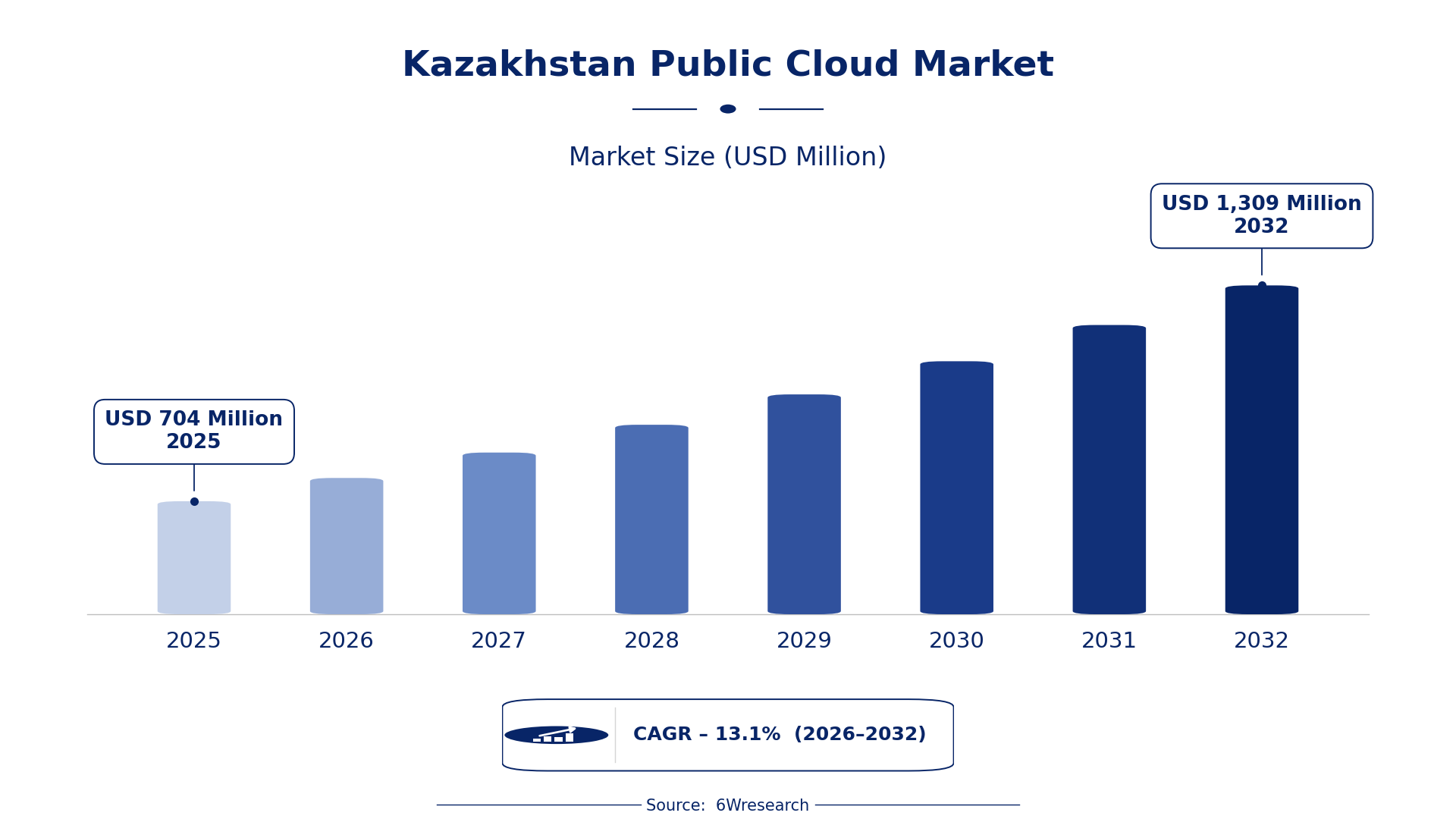
The Kazakhstan Public Cloud Market was estimated at USD 704 Million in 2025 and is projected to reach USD 1309 Million by 2032, growing at a CAGR of 13.1% from 2026 to 2032.
Kazakhstan Public Cloud Market Synopsis
The Kazakhstan public cloud market is on an upward trajectory, fueled by businesses increasingly embracing cloud services for operational efficiency and scalability. Government initiatives supporting digital transformation are further enhancing this growth, driving both public and private sectors to adopt innovative cloud solutions.
As local and global players vie for market share, industries such as banking, telecommunications, and government are leading the charge in public cloud adoption. However, challenges like data security concerns and regulatory compliance continue to test the market's resilience.
Kazakhstan Public Cloud Market Year-wise Growth Rate and Key Drivers
This graph illustrates the annual growth rates of the Kazakhstan Public Cloud Market from 2021 to 2032, highlighting a steady upward trajectory and projected expansion over the forecast period.
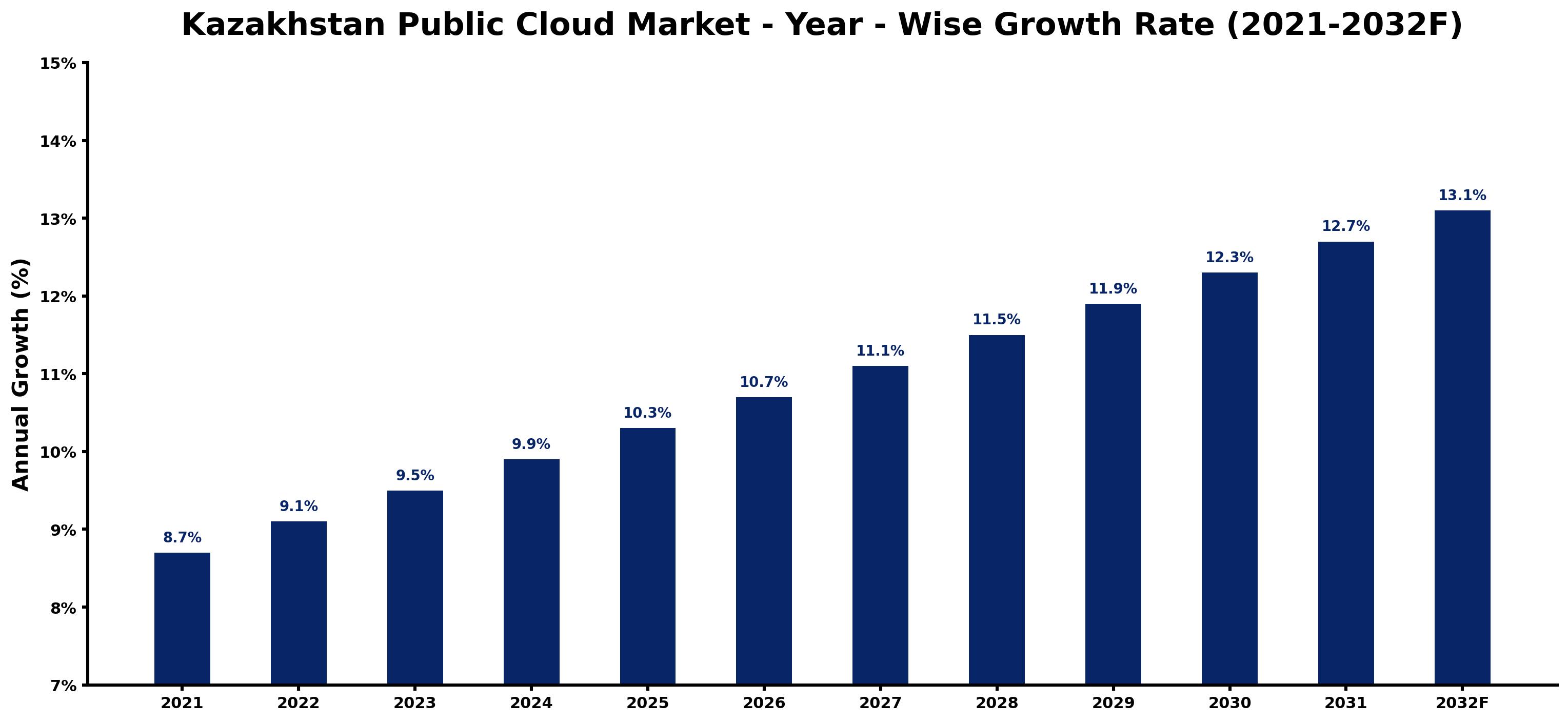
The table below presents the year‑wise growth rates along with the key drivers influencing the market
| Year | Growth Rate | Major Drivers |
| 2021 | 8.7% | Ministry of Digital Development's cloud adoption push. |
| 2022 | 9.1% | Increased investments in IT infrastructure by private sector. |
| 2023 | 9.5% | Growth of local tech startups requiring agile solutions. |
| 2024 | 9.9% | Launch of Kazakhstan's national data center initiative. |
| 2025 | 10.3% | Regulatory framework supporting cloud service providers established. |
| 2026 | 10.7% | Rising e-commerce activities demand scalable cloud resources. |
| 2027 | 11.1% | Increasing cybersecurity concerns driving cloud security solutions. |
| 2028 | 11.5% | Support for tech education boosts cloud computing adoption. |
| 2029 | 11.9% | Local industries transitioning to cloud for operational efficiency. |
| 2030 | 12.3% | Government incentives for businesses adopting cloud technology. |
| 2031 | 12.7% | Collaborations with global cloud firms enhancing local capacity. |
| 2032 | 13.1% | Emergence of AI solutions requiring robust cloud infrastructure. |
Note: Market size estimations and growth projections presented in this report are based on 6Wresearch's proprietary forecasting methodology, utilizing the latest available industry data, government publications, and primary research inputs.
Kazakhstan Public Cloud Market Key Takeaways
Below are some of the specific key takeaways from the market, including:
- The market is set for substantial growth, with a projected CAGR of 10.9% from 2026 to 2032.
- Government initiatives are pivotal in promoting cloud technology adoption across various sectors.
- Hybrid cloud solutions are gaining traction as businesses seek flexibility and security.
- Data security and regulatory compliance remain top concerns for organizations considering public cloud services.
- Investment opportunities exist in finance, healthcare, and government sectors, where tailored solutions are increasingly needed.
Evaluation of Restraints in Kazakhstan Public Cloud Market
The Kazakhstan public cloud market faces considerable challenges that hinder its expansion. Many businesses still lack a comprehensive understanding of cloud technologies, which stunts adoption rates. Concerns regarding data security and privacy regulations are prevalent, causing hesitation among potential users. Limited internet infrastructure in rural areas adds another layer of complexity, as connectivity remains sporadic and unreliable. on top of that, the current shortage of skilled IT professionals proficient in cloud services creates a bottleneck for businesses eager to transition to cloud-based solutions.
Kazakhstan Public Cloud Market Trends
Several trends are shaping the Kazakhstan public cloud market. There is a noticeable shift toward hybrid cloud strategies, where organizations seek a balance between on-premises and cloud solutions. Multi-cloud approaches are also emerging, enabling businesses to tap into the unique strengths of various providers. As digital transformation continues, sectors such as healthcare and finance are increasingly demanding specialized cloud services that address specific regulatory requirements.
Kazakhstan Public Cloud Market Opportunities
Opportunities for growth in the Kazakhstan public cloud market are abundant. The ongoing digital transformation across industries presents a ripe environment for cloud service providers to introduce innovative solutions tailored to local needs. As government policies increasingly favor digital infrastructure, sectors like finance and healthcare are expected to invest significantly in cloud technologies to enhance their operational capabilities. Additionally, the rise in mobile device usage is expanding access to cloud services, further driving demand.
Government Initiatives in the Kazakhstan Public Cloud Market
The government of Kazakhstan is playing a crucial role in shaping the public cloud market through various initiatives aimed at boosting digital capabilities. Policies supporting cloud adoption are designed to enhance the country’s IT infrastructure and ensure compliance with regulatory standards. This proactive stance is essential for fostering a conducive environment for cloud services.
- A recently launched "Digital Kazakhstan" program focuses on modernizing IT infrastructure and promoting public cloud services.
- Currently underway is a national data localization policy, requiring personal data of Kazakhstan citizens to be stored domestically, thus driving demand for local cloud services.
- Ongoing government support includes tax incentives for cloud service providers, aimed at encouraging growth in the public cloud sector.
- A planned initiative to enhance internet connectivity across rural regions is expected to roll out by 2028, which will benefit cloud service accessibility.
- Upcoming regulatory frameworks are anticipated to be introduced in 2026, focusing on transparency in cloud billing practices.
Future Insights of the Kazakhstan Public Cloud Market
Looking ahead to 2026-2032, the Kazakhstan public cloud market is expected to undergo transformative changes. With increasing digital demands and government backing, businesses will likely adopt cloud technologies at an accelerated pace. The competitive landscape will intensify as both international and local providers enhance their offerings. Investment in infrastructure will be critical to support the burgeoning demand, positioning Kazakhstan as a significant player in the regional cloud market.
Kazakhstan Public Cloud Market Latest Developments
In the past year, the Kazakhstan public cloud market has seen notable developments that signal a growing interest in cloud technologies. As various sectors ramp up their digital initiatives, providers are responding with innovative solutions tailored to local needs.
- A major technology vendor announced a new suite of cloud solutions designed specifically for the financial sector, launched in Q2 2025.
- An initiative aimed at upgrading the national cloud infrastructure is currently underway, expected to improve service quality and reliability by mid-2026.
- A leading regional operator is expanding its data center capabilities, with plans to increase capacity by 30% by late 2025.
- In early 2025, a partnership was formed between local and global players to enhance cybersecurity solutions within public cloud services.
- Upcoming in late 2026 is a rollout of a new training program focused on developing IT skills in cloud technologies for local professionals.
Kazakhstan Public Cloud Market - Key Attractiveness of the Report
- 10 Years of Market Numbers
- Historical Data Starting from 2022 to 2025
- Base Year: 2025
- Forecast Data until 2032
- Key Performance Indicators Impacting the Market
- Major Upcoming Developments and Projects
Key Highlights of the Report:
- Kazakhstan Public Cloud Market Outlook
- Market Size of Kazakhstan Public Cloud Market, 2025
- Forecast of Kazakhstan Public Cloud Market, 2032
- Historical Data and Forecast of Kazakhstan Public Cloud Revenues & Volume for the Period 2022-2032F
- Kazakhstan Public Cloud Market Trend Evolution
- Kazakhstan Public Cloud Market Drivers and Challenges
- Kazakhstan Public Cloud Price Trends
- Kazakhstan Public Cloud Porter's Five Forces
- Kazakhstan Public Cloud Industry Life Cycle
- Historical Data and Forecast of Kazakhstan Public Cloud Market Revenues & Volume By Service Model for the Period 2022-2032F
- Historical Data and Forecast of Kazakhstan Public Cloud Market Revenues & Volume By Infrastructure as a Service for the Period 2022-2032F
- Historical Data and Forecast of Kazakhstan Public Cloud Market Revenues & Volume By Platform as a Service for the Period 2022-2032F
- Historical Data and Forecast of Kazakhstan Public Cloud Market Revenues & Volume By Software as a Service for the Period 2022-2032F
- Historical Data and Forecast of Kazakhstan Public Cloud Market Revenues & Volume By Organization Size Large enterprises for the Period 2022-2032F
- Historical Data and Forecast of Kazakhstan Public Cloud Market Revenues & Volume By Small for the Period 2022-2032F
- Historical Data and Forecast of Kazakhstan Public Cloud Market Revenues & Volume By Medium Enterprises SMEs for the Period 2022-2032F
- Historical Data and Forecast of Kazakhstan Public Cloud Market Revenues & Volume By Verticals for the Period 2022-2032F
- Historical Data and Forecast of Kazakhstan Public Cloud Market Revenues & Volume By BFSI for the Period 2022-2032F
- Historical Data and Forecast of Kazakhstan Public Cloud Market Revenues & Volume By Telecommunication for the Period 2022-2032F
- Historical Data and Forecast of Kazakhstan Public Cloud Market Revenues & Volume By IT & ITeS for the Period 2022-2032F
- Historical Data and Forecast of Kazakhstan Public Cloud Market Revenues & Volume By Government & Public Sector for the Period 2022-2032F
- Historical Data and Forecast of Kazakhstan Public Cloud Market Revenues & Volume By Retail & Consumer Goods for the Period 2022-2032F
- Historical Data and Forecast of Kazakhstan Public Cloud Market Revenues & Volume By Manufacturing for the Period 2022-2032F
- Historical Data and Forecast of Kazakhstan Public Cloud Market Revenues & Volume By Energy & Utility for the Period 2022-2032F
- Historical Data and Forecast of Kazakhstan Public Cloud Market Revenues & Volume By Media & Entertainment for the Period 2022-2032F
- Kazakhstan Public Cloud Import Export Trade Statistics
- Market Opportunity Assessment By Service Model
- Market Opportunity Assessment By Organization Size Large enterprises
- Market Opportunity Assessment By Verticals
- Kazakhstan Public Cloud Top Companies Market Share
- Kazakhstan Public Cloud Competitive Benchmarking By Technical and Operational Parameters
- Kazakhstan Public Cloud Company Profiles
- Kazakhstan Public Cloud Key Strategic Recommendations






































