Kazakhstan Renewable Chemicals Market Size, Share & Growth Rate
The Kazakhstan Renewable Chemicals Market was estimated at USD 443 Million in 2025 and is projected to reach USD 626 Million by 2032, growing at a CAGR of 5.1% from 2026 to 2032. This growth is being fueled by a robust governmental commitment to sustainable development, as well as an increasing global demand for eco-friendly alternatives to conventional chemical products. Additionally, advancements in technology and the rise in investments targeted towards renewable resources contribute significantly to this market's positive trajectory.
Kazakhstan Renewable Chemicals Market Year-wise Growth Rate and Key Drivers
This graph highlights how the Kazakhstan Renewable Chemicals Market has steadily grown over the years, supported by major growth factors.
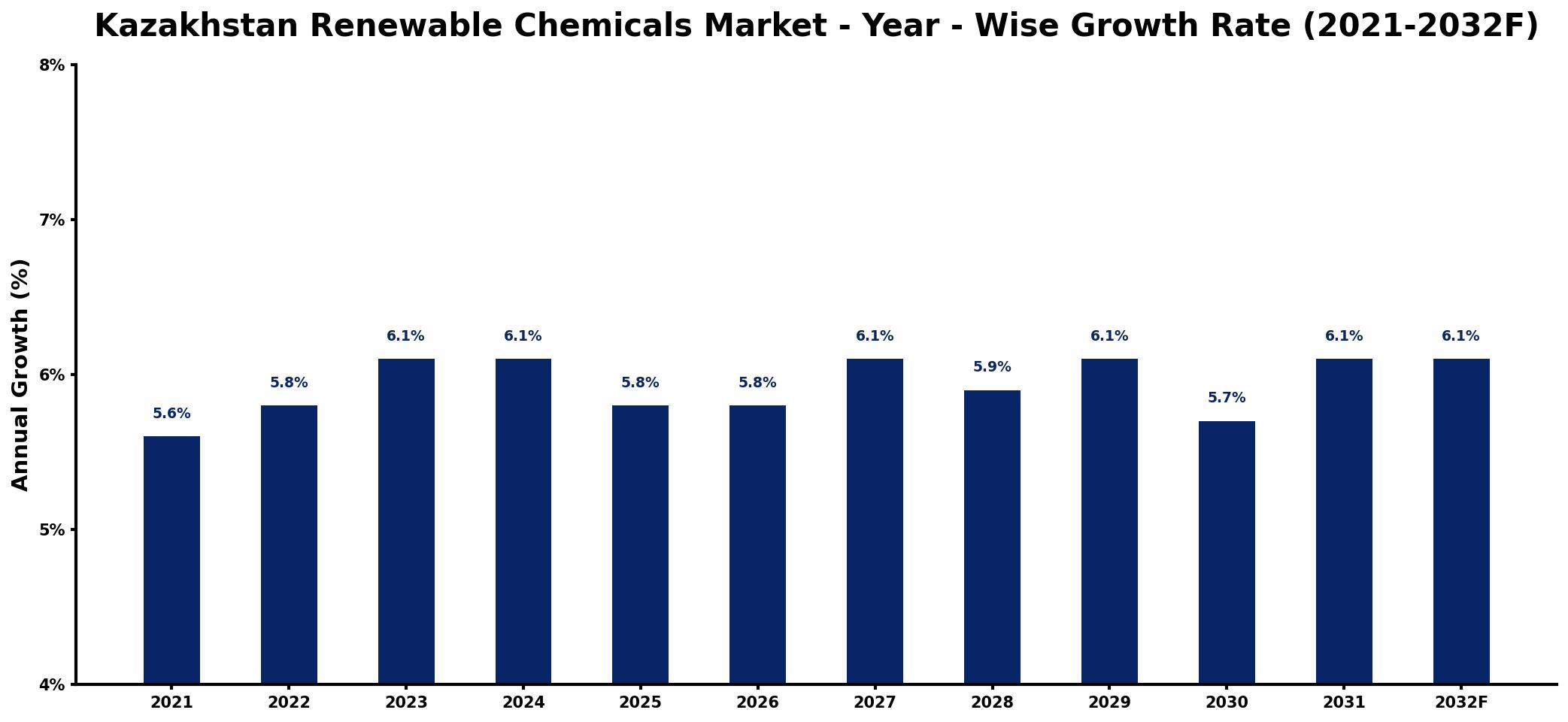
The table below presents the year‑wise growth rates along with the key drivers influencing the market
| Year | Growth Rate | Major Drivers |
| 2021 | 5.6% | rising demand for sustainable solutions |
| 2022 | 5.8% | increased investment in green technology |
| 2023 | 6.1% | growing interest in eco-friendly products |
| 2024 | 6.1% | expansion of alternative energy sources |
| 2025 | 5.8% | emerging markets seeking sustainable options |
| 2026 | 5.8% | government incentives for green initiatives |
| 2027 | 6.1% | collaboration among industry stakeholders |
| 2028 | 5.9% | advancements in production processes |
| 2029 | 6.1% | heightened consumer awareness of sustainability |
| 2030 | 5.7% | increased global focus on emissions |
| 2031 | 6.1% | enhanced research in sustainable practices |
| 2032 | 6.1% | stronger regulations promoting environmental responsibility |
Note: Market size estimations and growth projections presented in this report are based on 6Wresearch's proprietary forecasting methodology, utilizing the latest available industry data, government publications, and primary research inputs.
Kazakhstan Renewable Chemicals Market Synopsis
The most significant driving force currently shaping the Kazakhstan Renewable Chemicals Market is the country's emphasis on reducing greenhouse gas emissions. This commitment aligns with both national and global sustainability agendas, positioning renewable chemicals as a strategic area for investment and development.
Furthermore, as industries worldwide pivot towards greener practices, the Kazakhstan Renewable Chemicals Market is experiencing heightened interest. This shift is reflected in increasing corporate strategies aimed at integrating renewable chemicals into their supply chains, fostering innovation and collaboration within the sector.
Kazakhstan Renewable Chemicals Market Key Takeaways
- Government policies are increasingly favorable towards the development of renewable chemicals, supporting sustainable practices.
- Investment in research and development is crucial for lowering production costs and improving efficiency in renewable chemicals.
- Renewable diesel is gaining traction as a key product, driven by environmental concerns and energy security needs.
- Market acceptance of renewable chemicals is growing, though the establishment of supply chains remains a critical challenge.
- Technological advancements are paving the way for new applications and improved production processes in the sector.
Evaluation of Restraints in Kazakhstan Renewable Chemicals Market
Despite its promising outlook, the Kazakhstan Renewable Chemicals Market faces several restraints that could hinder its growth. The primary limitation is the high production costs associated with renewable chemical manufacturing, which often exceed those of traditional petrochemical processes. Furthermore, the need for substantial investment in research and development remains a barrier, as companies strive to enhance production efficiency and cost-effectiveness. Additionally, the market must navigate the complexities of establishing reliable supply chains for renewable raw materials, which is essential for ensuring consistent product quality and availability.
Kazakhstan Renewable Chemicals Market Trends
A significant trend in the Kazakhstan Renewable Chemicals Market is the increasing utilization of agricultural waste as a feedstock for chemical production. This not only addresses waste management issues but also aligns with the country's agricultural profile. Additionally, the integration of digital technologies in production processes is emerging, enhancing transparency and operational efficiency. Furthermore, collaborative initiatives between public and private sectors are on the rise, promoting knowledge-sharing and innovation in renewable chemical technologies.
Kazakhstan Renewable Chemicals Market Opportunities
The true growth opportunities in the Kazakhstan Renewable Chemicals Market lie within the development of localized supply chains and the enhancement of bio-based product portfolios. By leveraging its rich agricultural resources, Kazakhstan can position itself as a leader in producing renewable chemicals that cater to both domestic and international markets. Furthermore, as global demand for sustainable solutions increases, there is potential for export opportunities, especially for renewable diesel and bio-based intermediates.
Government Initiatives in the Kazakhstan Renewable Chemicals Market
The Kazakhstan government actively promotes sustainable and eco-friendly chemical production through a variety of initiatives. Policies designed to incentivize the development and utilization of renewable chemicals are in place, aligning with the nation's strategic goals to minimize environmental impact. Public spending in the renewable sector, along with various support programs for emerging technologies, reinforces the commitment to establishing Kazakhstan as a competitive player in the global renewable chemicals arena.
Future Insights of the Kazakhstan Renewable Chemicals Market
Looking ahead to the period of 2026-2032, the Kazakhstan Renewable Chemicals Market is poised for significant advancements. Anticipated growth will largely stem from continuous improvements in production efficiency and cost reduction technologies. Additionally, as international regulatory pressures increase surrounding environmental sustainability, Kazakhstans commitment to renewable chemicals will likely strengthen. This focus on sustainable practices will not only enhance the markets resilience but also attract foreign investment, paving the way for a more robust and diverse industrial landscape.
Kazakhstan Renewable Chemicals Market Latest Developments (2025 - 2026)
Recent developments in the Kazakhstan Renewable Chemicals Market indicate a growing trend towards collaborative research initiatives aimed at improving product formulations and manufacturing processes. Furthermore, several pilot projects are being launched to explore the viability of using alternative biomass sources. These initiatives reflect a broader commitment to enhancing sustainability and achieving energy independence, which are becoming integral to Kazakhstan's economic strategy moving forward.
Kazakhstan Renewable Chemicals Market - Key Attractiveness of the Report
- 10 Years of Market Numbers
- Historical Data Starting from 2022 to 2025
- Base Year: 2025
- Forecast Data until 2032
- Key Performance Indicators Impacting the Market
- Major Upcoming Developments and Projects
Key Highlights of the Report:
- Kazakhstan Renewable Chemicals Market Outlook
- Market Size of Kazakhstan Renewable Chemicals Market, 2025
- Forecast of Kazakhstan Renewable Chemicals Market, 2032
- Historical Data and Forecast of Kazakhstan Renewable Chemicals Revenues & Volume for the Period 2022-2032F
- Kazakhstan Renewable Chemicals Market Trend Evolution
- Kazakhstan Renewable Chemicals Market Drivers and Challenges
- Kazakhstan Renewable Chemicals Price Trends
- Kazakhstan Renewable Chemicals Porter's Five Forces
- Kazakhstan Renewable Chemicals Industry Life Cycle
- Historical Data and Forecast of Kazakhstan Renewable Chemicals Market Revenues & Volume By Product Type for the Period 2022-2032F
- Historical Data and Forecast of Kazakhstan Renewable Chemicals Market Revenues & Volume By Alcohols for the Period 2022-2032F
- Historical Data and Forecast of Kazakhstan Renewable Chemicals Market Revenues & Volume By Organic Acids for the Period 2022-2032F
- Historical Data and Forecast of Kazakhstan Renewable Chemicals Market Revenues & Volume By Ketones for the Period 2022-2032F
- Historical Data and Forecast of Kazakhstan Renewable Chemicals Market Revenues & Volume By Platform Chemicals for the Period 2022-2032F
- Historical Data and Forecast of Kazakhstan Renewable Chemicals Market Revenues & Volume By Biopolymers for the Period 2022-2032F
- Historical Data and Forecast of Kazakhstan Renewable Chemicals Market Revenues & Volume By Others for the Period 2022-2032F
- Historical Data and Forecast of Kazakhstan Renewable Chemicals Market Revenues & Volume By Applications for the Period 2022-2032F
- Historical Data and Forecast of Kazakhstan Renewable Chemicals Market Revenues & Volume By Transportation for the Period 2022-2032F
- Historical Data and Forecast of Kazakhstan Renewable Chemicals Market Revenues & Volume By Textiles for the Period 2022-2032F
- Historical Data and Forecast of Kazakhstan Renewable Chemicals Market Revenues & Volume By Food safety for the Period 2022-2032F
- Historical Data and Forecast of Kazakhstan Renewable Chemicals Market Revenues & Volume By Environment for the Period 2022-2032F
- Historical Data and Forecast of Kazakhstan Renewable Chemicals Market Revenues & Volume By Communication for the Period 2022-2032F
- Historical Data and Forecast of Kazakhstan Renewable Chemicals Market Revenues & Volume By Housing for the Period 2022-2032F
- Historical Data and Forecast of Kazakhstan Renewable Chemicals Market Revenues & Volume By Recreation for the Period 2022-2032F
- Historical Data and Forecast of Kazakhstan Renewable Chemicals Market Revenues & Volume By Other Applications for the Period 2022-2032F
- Kazakhstan Renewable Chemicals Import Export Trade Statistics
- Market Opportunity Assessment By Product Type
- Market Opportunity Assessment By Applications
- Kazakhstan Renewable Chemicals Top Companies Market Share
- Kazakhstan Renewable Chemicals Competitive Benchmarking By Technical and Operational Parameters
- Kazakhstan Renewable Chemicals Company Profiles
- Kazakhstan Renewable Chemicals Key Strategic Recommendations






































