Kazakhstan Swing Market Size, Share & Growth Rate
The Kazakhstan Swing Market was estimated at USD 358 Million in 2025 and is projected to reach USD 475 Million by 2032, growing at a CAGR of 4.1% from 2026 to 2032. This upward trajectory is primarily fueled by rising disposable incomes among consumers, which enables greater spending on recreational products. Additionally, urbanization efforts in Kazakhstan are fostering the development of public parks and recreational areas, further stimulating demand for swings and related outdoor equipment.
Kazakhstan Swing Market Year-wise Growth Rate and Key Drivers
This graph highlights how the Kazakhstan Swing Market has steadily grown over the years, supported by major growth factors.
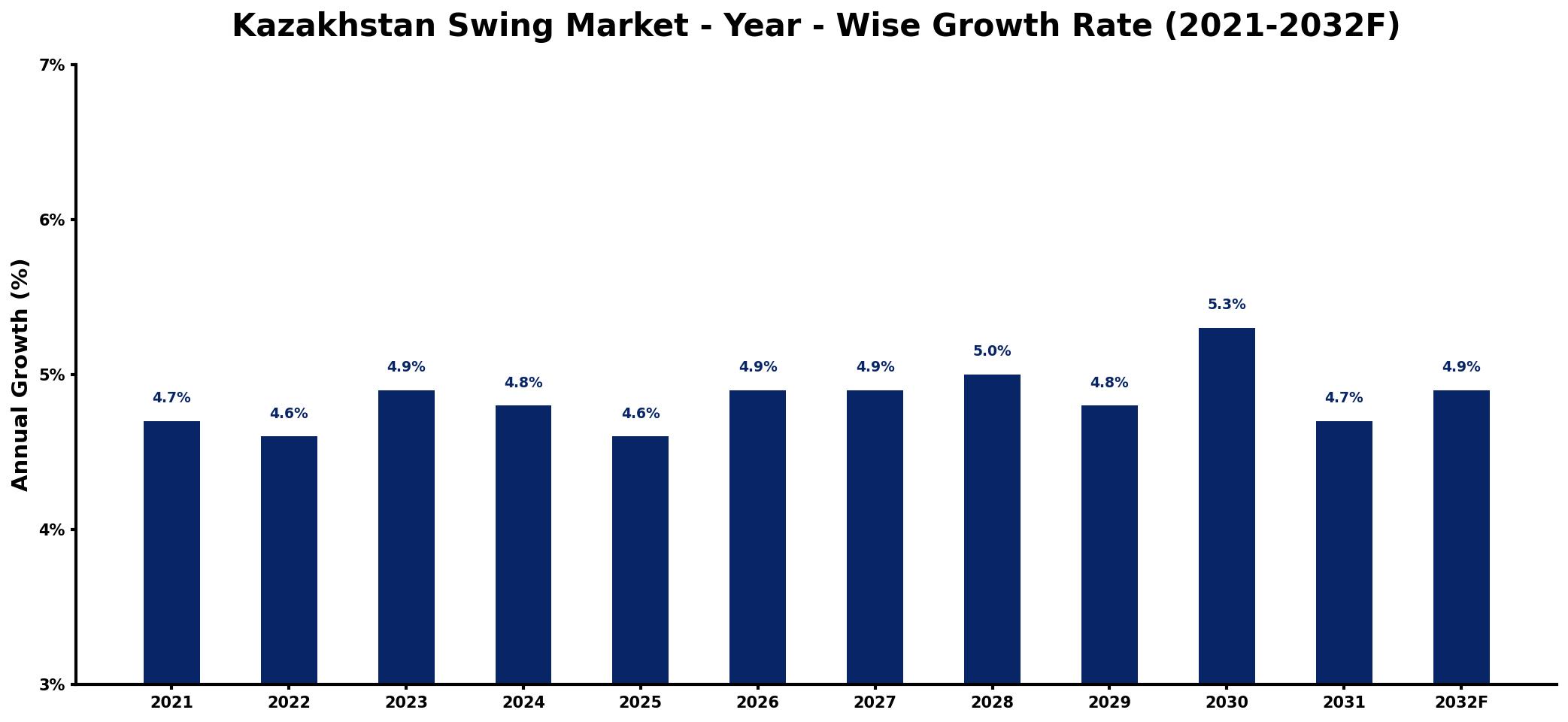
The table below presents the year‑wise growth rates along with the key drivers influencing the market
| Year | Growth Rate | Major Drivers |
| 2021 | 4.7% | Rising consumer spending patterns |
| 2022 | 4.6% | Increased investment in infrastructure |
| 2023 | 4.9% | Growing urban population trends |
| 2024 | 4.8% | Expansion of e-commerce platforms |
| 2025 | 4.6% | Higher disposable income levels |
| 2026 | 4.9% | Strengthening regional trade agreements |
| 2027 | 4.9% | Development of renewable energy sources |
| 2028 | 5.0% | Boost in tourism activities |
| 2029 | 4.8% | Advancements in technology adoption |
| 2030 | 5.3% | Enhanced transportation networks availability |
| 2031 | 4.7% | Surge in online service demand |
| 2032 | 4.9% | stronger distribution network expansion |
Note: Market size estimations and growth projections presented in this report are based on 6Wresearch's proprietary forecasting methodology, utilizing the latest available industry data, government publications, and primary research inputs.
Kazakhstan Swing Market Synopsis
The Kazakhstan swing market is on the cusp of significant growth as families increasingly invest in recreational amenities for their homes and communities. Swings are evolving from a luxury to a valued addition in urban settings, making them an essential component of family-oriented leisure spaces.
A variety of swing options are now available to cater to diverse consumer preferences—from traditional wooden swings that resonate with classic tastes to modern, eco-friendly designs that appeal to environmentally conscious buyers. This evolution showcases the market's responsiveness to shifting consumer dynamics and lifestyle trends.
Kazakhstan Swing Market Key Takeaways
- The Kazakhstan swing market is experiencing moderate growth, driven by urbanization and increasing disposable incomes.
- Consumers are prioritizing safety, durability, and eco-friendliness in their choice of swings.
- Government initiatives are supporting the expansion of public parks and recreational areas, enhancing market opportunities.
- Technological advancements are being integrated into swing designs, improving user experience and appeal.
- Customization options are increasingly influencing consumer purchasing decisions, catering to diverse aesthetic preferences.
Evaluation of Restraints in Kazakhstan Swing Market
Despite its growth potential, the Kazakhstan swing market faces significant hurdles. Limited consumer awareness of swings as recreational products means that businesses must invest heavily in education and marketing to stimulate demand. The seasonality of swing popularity further complicates sales strategies, with peak interest aligning strictly with warmer months. Additionally, domestic manufacturers contend with fierce competition from imported products, which can offer a broader range of styles and price points. High logistical costs and transportation issues also complicate supply chain management, making it imperative for companies to develop efficient distribution methods to maintain profitability.
Kazakhstan Swing Market Trends
Currently, the market is witnessing a clear shift towards sustainability, with eco-friendly materials gaining traction among consumers who are more conscious of their environmental footprint. Customizable swing designs are becoming increasingly popular, enabling consumers to select features that reflect their personal tastes and enhance outdoor aesthetics.
Technological advancements also play a crucial role in shaping demand; swings with adjustable settings or smart features are appealing to tech-savvy buyers looking for enhanced functionality. These trends indicate a market moving towards innovative solutions that cater to contemporary lifestyle preferences.
Kazakhstan Swing Market Opportunities
The Kazakhstan swing market presents numerous investment opportunities, particularly for both domestic and international manufacturers aiming to penetrate the sector. The increasing focus on family-oriented entertainment opens avenues for innovative product designs that prioritize safety and user experience. Additionally, aligning with government initiatives promoting recreational spaces can lead to fruitful partnerships and increased market visibility. Investors have a unique chance to tap into this growing demand, particularly by introducing unique, high-quality products tailored to the evolving preferences of Kazakh consumers.
Government Initiatives in the Kazakhstan Swing Market
The Kazakh government is actively promoting policies that support the growth of the swing market, focusing on enhancing public infrastructure and recreational spaces. Investment incentives aimed at attracting foreign direct investment and regulations ensuring consumer safety and product quality play crucial roles in developing this market. Additionally, programs to assist small and medium-sized enterprises enhance competitiveness in the swing sector, making the business environment more conducive for growth. Overall, these initiatives are paving the way for a thriving landscape for swing products and related recreational equipment.
Future Insights of the Kazakhstan Swing Market
The future outlook for the Kazakhstan swing market appears optimistic, with continued growth expected through 2032. Rising disposable incomes and an increasing interest in outdoor recreational activities suggest that swings will become integral to family life and urban public spaces. As infrastructure projects expand, the potential for increased public parks and recreational areas will further drive demand. Companies that focus on innovation, eco-friendly materials, and customization will likely find themselves well-positioned to thrive in this evolving market landscape.
Kazakhstan Swing Market Latest Developments (2025 - 2026)
Recent industry developments indicate a growing trend towards integrating smart technology within swing products, enhancing user engagement. Manufacturers are also collaborating with local governments to design playgrounds that incorporate swings as central features, reflecting a broader commitment to community-centric recreational solutions. Meanwhile, product launches showcasing eco-friendly materials are generating buzz, aligning with global sustainability trends. These directions indicate a market poised for dynamic transformations, catering to modern consumer needs.
Kazakhstan Swing Market - Key Attractiveness of the Report
- 10 Years of Market Numbers
- Historical Data Starting from 2022 to 2025
- Base Year: 2025
- Forecast Data until 2032
- Key Performance Indicators Impacting the Market
- Major Upcoming Developments and Projects
Key Highlights of the Report:
- Kazakhstan Swing Market Outlook
- Market Size of Kazakhstan Swing Market, 2025
- Forecast of Kazakhstan Swing Market, 2032
- Historical Data and Forecast of Kazakhstan Swing Revenues & Volume for the Period 2022-2032F
- Kazakhstan Swing Market Trend Evolution
- Kazakhstan Swing Market Drivers and Challenges
- Kazakhstan Swing Price Trends
- Kazakhstan Swing Porter's Five Forces
- Kazakhstan Swing Industry Life Cycle
- Historical Data and Forecast of Kazakhstan Swing Market Revenues & Volume By Product Type for the Period 2022-2032F
- Historical Data and Forecast of Kazakhstan Swing Market Revenues & Volume By Full-sized swing for the Period 2022-2032F
- Historical Data and Forecast of Kazakhstan Swing Market Revenues & Volume By Portable Swing for the Period 2022-2032F
- Historical Data and Forecast of Kazakhstan Swing Market Revenues & Volume By Application for the Period 2022-2032F
- Historical Data and Forecast of Kazakhstan Swing Market Revenues & Volume By Household for the Period 2022-2032F
- Historical Data and Forecast of Kazakhstan Swing Market Revenues & Volume By Nursery for the Period 2022-2032F
- Historical Data and Forecast of Kazakhstan Swing Market Revenues & Volume By Hospital for the Period 2022-2032F
- Historical Data and Forecast of Kazakhstan Swing Market Revenues & Volume By Garden for the Period 2022-2032F
- Historical Data and Forecast of Kazakhstan Swing Market Revenues & Volume By Distribution Channel for the Period 2022-2032F
- Historical Data and Forecast of Kazakhstan Swing Market Revenues & Volume By Modern Trade for the Period 2022-2032F
- Historical Data and Forecast of Kazakhstan Swing Market Revenues & Volume By Departmental Stores for the Period 2022-2032F
- Historical Data and Forecast of Kazakhstan Swing Market Revenues & Volume By Specialty Stores for the Period 2022-2032F
- Historical Data and Forecast of Kazakhstan Swing Market Revenues & Volume By Online Stores for the Period 2022-2032F
- Historical Data and Forecast of Kazakhstan Swing Market Revenues & Volume By Others for the Period 2022-2032F
- Kazakhstan Swing Import Export Trade Statistics
- Market Opportunity Assessment By Product Type
- Market Opportunity Assessment By Application
- Market Opportunity Assessment By Distribution Channel
- Kazakhstan Swing Top Companies Market Share
- Kazakhstan Swing Competitive Benchmarking By Technical and Operational Parameters
- Kazakhstan Swing Company Profiles
- Kazakhstan Swing Key Strategic Recommendations






































