Kazakhstan Telecom Service Assurance Market Size, Share & Growth Rate
The Kazakhstan Telecom Service Assurance Market was estimated at USD 220 Million in 2025 and is projected to reach USD 288 Million by 2032, growing at a CAGR of 3.9% from 2026 to 2032. This growth trajectory is fueled by increasing consumer demand for uninterrupted and high-quality telecom services, propelled further by the expansion of digital infrastructure. The ongoing implementation of advanced technologies like 5G and the Internet of Things (IoT) are also pivotal in driving the market forward.
Kazakhstan Telecom Service Assurance Market Year-wise Growth Rate and Key Drivers
This graph highlights how the Kazakhstan Telecom Service Assurance Market has steadily grown over the years, supported by major growth factors.
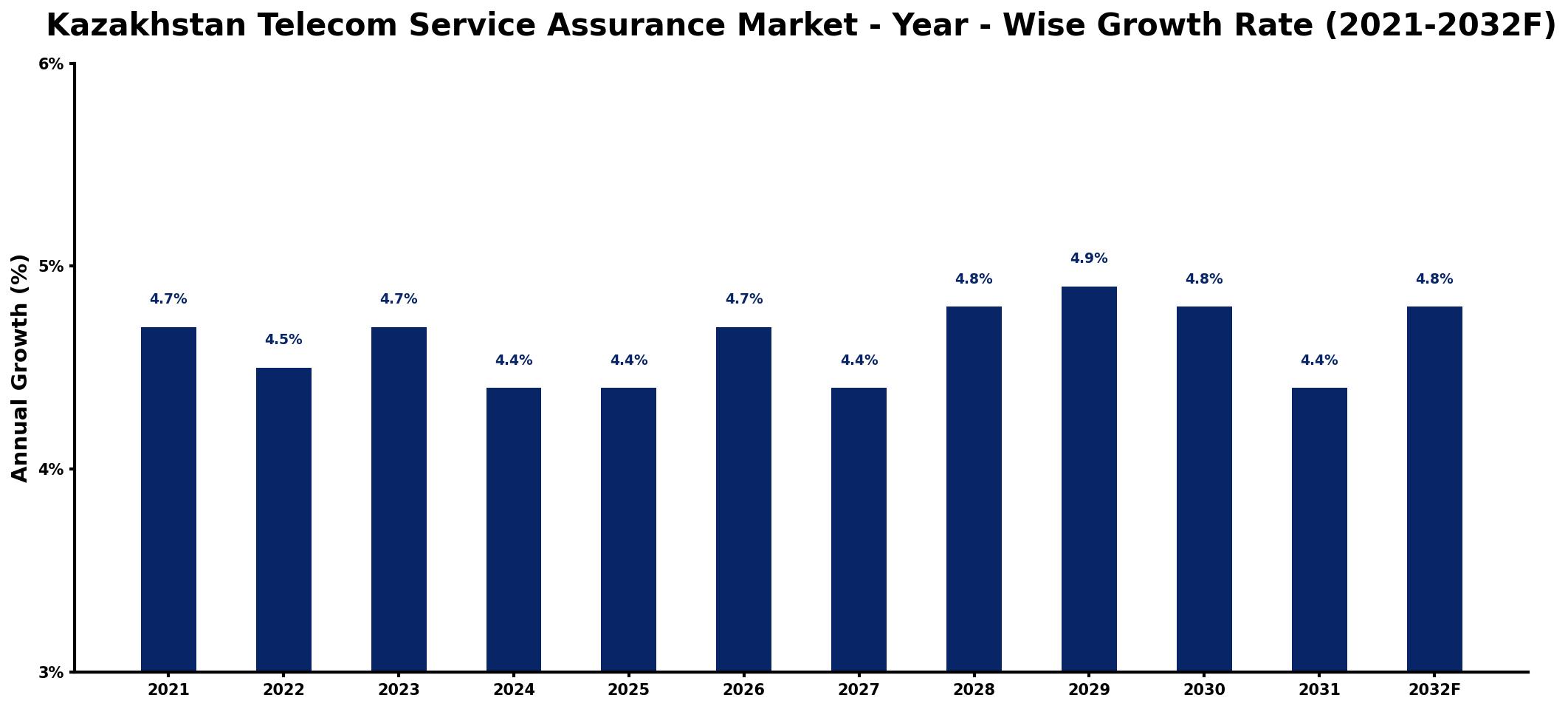
The table below presents the year‑wise growth rates along with the key drivers influencing the market
| Year | Growth Rate | Major Drivers |
| 2021 | 4.7% | Rising demand for connectivity solutions |
| 2022 | 4.5% | Increased investment in digital infrastructure |
| 2023 | 4.7% | Growth in mobile data consumption |
| 2024 | 4.4% | increased pharmaceutical industry usage |
| 2025 | 4.4% | Emergence of 5G technology applications |
| 2026 | 4.7% | Higher consumer expectations for performance |
| 2027 | 4.4% | Focus on network optimization strategies |
| 2028 | 4.8% | Adoption of IoT devices proliferation |
| 2029 | 4.9% | Investment in cybersecurity enhancements |
| 2030 | 4.8% | Integration of AI analytics tools |
| 2031 | 4.4% | Development of smart city projects |
| 2032 | 4.8% | Expansion of international partnerships |
Note: Market size estimations and growth projections presented in this report are based on 6Wresearch's proprietary forecasting methodology, utilizing the latest available industry data, government publications, and primary research inputs.
Kazakhstan Telecom Service Assurance Market Synopsis
Kazakhstan's telecom sector is witnessing a transformative phase, marked by escalating requirements for service assurance solutions. This surge in demand is linked to the increasing complexity of network environments as providers introduce more sophisticated services to cater to a digitally savvy customer base.
Furthermore, there is a notable emphasis on customer experience, prompting telecom companies to invest in solutions that deliver reliability and efficiency. As a result, both established providers and newcomers are actively developing their service assurance capabilities, which are vital for maintaining competitiveness in this evolving landscape.
Kazakhstan Telecom Service Assurance Market Key Takeaways
- Demand for high-quality telecom services drives the growth of service assurance solutions.
- Investment in AI and machine learning is reshaping the landscape of network performance and customer satisfaction.
- Providers are transitioning to automated systems for improved operational efficiency and cost reduction.
- Cloud-based service assurance platforms are gaining traction for their flexibility and scalability.
- Government policies support competitive practices and encourage technological innovation in telecom services.
Evaluation of Restraints in Kazakhstan Telecom Service Assurance Market
Despite its growth potential, the Kazakhstan Telecom Service Assurance Market faces significant constraints. The swift rise in data consumption leads to heightened pressure on network reliability and quality, presenting challenges for service providers. Furthermore, the complexities of multi-vendor environments can result in interoperability issues, hindering seamless service delivery. Cybersecurity threats continue to pose risks, necessitating robust measures to protect sensitive data. Financial burdens due to rapid technological advancements and regulatory compliance also challenge operators in their quest for innovation.
Kazakhstan Telecom Service Assurance Market Trends
Current trends in the Kazakhstan Telecom Service Assurance Market highlight a shift towards proactive monitoring and predictive maintenance strategies. Companies are increasingly implementing solutions that leverage AI and machine learning to optimize network operations. The demand for integrated service assurance platforms is on the rise, with an emphasis on end-to-end visibility across networks and applications. Additionally, the telecom sector is leaning into cloud-based architectures for enhanced agility and responsiveness to market dynamics.
Kazakhstan Telecom Service Assurance Market Opportunities
The market presents numerous investment opportunities, particularly as telecom operators ramp up their service assurance capabilities. There is a clear need for advanced solutions focused on network monitoring, performance analytics, and fault detection. Investors can explore avenues in creating technology partnerships and training initiatives that enhance workforce skills. Furthermore, the growing inclination towards 5G and IoT integration offers a fertile ground for innovative service assurance tools tailored to ensure high-quality connectivity.
Government Initiatives in the Kazakhstan Telecom Service Assurance Market
The Ministry of Digital Development, Innovation, and Aerospace Industry regulates the Kazakhstan Telecom Service Assurance Market. Government initiatives aim to enhance competition and access to telecommunications services while ensuring quality and reliability. Policies are geared towards developing robust infrastructure and consumer protection, with a strong focus on promoting data privacy and cybersecurity. The government actively encourages investments in emerging technologies to improve the operational efficiency of telecom services.
Future Insights of the Kazakhstan Telecom Service Assurance Market
Looking ahead to the period from 2026 to 2032, the Kazakhstan Telecom Service Assurance Market is poised for steady growth. As the adoption of 5G technology and IoT continues to expand, the need for comprehensive service assurance solutions will become even more pronounced. Telecom providers are expected to invest heavily in advanced tools that facilitate real-time monitoring and proactive issue resolution, thereby enhancing customer satisfaction. The overarching goal will be to offer seamless and reliable communication services, adapting to the demands of a digital economy.
Kazakhstan Telecom Service Assurance Market Latest Developments (2025 - 2026)
In recent months, the Kazakhstan Telecom Service Assurance Market has witnessed significant shifts as companies pivot towards integrating advanced analytics and AI-driven solutions into their operations. The emphasis on automation has increased, with providers adopting strategies to enhance their service management capabilities. Additionally, a growing number of collaborations and partnerships are forming to leverage technological advancements and improve service delivery across the sector.
Kazakhstan Telecom Service Assurance Market - Key Attractiveness of the Report
- 10 Years of Market Numbers
- Historical Data Starting from 2022 to 2025
- Base Year: 2025
- Forecast Data until 2032
- Key Performance Indicators Impacting the Market
- Major Upcoming Developments and Projects
Key Highlights of the Report:
- Kazakhstan Telecom Service Assurance Market Outlook
- Market Size of Kazakhstan Telecom Service Assurance Market, 2025
- Forecast of Kazakhstan Telecom Service Assurance Market, 2032
- Historical Data and Forecast of Kazakhstan Telecom Service Assurance Revenues & Volume for the Period 2022-2032F
- Kazakhstan Telecom Service Assurance Market Trend Evolution
- Kazakhstan Telecom Service Assurance Market Drivers and Challenges
- Kazakhstan Telecom Service Assurance Price Trends
- Kazakhstan Telecom Service Assurance Porter's Five Forces
- Kazakhstan Telecom Service Assurance Industry Life Cycle
- Historical Data and Forecast of Kazakhstan Telecom Service Assurance Market Revenues & Volume By Component for the Period 2022-2032F
- Historical Data and Forecast of Kazakhstan Telecom Service Assurance Market Revenues & Volume By Solutions (Fault and Event Management, Performance Management, and Quality and Service Management) for the Period 2022-2032F
- Historical Data and Forecast of Kazakhstan Telecom Service Assurance Market Revenues & Volume By Services (Professional, Managed) for the Period 2022-2032F
- Historical Data and Forecast of Kazakhstan Telecom Service Assurance Market Revenues & Volume By Operator Type for the Period 2022-2032F
- Historical Data and Forecast of Kazakhstan Telecom Service Assurance Market Revenues & Volume By Mobile Operator for the Period 2022-2032F
- Historical Data and Forecast of Kazakhstan Telecom Service Assurance Market Revenues & Volume By Fixed Operator for the Period 2022-2032F
- Historical Data and Forecast of Kazakhstan Telecom Service Assurance Market Revenues & Volume By Deployment Type for the Period 2022-2032F
- Historical Data and Forecast of Kazakhstan Telecom Service Assurance Market Revenues & Volume By On-Premises for the Period 2022-2032F
- Historical Data and Forecast of Kazakhstan Telecom Service Assurance Market Revenues & Volume By Cloud for the Period 2022-2032F
- Historical Data and Forecast of Kazakhstan Telecom Service Assurance Market Revenues & Volume By Organization Size for the Period 2022-2032F
- Historical Data and Forecast of Kazakhstan Telecom Service Assurance Market Revenues & Volume By Small and Medium Enterprises for the Period 2022-2032F
- Historical Data and Forecast of Kazakhstan Telecom Service Assurance Market Revenues & Volume By Large Enterprises for the Period 2022-2032F
- Kazakhstan Telecom Service Assurance Import Export Trade Statistics
- Market Opportunity Assessment By Component
- Market Opportunity Assessment By Operator Type
- Market Opportunity Assessment By Deployment Type
- Market Opportunity Assessment By Organization Size
- Kazakhstan Telecom Service Assurance Top Companies Market Share
- Kazakhstan Telecom Service Assurance Competitive Benchmarking By Technical and Operational Parameters
- Kazakhstan Telecom Service Assurance Company Profiles
- Kazakhstan Telecom Service Assurance Key Strategic Recommendations






































