Kazakhstan Tractor Market Size, Share & Growth Rate
The Kazakhstan Tractor Market was estimated at USD 170 Million in 2025 and is projected to reach USD 238 Million by 2032, growing at a CAGR of 4.9% from 2026 to 2032. This growth trajectory is propelled by the increasing mechanization of agriculture, as farmers seek to improve productivity and operational efficiency. Furthermore, favorable government policies and advancements in agricultural technologies are driving demand for modern tractors across the region.
Kazakhstan Tractor Market Year-wise Growth Rate and Key Drivers
This graph highlights how the Kazakhstan Tractor Market has steadily grown over the years, supported by major growth factors.
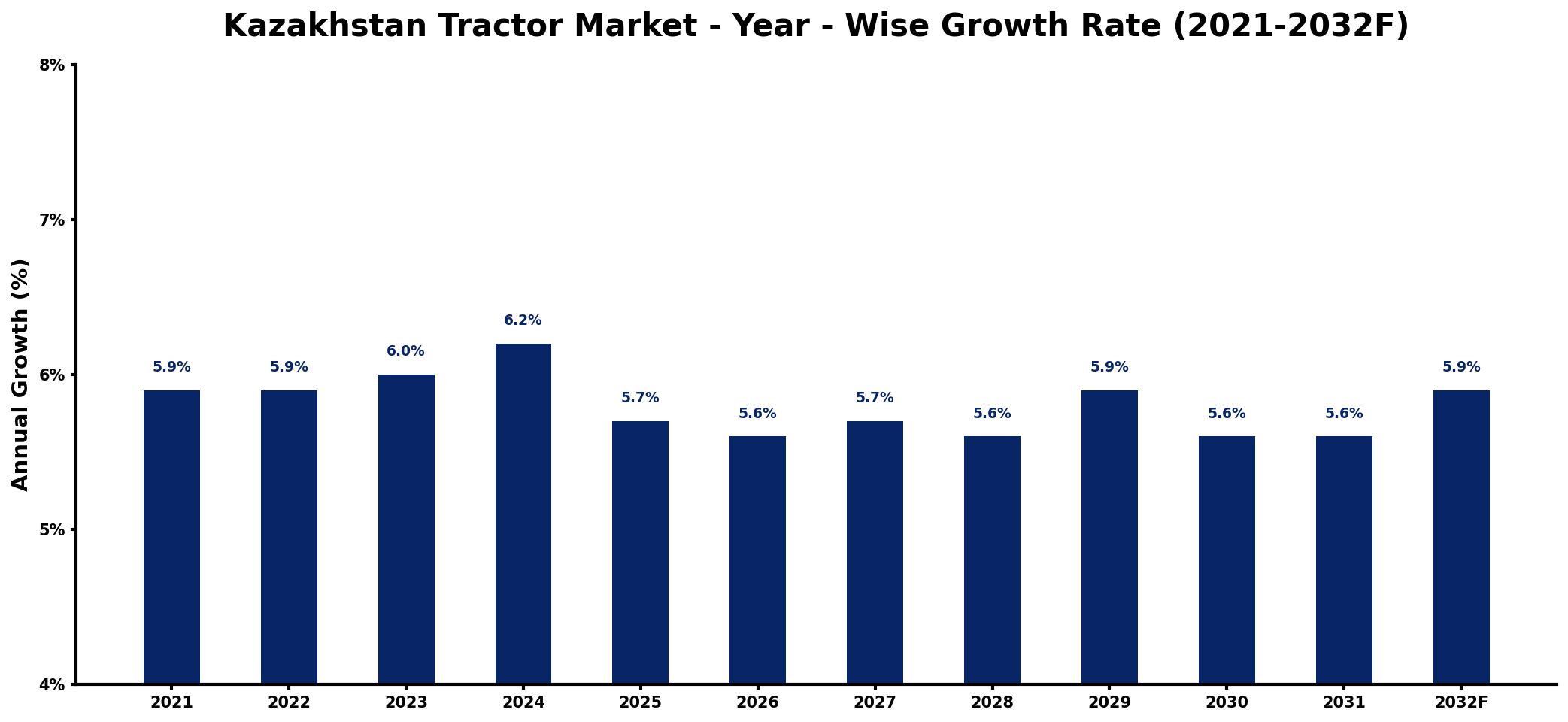
The table below presents the year‑wise growth rates along with the key drivers influencing the market
| Year | Growth Rate | Major Drivers |
| 2021 | 5.9% | strong agricultural investment trends |
| 2022 | 5.9% | rising demand for mechanization |
| 2023 | 6.0% | expansion in rural infrastructure |
| 2024 | 6.2% | increased export opportunities abroad |
| 2025 | 5.7% | growing focus on sustainability practices |
| 2026 | 5.6% | development of precision farming technologies |
| 2027 | 5.7% | enhanced government support programs |
| 2028 | 5.6% | improvement in financing options available |
| 2029 | 5.9% | increased adoption of smart agriculture |
| 2030 | 5.6% | growing population driving food production |
| 2031 | 5.6% | rising interest in agricultural innovation |
| 2032 | 5.9% | expansion of agricultural cooperatives network |
Note: Market size estimations and growth projections presented in this report are based on 6Wresearch's proprietary forecasting methodology, utilizing the latest available industry data, government publications, and primary research inputs.
Kazakhstan Tractor Market Synopsis
The Kazakhstan tractor market is currently evolving, with a noticeable increase in the adoption of advanced agricultural machinery. Tractors have become indispensable tools for farmers aiming to maximize output, streamline their processes, and respond to the demands of a competitive agricultural landscape.
Global manufacturers dominate the market, offering a wide range of tractors tailored to the unique needs of Kazakhstan's agricultural sector. With government support and a growing emphasis on precision farming, the market is poised for continued expansion and modernization.
Kazakhstan Tractor Market Key Takeaways
- The market is primarily driven by the push towards agricultural mechanization and productivity enhancement.
- Government initiatives provide financial support and subsidies, encouraging farmers to invest in new machinery.
- Technological advancements, particularly in precision agriculture, are shaping market demand.
- Increasing competition from foreign manufacturers necessitates strategic positioning and innovation.
- Investment opportunities exist in local manufacturing and distribution networks for tractors.
Evaluation of Restraints in Kazakhstan Tractor Market
Despite its growth potential, the Kazakhstan tractor market faces several restraints that could hinder its progress. Chief among these are the fluctuations in currency exchange rates, which can significantly impact the costs of imported tractors. Additionally, limited financing options for farmers restrict the acquisition of modern machinery, placing constraints on mechanization efforts. The market also grapples with infrastructure challenges, particularly in rural areas, where inadequate transport networks can delay the delivery of tractors. Lastly, a shortage of skilled technicians for maintenance and repairs can pose a challenge to sustaining equipment performance.
Kazakhstan Tractor Market Trends
The Kazakhstan tractor market is witnessing a trend towards the adoption of more sustainable machinery, including electric and hybrid tractors that offer long-term cost benefits and environmental advantages. Farmers are increasingly seeking connected tractors equipped with smart technologies, enabling remote monitoring and control for enhanced efficiency. Furthermore, there is a notable shift towards larger, more powerful tractors designed to meet the demands of modern agricultural practices. The integration of precision agriculture techniques continues to be a significant factor, fueling demand for tractors that incorporate GPS and advanced technology to optimize farming operations.
Kazakhstan Tractor Market Opportunities
The current landscape presents numerous investment opportunities within the Kazakhstan tractor market, particularly as the government emphasizes agricultural modernization. Establishing dealership or distribution networks for international manufacturers seeking entry into Kazakhstan could yield profitable returns. Additionally, there is substantial potential for developing local manufacturing facilities aimed at catering to domestic needs while also positioning for exports to neighboring Central Asian countries. As agricultural practices evolve, investments in this market hold promising prospects for long-term growth.
Government Initiatives in the Kazakhstan Tractor Market
Kazakhstan's government plays a pivotal role in shaping the tractor market through policies that promote domestic manufacturing and support agricultural development. Subsidies and incentives are available for local manufacturers to boost production levels and decrease reliance on imports. Moreover, financial assistance programs for farmers are designed to facilitate the adoption of modern machinery, including tractors, thereby enhancing agricultural efficiency and productivity. The governments regulatory framework also ensures the quality and safety of equipment available in the market.
Future Insights of the Kazakhstan Tractor Market
Looking ahead to 2026-2032, the Kazakhstan tractor market is expected to sustain its growth momentum, driven by ongoing mechanization initiatives and increasing demand for advanced agricultural technology. The incorporation of smart farming practices will likely further stimulate tractor sales as farmers seek to enhance operational efficiency. Furthermore, international manufacturers are anticipated to innovate by introducing tailored products that align with local agricultural needs. Overall, the outlook remains optimistic for stakeholders aiming to engage with this evolving market.
Kazakhstan Tractor Market Latest Developments (2025 - 2026)
Recent industry developments indicate a growing trend toward sustainable agriculture within Kazakhstan's tractor market. Innovations in electric and hybrid tractor technology are gaining traction as farmers become more environmentally conscious and seek cost-effective options. Additionally, partnerships between local firms and global manufacturers are emerging, facilitating knowledge transfer and fostering local capabilities. Moreover, an uptick in governmental programs aimed at enhancing agricultural productivity signals a commitment to modernizing the sector and addressing the needs of farmers.
Kazakhstan Tractor Market - Key Attractiveness of the Report
- 10 Years of Market Numbers
- Historical Data Starting from 2022 to 2025
- Base Year: 2025
- Forecast Data until 2032
- Key Performance Indicators Impacting the Market
- Major Upcoming Developments and Projects
Key Highlights of the Report:
- Kazakhstan Tractor Market Outlook
- Market Size of Kazakhstan Tractor Market, 2025
- Forecast of Kazakhstan Tractor Market, 2032
- Historical Data and Forecast of Kazakhstan Tractor Revenues & Volume for the Period 2022-2032F
- Kazakhstan Tractor Market Trend Evolution
- Kazakhstan Tractor Market Drivers and Challenges
- Kazakhstan Tractor Price Trends
- Kazakhstan Tractor Porter's Five Forces
- Kazakhstan Tractor Industry Life Cycle
- Historical Data and Forecast of Kazakhstan Tractor Market Revenues & Volume By Power Output for the Period 2022-2032F
- Historical Data and Forecast of Kazakhstan Tractor Market Revenues & Volume By Less Than 30 HP for the Period 2022-2032F
- Historical Data and Forecast of Kazakhstan Tractor Market Revenues & Volume By 30-50 HP for the Period 2022-2032F
- Historical Data and Forecast of Kazakhstan Tractor Market Revenues & Volume By 51-100 HP for the Period 2022-2032F
- Historical Data and Forecast of Kazakhstan Tractor Market Revenues & Volume By More Than 100 HP for the Period 2022-2032F
- Historical Data and Forecast of Kazakhstan Tractor Market Revenues & Volume By Drive Type for the Period 2022-2032F
- Historical Data and Forecast of Kazakhstan Tractor Market Revenues & Volume By 2 Wheel Drive for the Period 2022-2032F
- Historical Data and Forecast of Kazakhstan Tractor Market Revenues & Volume By 4 Wheel Drive for the Period 2022-2032F
- Historical Data and Forecast of Kazakhstan Tractor Market Revenues & Volume By Application for the Period 2022-2032F
- Historical Data and Forecast of Kazakhstan Tractor Market Revenues & Volume By Agriculture for the Period 2022-2032F
- Kazakhstan Tractor Import Export Trade Statistics
- Market Opportunity Assessment By Power Output
- Market Opportunity Assessment By Drive Type
- Market Opportunity Assessment By Application
- Kazakhstan Tractor Top Companies Market Share
- Kazakhstan Tractor Competitive Benchmarking By Technical and Operational Parameters
- Kazakhstan Tractor Company Profiles
- Kazakhstan Tractor Key Strategic Recommendations






































