Kazakhstan Urinalysis Market Size, Share & Growth Rate
The Kazakhstan Urinalysis Market was estimated at USD 1401 Million in 2025 and is projected to reach USD 1992 Million by 2032, growing at a CAGR of 5.2% from 2026 to 2032. This growth trajectory is primarily driven by a rising prevalence of urinary tract infections and kidney diseases, coupled with heightened awareness of preventive healthcare measures. Furthermore, the integration of advanced technologies in urinalysis, such as automated systems and point-of-care devices, is expected to significantly enhance diagnostic efficiency, propelling market expansion.
Kazakhstan Urinalysis Market Growth Rate Analysis (2021-2032)
The Kazakhstan Urinalysis Market is poised for steady growth, with projected annual increases of 5.8% in 2021 and 6.3% in both 2022 and 2023. This stability can be attributed to rising healthcare investments and an expanding diagnostic services sector, driven by an increasing prevalence of chronic diseases. The growth rate remains robust, averaging around 6.1% through 2029, reflecting ongoing improvements in medical infrastructure and the adoption of advanced urinalysis technologies. Policy initiatives aimed at enhancing healthcare access are further underpinning this trend. As consumer demand for accurate and efficient diagnostic solutions continues to rise, the market is expected to sustain its positive momentum into the early 2030s, with a slight uptick to 6.3% in 2032.
Kazakhstan Urinalysis Market Year-wise Growth Rate and Key Drivers
This graph highlights how the Kazakhstan Urinalysis Market has steadily grown over the past five years, supported by major growth factors.
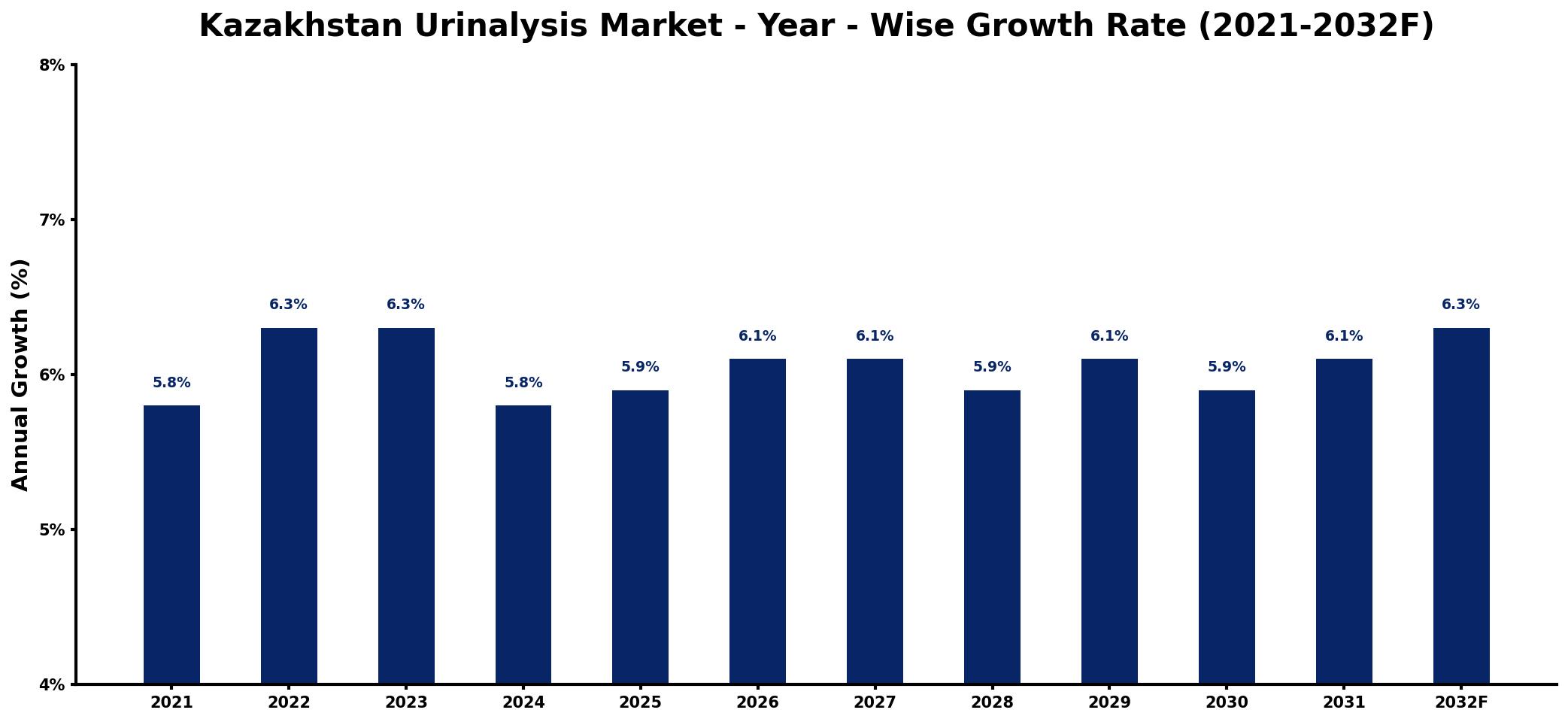
The table below presents the year‑wise growth rates along with the key drivers influencing the market
| Year | Growth Rate | Major Drivers |
| 2021 | 5.8% | Rising healthcare expenditure trends |
| 2022 | 6.3% | Increased public health initiatives |
| 2023 | 6.3% | Growth in diagnostic laboratories |
| 2024 | 5.8% | Expansion of healthcare infrastructure |
| 2025 | 5.9% | Surge in preventive healthcare awareness |
| 2026 | 6.1% | Advancements in medical technologies |
| 2027 | 6.1% | Increase in chronic disease prevalence |
| 2028 | 5.9% | Rising demand for routine screenings |
| 2029 | 6.1% | rising infrastructure development spending |
| 2030 | 5.9% | improved raw material availability |
| 2031 | 6.1% | Increased government healthcare funding |
| 2032 | 6.3% | Heightened focus on patient care |
Note: Market size estimations and growth projections presented in this report are based on 6Wresearch's proprietary forecasting methodology, utilizing the latest available industry data, government publications, and primary research inputs.
Kazakhstan Urinalysis Market Synopsis
Kazakhstan's healthcare landscape is undergoing a transformation, particularly in the realm of diagnostic testing. Urinalysis is emerging as a critical tool for early detection of urological disorders, reflecting an increased public focus on health monitoring and disease prevention. As healthcare infrastructures improve, more facilities are incorporating advanced urinalysis technologies to meet rising demand.
This shift is underscored by government initiatives aimed at enhancing healthcare access and promoting preventive care. With a growing elderly population and a rise in lifestyle-related ailments, the urgency for efficient diagnostic methods is driving both investment and innovation in the Kazakhstan Urinalysis Market.
Kazakhstan Urinalysis Market Key Takeaways
- The market is on an upward trajectory fueled by increasing prevalence of urological disorders.
- Technological advancements, such as automation and AI integration, are revolutionizing urinalysis procedures.
- Government initiatives are supporting improved healthcare access and diagnostic capabilities.
- Preventive healthcare measures are catalyzing a rise in routine urinalysis testing in medical facilities.
- Investment opportunities are abundant for companies focusing on innovative diagnostic solutions.
Evaluation of Restraints in Kazakhstan Urinalysis Market
Despite the promising growth, several limitations hinder the full potential of the Kazakhstan Urinalysis Market. Access to cutting-edge technologies remains uneven, with many healthcare facilities struggling to procure advanced equipment. Additionally, there is a notable gap in training healthcare professionals on result interpretation, which undermines the efficacy of testing. Quality control practices vary across laboratories, leading to inconsistencies in testing outcomes. To effectively address these barriers, a comprehensive strategy involving infrastructure investment, regulatory improvements, and enhanced training programs for medical staff will be essential.
Kazakhstan Urinalysis Market Trends
The Kazakhstan Urinalysis Market is witnessing a notable trend towards automation, with automated urinalysis systems gaining traction for their speed and precision. Point-of-care testing devices are increasingly sought after, aligning with the healthcare community's demand for rapid diagnosis. Additionally, there is an emerging focus on personalized medicine, where tailored diagnostic tests can lead to better patient outcomes. The integration of artificial intelligence in urinalysis technology is enhancing diagnostic capabilities, allowing for more nuanced interpretations of results and, ultimately, improved patient management.
Kazakhstan Urinalysis Market Opportunities
The burgeoning demand for urinalysis tests presents significant investment opportunities within the Kazakhstan market. As chronic diseases and urinary tract infections become more prevalent, innovative solutions such as advanced automated analyzers and portable testing devices are increasingly valuable. Collaborating with local healthcare providers to supply cutting-edge urinalysis products could strengthen market positions. Moreover, as public awareness of health issues rises, the push for routine screenings will likely create sustainable demand for reliable urinalysis technologies.
Government Initiatives in the Kazakhstan Urinalysis Market
The government of Kazakhstan is actively promoting policies that focus on enhancing the quality and safety of medical devices, including those used for urinalysis. Regulatory frameworks overseen by the Ministry of Health ensure that medical devices meet national standards, fostering trust in diagnostic tools. Initiatives aimed at increasing healthcare access emphasize the need for effective diagnostic solutions like urinalysis, which are essential for improving public health outcomes. Additionally, efforts to stimulate local manufacturing of medical devices aim to reduce import dependencies, supporting the growth of the domestic healthcare industry.
Future Insights of the Kazakhstan Urinalysis Market
Looking ahead, the Kazakhstan Urinalysis Market is set to expand significantly from 2026 to 2032. Factors such as a growing elderly population, increasing prevalence of chronic diseases, and a societal shift towards preventive healthcare will drive demand. Advances in technology will further enhance the accuracy and efficiency of urinalysis processes, making them more accessible to healthcare providers. With a stronger emphasis on early disease detection and personalized treatment approaches, the market is likely to see continuous innovation and growth.
Kazakhstan Urinalysis Market Latest Developments (2025 - 2026)
Recent developments in the Kazakhstan Urinalysis Market have reflected a commitment to modernization and innovation. Healthcare facilities are increasingly adopting automated systems to streamline operations and improve diagnostic accuracy. Point-of-care testing devices are also gaining popularity, catering to the rising demand for rapid testing solutions. Furthermore, ongoing government initiatives are aimed at enhancing healthcare infrastructure, ensuring wider access to effective urinalysis services across the country.
Kazakhstan Urinalysis Market - Key Attractiveness of the Report
- 10 Years of Market Numbers
- Historical Data Starting from 2022 to 2025
- Base Year: 2025
- Forecast Data until 2032
- Key Performance Indicators Impacting the Market
- Major Upcoming Developments and Projects
Key Highlights of the Report:
- Kazakhstan Urinalysis Market Outlook
- Market Size of Kazakhstan Urinalysis Market, 2025
- Forecast of Kazakhstan Urinalysis Market, 2032
- Historical Data and Forecast of Kazakhstan Urinalysis Revenues & Volume for the Period 2022-2032F
- Kazakhstan Urinalysis Market Trend Evolution
- Kazakhstan Urinalysis Market Drivers and Challenges
- Kazakhstan Urinalysis Price Trends
- Kazakhstan Urinalysis Porter's Five Forces
- Kazakhstan Urinalysis Industry Life Cycle
- Historical Data and Forecast of Kazakhstan Urinalysis Market Revenues & Volume By Product Type for the Period 2022-2032F
- Historical Data and Forecast of Kazakhstan Urinalysis Market Revenues & Volume By Instruments for the Period 2022-2032F
- Historical Data and Forecast of Kazakhstan Urinalysis Market Revenues & Volume By Consumables for the Period 2022-2032F
- Historical Data and Forecast of Kazakhstan Urinalysis Market Revenues & Volume By Application for the Period 2022-2032F
- Historical Data and Forecast of Kazakhstan Urinalysis Market Revenues & Volume By Urinary Tract Infection for the Period 2022-2032F
- Historical Data and Forecast of Kazakhstan Urinalysis Market Revenues & Volume By Diabetes for the Period 2022-2032F
- Historical Data and Forecast of Kazakhstan Urinalysis Market Revenues & Volume By Kidney Diseases for the Period 2022-2032F
- Historical Data and Forecast of Kazakhstan Urinalysis Market Revenues & Volume By Hypertension for the Period 2022-2032F
- Historical Data and Forecast of Kazakhstan Urinalysis Market Revenues & Volume By Liver Diseases for the Period 2022-2032F
- Historical Data and Forecast of Kazakhstan Urinalysis Market Revenues & Volume By End-User for the Period 2022-2032F
- Historical Data and Forecast of Kazakhstan Urinalysis Market Revenues & Volume By Hospitals for the Period 2022-2032F
- Historical Data and Forecast of Kazakhstan Urinalysis Market Revenues & Volume By Clinical Laboratories for the Period 2022-2032F
- Historical Data and Forecast of Kazakhstan Urinalysis Market Revenues & Volume By Home Healthcare for the Period 2022-2032F
- Historical Data and Forecast of Kazakhstan Urinalysis Market Revenues & Volume By Research for the Period 2022-2032F
- Historical Data and Forecast of Kazakhstan Urinalysis Market Revenues & Volume By Academics for the Period 2022-2032F
- Kazakhstan Urinalysis Import Export Trade Statistics
- Market Opportunity Assessment By Product Type
- Market Opportunity Assessment By Application
- Market Opportunity Assessment By End-User
- Kazakhstan Urinalysis Top Companies Market Share
- Kazakhstan Urinalysis Competitive Benchmarking By Technical and Operational Parameters
- Kazakhstan Urinalysis Company Profiles
- Kazakhstan Urinalysis Key Strategic Recommendations






































