Kazakhstan Worldwide Rolling Stock Wheel Market Size, Share & Growth Rate
The Kazakhstan Worldwide Rolling Stock Wheel Market was estimated at USD 364 Million in 2025 and is projected to reach USD 478 Million by 2032, growing at a CAGR of 4.0% from 2026 to 2032. This positive trajectory can be attributed to robust government initiatives aimed at enhancing public transportation infrastructure and an uptick in economic activities spurred by rising oil exports. The increasing demand for both passenger and freight rail services in the region is anticipated to further fuel market growth, creating a sustainable environment for investment in rolling stock wheels.
Kazakhstan Worldwide Rolling Stock Wheel Market Growth Rate Analysis (2021-2032)
The Kazakhstan Worldwide Rolling Stock Wheel Market has exhibited stable growth, reflecting a compound annual growth rate of roughly 4.5% over the period from 2021 to 2032. The strongest performance occurred in 2021, with a 5.0% increase, prompted by substantial infrastructure investments and rising consumer demand for efficient rail transportation. Growth slightly softened to 4.4% in 2022 due to global supply chain disruptions, but it rebounded in 2023 to 4.8% as local manufacturing adapted to these challenges. Projections indicate a steady 4.9% growth in 2024 and 2025, as ongoing digitalization efforts and an energy transition boost technological advancements in the industry. By 2032, growth is expected to stabilize around 4.6%, demonstrating resilience despite potential economic fluctuations.
Kazakhstan Worldwide Rolling Stock Wheel Market Year-wise Growth Rate and Key Drivers
This graph highlights how the Kazakhstan Worldwide Rolling Stock Wheel Market has steadily grown over the past five years, supported by major growth factors.
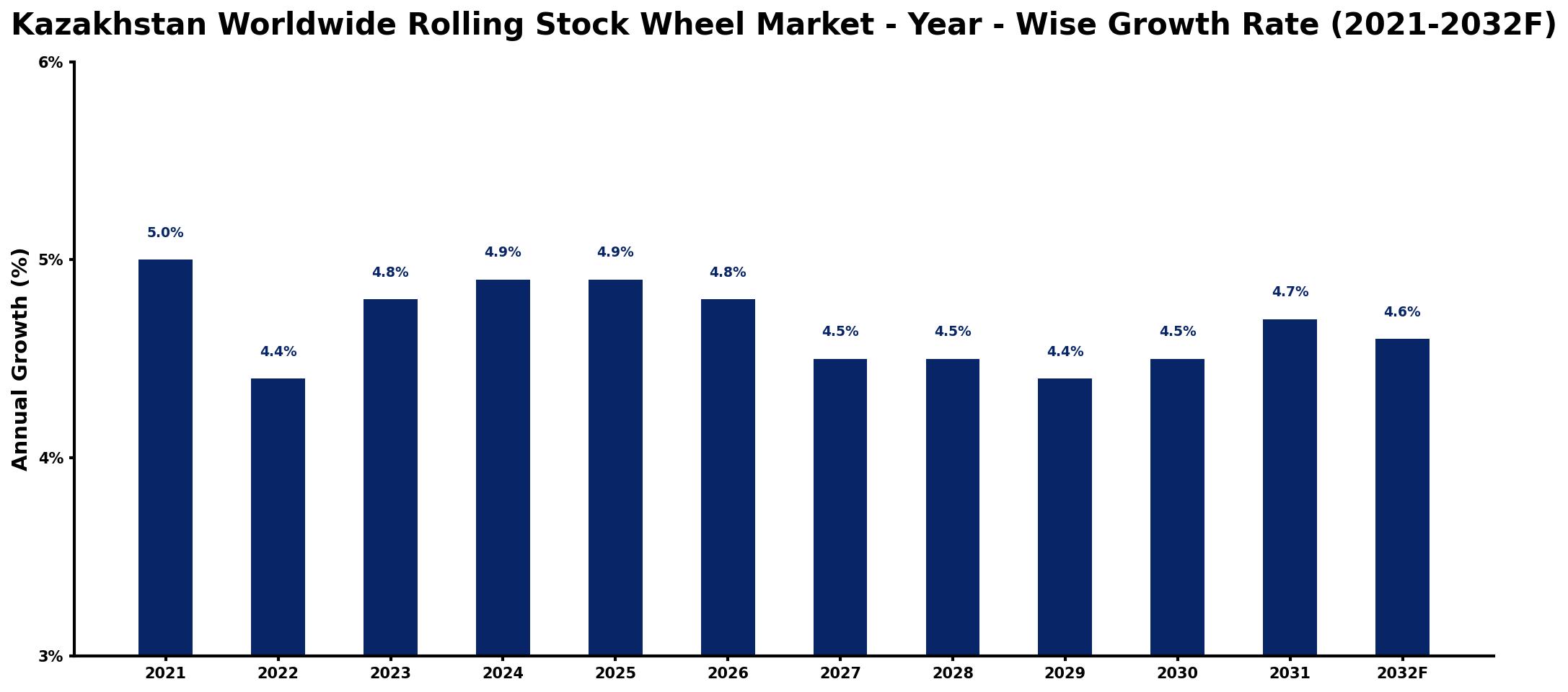
The table below presents the year‑wise growth rates along with the key drivers influencing the market
| Year | Growth Rate | Major Drivers |
| 2021 | 5.0% | Increased infrastructure investment initiatives |
| 2022 | 4.4% | Growing urban transit system demand |
| 2023 | 4.8% | Rise in freight transportation needs |
| 2024 | 4.9% | Expansion of regional trade networks |
| 2025 | 4.9% | Technological advancements in manufacturing |
| 2026 | 4.8% | Strengthened supply chain reliability |
| 2027 | 4.5% | Enhanced regulatory support frameworks |
| 2028 | 4.5% | Surge in commuter rail projects |
| 2029 | 4.4% | Growing sustainability initiatives adoption |
| 2030 | 4.5% | Increased public transportation funding |
| 2031 | 4.7% | Expanding global logistics operations |
| 2032 | 4.6% | Rising investments in infrastructure modernization |
Note: Market size estimations and growth projections presented in this report are based on 6Wresearch's proprietary forecasting methodology, utilizing the latest available industry data, government publications, and primary research inputs.
Kazakhstan Worldwide Rolling Stock Wheel Market Synopsis
The primary driving force shaping the Kazakhstan Worldwide Rolling Stock Wheel Market is significant governmental investment in the railway sector. This includes efforts to modernize existing rail infrastructure, which is crucial for accommodating the projected increase in rail traffic.
Moreover, the growing economic activities fueled by oil exports are enhancing the need for efficient freight transportation solutions. This creates a favorable environment for increased demand for rolling stock wheels, particularly as local manufacturers strive to meet rising expectations.
Kazakhstan Worldwide Rolling Stock Wheel Market Key Takeaways
- The market is set to grow steadily, reflecting the country's strategic focus on rail infrastructure development.
- Government investment is a key component driving demand for rolling stock wheels in Kazakhstan.
- Increased oil exports and economic activity are boosting freight transport needs.
- Local production of rolling stock wheels may attract foreign investment, enhancing market dynamics.
- The next few years present an opportune moment for stakeholders looking to enter or expand within this market.
Evaluation of Restraints in Kazakhstan Worldwide Rolling Stock Wheel Market
Despite the optimistic outlook, the Kazakhstan Worldwide Rolling Stock Wheel Market faces several challenges that could hinder its growth. Key restraints include potential supply chain disruptions and fluctuating material costs that could impact manufacturing. Additionally, the reliance on public funding for infrastructure projects may create volatility in demand should budgetary constraints arise. The market's growth may also be moderated by competition from established international suppliers who might offer technologically advanced products.
Kazakhstan Worldwide Rolling Stock Wheel Market Trends
One of the prominent trends influencing the market is the shift towards sustainable and eco-friendly railway solutions. As global standards for environmental impact intensify, there is an increasing demand for rolling stock wheels that not only meet performance criteria but also contribute to lower emissions. Advances in materials technology are also evident, with lighter and more durable materials becoming a focal point for manufacturers.
Furthermore, the integration of smart technology in rail systems is emerging as a crucial trend. This includes the development of smart wheels equipped with sensors that monitor performance and predict maintenance needs, thereby enhancing efficiency and safety.
Kazakhstan Worldwide Rolling Stock Wheel Market Opportunities
The market presents several avenues for growth and investment, particularly in enhancing local manufacturing capabilities. With government initiatives aimed at boosting domestic production, foreign companies may find opportunities to collaborate or establish joint ventures with local manufacturers. Furthermore, as Kazakhstan continues to position itself as a logistics hub in the region, the demand for advanced rolling stock wheels is likely to increase, particularly for freight services. This provides an attractive landscape for innovation and development within the sector.
Government Initiatives in the Kazakhstan Worldwide Rolling Stock Wheel Market
Kazakhstans government has launched a series of initiatives aimed at bolstering its railway infrastructure. This includes substantial investments focused on modernizing rail networks and enhancing passenger and freight services. Policies promoting local production and procurement are also in place, encouraging foreign investments that align with national development objectives. These initiatives are expected to stimulate growth and improve the overall market ecosystem.
Future Insights of the Kazakhstan Worldwide Rolling Stock Wheel Market
Looking ahead to the period between 2026 and 2032, the Kazakhstan Worldwide Rolling Stock Wheel Market is poised for notable advancements. The combination of government support and the growing demand for efficient transport solutions will likely propel the market further. Emerging technologies, coupled with strategic partnerships, will enhance competitive positioning. The focus on sustainable practices will also reshape product offerings, aligning with global trends that prioritize eco-friendliness in the transport sector.
Kazakhstan Worldwide Rolling Stock Wheel Market Latest Developments (2025 - 2026)
Recent industry developments indicate a strategic shift towards local production facilities, as various stakeholders adapt to government incentives aimed at enhancing domestic manufacturing capabilities. Alongside this, there has been a noticeable trend towards adopting advanced technologies in production processes, improving efficiency and quality. Collaborative projects between government and private sectors are also being initiated, emphasizing infrastructure upgrades that will support the growing demand for rolling stock wheels.
Kazakhstan Worldwide Rolling Stock Wheel Market - Key Attractiveness of the Report
- 10 Years of Market Numbers
- Historical Data Starting from 2022 to 2025
- Base Year: 2025
- Forecast Data until 2032
- Key Performance Indicators Impacting the Market
- Major Upcoming Developments and Projects
Key Highlights of the Report:
- Kazakhstan Worldwide Rolling Stock Wheel Market Outlook
- Market Size of Kazakhstan Worldwide Rolling Stock Wheel Market, 2025
- Forecast of Kazakhstan Worldwide Rolling Stock Wheel Market, 2032
- Historical Data and Forecast of Kazakhstan Worldwide Rolling Stock Wheel Revenues & Volume for the Period 2022-2032F
- Kazakhstan Worldwide Rolling Stock Wheel Market Trend Evolution
- Kazakhstan Worldwide Rolling Stock Wheel Market Drivers and Challenges
- Kazakhstan Worldwide Rolling Stock Wheel Price Trends
- Kazakhstan Worldwide Rolling Stock Wheel Porter's Five Forces
- Kazakhstan Worldwide Rolling Stock Wheel Industry Life Cycle
- Historical Data and Forecast of Kazakhstan Worldwide Rolling Stock Wheel Market Revenues & Volume By Product Type for the Period 2022-2032F
- Historical Data and Forecast of Kazakhstan Worldwide Rolling Stock Wheel Market Revenues & Volume By Casting for the Period 2022-2032F
- Historical Data and Forecast of Kazakhstan Worldwide Rolling Stock Wheel Market Revenues & Volume By Forged for the Period 2022-2032F
- Historical Data and Forecast of Kazakhstan Worldwide Rolling Stock Wheel Market Revenues & Volume By Applications for the Period 2022-2032F
- Historical Data and Forecast of Kazakhstan Worldwide Rolling Stock Wheel Market Revenues & Volume By High Speed for the Period 2022-2032F
- Historical Data and Forecast of Kazakhstan Worldwide Rolling Stock Wheel Market Revenues & Volume By Freight Wagons for the Period 2022-2032F
- Historical Data and Forecast of Kazakhstan Worldwide Rolling Stock Wheel Market Revenues & Volume By Passenger Wagons for the Period 2022-2032F
- Historical Data and Forecast of Kazakhstan Worldwide Rolling Stock Wheel Market Revenues & Volume By Locos for the Period 2022-2032F
- Kazakhstan Worldwide Rolling Stock Wheel Import Export Trade Statistics
- Market Opportunity Assessment By Product Type
- Market Opportunity Assessment By Applications
- Kazakhstan Worldwide Rolling Stock Wheel Top Companies Market Share
- Kazakhstan Worldwide Rolling Stock Wheel Competitive Benchmarking By Technical and Operational Parameters
- Kazakhstan Worldwide Rolling Stock Wheel Company Profiles
- Kazakhstan Worldwide Rolling Stock Wheel Key Strategic Recommendations






































