Kenya Cloud Security Market Size & Growth Rate (2026-2032)
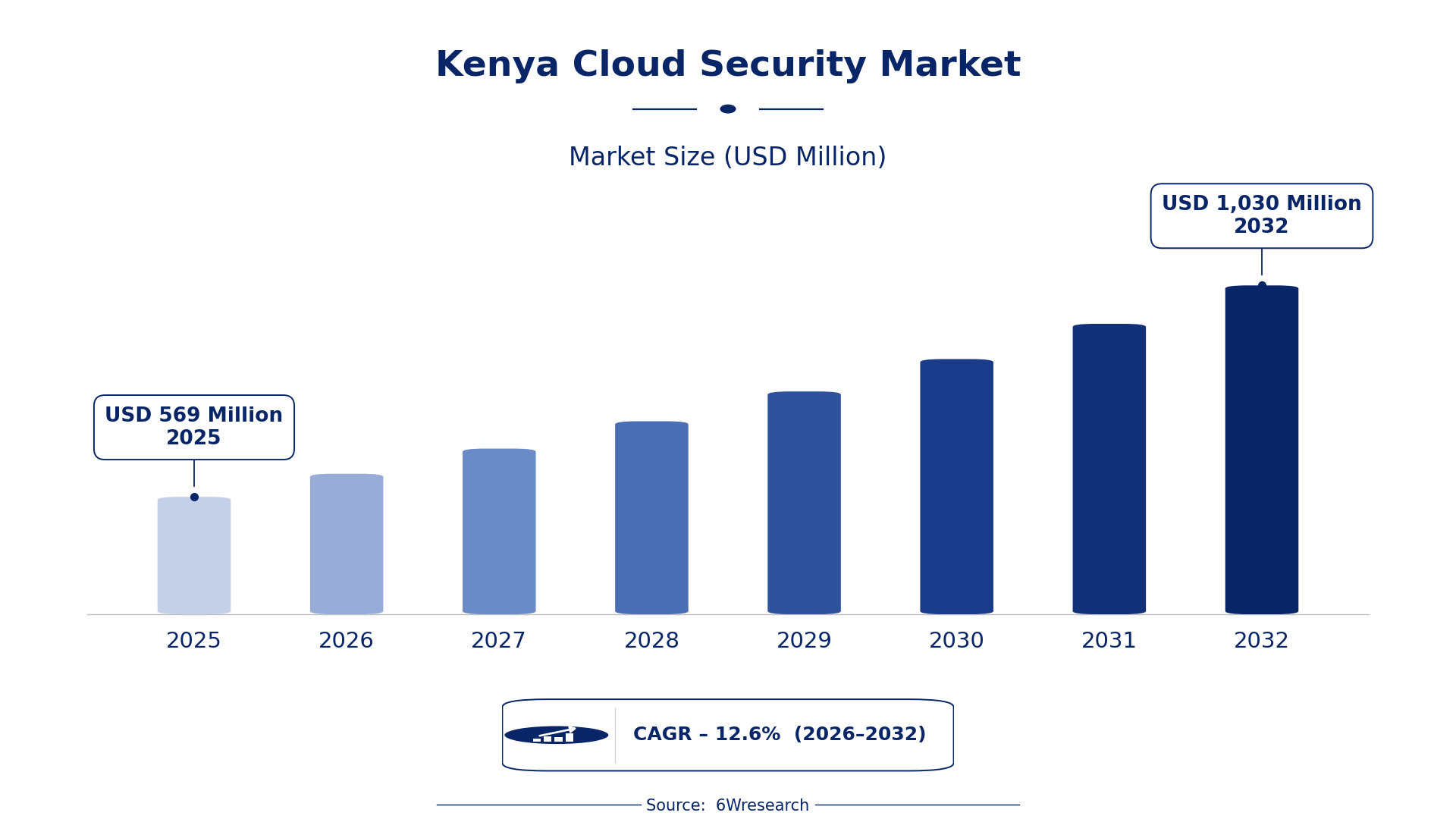
The Kenya Cloud Security Market was estimated at USD 569 Million in 2025 and is projected to reach USD 1030 Million by 2032, growing at a CAGR of 12.6% from 2026 to 2032.
Kenya Cloud Security Market Synopsis
The Kenya Cloud Security Market is rapidly expanding, spurred by increasing cyber threats that have organizations scrambling for enhanced data protection. With companies migrating to cloud-based services, safeguarding sensitive information has become a top priority. As a result, cloud security solutions featuring encryption, threat detection, and access control are in high demand.
Businesses in Kenya are recognizing that a strong cloud security posture is essential for compliance and trust. The rise of remote work and hybrid cloud infrastructures is pushing organizations to adopt integrated security measures. This trend underscores the need for visibility and control over their cloud environments, highlighting a clear trajectory for the market's growth.
Kenya Cloud Security Market Year-wise Growth Rate and Key Drivers
This graph illustrates the annual growth rates of the Kenya Cloud Security Market from 2021 to 2032, highlighting a steady upward trajectory and projected expansion over the forecast period.
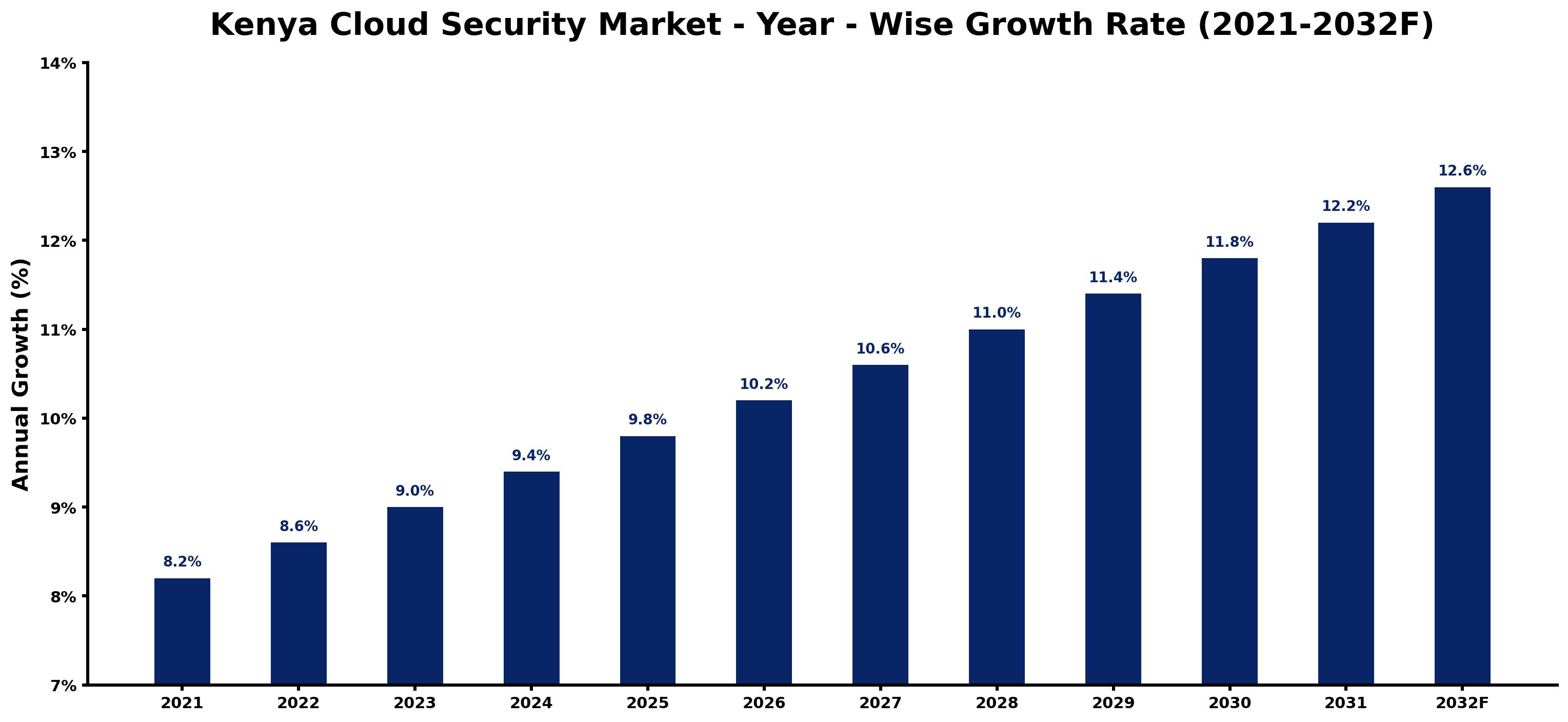
The table below presents the year‑wise growth rates along with the key drivers influencing the market
| Year | Growth Rate | Major Drivers |
| 2021 | 8.2% | Growing government emphasis on data protection regulations. |
| 2022 | 8.6% | Increased cyber threats motivating security investments. |
| 2023 | 9.0% | Adoption of remote work driving cloud security demand. |
| 2024 | 9.4% | Mobile money services enhancing cybersecurity requirements. |
| 2025 | 9.8% | Digital transformation initiatives boosting cloud platform migration. |
| 2026 | 10.2% | Launch of national cybersecurity strategy attracting investments. |
| 2027 | 10.6% | Rise in e-commerce necessitating enhanced security measures. |
| 2028 | 11.0% | Growth of IoT devices creating new security challenges. |
| 2029 | 11.4% | Public cloud adoption momentum increasing security solutions popularity. |
| 2030 | 11.8% | Regulatory compliance pressures driving cloud security deployment. |
| 2031 | 12.2% | Regional tech hubs fostering cybersecurity innovations. |
| 2032 | 12.6% | Partnerships with global security firms expanding local capabilities. |
Note: Market size estimations and growth projections presented in this report are based on 6Wresearch's proprietary forecasting methodology, utilizing the latest available industry data, government publications, and primary research inputs.
Kenya Cloud Security Market Key Takeaways
Below are some of the specific key takeaways from the market, including:
- Cybersecurity threats are the primary drivers for cloud security adoption in Kenya.
- Organizations are increasingly shifting towards hybrid and multi-cloud environments.
- Cloud security solutions are crucial for achieving regulatory compliance.
- Remote work trends are influencing the demand for robust security measures.
- The shortage of skilled security professionals presents a significant challenge.
Evaluation of Restraints in Kenya Cloud Security Market
Despite its promising growth, the Kenya Cloud Security Market faces several constraints. Data privacy regulations are complex and often inconsistent, leading to confusion among organizations on compliance requirements. on top of that, the lack of a comprehensive understanding of cybersecurity risks hampers effective implementation of security measures. The shortage of skilled professionals further exacerbates these issues, preventing companies from fully capitalizing on cloud security opportunities.
Kenya Cloud Security Market Trends
Several trends are shaping the Kenya Cloud Security Market today. The shift to hybrid and multi-cloud strategies is gaining traction as organizations seek to optimize cost and efficiency while managing risks. There's a growing emphasis on automated threat detection and response solutions, allowing businesses to react swiftly to potential breaches. Additionally, increasing awareness of data privacy is driving the adoption of compliance-focused security measures.
Kenya Cloud Security Market Opportunities
The market offers numerous opportunities for growth and investment. As more businesses transition to cloud services, there is a heightened need for advanced security solutions tailored to specific industry requirements. Companies specializing in artificial intelligence and machine learning are well-positioned to offer innovative security technologies. on top of that, public-private partnerships in cybersecurity initiatives can further enhance the ecosystem, presenting a fertile ground for collaboration and development.
Government Initiatives in the Kenya Cloud Security Market
The Kenyan government is taking proactive steps to bolster cybersecurity through a series of initiatives aimed at enhancing the cloud security framework. Legislative measures and policies are being established to ensure compliance and safeguard national data. These efforts are critical as they address the increasing cyber threats while promoting a secure digital environment.
- A regulatory framework introduced in 2025 mandating data protection standards for cloud service providers.
- A national cybersecurity awareness program currently underway, aimed at educating organizations on best practices.
- A public-private initiative planned to launch in 2026, focusing on improving the cybersecurity workforce in Kenya.
- A pilot project initiated in early 2025 aimed at developing a national incident response framework.
- Current negotiations for a comprehensive cybersecurity strategy expected to be unveiled by mid-2026.
Future Insights of the Kenya Cloud Security Market
From 2026 to 2032, the Kenya Cloud Security Market is expected to evolve significantly. Businesses will likely invest more in integrated security solutions that provide comprehensive protection across various platforms. Additionally, as technology advances, there will be a notable shift toward adopting AI-driven security measures that enhance threat detection and response. Organizations that prioritize cloud security will gain a competitive edge in the market, underscoring the importance of proactive security strategies.
Kenya Cloud Security Market Latest Developments
Recent activity in the Kenya Cloud Security Market reflects a growing emphasis on innovation and resilience. Companies are actively upgrading their security measures to address emerging threats. The next phase of cloud security development promises to introduce more sophisticated tools and frameworks to combat cyber risks.
- A leading technology vendor launched a new cloud security solution in Q1 2025, focusing on enhanced encryption techniques.
- An ongoing initiative began in mid-2025 to implement advanced threat detection capabilities across several industries.
- A recent partnership between cybersecurity firms aims to develop new cloud security protocols, with rollout expected in late 2026.
- A technology upgrade project focusing on secure cloud infrastructure completed in early 2025, improving data protection for enterprises.
- A new training program for security professionals is currently underway, designed to address the skills gap in the market.
Kenya Cloud Security Market - Key Attractiveness of the Report
- 10 Years of Market Numbers
- Historical Data Starting from 2022 to 2025
- Base Year: 2025
- Forecast Data until 2032
- Key Performance Indicators Impacting the Market
- Major Upcoming Developments and Projects
Key Highlights of the Report:
- Kenya Cloud Security Market Outlook
- Market Size of Kenya Cloud Security Market, 2025
- Forecast of Kenya Cloud Security Market, 2032
- Historical Data and Forecast of Kenya Cloud Security Revenues & Volume for the Period 2022-2032F
- Kenya Cloud Security Market Trend Evolution
- Kenya Cloud Security Market Drivers and Challenges
- Kenya Cloud Security Price Trends
- Kenya Cloud Security Porter's Five Forces
- Kenya Cloud Security Industry Life Cycle
- Historical Data and Forecast of Kenya Cloud Security Market Revenues & Volume By Application for the Period 2022-2032F
- Historical Data and Forecast of Kenya Cloud Security Market Revenues & Volume By Visibility for the Period 2022-2032F
- Historical Data and Forecast of Kenya Cloud Security Market Revenues & Volume By Risk Assessment for the Period 2022-2032F
- Historical Data and Forecast of Kenya Cloud Security Market Revenues & Volume By User for the Period 2022-2032F
- Historical Data and Forecast of Kenya Cloud Security Market Revenues & Volume By Data Governance for the Period 2022-2032F
- Historical Data and Forecast of Kenya Cloud Security Market Revenues & Volume By Vertical for the Period 2022-2032F
- Historical Data and Forecast of Kenya Cloud Security Market Revenues & Volume By BFSI for the Period 2022-2032F
- Historical Data and Forecast of Kenya Cloud Security Market Revenues & Volume By IT for the Period 2022-2032F
- Historical Data and Forecast of Kenya Cloud Security Market Revenues & Volume By ITeS for the Period 2022-2032F
- Historical Data and Forecast of Kenya Cloud Security Market Revenues & Volume By Retail for the Period 2022-2032F
- Historical Data and Forecast of Kenya Cloud Security Market Revenues & Volume By Organization Size for the Period 2022-2032F
- Historical Data and Forecast of Kenya Cloud Security Market Revenues & Volume By Large Enterprises for the Period 2022-2032F
- Historical Data and Forecast of Kenya Cloud Security Market Revenues & Volume By SMEs for the Period 2022-2032F
- Historical Data and Forecast of Kenya Cloud Security Market Revenues & Volume By Security Type for the Period 2022-2032F
- Historical Data and Forecast of Kenya Cloud Security Market Revenues & Volume By Perimeter Security for the Period 2022-2032F
- Historical Data and Forecast of Kenya Cloud Security Market Revenues & Volume By Network Security for the Period 2022-2032F
- Historical Data and Forecast of Kenya Cloud Security Market Revenues & Volume By Endpoint Security for the Period 2022-2032F
- Historical Data and Forecast of Kenya Cloud Security Market Revenues & Volume By Application Security for the Period 2022-2032F
- Historical Data and Forecast of Kenya Cloud Security Market Revenues & Volume By Others for the Period 2022-2032F
- Historical Data and Forecast of Kenya Cloud Security Market Revenues & Volume By Service Model for the Period 2022-2032F
- Historical Data and Forecast of Kenya Cloud Security Market Revenues & Volume By IaaS for the Period 2022-2032F
- Historical Data and Forecast of Kenya Cloud Security Market Revenues & Volume By PaaS for the Period 2022-2032F
- Historical Data and Forecast of Kenya Cloud Security Market Revenues & Volume By SaaS for the Period 2022-2032F
- Kenya Cloud Security Import Export Trade Statistics
- Market Opportunity Assessment By Application
- Market Opportunity Assessment By Vertical
- Market Opportunity Assessment By Organization Size
- Market Opportunity Assessment By Security Type
- Market Opportunity Assessment By Service Model
- Kenya Cloud Security Top Companies Market Share
- Kenya Cloud Security Competitive Benchmarking By Technical and Operational Parameters
- Kenya Cloud Security Company Profiles
- Kenya Cloud Security Key Strategic Recommendations






































