Kenya Coal Market Size Growth Rate
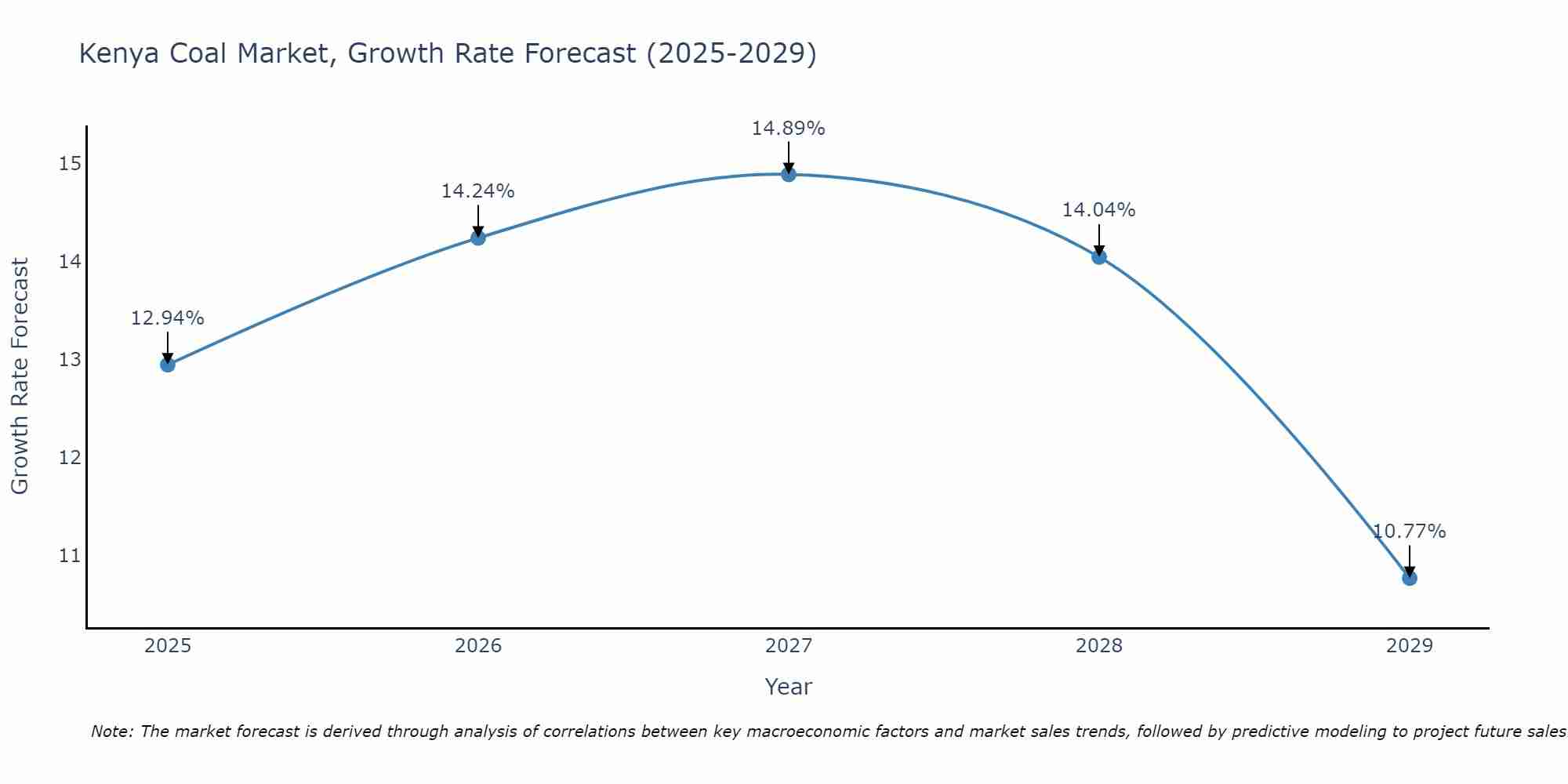
The Kenya Coal Market is projected to witness mixed growth rate patterns during 2025 to 2029. Starting at 12.94% in 2025, the market peaks at 14.89% in 2027, and settles at 10.77% by 2029.
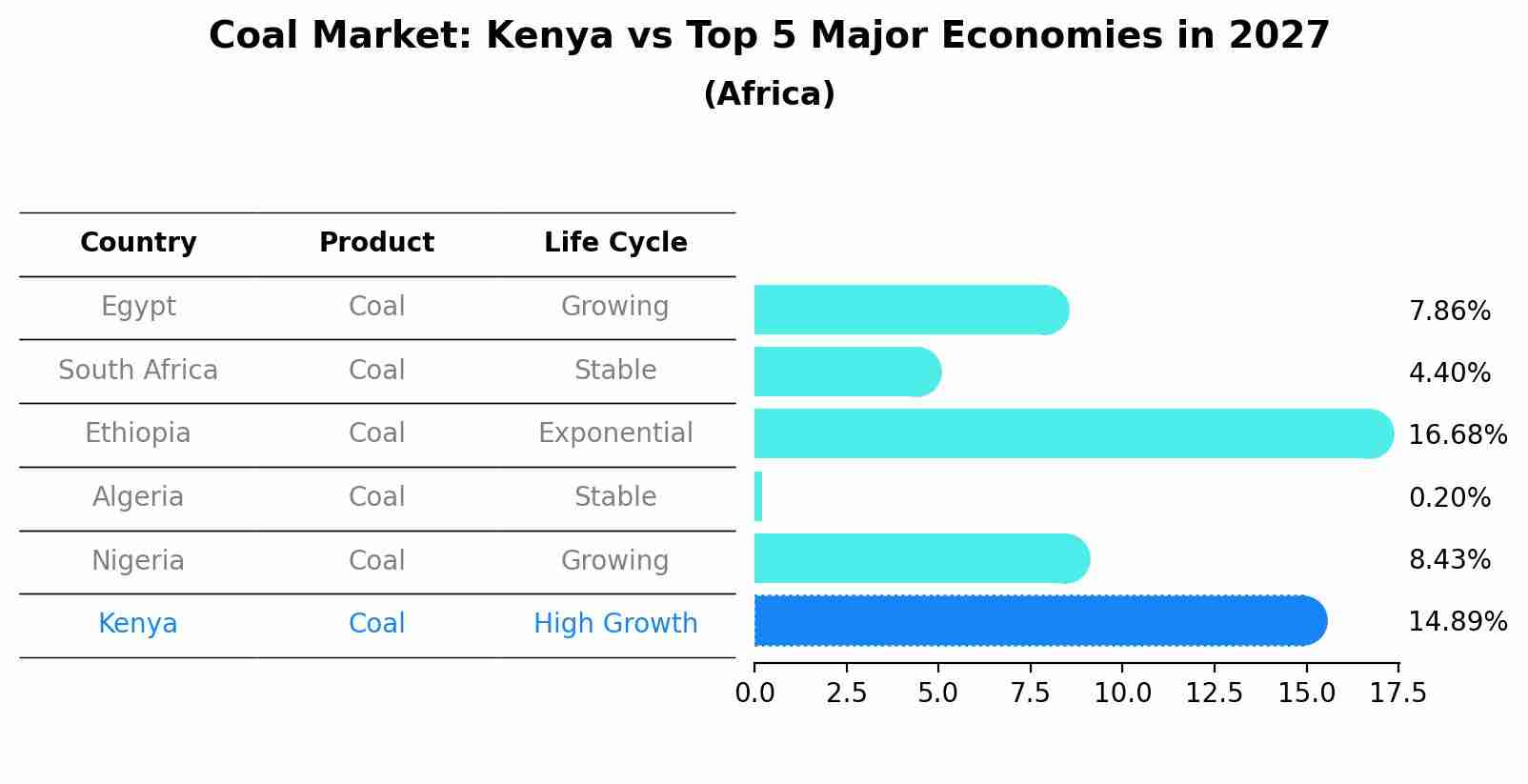
Coal Market: Kenya vs Top 5 Major Economies in 2027 (Africa)
By 2027, the Coal market in Kenya is anticipated to reach a growth rate of 14.89%, as part of an increasingly competitive Africa region, where Egypt remains at the forefront, supported by South Africa, Ethiopia, Algeria and Nigeria, driving innovations and market adoption across sectors.
Kenya Coal Market Overview
The Kenya Coal Market is undergoing significant shifts as the country seeks to balance its energy needs with environmental concerns. While coal has historically been a primary source of energy, there`s a growing emphasis on renewable energy sources and cleaner alternatives. The market is witnessing transitions in regulations, investment patterns, and energy policies to align with global sustainability goals.
Drivers of the market
The Kenya coal market is witnessing growth driven by factors such as the country`s energy needs, industrial development, and the presence of coal reserves. Coal remains a significant source of energy for power generation, industrial processes, and heating applications in Kenya. The market expansion is fueled by factors such as the growth of the manufacturing sector, the need for reliable and affordable energy sources, and government initiatives to develop coal resources and infrastructure.
Challenges of the market
Kenya coal market faces challenges related to environmental regulations and the global shift towards renewable energy sources. Infrastructure limitations for coal transportation and logistics also impact market dynamics.
Government Policy of the market
The Kenya government has policies aimed at promoting the sustainable development and utilization of coal resources in the country. Regulations may include licensing requirements for coal mining operations, environmental impact assessments, and measures to address social and environmental concerns associated with coal extraction and use. Additionally, there may be initiatives to encourage investment in clean coal technologies and diversification of the energy mix to reduce reliance on coal.
Key Highlights of the Report:
- Kenya Coal Market Outlook
- Market Size of Kenya Coal Market, 2019
- Forecast of Kenya Coal Market, 2026
- Historical Data and Forecast of Kenya Coal Revenues & Volume for the Period 2016 - 2026
- Kenya Coal Market Trend Evolution
- Kenya Coal Market Drivers and Challenges
- Kenya Coal Price Trends
- Kenya Coal Porter's Five Forces
- Kenya Coal Industry Life Cycle
- Historical Data and Forecast of Kenya Coal Market Revenues & Volume By Types for the Period 2016 - 2026
- Historical Data and Forecast of Kenya Coal Market Revenues & Volume By Bituminous Coal for the Period 2016 - 2026
- Historical Data and Forecast of Kenya Coal Market Revenues & Volume By Sub-Bituminous Coal for the Period 2016 - 2026
- Historical Data and Forecast of Kenya Coal Market Revenues & Volume By Anthracite for the Period 2016 - 2026
- Historical Data and Forecast of Kenya Coal Market Revenues & Volume By Lignite for the Period 2016 - 2026
- Historical Data and Forecast of Kenya Coal Market Revenues & Volume By End-Users for the Period 2016 - 2026
- Historical Data and Forecast of Kenya Coal Market Revenues & Volume By Electricity for the Period 2016 - 2026
- Historical Data and Forecast of Kenya Coal Market Revenues & Volume By Steel for the Period 2016 - 2026
- Historical Data and Forecast of Kenya Coal Market Revenues & Volume By Cement for the Period 2016 - 2026
- Historical Data and Forecast of Kenya Coal Market Revenues & Volume By Others for the Period 2016 - 2026
- Kenya Coal Import Export Trade Statistics
- Market Opportunity Assessment By Types
- Market Opportunity Assessment By End-Users
- Kenya Coal Top Companies Market Share
- Kenya Coal Competitive Benchmarking By Technical and Operational Parameters
- Kenya Coal Company Profiles
- Kenya Coal Key Strategic Recommendations






































