Kenya Cobalt Market Size Growth Rate
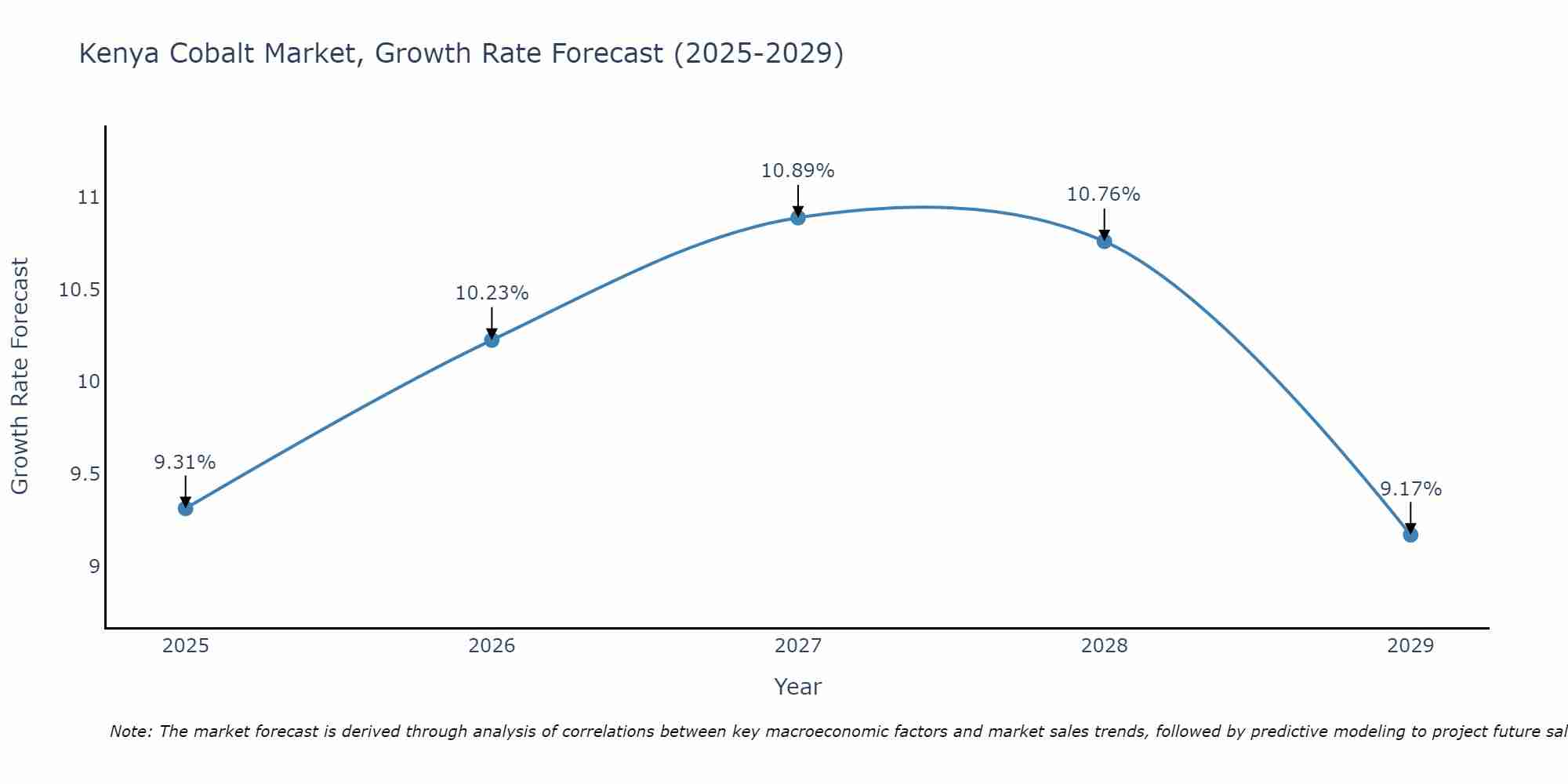
The Kenya Cobalt Market is projected to witness mixed growth rate patterns during 2025 to 2029. Growth accelerates to 10.89% in 2027, following an initial rate of 9.31%, before easing to 9.17% at the end of the period.
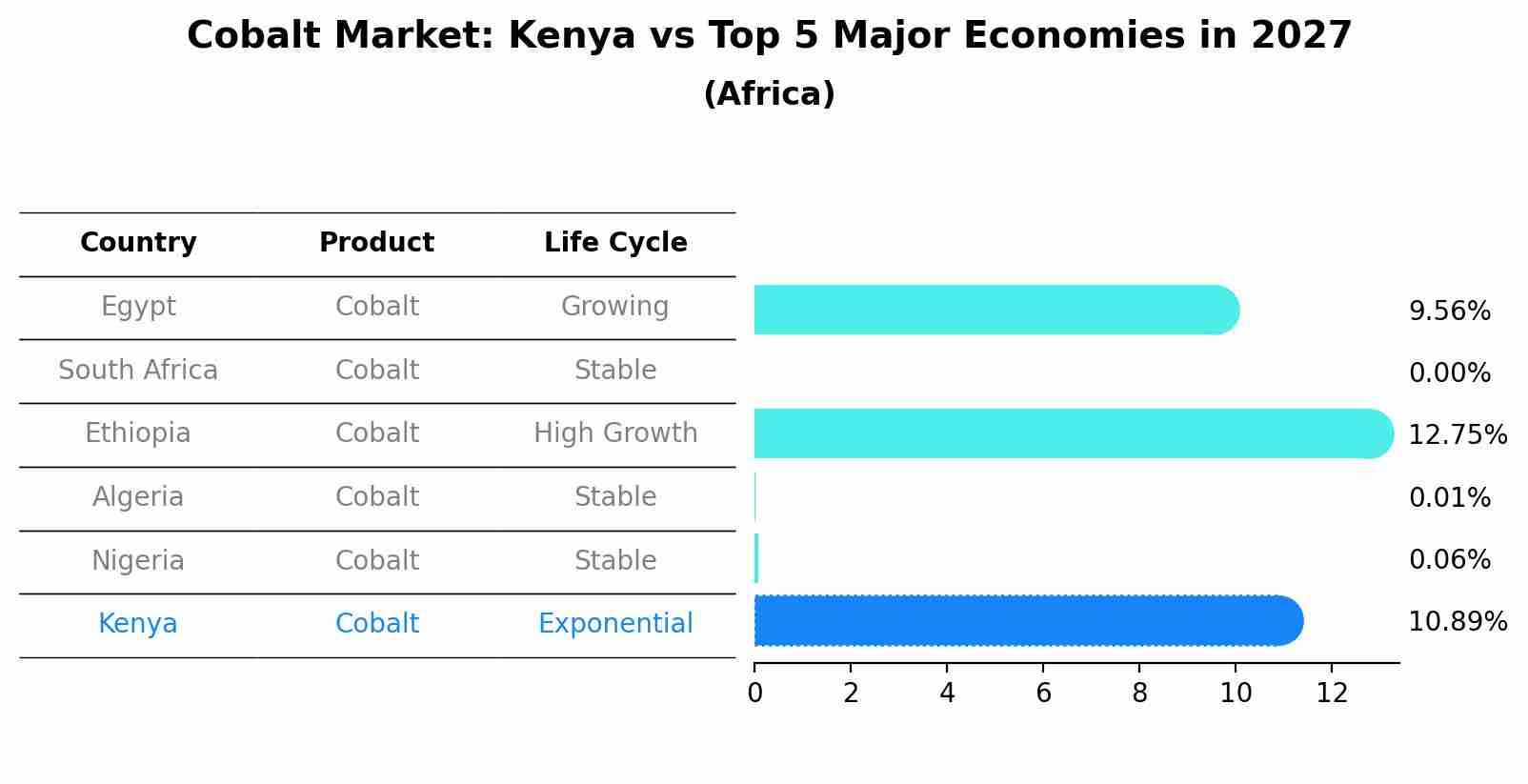
Cobalt Market: Kenya vs Top 5 Major Economies in 2027 (Africa)
By 2027, Kenya's Cobalt market is forecasted to achieve a high growth rate of 10.89%, with Egypt leading the Africa region, followed by South Africa, Ethiopia, Algeria and Nigeria.
Kenya Cobalt Market Overview
The Kenya Cobalt Market plays a critical role in global supply chains, with cobalt being an essential component in rechargeable batteries for electric vehicles, electronics, and energy storage systems. Kenya cobalt reserves contribute to the global cobalt supply, although the market is influenced by geopolitical factors, supply chain transparency, and ethical sourcing concerns. Market dynamics are intertwined with developments in battery technologies, recycling initiatives, and sustainability standards.
Drivers of the market
In Kenya, the cobalt market is experiencing growth propelled by the demand for cobalt-based alloys, chemicals, and battery materials in various industries such as aerospace, automotive, and electronics. Cobalt, a critical metal with properties such as hardness, corrosion resistance, and magnetic conductivity, finds applications in superalloys, magnetic materials, and rechargeable batteries. The market expansion is driven by factors such as the growth of electric vehicle (EV) manufacturing, the adoption of renewable energy storage solutions, and the increasing demand for cobalt in aerospace and defense applications.
Challenges of the market
Kenya cobalt market faces challenges related to geopolitical instability in cobalt-producing regions and fluctuating demand from industries such as electronics and batteries. Additionally, environmental concerns surrounding cobalt mining impact market dynamics.
Government Policy of the market
The Kenya government may implement policies to regulate the cobalt market, including licensing requirements for cobalt exploration and mining activities, environmental regulations, and export controls. Additionally, there may be initiatives to promote value addition in the cobalt supply chain, support local processing and manufacturing industries, and attract investment in cobalt-related infrastructure.
Key Highlights of the Report:
- Kenya Cobalt Market Outlook
- Market Size of Kenya Cobalt Market, 2024
- Forecast of Kenya Cobalt Market, 2031
- Historical Data and Forecast of Kenya Cobalt Revenues & Volume for the Period 2021-2031
- Kenya Cobalt Market Trend Evolution
- Kenya Cobalt Market Drivers and Challenges
- Kenya Cobalt Price Trends
- Kenya Cobalt Porter's Five Forces
- Kenya Cobalt Industry Life Cycle
- Historical Data and Forecast of Kenya Cobalt Market Revenues & Volume By Form for the Period 2021-2031
- Historical Data and Forecast of Kenya Cobalt Market Revenues & Volume By Chemical Compound for the Period 2021-2031
- Historical Data and Forecast of Kenya Cobalt Market Revenues & Volume By Metal for the Period 2021-2031
- Historical Data and Forecast of Kenya Cobalt Market Revenues & Volume By Purchased Scrap for the Period 2021-2031
- Historical Data and Forecast of Kenya Cobalt Market Revenues & Volume By Application for the Period 2021-2031
- Historical Data and Forecast of Kenya Cobalt Market Revenues & Volume By Battery Chemicals for the Period 2021-2031
- Historical Data and Forecast of Kenya Cobalt Market Revenues & Volume By Super Alloy for the Period 2021-2031
- Historical Data and Forecast of Kenya Cobalt Market Revenues & Volume By Ceramic & Pigments for the Period 2021-2031
- Historical Data and Forecast of Kenya Cobalt Market Revenues & Volume By Hard Metals for the Period 2021-2031
- Historical Data and Forecast of Kenya Cobalt Market Revenues & Volume By Magnets for the Period 2021-2031
- Historical Data and Forecast of Kenya Cobalt Market Revenues & Volume By Life Science for the Period 2021-2031
- Historical Data and Forecast of Kenya Cobalt Market Revenues & Volume By Binder Material for the Period 2021-2031
- Historical Data and Forecast of Kenya Cobalt Market Revenues & Volume By End-Users for the Period 2021-2031
- Historical Data and Forecast of Kenya Cobalt Market Revenues & Volume By Electronics for the Period 2021-2031
- Historical Data and Forecast of Kenya Cobalt Market Revenues & Volume By Automotive for the Period 2021-2031
- Historical Data and Forecast of Kenya Cobalt Market Revenues & Volume By Aerospace for the Period 2021-2031
- Historical Data and Forecast of Kenya Cobalt Market Revenues & Volume By Medical for the Period 2021-2031
- Kenya Cobalt Import Export Trade Statistics
- Market Opportunity Assessment By Form
- Market Opportunity Assessment By Application
- Market Opportunity Assessment By End-Users
- Kenya Cobalt Top Companies Market Share
- Kenya Cobalt Competitive Benchmarking By Technical and Operational Parameters
- Kenya Cobalt Company Profiles
- Kenya Cobalt Key Strategic Recommendations






































