Kenya Disposable Razor Blades Market Size, Share & Growth Rate
The Kenya Disposable Razor Blades Market was estimated at USD 458 Million in 2025 and is projected to reach USD 617 Million by 2032, growing at a CAGR of 4.3% from 2026 to 2032. This growth trajectory is driven primarily by the rising urbanization in Kenya, which enhances access to grooming products. Furthermore, as disposable incomes increase, more consumers are willing to invest in personal care, propelling the demand for high-quality disposable razors.
Kenya Disposable Razor Blades Market Year-wise Growth Rate and Key Drivers
This graph highlights how the Kenya Disposable Razor Blades Market has steadily grown over the years, supported by major growth factors.
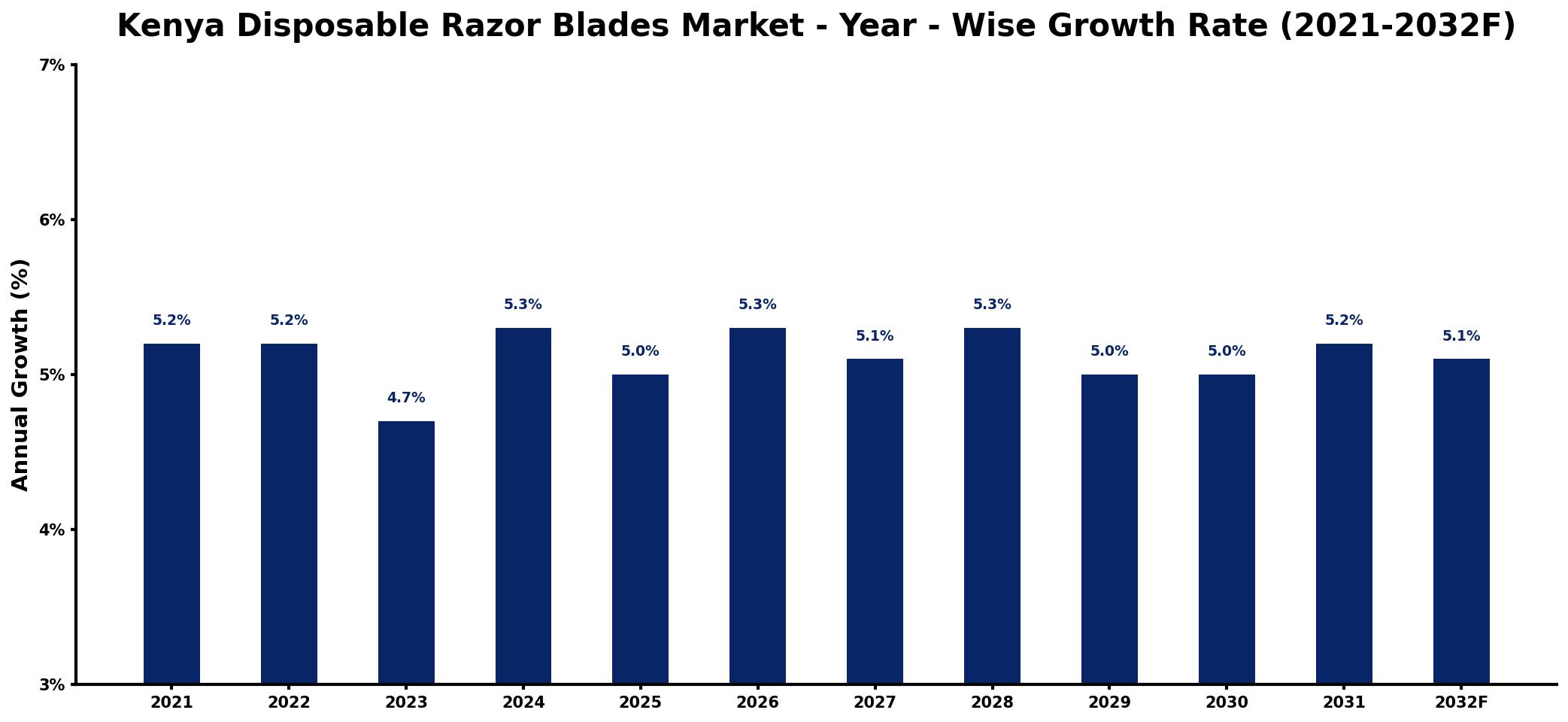
The table below presents the year‑wise growth rates along with the key drivers influencing the market
| Year | Growth Rate | Major Drivers |
| 2021 | 5.2% | Rising grooming standards among consumers |
| 2022 | 5.2% | Increased urban population growth |
| 2023 | 4.7% | Growth in personal care spending |
| 2024 | 5.3% | Expansion of retail distribution channels |
| 2025 | 5.0% | expanding healthcare application demand |
| 2026 | 5.3% | Surge in online shopping preferences |
| 2027 | 5.1% | Emergence of eco-friendly alternatives |
| 2028 | 5.3% | Strengthening consumer health consciousness |
| 2029 | 5.0% | Boost in male grooming trends |
| 2030 | 5.0% | Growing influence of social media |
| 2031 | 5.2% | growing commercial sector adoption |
| 2032 | 5.1% | Increased demand for convenience products |
Note: Market size estimations and growth projections presented in this report are based on 6Wresearch's proprietary forecasting methodology, utilizing the latest available industry data, government publications, and primary research inputs.
Kenya Disposable Razor Blades Market Synopsis
A significant force shaping the Kenya Disposable Razor Blades Market is the growing emphasis on personal grooming and hygiene, particularly among younger demographics. As awareness of grooming trends heightens, the demand for effective and affordable shaving solutions continues to escalate.
In addition to this demand, an increasing preference for sustainable products is influencing consumer choices. As environmentally conscious practices gain traction, more consumers are gravitating toward disposable razors made from recyclable materials, pushing brands to innovate and adapt to these evolving preferences.
Kenya Disposable Razor Blades Market Key Takeaways
- The market is projected to grow from USD 458 Million in 2025 to USD 617 Million by 2032.
- Urbanization and rising disposable incomes are key drivers of market growth.
- There is a growing demand for environmentally friendly disposable razor options.
- Innovations, such as multi-blade designs and ergonomic features, are crucial for attracting consumers.
- The rise of e-commerce is enhancing the accessibility of razor products across various demographics.
Evaluation of Restraints in Kenya Disposable Razor Blades Market
Despite the market's growth potential, several restraints impede its progress. Intense competition from established brands creates pricing pressures, making it challenging for newcomers to penetrate the market. Additionally, the prevalence of counterfeit products undermines consumer trust, impacting brand loyalty. With consumers being highly price-sensitive, brands must continually innovate while maintaining competitive pricing to thrive in this landscape.
Kenya Disposable Razor Blades Market Trends
Current trends in the Kenya Disposable Razor Blades Market indicate a pronounced shift towards sustainable products. Many consumers now prioritize razors made from biodegradable or recyclable materials, reflecting a growing awareness of environmental issues. In tandem with this, brands are responding by introducing innovative designs and enhanced features—such as lubricating strips and multi-blade systems—that promise a superior shaving experience. Additionally, the surge in online shopping is revolutionizing how consumers acquire grooming products, making them more accessible than ever.
Kenya Disposable Razor Blades Market Opportunities
The Kenya Disposable Razor Blades Market presents substantial opportunities for growth, especially with the nation's burgeoning population and increasing urbanization. Brands that align their offerings with the demands of a youthful consumer base are likely to flourish. There is significant potential in investing in sustainable product lines, capturing the environmentally conscious segment of the market. Furthermore, leveraging online retail channels can enhance market penetration and accessibility, catering to consumers seeking convenience.
Government Initiatives in the Kenya Disposable Razor Blades Market
The Kenyan government plays a critical role in regulating the disposable razor blades market through the Kenya Bureau of Standards (KEBS). This regulatory body ensures that quality and safety standards are upheld for consumer protection. Additionally, the government encourages local manufacturing by offering various incentives, thereby enhancing domestic production capabilities and reducing dependence on imported products. Such initiatives foster a more competitive landscape while ensuring consumer safety.
Future Insights of the Kenya Disposable Razor Blades Market
Looking ahead to 2026-2032, the Kenya Disposable Razor Blades Market is poised for steady growth. With increasing urbanization and shifting consumer preferences towards personal grooming, the demand for disposable razors is expected to strengthen. E-commerce will continue to expand, offering consumers easy access to a diverse range of products, while manufacturers are likely to prioritize sustainability and innovation to align with evolving consumer values. This favorable outlook underscores the market's potential for both local and international brands.
Kenya Disposable Razor Blades Market Latest Developments (2025 - 2026)
Recent trends in the industry highlight a growing focus on sustainability, with several brands introducing environmentally friendly disposable razor options. Additionally, the rise of e-commerce platforms has led to enhanced distribution strategies, making grooming products more accessible to consumers across various regions. Innovations in product design aimed at improving user experience are also becoming more prevalent, reflecting the market's adaptive nature in response to consumer demand.
Kenya Disposable Razor Blades Market - Key Attractiveness of the Report
- 10 Years of Market Numbers
- Historical Data Starting from 2022 to 2025
- Base Year: 2025
- Forecast Data until 2032
- Key Performance Indicators Impacting the Market
- Major Upcoming Developments and Projects
Key Highlights of the Report:
- Kenya Disposable Razor Blades Market Outlook
- Market Size of Kenya Disposable Razor Blades Market, 2025
- Forecast of Kenya Disposable Razor Blades Market, 2032
- Historical Data and Forecast of Kenya Disposable Razor Blades Revenues & Volume for the Period 2022-2032F
- Kenya Disposable Razor Blades Market Trend Evolution
- Kenya Disposable Razor Blades Market Drivers and Challenges
- Kenya Disposable Razor Blades Price Trends
- Kenya Disposable Razor Blades Porter's Five Forces
- Kenya Disposable Razor Blades Industry Life Cycle
- Historical Data and Forecast of Kenya Disposable Razor Blades Market Revenues & Volume By Blade Count for the Period 2022-2032F
- Historical Data and Forecast of Kenya Disposable Razor Blades Market Revenues & Volume By 1 & 2 Blades for the Period 2022-2032F
- Historical Data and Forecast of Kenya Disposable Razor Blades Market Revenues & Volume By 3 & 4 Blades for the Period 2022-2032F
- Historical Data and Forecast of Kenya Disposable Razor Blades Market Revenues & Volume By 5 & More Blades for the Period 2022-2032F
- Historical Data and Forecast of Kenya Disposable Razor Blades Market Revenues & Volume By End-user for the Period 2022-2032F
- Historical Data and Forecast of Kenya Disposable Razor Blades Market Revenues & Volume By Men for the Period 2022-2032F
- Historical Data and Forecast of Kenya Disposable Razor Blades Market Revenues & Volume By Women for the Period 2022-2032F
- Historical Data and Forecast of Kenya Disposable Razor Blades Market Revenues & Volume By Distribution Channel for the Period 2022-2032F
- Historical Data and Forecast of Kenya Disposable Razor Blades Market Revenues & Volume By Hypermarkets/Supermarkets for the Period 2022-2032F
- Historical Data and Forecast of Kenya Disposable Razor Blades Market Revenues & Volume By Pharmacies for the Period 2022-2032F
- Historical Data and Forecast of Kenya Disposable Razor Blades Market Revenues & Volume By Online for the Period 2022-2032F
- Historical Data and Forecast of Kenya Disposable Razor Blades Market Revenues & Volume By Others for the Period 2022-2032F
- Kenya Disposable Razor Blades Import Export Trade Statistics
- Market Opportunity Assessment By Blade Count
- Market Opportunity Assessment By End-user
- Market Opportunity Assessment By Distribution Channel
- Kenya Disposable Razor Blades Top Companies Market Share
- Kenya Disposable Razor Blades Competitive Benchmarking By Technical and Operational Parameters
- Kenya Disposable Razor Blades Company Profiles
- Kenya Disposable Razor Blades Key Strategic Recommendations






































