Kenya Electric Hair Clipper & Trimmer Market Size, Share & Growth Rate
The Kenya Electric Hair Clipper & Trimmer Market was estimated at USD 423 Million in 2025 and is projected to reach USD 778 Million by 2032, growing at a CAGR of 9.1% from 2026 to 2032. This robust growth is primarily driven by rising disposable incomes among consumers, a burgeoning urban population, and an increasing emphasis on personal grooming. As more individuals prioritize self-care and grooming routines, the demand for electric hair clippers and trimmers is expected to expand significantly.
Kenya Electric Hair Clipper & Trimmer Market Year-wise Growth Rate and Key Drivers
This graph highlights how the Kenya Electric Hair Clipper & Trimmer Market has steadily grown over the years, supported by major growth factors.
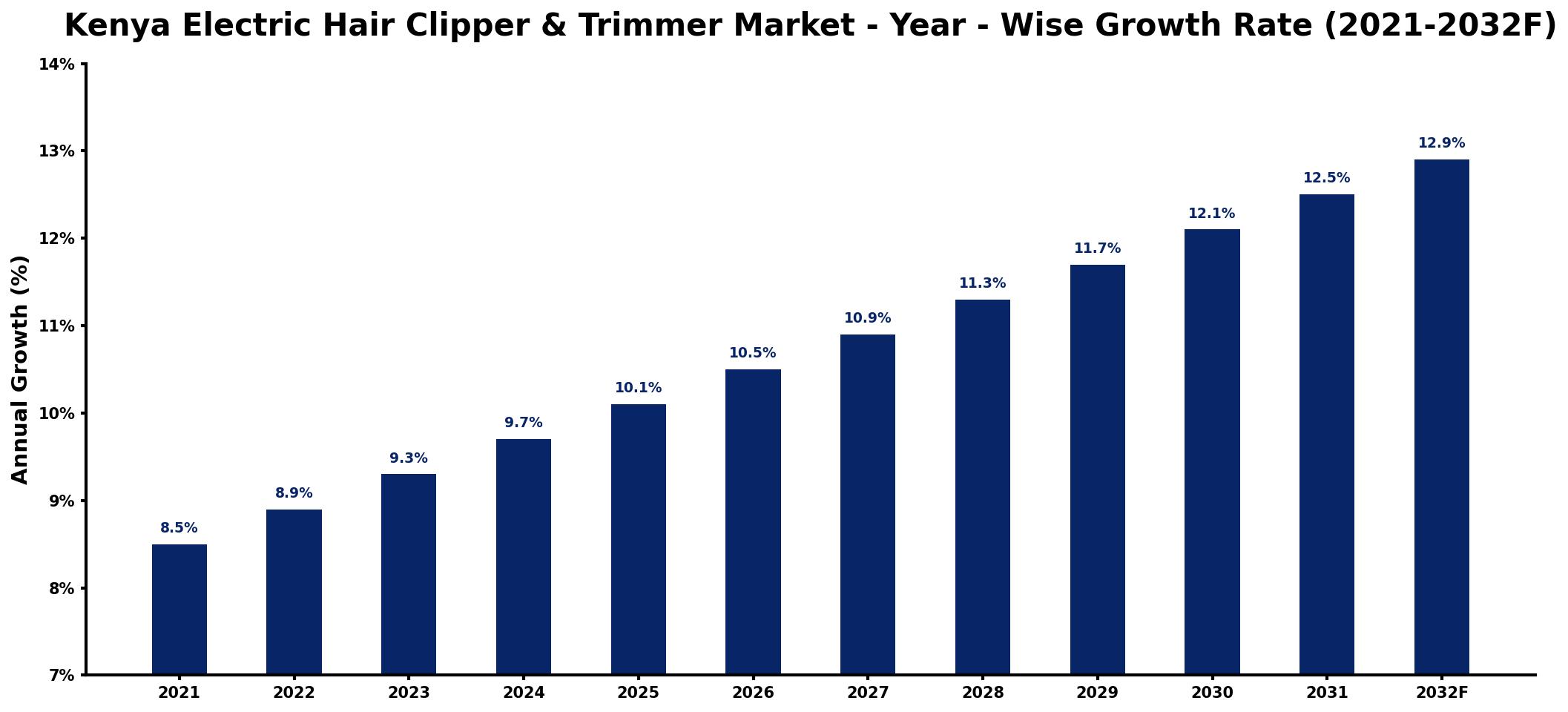
The table below presents the year‑wise growth rates along with the key drivers influencing the market
| Year | Growth Rate | Major Drivers |
| 2021 | 8.5% | Rising demand for grooming tools |
| 2022 | 8.9% | Increased consumer spending trends |
| 2023 | 9.3% | Growth in online retail sales |
| 2024 | 9.7% | Expansion of beauty salons industry |
| 2025 | 10.1% | Higher disposable income levels |
| 2026 | 10.5% | Emergence of new brands |
| 2027 | 10.9% | Advancements in grooming technologies |
| 2028 | 11.3% | Growing influence of social media |
| 2029 | 11.7% | Shift towards home grooming solutions |
| 2030 | 12.1% | Rise in male grooming awareness |
| 2031 | 12.5% | Increased urbanization and lifestyle changes |
| 2032 | 12.9% | rising export shipment volumes |
Note: Market size estimations and growth projections presented in this report are based on 6Wresearch's proprietary forecasting methodology, utilizing the latest available industry data, government publications, and primary research inputs.
Kenya Electric Hair Clipper & Trimmer Market Synopsis
One of the most notable trends in the Kenya Electric Hair Clipper & Trimmer Market is the shift towards home grooming solutions, particularly as consumers seek convenience and cost-effectiveness. With the availability of a diverse range of products from local and international brands, consumers are now able to find clippers and trimmers that align with their specific grooming needs and budget.
Furthermore, the rise of e-commerce platforms has revolutionized product accessibility, allowing consumers to conveniently purchase grooming tools from the comfort of their homes. This, coupled with a growing awareness about the benefits of electric grooming devices, is fueling significant demand in the market.
- The market is currently valued at USD 423 Million and is expected to reach USD 778 Million by 2032.
- A growing urban population and increasing disposable incomes are key drivers of market growth.
- Home grooming has gained popularity, influencing consumer preferences towards electric clippers and trimmers.
- Advancements in technology are enabling the introduction of innovative features in grooming products.
- The rise of e-commerce platforms is enhancing accessibility and convenience for consumers.
Despite the promising growth trajectory, several factors pose challenges to the Kenya Electric Hair Clipper & Trimmer Market. Intense competition among local and international brands has led to price wars, squeezing profit margins and impacting overall market dynamics. The prevalence of counterfeit products remains a significant concern, as it not only undermines the reputation of legitimate brands but also threatens consumer safety. Furthermore, inconsistent power supply in certain regions can affect the performance and durability of electric grooming tools. Efforts to elevate consumer awareness regarding the benefits of electric grooming devices compared to traditional manual tools are also crucial to stimulate market growth.
The market is witnessing a notable shift towards cordless and rechargeable models, which enhance user convenience and flexibility during grooming sessions. Additionally, there is an increasing preference for multi-functional devices that allow for various cutting lengths and styling options. As a result, brands are prioritizing product innovation, focusing on features such as precision blades, ergonomic designs, and waterproof capabilities to better meet the evolving demands of consumers.
The electric hair clipper and trimmer market in Kenya is ripe with opportunities for investment. As personal grooming trends continue to rise among both men and women, high-quality electric grooming tools are in great demand. Investors could explore avenues in manufacturing or distribution, as well as collaborate with local salons and barbershops to introduce their products. Additionally, there exists significant potential for innovation, particularly in developing products tailored to the specific needs of Kenyan consumers, which could lead to substantial market penetration.
The Kenyan government has enacted policies aimed at ensuring consumer safety and enforcing quality standards within the Electric Hair Clipper & Trimmer Market. The Kenya Bureau of Standards (KEBS) regulates the importation and sale of electrical appliances, requiring manufacturers to comply with safety and quality benchmarks. Moreover, to support local production, the government imposes tariffs and taxes on imported grooming products, which underscores the importance of maintaining a competitive domestic market.
Looking ahead, the future of the Kenya Electric Hair Clipper & Trimmer Market appears promising. As disposable incomes rise and grooming habits evolve, there will likely be a sustained demand for electric grooming tools, particularly those that are designed with advanced technology. With increasing emphasis on hygiene and self-care, alongside ongoing product innovations, companies that effectively align their offerings with consumer preferences stand to benefit immensely in this dynamic landscape.
Recent industry developments have indicated a strong shift towards enhancing product accessibility and consumer education. Companies are launching targeted marketing campaigns to raise awareness about the advantages of electric grooming tools. Furthermore, various brands are expanding their product lines to include innovative features that cater to the specific grooming needs of diverse consumer segments, driving competition in the market.
- 10 Years of Market Numbers
- Historical Data Starting from 2022 to 2025
- Base Year: 2025
- Forecast Data until 2032
- Key Performance Indicators Impacting the Market
- Major Upcoming Developments and Projects
Key Highlights of the Report:
- Kenya Electric Hair Clipper & Trimmer Market Outlook
- Market Size of Kenya Electric Hair Clipper & Trimmer Market, 2025
- Forecast of Kenya Electric Hair Clipper & Trimmer Market, 2032
- Historical Data and Forecast of Kenya Electric Hair Clipper & Trimmer Revenues & Volume for the Period 2022-2032F
- Kenya Electric Hair Clipper & Trimmer Market Trend Evolution
- Kenya Electric Hair Clipper & Trimmer Market Drivers and Challenges
- Kenya Electric Hair Clipper & Trimmer Price Trends
- Kenya Electric Hair Clipper & Trimmer Porter's Five Forces
- Kenya Electric Hair Clipper & Trimmer Industry Life Cycle
- Historical Data and Forecast of Kenya Electric Hair Clipper & Trimmer Market Revenues & Volume By Product for the Period 2022-2032F
- Historical Data and Forecast of Kenya Electric Hair Clipper & Trimmer Market Revenues & Volume By Corded for the Period 2022-2032F
- Historical Data and Forecast of Kenya Electric Hair Clipper & Trimmer Market Revenues & Volume By Cordless for the Period 2022-2032F
- Historical Data and Forecast of Kenya Electric Hair Clipper & Trimmer Market Revenues & Volume By Distribution Channel for the Period 2022-2032F
- Historical Data and Forecast of Kenya Electric Hair Clipper & Trimmer Market Revenues & Volume By Offline for the Period 2022-2032F
- Historical Data and Forecast of Kenya Electric Hair Clipper & Trimmer Market Revenues & Volume By Online for the Period 2022-2032F
- Kenya Electric Hair Clipper & Trimmer Import Export Trade Statistics
- Market Opportunity Assessment By Product
- Market Opportunity Assessment By Distribution Channel
- Kenya Electric Hair Clipper & Trimmer Top Companies Market Share
- Kenya Electric Hair Clipper & Trimmer Competitive Benchmarking By Technical and Operational Parameters
- Kenya Electric Hair Clipper & Trimmer Company Profiles
- Kenya Electric Hair Clipper & Trimmer Key Strategic Recommendations






































