Kenya Engineered Wood Market Size, Share & Growth Rate
The Kenya Engineered Wood Market was estimated at USD 210 Million in 2025 and is projected to reach USD 285 Million by 2032, growing at a CAGR of 4.5% from 2026 to 2032. This growth trajectory is primarily driven by the rising demand for sustainable construction materials, accelerated urbanization, and robust investments in various construction projects across the nation. As the construction sector continues to expand, engineered wood products are emerging as a preferred alternative due to their impressive durability and cost-effectiveness.
Kenya Engineered Wood Market Year-wise Growth Rate and Key Drivers
This graph highlights how the Kenya Engineered Wood Market has steadily grown over the years, supported by major growth factors.
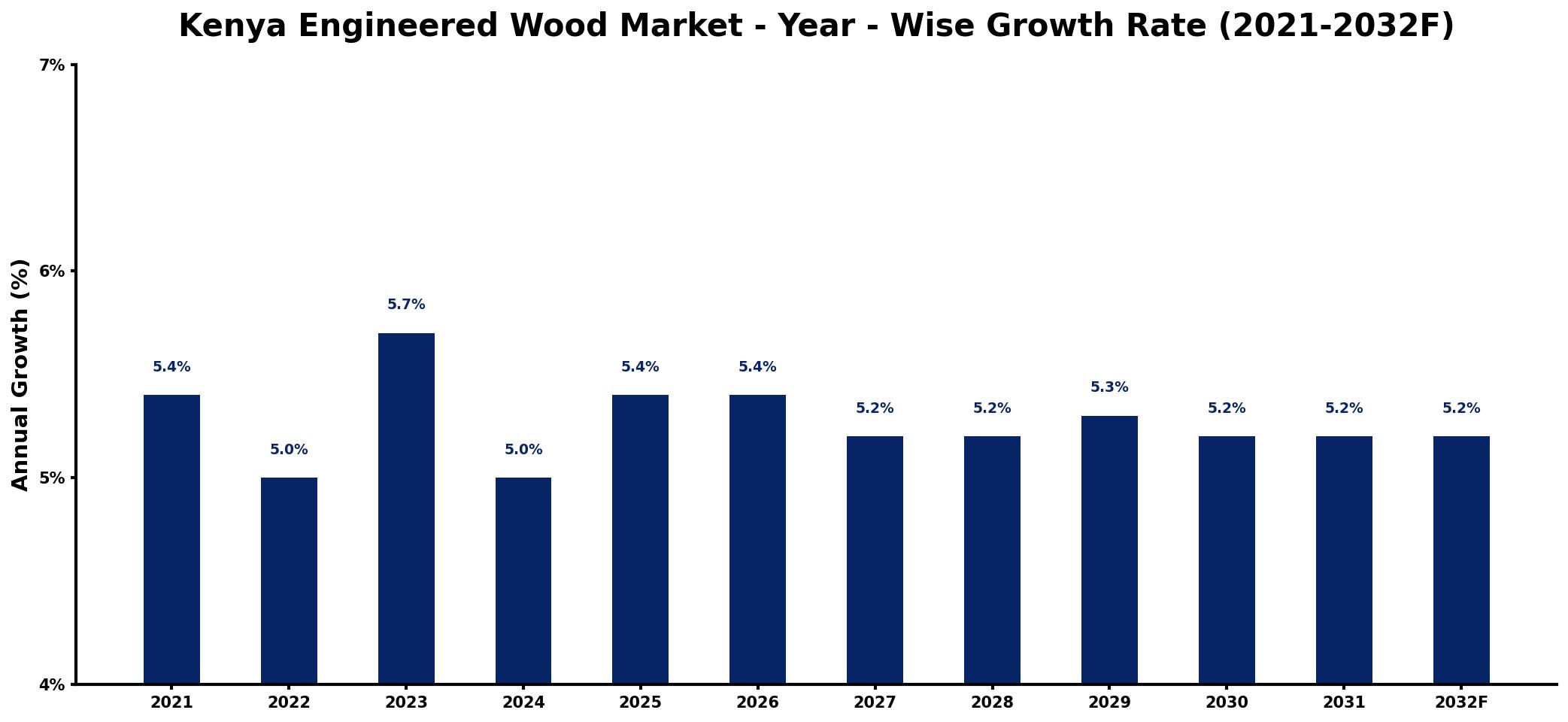
The table below presents the year‑wise growth rates along with the key drivers influencing the market
| Year | Growth Rate | Major Drivers |
| 2021 | 5.4% | Rising construction sector investments |
| 2022 | 5.0% | Increased demand for sustainable materials |
| 2023 | 5.7% | Growth in urban housing projects |
| 2024 | 5.0% | Expansion of furniture manufacturing industry |
| 2025 | 5.4% | Surge in interior design trends |
| 2026 | 5.4% | Boost in renovation and remodeling |
| 2027 | 5.2% | Emerging market for eco-friendly solutions |
| 2028 | 5.2% | Growing popularity of DIY projects |
| 2029 | 5.3% | Increase in commercial construction activities |
| 2030 | 5.2% | Rise in government infrastructure initiatives |
| 2031 | 5.2% | Strengthening export market opportunities |
| 2032 | 5.2% | Enhanced technological advancements adoption |
Note: Market size estimations and growth projections presented in this report are based on 6Wresearch's proprietary forecasting methodology, utilizing the latest available industry data, government publications, and primary research inputs.
Kenya Engineered Wood Market Synopsis
The strongest force currently shaping the Kenya Engineered Wood Market is the increasing shift towards sustainable and eco-friendly construction practices. As urbanization accelerates, the demand for versatile building materials like plywood, MDF, and laminated veneer lumber is soaring, reflecting a broader trend towards environmentally responsible construction.
With growing awareness of the benefits associated with engineered wood products, consumers and builders alike are gravitating towards these materials for both residential and commercial applications. The market is bolstered by innovations in product offerings that enhance aesthetic appeal, contributing significantly to its acceptance in interior design and furniture manufacturing.
Kenya Engineered Wood Market Key Takeaways
- The market is propelled by urbanization and increased demand for sustainable building materials.
- Engineered wood products provide superior strength, durability, and cost-effectiveness.
- Growing awareness and acceptance are shifting consumer preferences towards engineered wood.
- Government policies are promoting the use of engineered wood as an alternative to traditional timber.
- Investment opportunities abound in manufacturing and distribution networks focused on engineered wood.
Evaluation of Restraints in Kenya Engineered Wood Market
Despite its promising growth, the Kenya Engineered Wood Market faces several challenges that may impede its potential. A key restraint is the limited consumer awareness regarding the advantages of engineered wood over traditional solid wood. Many builders and homeowners still favor solid wood products due to familiarity and perceived quality. Furthermore, the high cost of importing raw materials needed for engineered wood production presents a financial barrier for local manufacturers. Infrastructure inadequacies and supply chain inconsistencies also hinder efficient market growth. Additionally, competition from alternative building materials and the prevalence of counterfeit products threaten the reputation of authentic engineered wood products, making it crucial for manufacturers to enhance quality assurance measures.
Kenya Engineered Wood Market Trends
Several trends are currently influencing the Kenya Engineered Wood Market. A prominent trend is the growing preference for environmentally friendly building materials among consumers, driving up demand for products with lower ecological footprints. Additionally, the versatility of engineered wood products is leading to their increased utilization in various applications, including furniture design, flooring, and interior fittings. Innovations in engineered wood technology are further enhancing product performance, expanding their appeal. As the construction sector matures, there is a notable shift towards adopting advanced building practices, and engineered wood is at the forefront of this evolution.
Kenya Engineered Wood Market Opportunities
The Kenya Engineered Wood Market presents substantial investment opportunities, particularly in the context of the booming construction industry. As urban areas expand and infrastructure projects increase, there is a growing need for high-quality engineered wood products. Investors can explore opportunities in manufacturing facilities that produce engineered wood, distribution networks that ensure product availability, and retail outlets specializing in these materials. Additionally, the rising emphasis on sustainability creates a favorable environment for businesses that align with eco-friendly practices and contribute to Kenya's development goals.
Government Initiatives in the Kenya Engineered Wood Market
The Kenyan government has enacted several initiatives to bolster the engineered wood market, aiming to promote sustainability and reduce dependence on traditional timber sources. A notable policy includes the restriction on logging indigenous trees, which drives demand for engineered wood as a viable alternative. Additionally, the government offers various incentives, such as tax breaks and subsidies, to manufacturers and businesses that engage in the production and utilization of engineered wood products. Regulations ensuring quality standards and safety measures further support the market's growth and credibility.
Future Insights of the Kenya Engineered Wood Market
Looking ahead to 2026-2032, the Kenya Engineered Wood Market is expected to sustain its upward trajectory. As disposable incomes rise and construction practices evolve towards more sustainable methodologies, demand for engineered wood products is anticipated to increase significantly. The alignment of government policies with environmental sustainability will further boost market growth. Additionally, enhanced consumer awareness about the benefits of engineered wood will likely contribute to its acceptance as a preferred construction material, ensuring a promising outlook for both local and international players in the sector.
Kenya Engineered Wood Market Latest Developments (2025 - 2026)
In recent months, the Kenya Engineered Wood Market has witnessed a series of strategic developments aimed at enhancing product accessibility and market penetration. Initiatives focused on increasing local production capabilities are underway, addressing the challenges posed by raw material imports. Furthermore, collaborative efforts between manufacturers and government bodies are intensifying, promoting awareness and education about the advantages of engineered wood products. Innovations in design and technology are also being explored, positioning engineered wood as a leading choice for modern construction practices.
Kenya Engineered Wood Market - Key Attractiveness of the Report
- 10 Years of Market Numbers
- Historical Data Starting from 2022 to 2025
- Base Year: 2025
- Forecast Data until 2032
- Key Performance Indicators Impacting the Market
- Major Upcoming Developments and Projects
Key Highlights of the Report:
- Kenya Engineered Wood Market Outlook
- Market Size of Kenya Engineered Wood Market, 2025
- Forecast of Kenya Engineered Wood Market, 2032
- Historical Data and Forecast of Kenya Engineered Wood Revenues & Volume for the Period 2022-2032F
- Kenya Engineered Wood Market Trend Evolution
- Kenya Engineered Wood Market Drivers and Challenges
- Kenya Engineered Wood Price Trends
- Kenya Engineered Wood Porter's Five Forces
- Kenya Engineered Wood Industry Life Cycle
- Historical Data and Forecast of Kenya Engineered Wood Market Revenues & Volume By Type for the Period 2022-2032F
- Historical Data and Forecast of Kenya Engineered Wood Market Revenues & Volume By I-Beams for the Period 2022-2032F
- Historical Data and Forecast of Kenya Engineered Wood Market Revenues & Volume By Plywood for the Period 2022-2032F
- Historical Data and Forecast of Kenya Engineered Wood Market Revenues & Volume By Laminated Veneer Lumber (LVL) for the Period 2022-2032F
- Historical Data and Forecast of Kenya Engineered Wood Market Revenues & Volume By Glulam (Glued Laminated Timber) for the Period 2022-2032F
- Historical Data and Forecast of Kenya Engineered Wood Market Revenues & Volume By Oriented Strand Boards (OSB) for the Period 2022-2032F
- Historical Data and Forecast of Kenya Engineered Wood Market Revenues & Volume By Cross-Laminated Timber (CLT) for the Period 2022-2032F
- Historical Data and Forecast of Kenya Engineered Wood Market Revenues & Volume By Others for the Period 2022-2032F
- Historical Data and Forecast of Kenya Engineered Wood Market Revenues & Volume By Application for the Period 2022-2032F
- Historical Data and Forecast of Kenya Engineered Wood Market Revenues & Volume By Construction for the Period 2022-2032F
- Historical Data and Forecast of Kenya Engineered Wood Market Revenues & Volume By Furniture for the Period 2022-2032F
- Historical Data and Forecast of Kenya Engineered Wood Market Revenues & Volume By Flooring for the Period 2022-2032F
- Historical Data and Forecast of Kenya Engineered Wood Market Revenues & Volume By Packaging for the Period 2022-2032F
- Historical Data and Forecast of Kenya Engineered Wood Market Revenues & Volume By Others for the Period 2022-2032F
- Historical Data and Forecast of Kenya Engineered Wood Market Revenues & Volume By End-User for the Period 2022-2032F
- Historical Data and Forecast of Kenya Engineered Wood Market Revenues & Volume By Residential for the Period 2022-2032F
- Historical Data and Forecast of Kenya Engineered Wood Market Revenues & Volume By Commercial & Industrial for the Period 2022-2032F
- Kenya Engineered Wood Import Export Trade Statistics
- Market Opportunity Assessment By Type
- Market Opportunity Assessment By Application
- Market Opportunity Assessment By End-User
- Kenya Engineered Wood Top Companies Market Share
- Kenya Engineered Wood Competitive Benchmarking By Technical and Operational Parameters
- Kenya Engineered Wood Company Profiles
- Kenya Engineered Wood Key Strategic Recommendations






































