Nigeria Engineered Wood Market Size, Share & Growth Rate
The Nigeria Engineered Wood Market was estimated at USD 1271 Million in 2025 and is projected to reach USD 1851 Million by 2032, growing at a CAGR of 5.5% from 2026 to 2032. This upward trajectory is supported by a surge in urbanization and infrastructure development, coupled with an increasing consumer preference for durable, eco-friendly building materials. As construction activities ramp up, particularly in urban centers, the demand for engineered wood products is set to expand significantly.
Nigeria Engineered Wood Market Growth Rate Analysis (2021-2032)
The Nigeria engineered wood market has shown a stable growth pattern over recent years, with a notable increase from 6.4% in 2021 and 2022 to 6.9% in 2023. This uptick can be attributed to rising consumer demand for sustainable building materials, driven by a growing awareness of environmental impacts and supportive governmental policies promoting eco-friendly construction practices. However, the growth rate slightly moderates to 6.5% and 6.2% in 2024 and 2026, respectively, reflecting fluctuations in raw material costs and fluctuating energy supplies. As the market matures, investments in technology and infrastructure are expected to foster further growth, with projections of 6.7% in 2025 and 2029 highlighting an ongoing commitment to improving operational efficiencies in the sector.
Nigeria Engineered Wood Market Year-wise Growth Rate and Key Drivers
This graph highlights how the Nigeria Engineered Wood Market has steadily grown over the past five years, supported by major growth factors.
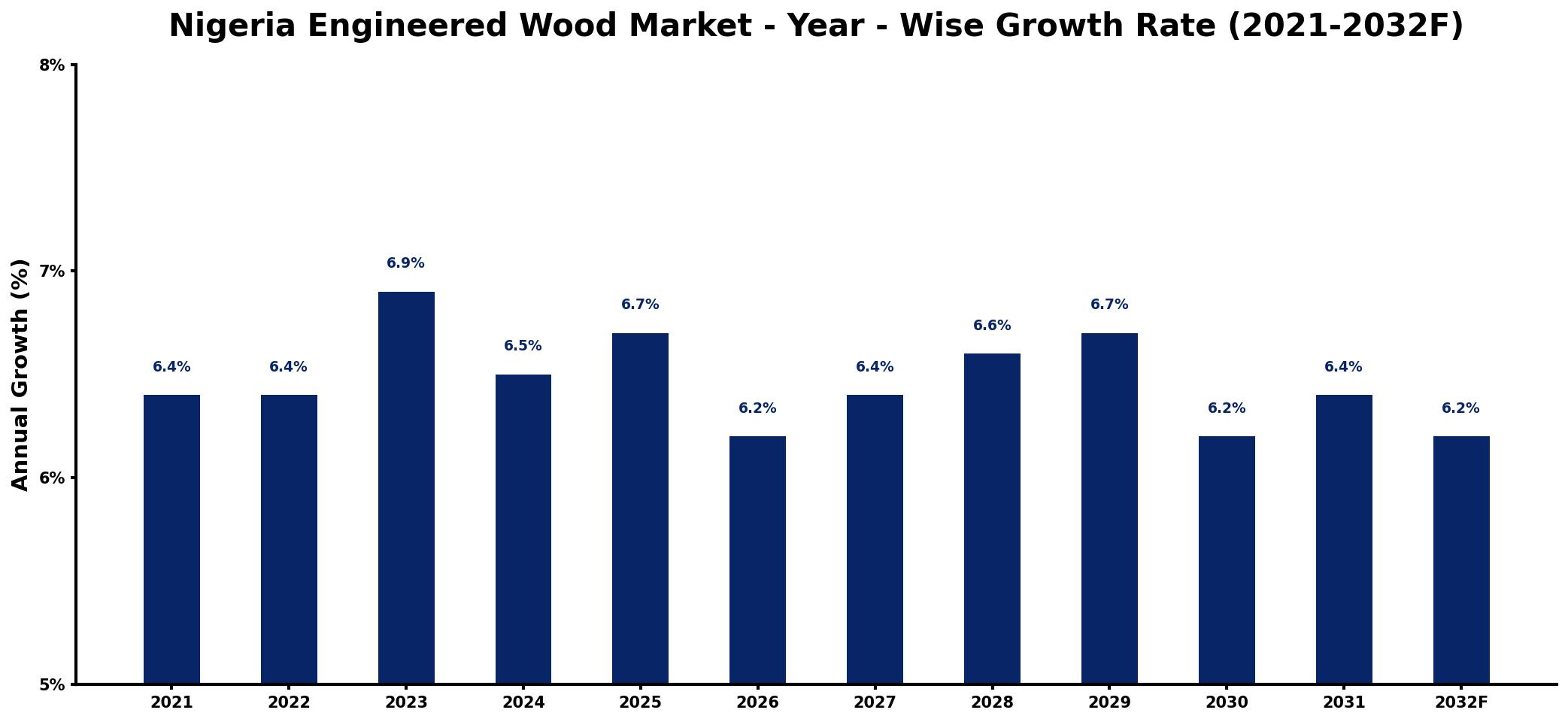
The table below presents the year‑wise growth rates along with the key drivers influencing the market
| Year | Growth Rate | Major Drivers |
| 2021 | 6.4% | Rising construction sector investments |
| 2022 | 6.4% | Growing urban population demands housing |
| 2023 | 6.9% | Increased focus on sustainable materials |
| 2024 | 6.5% | Expansion in furniture manufacturing sector |
| 2025 | 6.7% | Higher disposable incomes driving consumption |
| 2026 | 6.2% | Emerging trends in interior design |
| 2027 | 6.4% | Government incentives for building projects |
| 2028 | 6.6% | Booming real estate development activities |
| 2029 | 6.7% | Surge in home renovation projects |
| 2030 | 6.2% | Growing awareness of eco-friendly options |
| 2031 | 6.4% | Increased exports to international markets |
| 2032 | 6.2% | Technological advancements in manufacturing |
Note: Market size estimations and growth projections presented in this report are based on 6Wresearch's proprietary forecasting methodology, utilizing the latest available industry data, government publications, and primary research inputs.
Nigeria Engineered Wood Market Synopsis
In Nigeria, the engineered wood market is evolving rapidly, driven by a robust construction sector and growing awareness of sustainable building practices. Engineered wood products, known for their durability and versatility, are becoming the materials of choice for furniture manufacturing and residential construction.
The increasing urban population is propelling demand for innovative building solutions that address both aesthetic and functional needs. As consumers seek high-quality furnishing products that align with contemporary lifestyles, engineered wood's appeal continues to rise, paving the way for a prosperous market landscape.
Nigeria Engineered Wood Market Key Takeaways
- Demand for engineered wood products is driven by urbanization and rising disposable incomes.
- Eco-friendly manufacturing practices are becoming a significant selling point in the market.
- Panel boards such as plywood and MDF are seeing increased utilization in furniture production.
- The market is challenged by economic factors such as inflation and currency devaluation.
- Investments in infrastructure development are critical to sustaining growth in the engineered wood sector.
Evaluation of Restraints in Nigeria Engineered Wood Market
Despite its growth potential, the Nigeria engineered wood market faces substantial restraints. Economic instability, characterized by inflation and currency devaluation, is constraining consumer purchasing power, resulting in a decline in demand for building materials. Moreover, political uncertainty can deter investments and slow down crucial infrastructural projects, which in turn affects the availability and reliability of supply chains. These factors create a challenging environment, requiring businesses to adopt robust strategies and seek government support to navigate these economic hurdles effectively.
Nigeria Engineered Wood Market Trends
Current trends in the Nigeria engineered wood market are reflecting a strong shift towards sustainability and innovation. Manufacturers are increasingly focusing on eco-friendly production methods, utilizing recycled wood fibers and sustainable sourcing to meet consumer demands for greener products. Additionally, advancements in technology are enhancing the quality and performance of engineered wood, expanding its applications in both residential and commercial sectors. The rising awareness among consumers regarding the advantages of engineered wood over traditional timber is further fueling market growth.
Nigeria Engineered Wood Market Opportunities
The Nigeria engineered wood market presents numerous opportunities for growth and investment. With the ongoing urbanization and infrastructural projects, there is a high demand for engineered wood products in residential and commercial constructions. Moreover, as consumer preferences shift towards sustainable building materials, businesses that prioritize eco-friendly practices are likely to find a competitive edge. Collaborative efforts with government initiatives can also unlock further opportunities, enabling manufacturers to tap into public sector projects that emphasize green construction practices.
Government Initiatives in the Nigeria Engineered Wood Market
The Nigerian government is increasingly prioritizing sustainable construction practices, which significantly influences the engineered wood market. Through various policies and public spending initiatives, the government aims to promote eco-friendly materials in the building sector. Incentives for green technology adoption and investments in infrastructure projects are designed to support industry growth and enhance investor confidence, creating a favorable environment for the engineered wood market to flourish.
Future Insights of the Nigeria Engineered Wood Market
Looking ahead, the Nigeria engineered wood market is poised for substantial growth between 2026 and 2032. The projected increase in urbanization and infrastructural developments will continue to drive demand for high-quality building materials. As consumer awareness surrounding environmental sustainability deepens, engineered wood will likely gain further traction, cementing its role as a preferred option for construction and furnishing. The market's future will depend on the ability of businesses to adapt to economic fluctuations and consumer preferences while leveraging technological advancements for innovation.
Nigeria Engineered Wood Market Latest Developments (2025 - 2026)
Recent developments in the Nigeria engineered wood market indicate a focus on expanding production capacities and enhancing product offerings. Companies are increasingly investing in research and development to create innovative engineered wood products tailored to diverse consumer needs. Additionally, there is a noticeable trend towards collaboration between manufacturers and local government agencies to boost sustainable practices within the construction sector, fostering a more resilient industry landscape.
Nigeria Engineered Wood Market - Key Attractiveness of the Report
- 10 Years of Market Numbers
- Historical Data Starting from 2022 to 2025
- Base Year: 2025
- Forecast Data until 2032
- Key Performance Indicators Impacting the Market
- Major Upcoming Developments and Projects
Key Highlights of the Report:
- Nigeria Engineered Wood Market Outlook
- Market Size of Nigeria Engineered Wood Market, 2025
- Forecast of Nigeria Engineered Wood Market, 2032
- Historical Data and Forecast of Nigeria Engineered Wood Revenues & Volume for the Period 2022-2032F
- Nigeria Engineered Wood Market Trend Evolution
- Nigeria Engineered Wood Market Drivers and Challenges
- Nigeria Engineered Wood Price Trends
- Nigeria Engineered Wood Porter's Five Forces
- Nigeria Engineered Wood Industry Life Cycle
- Historical Data and Forecast of Nigeria Engineered Wood Market Revenues & Volume By Type for the Period 2022-2032F
- Historical Data and Forecast of Nigeria Engineered Wood Market Revenues & Volume By I-Beams for the Period 2022-2032F
- Historical Data and Forecast of Nigeria Engineered Wood Market Revenues & Volume By Plywood for the Period 2022-2032F
- Historical Data and Forecast of Nigeria Engineered Wood Market Revenues & Volume By Laminated Veneer Lumber (LVL) for the Period 2022-2032F
- Historical Data and Forecast of Nigeria Engineered Wood Market Revenues & Volume By Glulam (Glued Laminated Timber) for the Period 2022-2032F
- Historical Data and Forecast of Nigeria Engineered Wood Market Revenues & Volume By Oriented Strand Boards (OSB) for the Period 2022-2032F
- Historical Data and Forecast of Nigeria Engineered Wood Market Revenues & Volume By Cross-Laminated Timber (CLT) for the Period 2022-2032F
- Historical Data and Forecast of Nigeria Engineered Wood Market Revenues & Volume By Others for the Period 2022-2032F
- Historical Data and Forecast of Nigeria Engineered Wood Market Revenues & Volume By Application for the Period 2022-2032F
- Historical Data and Forecast of Nigeria Engineered Wood Market Revenues & Volume By Construction for the Period 2022-2032F
- Historical Data and Forecast of Nigeria Engineered Wood Market Revenues & Volume By Furniture for the Period 2022-2032F
- Historical Data and Forecast of Nigeria Engineered Wood Market Revenues & Volume By Flooring for the Period 2022-2032F
- Historical Data and Forecast of Nigeria Engineered Wood Market Revenues & Volume By Packaging for the Period 2022-2032F
- Historical Data and Forecast of Nigeria Engineered Wood Market Revenues & Volume By Others for the Period 2022-2032F
- Historical Data and Forecast of Nigeria Engineered Wood Market Revenues & Volume By End-User for the Period 2022-2032F
- Historical Data and Forecast of Nigeria Engineered Wood Market Revenues & Volume By Residential for the Period 2022-2032F
- Historical Data and Forecast of Nigeria Engineered Wood Market Revenues & Volume By Commercial & Industrial for the Period 2022-2032F
- Nigeria Engineered Wood Import Export Trade Statistics
- Market Opportunity Assessment By Type
- Market Opportunity Assessment By Application
- Market Opportunity Assessment By End-User
- Nigeria Engineered Wood Top Companies Market Share
- Nigeria Engineered Wood Competitive Benchmarking By Technical and Operational Parameters
- Nigeria Engineered Wood Company Profiles
- Nigeria Engineered Wood Key Strategic Recommendations






































