Bahrain Engineered Wood Market Size, Share & Growth Rate
The Bahrain Engineered Wood Market was estimated at USD 1279 Million in 2025 and is projected to reach USD 2405 Million by 2032, growing at a CAGR of 9.4% from 2026 to 2032. This growth trajectory is primarily fueled by the rising demand in the construction and interior design sectors, where engineered wood products like plywood and MDF are increasingly being preferred for their sustainability and design flexibility. As government regulations support eco-friendly building materials, the market is poised for robust expansion in the coming years.
Bahrain Engineered Wood Market Year-wise Growth Rate and Key Drivers
This graph highlights how the Bahrain Engineered Wood Market has steadily grown over the years, supported by major growth factors.
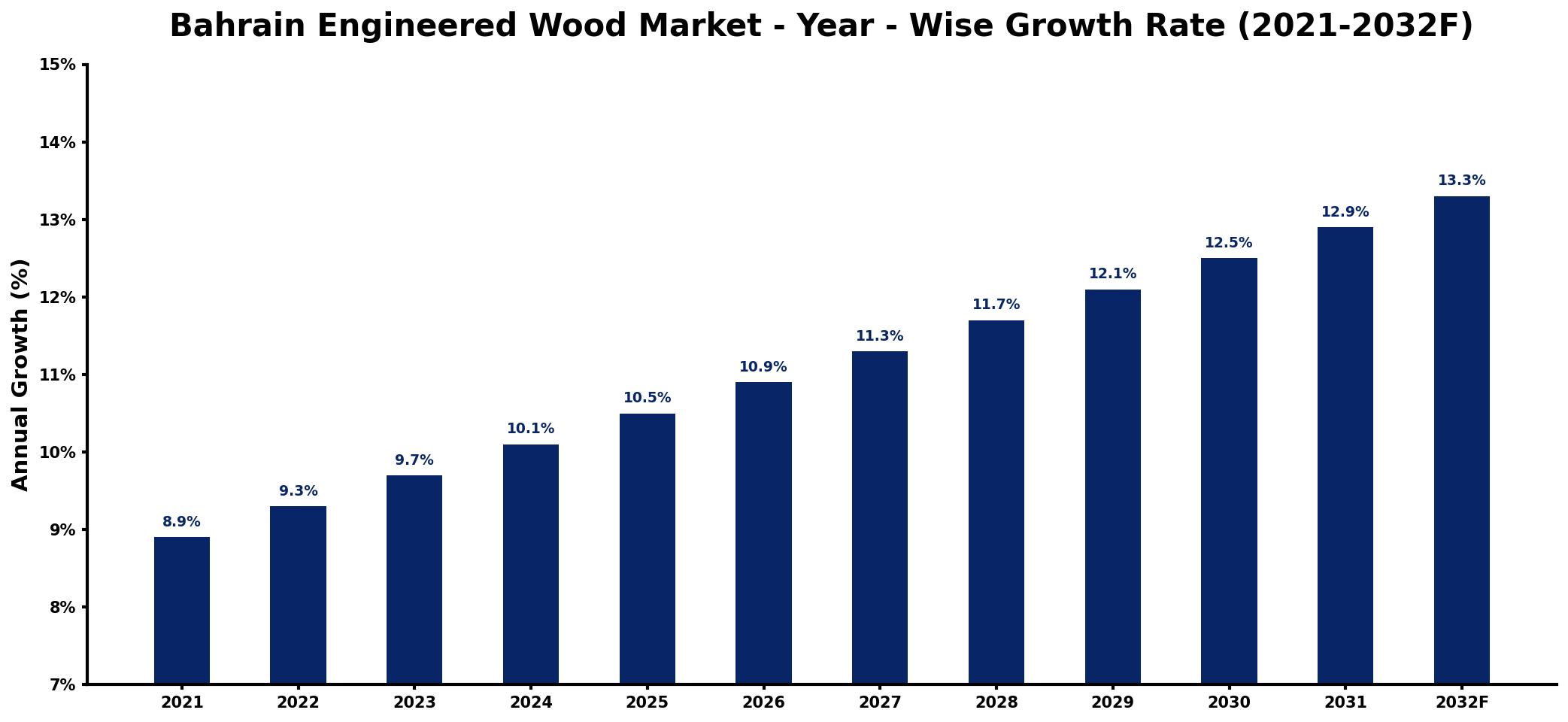
The table below presents the year‑wise growth rates along with the key drivers influencing the market
| Year | Growth Rate | Major Drivers |
| 2021 | 8.9% | Increased residential construction projects |
| 2022 | 9.3% | Growing demand for sustainable materials |
| 2023 | 9.7% | Expansion of furniture manufacturing sector |
| 2024 | 10.1% | Rise in interior design trends |
| 2025 | 10.5% | Increased investments in construction industry |
| 2026 | 10.9% | Higher consumer spending on renovations |
| 2027 | 11.3% | Growth in real estate market |
| 2028 | 11.7% | Emergence of eco-friendly building regulations |
| 2029 | 12.1% | Surge in export opportunities |
| 2030 | 12.5% | Development of innovative design solutions |
| 2031 | 12.9% | Rising popularity of multifunctional spaces |
| 2032 | 13.3% | Strengthening of local supply chains |
Note: Market size estimations and growth projections presented in this report are based on 6Wresearch's proprietary forecasting methodology, utilizing the latest available industry data, government publications, and primary research inputs.
Bahrain Engineered Wood Market Synopsis
In Bahrain, the construction boom has created a significant demand for engineered wood products. Plywood and MDF, in particular, are gaining traction for their durability and cost-effectiveness, making them ideal for modern architectural designs. Additionally, the interior décor market is embracing these materials, offering enhanced aesthetic appeal while aligning with environmental standards.
The shift towards sustainable construction practices in Bahrain is also shaping the engineered wood market. The emphasis on using certified wood and low-emission adhesives is becoming a norm, compelling manufacturers to adapt and innovate. The rise of prefabricated housing and modular furniture manufacturing is further driving market adoption and diversification.
Bahrain Engineered Wood Market Key Takeaways
- The market is poised for growth, driven by increased construction activities and a shift toward sustainable materials.
- Government regulations are promoting the use of environmentally friendly building materials, enhancing market prospects.
- Technological advancements in manufacturing are improving the durability and design options of engineered wood products.
- The interior décor and furniture sectors are significant drivers of demand for engineered wood solutions.
- Investments in local production and advanced processing techniques present lucrative opportunities for market players.
Evaluation of Restraints in Bahrain Engineered Wood Market
Despite the promising growth outlook, the Bahrain Engineered Wood Market faces notable constraints. Environmental scrutiny regarding the carbon footprint of engineered wood products is rising, particularly concerning the adhesives and chemicals used in manufacturing. Additionally, competition from alternative materials like steel and concrete, perceived as more durable, challenges market penetration. Price volatility of raw materials, especially timber, also complicates profit margins and poses a risk to market stability.
Bahrain Engineered Wood Market Trends
Current trends indicate a marked shift towards engineered wood products that emphasize sustainability and aesthetic versatility. The growing consumer preference for eco-friendly building materials is prompting manufacturers to adopt innovative processing techniques. Additionally, the popularity of modular housing and custom furniture solutions reflects a burgeoning market for engineered wood, supporting both functionality and design. This combination of trends is reshaping product offerings and driving the market forward.
Bahrain Engineered Wood Market Opportunities
The future holds significant opportunities for growth within the Bahrain Engineered Wood Market. With increasing investments in sustainable construction, there is a robust demand for high-quality engineered wood products. Local production facilities geared towards advanced processing techniques could capitalize on the growing trend of customization in furniture design. Furthermore, exploring avenues in the prefabricated housing market presents lucrative prospects, promising substantial returns for stakeholders.
Government Initiatives in the Bahrain Engineered Wood Market
The Bahraini government actively promotes sustainable construction practices through various policies and regulations. The green building code encourages the use of fire-retardant and environmentally friendly materials. The Ministry of Works is advocating for local sourcing of engineered wood products to minimize the carbon footprint, while also ensuring compliance with quality standards related to moisture resistance and load-bearing capacities. These initiatives create a supportive framework for the engineered wood market.
Future Insights of the Bahrain Engineered Wood Market
Looking ahead to 2026-2032, the Bahrain Engineered Wood Market is set to expand significantly, driven by a combination of government support and market demands for sustainability. Advancements in product innovation, coupled with the increasing preference for engineered wood in various sectors, will likely sustain the market's upward trajectory. The industry's response to environmental concerns and the focus on eco-friendly construction practices will define its future landscape.
Bahrain Engineered Wood Market Latest Developments (2025 - 2026)
Recent developments in the Bahrain Engineered Wood Market reflect a growing commitment to sustainability and innovation. New product launches that adhere to environmental standards are becoming more common, as manufacturers strive to meet consumer demand for eco-friendly solutions. Furthermore, collaborations between industry players and government entities are fostering an environment of enhanced research and development, aimed at improving product quality and expanding market reach.
Bahrain Engineered Wood Market - Key Attractiveness of the Report
- 10 Years of Market Numbers
- Historical Data Starting from 2022 to 2025
- Base Year: 2025
- Forecast Data until 2032
- Key Performance Indicators Impacting the Market
- Major Upcoming Developments and Projects
Key Highlights of the Report:
- Bahrain Engineered Wood Market Outlook
- Market Size of Bahrain Engineered Wood Market, 2025
- Forecast of Bahrain Engineered Wood Market, 2032
- Historical Data and Forecast of Bahrain Engineered Wood Revenues & Volume for the Period 2022-2032F
- Bahrain Engineered Wood Market Trend Evolution
- Bahrain Engineered Wood Market Drivers and Challenges
- Bahrain Engineered Wood Price Trends
- Bahrain Engineered Wood Porter's Five Forces
- Bahrain Engineered Wood Industry Life Cycle
- Historical Data and Forecast of Bahrain Engineered Wood Market Revenues & Volume By Type for the Period 2022-2032F
- Historical Data and Forecast of Bahrain Engineered Wood Market Revenues & Volume By I-Beams for the Period 2022-2032F
- Historical Data and Forecast of Bahrain Engineered Wood Market Revenues & Volume By Plywood for the Period 2022-2032F
- Historical Data and Forecast of Bahrain Engineered Wood Market Revenues & Volume By Laminated Veneer Lumber (LVL) for the Period 2022-2032F
- Historical Data and Forecast of Bahrain Engineered Wood Market Revenues & Volume By Glulam (Glued Laminated Timber) for the Period 2022-2032F
- Historical Data and Forecast of Bahrain Engineered Wood Market Revenues & Volume By Oriented Strand Boards (OSB) for the Period 2022-2032F
- Historical Data and Forecast of Bahrain Engineered Wood Market Revenues & Volume By Cross-Laminated Timber (CLT) for the Period 2022-2032F
- Historical Data and Forecast of Bahrain Engineered Wood Market Revenues & Volume By Others for the Period 2022-2032F
- Historical Data and Forecast of Bahrain Engineered Wood Market Revenues & Volume By Application for the Period 2022-2032F
- Historical Data and Forecast of Bahrain Engineered Wood Market Revenues & Volume By Construction for the Period 2022-2032F
- Historical Data and Forecast of Bahrain Engineered Wood Market Revenues & Volume By Furniture for the Period 2022-2032F
- Historical Data and Forecast of Bahrain Engineered Wood Market Revenues & Volume By Flooring for the Period 2022-2032F
- Historical Data and Forecast of Bahrain Engineered Wood Market Revenues & Volume By Packaging for the Period 2022-2032F
- Historical Data and Forecast of Bahrain Engineered Wood Market Revenues & Volume By Others for the Period 2022-2032F
- Historical Data and Forecast of Bahrain Engineered Wood Market Revenues & Volume By End-User for the Period 2022-2032F
- Historical Data and Forecast of Bahrain Engineered Wood Market Revenues & Volume By Residential for the Period 2022-2032F
- Historical Data and Forecast of Bahrain Engineered Wood Market Revenues & Volume By Commercial & Industrial for the Period 2022-2032F
- Bahrain Engineered Wood Import Export Trade Statistics
- Market Opportunity Assessment By Type
- Market Opportunity Assessment By Application
- Market Opportunity Assessment By End-User
- Bahrain Engineered Wood Top Companies Market Share
- Bahrain Engineered Wood Competitive Benchmarking By Technical and Operational Parameters
- Bahrain Engineered Wood Company Profiles
- Bahrain Engineered Wood Key Strategic Recommendations






































