Slovakia Engineered Wood Market Size, Share & Growth Rate
The Slovakia Engineered Wood Market was estimated at USD 458 Million in 2025 and is projected to reach USD 599 Million by 2032, growing at a CAGR of 3.9% from 2026 to 2032. This growth trajectory is fueled by a robust construction sector that is increasingly leaning towards sustainable materials. The rising consumer preference for aesthetically pleasing yet durable products further solidifies the demand for engineered wood, as its superior characteristics over traditional solid wood become more recognized.
Slovakia Engineered Wood Market Year-wise Growth Rate and Key Drivers
This graph highlights how the Slovakia Engineered Wood Market has steadily grown over the years, supported by major growth factors.
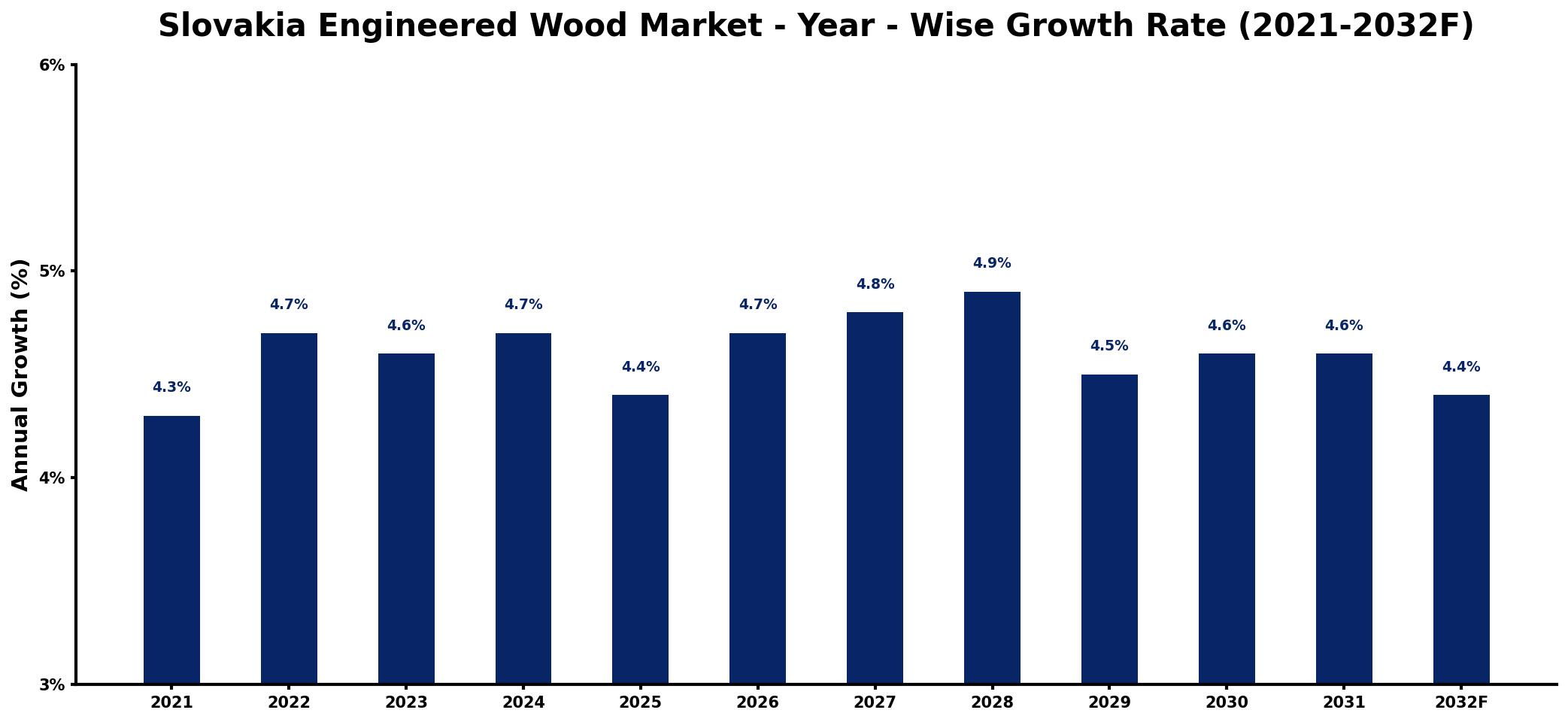
The table below presents the year‑wise growth rates along with the key drivers influencing the market
| Year | Growth Rate | Major Drivers |
| 2021 | 4.3% | Rising construction sector investments |
| 2022 | 4.7% | Increased residential renovation projects |
| 2023 | 4.6% | Growing demand for sustainable materials |
| 2024 | 4.7% | Expansion of furniture manufacturing industry |
| 2025 | 4.4% | Surge in home improvement activities |
| 2026 | 4.7% | Investment in green building initiatives |
| 2027 | 4.8% | Growing popularity of modular designs |
| 2028 | 4.9% | Increased focus on eco-friendly solutions |
| 2029 | 4.5% | Rising urbanization and infrastructure projects |
| 2030 | 4.6% | Strengthening of export markets demand |
| 2031 | 4.6% | Boost in commercial construction activities |
| 2032 | 4.4% | Growing interest in energy efficiency |
Note: Market size estimations and growth projections presented in this report are based on 6Wresearch's proprietary forecasting methodology, utilizing the latest available industry data, government publications, and primary research inputs.
Slovakia Engineered Wood Market Synopsis
The Slovakia Engineered Wood Market is characterized by a paradigm shift towards innovative construction solutions. Increasingly, builders and architects are opting for engineered wood materials, such as plywood and laminated veneer lumber, which offer enhanced stability and moisture resistance compared to conventional wood products. This trend aligns with a broader commitment to sustainable building practices.
Additionally, the market is witnessing heightened awareness regarding eco-friendly materials among consumers. As the construction sector prioritizes sustainability, the demand for engineered wood, renowned for its eco-friendly attributes, is expected to continue on its upward trajectory.
Slovakia Engineered Wood Market Key Takeaways
- Increasing construction activities are propelling the demand for engineered wood products.
- Consumer awareness surrounding sustainable building practices is on the rise.
- Innovative products with superior performance characteristics are emerging in the market.
- Government incentives are encouraging the adoption of eco-friendly materials in construction.
- Investment opportunities are plentiful in sustainable engineered wood production technologies.
Evaluation of Restraints in Slovakia Engineered Wood Market
Despite the promising growth prospects, the Slovakia Engineered Wood Market grapples with several restraints. Notably, fluctuating raw material prices can significantly affect production costs, thereby impacting profit margins. Additionally, the entrenched popularity of traditional solid wood products, driven by consumer loyalty and cultural perceptions, poses a challenge. Manufacturers face the uphill task of educating the market on the advantages of engineered wood, while simultaneously competing against the stronghold of conventional lumber.
Slovakia Engineered Wood Market Trends
The market is currently witnessing a surge in demand for sustainable building materials, driven by both regulatory frameworks and consumer preferences. Moreover, engineered wood products are evolving with innovative features such as improved strength, moisture resistance, and fire retardancy. The advancement in manufacturing processes is facilitating quicker and more cost-effective production, which is expected to enhance market reach and responsiveness.
Slovakia Engineered Wood Market Opportunities
Investment opportunities abound in the Slovakia Engineered Wood Market, particularly in companies focusing on the production of laminated veneer lumber (LVL), oriented strand board (OSB), and glued laminated timber (glulam). The growing trend towards eco-friendly construction provides fertile ground for innovative engineered wood technologies. Establishing partnerships with local forestry entities for sustainable resource supply chains can further enhance profitability and market presence.
Government Initiatives in the Slovakia Engineered Wood Market
The Slovakian government has proactively enacted several policies to foster sustainable forestry and promote the use of environmentally friendly materials in construction. These initiatives include regulations designed to ensure responsible timber harvesting, incentives aimed at encouraging the adoption of engineered wood, and subsidies for R&D within the engineered wood technology sector. Certification schemes have also been introduced to bolster consumer confidence in the quality and sustainability of these products.
Future Insights of the Slovakia Engineered Wood Market
Looking ahead to 2026-2032, the Slovakia Engineered Wood Market is poised for sustained growth, driven by urbanization and infrastructure projects. The ongoing shift towards sustainable construction, supported by favorable government regulations, is expected to catalyze demand for engineered wood. As awareness of the ecological advantages of engineered wood continues to expand, market dynamics will increasingly favor innovative solutions that address modern design challenges.
Slovakia Engineered Wood Market Latest Developments (2025 - 2026)
Recent developments in the Slovakia Engineered Wood Market indicate a strong trend toward collaborative efforts in sustainability, with industry players exploring partnerships for better resource management. Additionally, technological advancements in manufacturing processes are allowing companies to produce high-quality products at competitive prices. As the market adapts to evolving consumer expectations, a wave of product innovations is anticipated, aimed at enhancing the performance and aesthetic appeal of engineered wood solutions.
Slovakia Engineered Wood Market - Key Attractiveness of the Report
- 10 Years of Market Numbers
- Historical Data Starting from 2022 to 2025
- Base Year: 2025
- Forecast Data until 2032
- Key Performance Indicators Impacting the Market
- Major Upcoming Developments and Projects
Key Highlights of the Report:
- Slovakia Engineered Wood Market Outlook
- Market Size of Slovakia Engineered Wood Market, 2025
- Forecast of Slovakia Engineered Wood Market, 2032
- Historical Data and Forecast of Slovakia Engineered Wood Revenues & Volume for the Period 2022-2032F
- Slovakia Engineered Wood Market Trend Evolution
- Slovakia Engineered Wood Market Drivers and Challenges
- Slovakia Engineered Wood Price Trends
- Slovakia Engineered Wood Porter's Five Forces
- Slovakia Engineered Wood Industry Life Cycle
- Historical Data and Forecast of Slovakia Engineered Wood Market Revenues & Volume By Type for the Period 2022-2032F
- Historical Data and Forecast of Slovakia Engineered Wood Market Revenues & Volume By I-Beams for the Period 2022-2032F
- Historical Data and Forecast of Slovakia Engineered Wood Market Revenues & Volume By Plywood for the Period 2022-2032F
- Historical Data and Forecast of Slovakia Engineered Wood Market Revenues & Volume By Laminated Veneer Lumber (LVL) for the Period 2022-2032F
- Historical Data and Forecast of Slovakia Engineered Wood Market Revenues & Volume By Glulam (Glued Laminated Timber) for the Period 2022-2032F
- Historical Data and Forecast of Slovakia Engineered Wood Market Revenues & Volume By Oriented Strand Boards (OSB) for the Period 2022-2032F
- Historical Data and Forecast of Slovakia Engineered Wood Market Revenues & Volume By Cross-Laminated Timber (CLT) for the Period 2022-2032F
- Historical Data and Forecast of Slovakia Engineered Wood Market Revenues & Volume By Others for the Period 2022-2032F
- Historical Data and Forecast of Slovakia Engineered Wood Market Revenues & Volume By Application for the Period 2022-2032F
- Historical Data and Forecast of Slovakia Engineered Wood Market Revenues & Volume By Construction for the Period 2022-2032F
- Historical Data and Forecast of Slovakia Engineered Wood Market Revenues & Volume By Furniture for the Period 2022-2032F
- Historical Data and Forecast of Slovakia Engineered Wood Market Revenues & Volume By Flooring for the Period 2022-2032F
- Historical Data and Forecast of Slovakia Engineered Wood Market Revenues & Volume By Packaging for the Period 2022-2032F
- Historical Data and Forecast of Slovakia Engineered Wood Market Revenues & Volume By Others for the Period 2022-2032F
- Historical Data and Forecast of Slovakia Engineered Wood Market Revenues & Volume By End-User for the Period 2022-2032F
- Historical Data and Forecast of Slovakia Engineered Wood Market Revenues & Volume By Residential for the Period 2022-2032F
- Historical Data and Forecast of Slovakia Engineered Wood Market Revenues & Volume By Commercial & Industrial for the Period 2022-2032F
- Slovakia Engineered Wood Import Export Trade Statistics
- Market Opportunity Assessment By Type
- Market Opportunity Assessment By Application
- Market Opportunity Assessment By End-User
- Slovakia Engineered Wood Top Companies Market Share
- Slovakia Engineered Wood Competitive Benchmarking By Technical and Operational Parameters
- Slovakia Engineered Wood Company Profiles
- Slovakia Engineered Wood Key Strategic Recommendations






































