Kenya Fans and Ventilators Market Summary
The kenya fans and ventilators market was estimated at USD 464 Million in 2025 and is projected to reach USD 628 Million by 2032, growing at a CAGR of 5.2% from 2026 to 2032.
Kenya Fans and Ventilators Market Year-wise Growth Rate and Key Drivers
This graph highlights how the Kenya Fans and Ventilators Market has steadily grown over the past five years, supported by major growth factors.
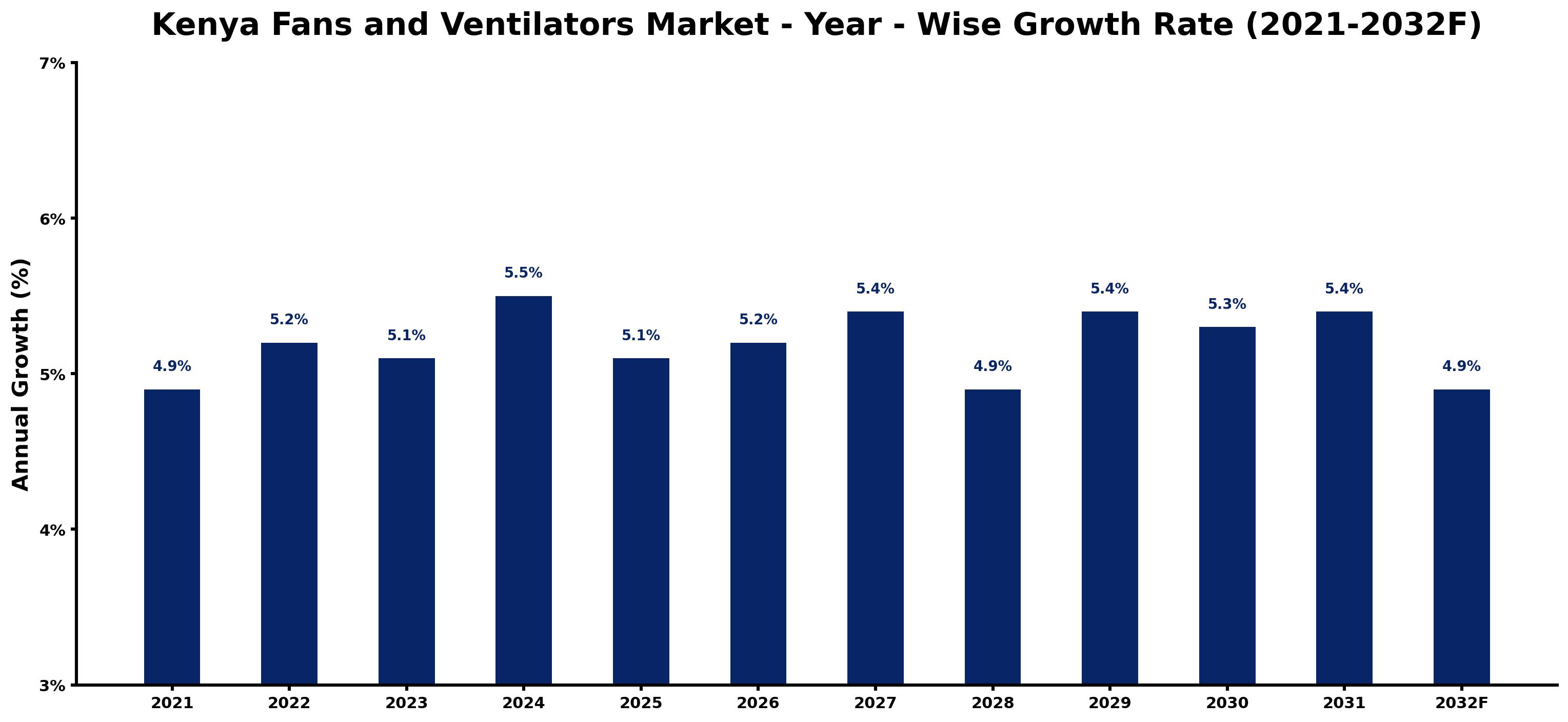
The table below presents the year wise growth rates along with the key drivers influencing the market
| Year | Growth Rate | Major Drivers |
| 2021 | 4.9% | Increased urbanization in Kenya has stimulated demand for cooling solutions in households. |
| 2022 | 5.2% | Rising temperatures have heightened the need for energy-efficient ventilation systems across regions. |
| 2023 | 5.1% | Investment in infrastructure projects has created a surge in commercial fan installations. |
| 2024 | 5.5% | Emerging middle-class consumers are prioritizing comfort in homes and workplaces through ventilation. |
| 2025 | 5.1% | E-commerce growth facilitates easier access to ventilation products across diverse consumer segments. |
| 2026 | 5.2% | Technological innovations are resulting in smarter, eco-friendly fans with enhanced performance metrics. |
| 2027 | 5.4% | Construction boom in urban areas leads to higher demand for industrial-grade ventilation systems. |
| 2028 | 4.9% | Education campaigns highlight health benefits related to improved air quality in living spaces. |
| 2029 | 5.4% | Local manufacturing initiatives have reduced product costs, making fans more accessible to consumers. |
| 2030 | 5.3% | Energy efficiency standards drive manufacturers to innovate and produce better ventilation systems. |
| 2031 | 5.4% | Partnerships between local businesses and international brands enhance product variety and availability. |
| 2032 | 4.9% | Consumer preferences are shifting towards smart home integration with automated ventilation solutions. |
Note - Market size estimations and growth projections presented in this report are based on 6Wresearch's advanced forecasting approach, validated with industry datasets as of June 2026.
Kenya Fans and Ventilators Market Synopsis
The Kenya Fans and Ventilators Market is projected to reach 5.2% and witness significant growth during the forecast period (2026-2032). This growth can be attributed to the increasing adoption of ventilation systems across various sectors, including residential, commercial, and industrial applications. As the need for improved indoor air quality and energy efficiency continues to rise, the demand for fans and ventilators is expected to surge, driven by urbanization and heightened awareness of environmental issues. Manufacturers are responding to this demand by innovating and offering energy-efficient products that cater to a diverse range of applications.
Kenya Fans and Ventilators Market Growth Drivers
Several key factors are driving the growth of the Kenya Fans and Ventilators Market. Firstly, the expansion of the industrial and commercial sectors has led to an increased need for efficient ventilation solutions. As factories, offices, and public buildings become more complex, the need for effective air circulation has become paramount. Secondly, a growing awareness of indoor air quality and its impact on health is prompting consumers and businesses alike to invest in advanced ventilation systems.
- Urbanization is leading to higher residential and commercial construction rates, thus boosting the market for fans and ventilators.
- Health concerns related to indoor air quality are pushing consumers to prioritize ventilation solutions that enhance air purity.
- Energy efficiency initiatives by the government are propelling the demand for modern, low-energy consumption fans and ventilators.
- Increased availability of smart technology in ventilation systems promotes enhanced user engagement and energy savings.
- Market players are innovating to create products that minimize noise levels while maximizing airflow, meeting customer demand for quieter operations.
Kenya Fans and Ventilators Market Challenges and Restraints
Despite the positive outlook, the Kenya Fans and Ventilators Market also faces several challenges that could hinder its growth. Manufacturers must continuously work on improving energy efficiency and reducing noise levels, which remain critical consumer concerns. Furthermore, product customization is increasingly demanded by customers, adding complexity to the design and production processes.
- Maintaining competitive pricing while ensuring high-quality, energy-efficient products poses a significant challenge for manufacturers.
- The requirement for advanced features in fans and ventilators, such as IoT connectivity, increases development costs.
- Regulatory compliance and the evolving standards for energy efficiency can create barriers for market entry.
- Consumer awareness regarding the benefits of advanced ventilation systems varies, which can limit market penetration in certain segments.
- Supply chain disruptions can impact the availability of components needed for manufacturing efficient fans and ventilators.
Kenya Fans and Ventilators Market Government Investment and Initiatives
The Kenya government has recognized the importance of ventilation systems and is implementing policies aimed at enhancing air quality and energy efficiency in various sectors. Government initiatives focus on developing regulations that promote innovation in fan and ventilator designs and technologies. Through public spending and incentives, the government supports projects aimed at improving indoor air quality, which is critical for public health. By enforcing energy efficiency standards, the government is also encouraging manufacturers to adopt sustainable practices that align with national development goals.
- Policies advocating for energy efficiency have motivated industries to invest in modern ventilation systems.
- Public initiatives focused on urban health and sustainability are increasing investment in infrastructure that supports air quality improvements.
- The promotion of green building standards is influencing the adoption of advanced HVAC solutions, including fans and ventilators.
- Government-sponsored training and workshops are enhancing industry knowledge on modern ventilation technologies.
- Incentives for businesses adopting energy-efficient solutions are fostering a competitive environment in the fans and ventilators market.
Kenya Fans and Ventilators Market Latest Developments (May 2025 - June 2026)
Recent developments within the Kenya Fans and Ventilators Market indicate a shift toward greater emphasis on energy efficiency and advanced technology integration. Manufacturers are increasingly focusing on product innovation, with many introducing models that feature variable speed drives and enhanced IoT capabilities. There is a noticeable trend of collaboration among industry players to develop solutions tailored to urban environments, addressing specific challenges posed by air pollution and humidity. The market is also witnessing growing consumer interest in smart home technologies, leading to an increase in demand for ventilators that can be integrated into existing smart home systems.
Kenya Fans and Ventilators Market - Key Attractiveness of the Report
- 10 Years of Market Numbers
- Historical Data Starting from 2022 to 2025
- Base Year: 2025
- Forecast Data until 2032
- Key Performance Indicators Impacting the Market
- Major Upcoming Developments and Projects
Key Highlights of the Report:
- Kenya Fans and Ventilators Market Outlook
- Market Size of Kenya Fans and Ventilators Market, 2025
- Forecast of Kenya Fans and Ventilators Market, 2032
- Historical Data and Forecast of Kenya Fans and Ventilators Revenues & Volume for the Period 2022-2032F
- Kenya Fans and Ventilators Market Trend Evolution
- Kenya Fans and Ventilators Market Drivers and Challenges
- Kenya Fans and Ventilators Price Trends
- Kenya Fans and Ventilators Porter's Five Forces
- Kenya Fans and Ventilators Industry Life Cycle
- Historical Data and Forecast of Kenya Fans and Ventilators Market Revenues & Volume By Material for the Period 2022-2032F
- Historical Data and Forecast of Kenya Fans and Ventilators Market Revenues & Volume By Metal for the Period 2022-2032F
- Historical Data and Forecast of Kenya Fans and Ventilators Market Revenues & Volume By Composite for the Period 2022-2032F
- Historical Data and Forecast of Kenya Fans and Ventilators Market Revenues & Volume By Rubber for the Period 2022-2032F
- Historical Data and Forecast of Kenya Fans and Ventilators Market Revenues & Volume By Plastic for the Period 2022-2032F
- Historical Data and Forecast of Kenya Fans and Ventilators Market Revenues & Volume By Application for the Period 2022-2032F
- Historical Data and Forecast of Kenya Fans and Ventilators Market Revenues & Volume By Interior for the Period 2022-2032F
- Historical Data and Forecast of Kenya Fans and Ventilators Market Revenues & Volume By Exterior for the Period 2022-2032F
- Historical Data and Forecast of Kenya Fans and Ventilators Market Revenues & Volume By Structural for the Period 2022-2032F
- Historical Data and Forecast of Kenya Fans and Ventilators Market Revenues & Volume By Powertrain for the Period 2022-2032F
- Historical Data and Forecast of Kenya Fans and Ventilators Market Revenues & Volume By Vehicle Types for the Period 2022-2032F
- Historical Data and Forecast of Kenya Fans and Ventilators Market Revenues & Volume By Passenger Vehicles for the Period 2022-2032F
- Historical Data and Forecast of Kenya Fans and Ventilators Market Revenues & Volume By Light Commercial Vehicles for the Period 2022-2032F
- Historical Data and Forecast of Kenya Fans and Ventilators Market Revenues & Volume By Heavy Commercial Vehicles for the Period 2022-2032F
- Kenya Fans and Ventilators Import Export Trade Statistics
- Market Opportunity Assessment By Material
- Market Opportunity Assessment By Application
- Market Opportunity Assessment By Vehicle Types
- Kenya Fans and Ventilators Top Companies Market Share
- Kenya Fans and Ventilators Competitive Benchmarking By Technical and Operational Parameters
- Kenya Fans and Ventilators Company Profiles
- Kenya Fans and Ventilators Key Strategic Recommendations






































